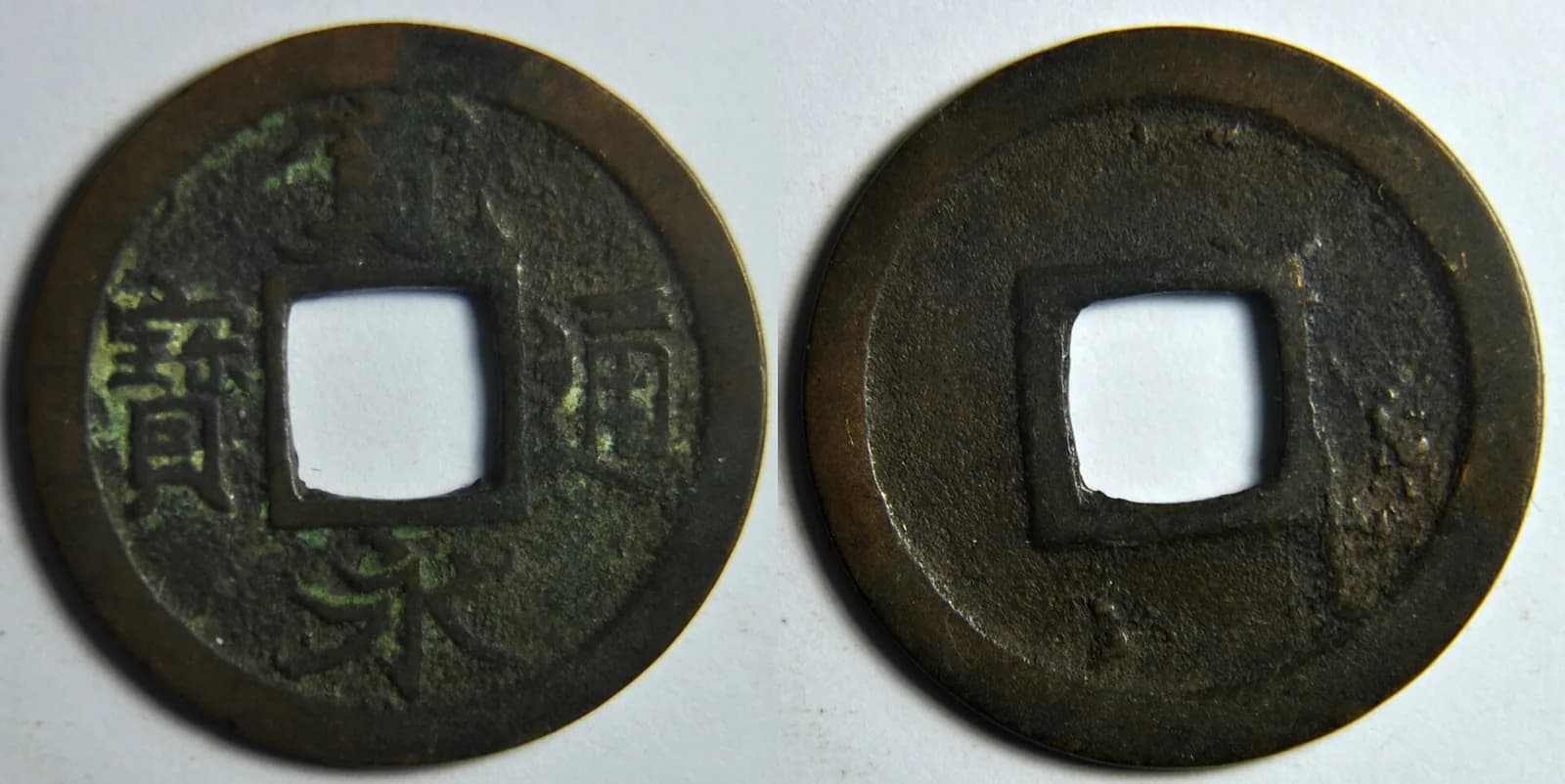
Image: Japanese holed coins (square-holed cash coins) / Jean-Michel Moullec from Vern sur Seiche (35, Bretagne), France / Wikimedia Commons / CC BY 2.0(source)
Yamada Hagaki — Japan's Oldest Banknote Born from Ise Pilgrimage Faith
The story of the hand-written notes connecting pilgrims to Oshi in Ise Pilgrimage
Subject coin: 山田羽書
Overview
The Yamada Hagaki is considered one of Japan's oldest banknotes, issued by the Oshi in Yamada, Ise Province (modern-day Ise City, Mie Prefecture) in the early 17th century (though this is debated). These notes were used as "Ichiran-barai Tegata" to provide accommodation and meals to pilgrims visiting Ise. The Oshi issued hand-written notes to pilgrims, which circulated as currency. With the increase in pilgrims during the Edo period, the Yamada Hagaki played a significant economic role. From the 18th century onward, as domain notes became widespread due to shogunate policies, the role of Yamada Hagaki gradually diminished but its historical significance remains. Yamada Hagaki was not merely a means of payment; instead, it was an important medium linking Ise Faith with the local economy.
Specifications
- Denomination
- 手形
- Minting period
- 17世紀初頭〜18世紀末(1600-1800年)
- Metal composition
- 紙
- Weight
- 不詳(諸説あり)
- Dimensions
- 縦約15cm × 横約10cm
- Mintage
- 不詳(諸説あり)
- Mint supervisor
- 伊勢国山田の御師
- Market price
- 数万円〜数十万円(状態による)
Faith and Economy — The Background of Yamada Hagaki's Birth
Image: Modern Japanese coinage / Coindesmonnaies / Wikimedia Commons / CC BY-SA 4.0(source)
In the early 17th century, Japan had just transitioned from the war-torn Sengoku period to governance under the Tokugawa shogunate, established by Tokugawa Ieyasu in 1603. During this era, Ise Jingu was a nationwide object of faith, attracting many pilgrims. Throughout the Edo period, visiting Ise was considered a once-in-a-lifetime event for the common people, with an estimated hundreds of thousands of pilgrims visiting annually. Yamada in Ise Province, being close to the Outer Shrine of Ise Jingu, thrived as an accommodation site for pilgrims. Here, the Oshi played a crucial role. Although they were priests, they offered accommodation, meals, and prayers, supporting the pilgrims. The Oshi issued handwritten notes to them as a means to pay for lodging, which became the Yamada Hagaki. In the early 17th century, the notes issued by the Oshi were recognized as currency among pilgrims from across the country, playing an important role in facilitating the journey of Ise pilgrimage.
Yamada Hagaki, also known as "Ichiran-barai Tegata", recorded lodging and meal payments to the Oshi in Yamada, Ise Province. The notes bore the signatures or seals of the Oshi to guarantee their authenticity. This allowed pilgrims to travel without carrying cash, thereby increasing travel safety. Thus, Yamada Hagaki was born, functioning as an important medium linking faith with the economy. On the other hand, from the 18th century, official banknotes such as domain-issued notes began to spread, reducing the prominence of Yamada Hagaki, which eventually lost its role towards the end of the Edo period. However, its historical significance cannot be ignored when considering the evolution of Japan’s currency system.
The Oshi's Craft and the Circulation of Yamada Hagaki
Image: Modern Japanese coinage / Coindesmonnaies / Wikimedia Commons / CC BY-SA 4.0(source)
Yamada Hagaki circulated based on the Oshi's skillful techniques and trust. The handwritten notes of the time were made of Japanese paper with ink writings and stamped with the Oshi's signature or seal, ensuring their validity and reliability. The Oshi, based in Yamada, Ise Province, welcomed pilgrims, earning trust as local notables, and ensured these notes could be used in other lodging facilities or stores as pilgrims continued their journey to Ise. Such a distribution system spread nationwide, and Yamada Hagaki became known among pilgrims from the 17th to the 18th centuries.
Through the Oshi's network, Yamada Hagaki spread throughout Japan and began to be used by merchants and travelers beyond just pilgrims. In major cities like Edo, Kyoto, and Osaka, stores accepting Yamada Hagaki increased, enhancing convenience for Ise pilgrims. Furthermore, the issuance of these notes was a significant income source for the Oshi, greatly impacting the local economy. The Oshi successfully built relationships with pilgrims through the issuance of these notes, increasing repeat visitors.
Although the exact circulation volume is unknown, considering the thriving Ise pilgrimages at the time, a significant number were likely issued. During the Edo period, Ise pilgrimage was seen as a once-in-a-lifetime event, with an annual visitor count said to be in the hundreds of thousands. Against this backdrop, issuance volumes of Yamada Hagaki increased significantly, impacting the economy of Ise Province. Thus, Yamada Hagaki was not merely a payment method but played an important role in supporting the local economy.
From the 18th century onward, the circulation of Yamada Hagaki gradually declined. This closely related to the proliferation of shogunate-issued banknotes (domain notes), which had public credit backing, surpassed in distribution and usage stability, eventually replacing Yamada Hagaki. Despite this, Yamada Hagaki has been remembered as a symbol of historical value and regional culture, passed down through generations.
The Decline of Yamada Hagaki and the Influence of the Shogunate
Image: Modern Japanese coinage / Coindesmonnaies / Wikimedia Commons / CC BY-SA 4.0(source)
Entering the 18th century, Yamada Hagaki gradually began to wane in its role. This was largely influenced by shogunate policies. The shogunate pursued monetary reforms aiming for a nationwide unified monetary system, permitting domains to issue their own notes. Especially in 1715, the eighth shogun, Tokugawa Yoshimune, promoted the issuance of domain notes as part of the Kyōhō reforms, strengthening this system. Consequently, Yamada Hagaki was increasingly less used, and domain notes became mainstream.
Additionally, the shogunate adopted policies to stabilize the currency system, promoting the circulation of Edo silver coins and Edo gold coins, and suppressing regional currency distribution. By 1710, coin measurement systems were also established and the standards for silver and gold were unified, improving the reliability of currency. These policies led to the decline of Yamada Hagaki circulation, and by the late 18th century, it was scarcely used.
However, Yamada Hagaki, having played a significant role in connecting Ise faith and the regional economy, has its historical significance remembered today. In economic activities in Ise's Yamada, the Oshi provided lodging and meal payments for pilgrims, supporting the local economy as an important element. Yamada Hagaki assumed part of the trust-based economy between pilgrims and Oshi, serving as a convenient means to smoothly facilitate their pilgrimage journey to others from different regions.
Contemporary Evaluation of Yamada Hagaki
Image: Modern Japanese coinage / Coindesmonnaies / Wikimedia Commons / CC BY-SA 4.0(source)
In modern times, Yamada Hagaki is evaluated as an important chapter in Japan’s currency history. Especially the privately issued banknotes by the religious leaders known as Oshi in Yamada, Ise Province (present-day Ise City, Mie Prefecture) in the early 17th century draw attention from historians and economists for their role in connecting Ise faith with the local economy. The "Ichiran-barai Tegata" used for providing accommodation and meals to pilgrims visiting Ise Jingu circulated as a substitute currency among them, aiding in the revitalization of the local economy.
Yamada Hagaki is re-evaluated not merely as a payment means but as a unique cultural phenomenon integrating faith and economy. This phenomenon indicates a broad network spanning beyond regions, which created economic connections as pilgrims visited Ise from all over the country. Although Yamada Hagaki gradually declined with the spread of shogunate-issued banknotes (domain notes) from the 18th century, its historical significance remains vibrant, continuing to attract research interest.
Moreover, Yamada Hagaki is a rare entity for coin collectors, and its rarity attributes it a high value in the market. It can trade from several tens of thousands to hundreds of thousands of yen depending on condition and preservation state. Especially those retaining the complete original style from issuance command high prices. This evaluation suggests that Yamada Hagaki, beyond just material value, holds value as part of Japan’s cultural heritage. For collectors and researchers, Yamada Hagaki serves as a window to understand past economies and cultures, with value constantly reaffirmed through ongoing research and collecting activities.
Value & Rarity
Yamada Hagaki holds high value in today’s coin market due to its rarity. These notes, issued from the 17th to 18th centuries and later replaced by the spread of domain notes, are extremely few in existence. Well-preserved ones especially trade at high prices, valued at tens of thousands to hundreds of thousands of yen. The market value of Yamada Hagaki exceeds mere monetary worth due to its re-evaluated significance as a part of Japan’s cultural heritage. Collectors find the historical background and connection to faith of these notes highly appealing. Learning about the basics of coin auctions further deepens understanding of Yamada Hagaki's value.
Related Guide: Value and Identification of Modern Coins
Conclusion
Yamada Hagaki is a unique presence in Japan’s currency history, vividly showing the economic influence of faith in Ise Jingu. This note symbolized the connection between local economy and faith, serving as a link between pilgrims and the local community. Although it ceased its role from the 18th century due to shogunate policies, its historical significance is still remembered today. Yamada Hagaki continues to provide value as part of Japan’s cultural heritage, not only being a payment instrument but also a necessary entity for coin collectors and history enthusiasts to understand the connection between faith and economy in Japan. The story of Yamada Hagaki offers important lessons on how faith and economy interconnected and supported regional societies.
Related Stories
Counterfeiting and Crackdowns on the Eiraku Tsūhō (永楽通宝) — The Most Widely Circulated and Most Counterfeited Coin
A History of Counterfeiting and Regulation from the Kamakura Period through the Edo Period
Coin StoryEiraku Tsuho — The Chinese 'Standard Currency' that Moved Muromachi Japan
An Unknown Era When Foreign Coins Formed Japan's Economic Foundation
Coin StoryThe Monetization of Kamakura Estates — Innovations in the Medieval Currency Economy
The Transformation of the Japanese Economy Triggered by the Kamakura Shogunate and the Advancement of Monetized Tribute
Dealers
Dealers Handling This Category
A reference when considering a sale or appraisal. All are dealers and auction houses with a proven track record.
Ginza Coins
Ginza, Chuo-ku, Tokyo
One of Japan's most established numismatic dealers. The scale and variety of their regular auctions is among the largest in the country. Their catalogs are considered a benchmark for market pricing.
Japan Coin Auction (JCA)
Tokyo
Holds regular auctions with reliable hammer price data, making it a useful resource for tracking market values. Caters to a wide range of collectors from beginners to advanced buyers.
Taisei Coins
Tokyo
A dealer with an international network. Offers advanced services such as consignment to overseas auctions and NGC/PCGS grading submission. Recommended for high-value or internationally recognized coins.