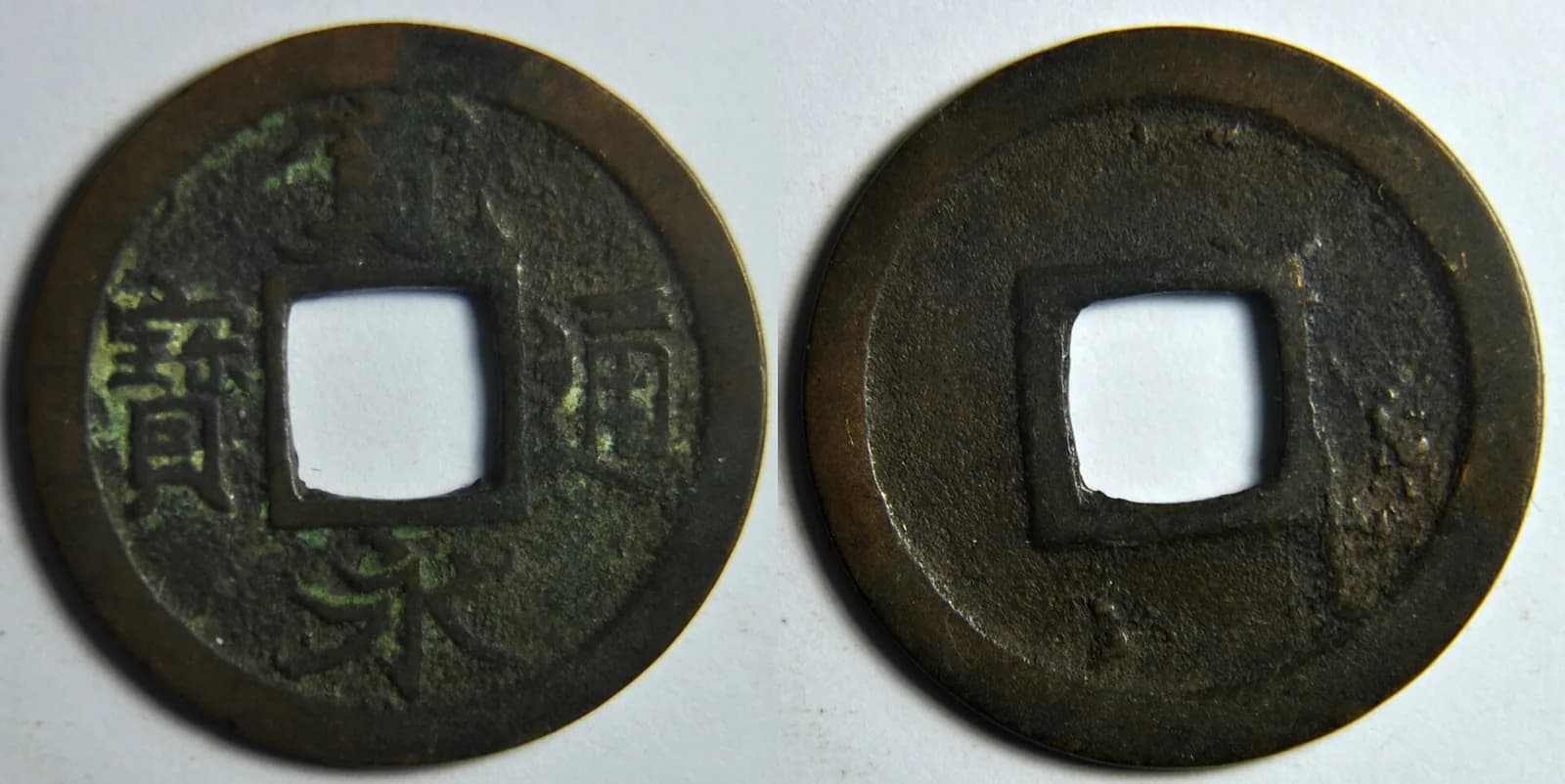
Image: Japanese holed coins (square-holed cash coins) / Jean-Michel Moullec from Vern sur Seiche (35, Bretagne), France / Wikimedia Commons / CC BY 2.0(source)
The Monetization of Kamakura Estates — Innovations in the Medieval Currency Economy
The Transformation of the Japanese Economy Triggered by the Kamakura Shogunate and the Advancement of Monetized Tribute
Subject coin: 鎌倉荘園の銭納化
Overview
From the mid to late Kamakura period, Japan's economy underwent significant transformation. The establishment of the Kamakura Shogunate marked the beginning of a major shift in how annual tributes were paid. Until then, tributes were primarily paid in rice, but from the mid-Kamakura period, a portion began to be paid in coins, known as 'daisennō'. This change was driven by the import and use of Song currency from China, expanding circulation from the Kinai region to the eastern provinces and Kyushu. The Kamakura Shogunate did not mint its own currency but relied on Song coins to support the economy. This transformation was significantly influenced by the increase in 'jitō uke', where estate management was entrusted to bailiffs, which began to be conducted in monetary terms. Furthermore, in urban Kamakura, the emergence of establishments like pawnbrokers and moneylenders led to a boom in financial activities. These factors combined to unravel the process by which Japan's currency economy permeated regional areas.
Specifications
- Denomination
- 不詳
- Minting period
- 鎌倉時代中期〜末期(1185-1333年)
- Metal composition
- 宋銭(銅製)
- Weight
- 不詳(諸説あり)
- Dimensions
- 不詳(諸説あり)
- Mintage
- 不詳(諸説あり)
- Mint supervisor
- 不詳
- Market price
- 状態により異なる(例: 数千円〜数万円)
Chapter 1: Establishment of the Kamakura Shogunate and Economic Transformation
Image: Modern Japanese coinage / Coindesmonnaies / Wikimedia Commons / CC BY-SA 4.0(source)
In 1185, Minamoto no Yoritomo defeated the Taira clan at the Battle of Dan-no-ura and founded the Kamakura Shogunate. This new regime, while aiming for political stability, also brought significant changes to the economy. In the early Kamakura period, annual tributes were mainly paid in rice, but gradually some began to be paid in coins, known as 'daisennō'. Behind this was the increasing import of coins from Song China and the development of the currency economy. Song coins circulated widely in Japan due to their quality and reliability and were particularly used from the Kinai region to the eastern provinces and Kyushu. The Kamakura Shogunate did not mint its own currency, relying on Song coins to support the economy. For example, Minamoto no Yoritomo, appointed Shōgun in 1192, prioritized trade with Song to stabilize the economy, which is said to have laid the foundation for currency circulation.
The increase in 'jitō uke' also promoted monetization. Jitō, or bailiffs, were entrusted with managing estates and increasingly received their compensation in coins. Jitō played an active role particularly in the Kanto region and northern Kyushu, supporting local economies. These movements expanded the currency economy to regional areas and contributed to Japan's economic development. During this transformative period in the Kamakura era, the circulation of Song coins invigorated economic activities in Japan and laid the foundation for new commercial cultures. Moreover, in Kamakura city, pawnbrokers (such as 'dozura') and moneylenders emerged, and by supporting the circulation of currency, urban economies achieved further development. Especially, commercial facilities located along the roads of Kamakura served as trade hubs, attracting merchants from across the country, becoming vibrant places for the exchange of goods and coins.
Chapter 2: The Process of Monetization and Stakeholders
Image: Modern Japanese coinage / Coindesmonnaies / Wikimedia Commons / CC BY-SA 4.0(source)
By the mid-Kamakura period, the system of 'daisennō', paying estate taxes in coins, became widespread. Let's look into how this system was implemented and who was involved. Estates were mainly owned by nobles and temples, and bailiffs often managed them. Bailiffs undertook tax collection for these estates, increasingly introducing monetization. With bailiffs receiving coins, they too reaped the benefits. Song coins were the primary form of currency of the time and were circulated around Kamakura. The import of coins occurred mainly via Hakata, brought in by Chinese traders. As a result, the economy of the Kamakura period became increasingly dependent on money. Bailiffs cooperated with local merchants and moneylenders to smoothly collect funds in each estate. This led to increased local trade activities and the appearance of financial operators such as pawnbrokers and moneylenders. They provided financial support to back the monetized payments of estate taxes and contributed to invigorating local economies. Details on Edo Silver Coins can also serve as a reference when considering the history of coin circulation.
Chapter 3: Realities of Monetization and Its Economic Impact
Image: Modern Japanese coinage / Coindesmonnaies / Wikimedia Commons / CC BY-SA 4.0(source)
Let's delve into how monetization in the Kamakura period affected local economies centered around estates. First, monetization spurred regional commercial activity. As estate taxes began to be paid in coins, local market places increased their use of coins. Merchants could efficiently circulate goods through coin-based transactions. A secondary effect of monetization was price stability. The penetration of the monetary economy stabilized product prices and improved transaction convenience. Especially, the widespread circulation of Song coins helped reduce price differences across Japan, promoting economic unification. Public reaction was varied. For farmers without money, monetized tribute initially felt burdensome, but the activation of commerce allowed them easier access to buying and selling in markets. This economic transformative period in Kamakura Japan was a significant step towards the transition from regional to national economies. Such changes in circulation are foundational to the later development of Edo Gold Coin Types and Identification based on the progress of the monetary economy.
Chapter 4: Impact and Evaluation of Monetization on Future Generations
Image: Modern Japanese coinage / Coindesmonnaies / Wikimedia Commons / CC BY-SA 4.0(source)
Monetization not only impacted the Kamakura period but also had a significant influence on Japan's subsequent economy. With the currency economy established, Japan's commercial activity flourished into the Muromachi and Edo periods. The circulation of coins advanced national market integration and commercial expansion. The monetary economy foundation laid during the Kamakura period directly impacted future systems of gold and silver coins. For instance, as seen in the Details of Keichō Koban and Types and Values of Koban, the Edo period implemented more intricate currency systems, allowing Japanese economic growth to flourish even further. Monetization raised the convenience of monetary transactions for farmers and merchants, ultimately contributing to the economic stability and development of local communities. Economic historians consider this period as a turning point where Japan's currency economy deeply penetrated. Reflecting on the impact of Kamakura's monetization today holds great significance for understanding the history of Japan's monetary economy.
Value & Rarity
The Song coins used during Kamakura's monetization hold certain value in today's antique coin market. Particularly, their market value greatly fluctuates based on the condition and rarity of the coins. Well-preserved Song coins can be traded for several thousand to tens of thousands of yen. For antique coin collectors, coins from the Kamakura period are important items that tell the story of Japan's currency history, and their rarity is highly valued. However, caution is needed since counterfeits and altered items circulate in the market. When purchasing old coins, it is recommended to refer to How to Identify Counterfeits and Altered Items. Typically, purchases are made through auctions and specialty shops, and learning about Basic Knowledge of Antique Coin Auctions can lead to better deals. Coins from the Kamakura period not only hold value as mere antiquities but also offer deeper appeal when one understands their historical background.
Conclusion
The monetization during the Kamakura period was a crucial event that brought significant transformation to Japan's economy. The penetration of the currency economy spurred economic development in regional societies and established the commercial foundation for subsequent eras. The circulation centered around Song coins impacted all of Japan, advancing economic unification. This historical fact holds important significance for the study of economic history today. Monetization during the Kamakura period was not merely a part of economic activities but played a role in shaping the evolution of Japan's currency system. Understanding the process by which the currency economy from this era laid the foundations for the present is deeply meaningful in studying history. Behind the money we use daily lies such history. We hope readers can gain a deeper understanding of the historical changes in Japan's economy through Kamakura's monetization.
Related Stories
Eiraku Tsuho — The Chinese 'Standard Currency' that Moved Muromachi Japan
An Unknown Era When Foreign Coins Formed Japan's Economic Foundation
Coin StoryThe Import and Circulation of Ming Coins — Tracing the History of Medieval Currency
Beyond Yongle Tongbao, Ming coins such as Hongwu Tongbao and Xuande Tongbao were issued in dozens. Their quality and trust discrepancies caused chaos in the Japanese market.
Coin StoryThe Reality of Sengoku Bansen — Tracing the History of Medieval Currency
During the Sengoku period, bansen (板銭), made from finely cut copper plates, appeared across the regions. An era when metal pieces without coin shapes served as 'money'.
Dealers
Dealers Handling This Category
A reference when considering a sale or appraisal. All are dealers and auction houses with a proven track record.
Ginza Coins
Ginza, Chuo-ku, Tokyo
One of Japan's most established numismatic dealers. The scale and variety of their regular auctions is among the largest in the country. Their catalogs are considered a benchmark for market pricing.
Japan Coin Auction (JCA)
Tokyo
Holds regular auctions with reliable hammer price data, making it a useful resource for tracking market values. Caters to a wide range of collectors from beginners to advanced buyers.
Taisei Coins
Tokyo
A dealer with an international network. Offers advanced services such as consignment to overseas auctions and NGC/PCGS grading submission. Recommended for high-value or internationally recognized coins.