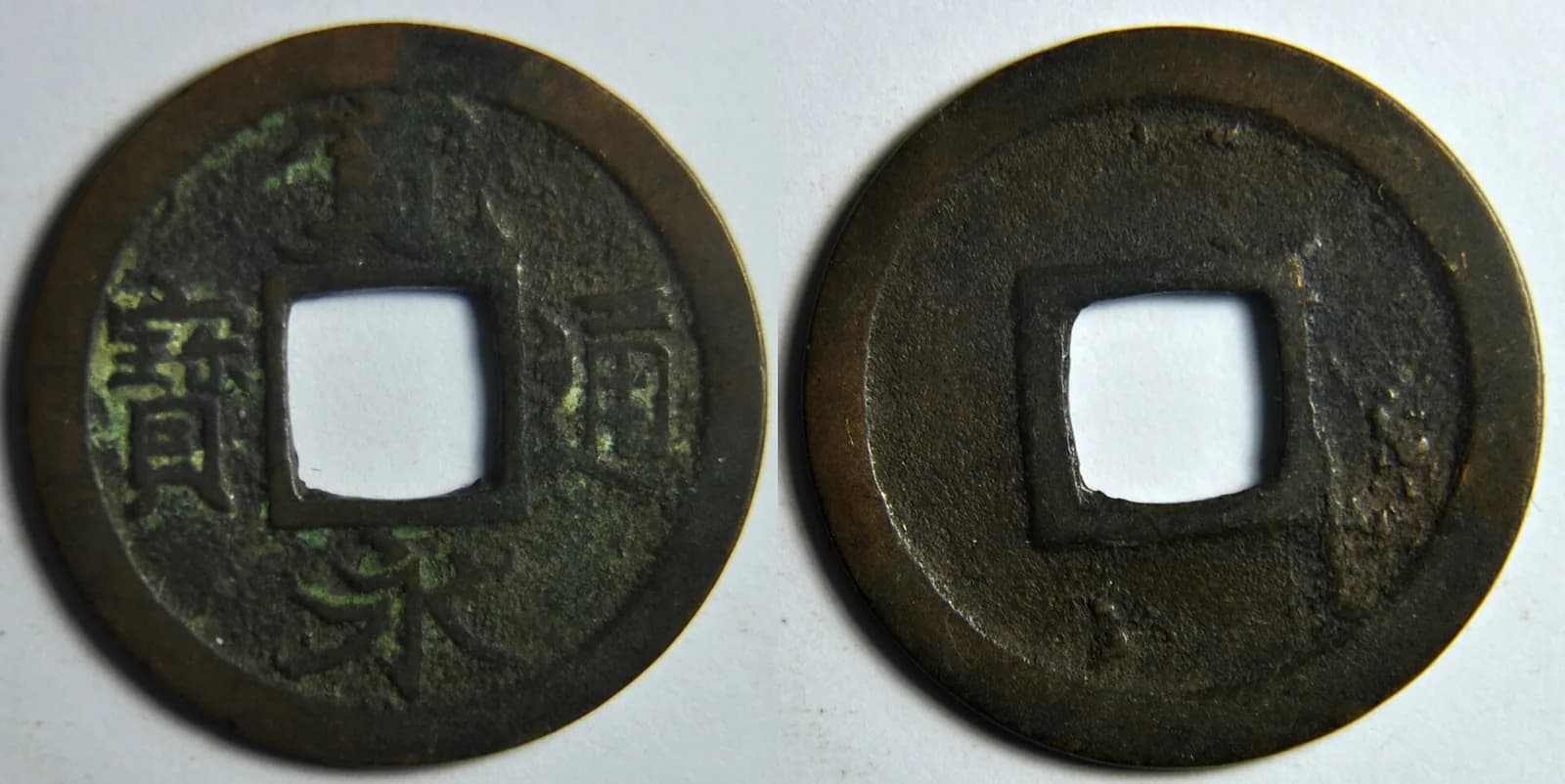
Image: Japanese holed coins (square-holed cash coins) / Jean-Michel Moullec from Vern sur Seiche (35, Bretagne), France / Wikimedia Commons / CC BY 2.0(source)
Counterfeiting and Crackdowns on the Eiraku Tsūhō (永楽通宝) — The Most Widely Circulated and Most Counterfeited Coin
A History of Counterfeiting and Regulation from the Kamakura Period through the Edo Period
Subject coin: 永楽通宝の偽造と摘発
Overview
The Eiraku Tsūhō (永楽通宝) was a coin cast during the reign of the Yongle Emperor of China's Ming dynasty and subsequently imported into Japan, where it circulated widely. Because of its high degree of penetration within Japan, it frequently became a target for counterfeiting. Domestic imitations known as "Eiraku utsushi" (永楽写し)—cast by melting copper inside Japan—were produced in large quantities; counterfeit pieces were lighter and cruder than genuine coins and differed in color. The daimyo and the shogunate repeatedly issued prohibitions against counterfeiting in an effort to curb its spread, yet counterfeit coins continued to circulate. According to historical records, analysis of excavated artifacts reveals sites where the counterfeit rate reached 30 to 50 percent. Against this backdrop, the counterfeiting and crackdown of the Eiraku Tsūhō occupies an important place in Japanese monetary history.
Specifications
- Denomination
- 永楽通宝
- Minting period
- 1400-1650年
- Metal composition
- 銅(諸説あり)
- Weight
- 約3.5g(偽造品は軽量)
- Dimensions
- 直径約25mm
- Mintage
- 不詳(諸説あり)
- Mint supervisor
- 不詳
- Market price
- 状態によるが数千円〜数万円
The Spread of the Eiraku Tsūhō and the Beginnings of Counterfeiting — The 1400s
Image: Modern Japanese coinage / Coindesmonnaies / Wikimedia Commons / CC BY-SA 4.0(source)
The Eiraku Tsūhō began to be cast during the reign of the Yongle Emperor (r. 1402–1424) of China's Ming dynasty. As its name indicates, the coin bears the Yongle era name, and it originally circulated within China. However, as Japan entered the Muromachi period, trade with Ming China became more active and large numbers of Eiraku Tsūhō were imported. Particularly from the latter half of the 1400s onward, around the time of Ashikaga Yoshimitsu (r. 1368–1394), the Eiraku Tsūhō had become one of the principal currencies in Japan. The coin's popularity in Japan rested first and foremost on its reliability and the abundance of its supply. As a result, the Eiraku Tsūhō came to be used widely in regional markets and among merchants, accepted as a trustworthy currency. Yet precisely because of its wide circulation, the Eiraku Tsūhō also became a target for counterfeiting. Inside Japan, numerous "Eiraku utsushi" were produced by melting down copper and casting it into molds, and counterfeit Eiraku Tsūhō began to appear on the market. In this era Japan's economy ran on coin currency, and the reliability of coins was crucial in commercial transactions. Because the circulation of counterfeit coins had an adverse effect on price stability, the daimyo and the shogunate were compelled to crack down on counterfeiting. Ashikaga Yoshimitsu, in 1405, ordered a crackdown on counterfeit coins and carried out their confiscation. In this way, the crackdown on Eiraku Tsūhō counterfeiting began at the same time as the counterfeiting itself.
The Production Process and Technology of Counterfeit Coins — The 1500s
Image: Modern Japanese coinage / Coindesmonnaies / Wikimedia Commons / CC BY-SA 4.0(source)
Entering the 1500s, counterfeiting of the Eiraku Tsūhō became further organized and the techniques involved improved. Particularly during the Sengoku period, daimyo in various regions began casting their own Eiraku Tsūhō, which promoted the mass production of the so-called "Eiraku utsushi" counterfeit pieces. The manufacture of counterfeits employed casting techniques in which copper was melted and poured into molds. The molds were made based on genuine Eiraku Tsūhō and were crafted to resemble the originals as closely as possible, yet the finish remained crude in comparison to genuine coins. Counterfeit pieces were also generally lighter than genuine ones and often differed in color, which meant that knowledgeable individuals could tell them apart. Those involved in counterfeiting were local craftsmen and metalworkers. They applied their skills in an effort to produce counterfeits as close to the genuine article as possible, but the quality of the materials and the limits of their techniques meant that the inferior quality could not be denied. Counterfeiting of the Eiraku Tsūhō was carried out secretly in small regional workshops by the hands of such craftsmen. In the latter half of the 1500s, as powerful daimyo such as Oda Nobunaga (in power 1568–1582) and Toyotomi Hideyoshi (in power 1582–1598) proceeded to unify the country, control over currency was tightened. Wary of the adverse effects counterfeit coins had on the economy, Nobunaga and Hideyoshi strictly cracked down on the manufacture of counterfeit coins. As a result, the production of counterfeits gradually decreased but did not disappear entirely, continuing to be made in secret.
The Reality of Circulation and the Reaction of the People — The Early 1600s
Image: Modern Japanese coinage / Coindesmonnaies / Wikimedia Commons / CC BY-SA 4.0(source)
In the early 1600s, as the Edo period opened, the Eiraku Tsūhō was still in wide circulation within Japan. During this era, Tokugawa Ieyasu (r. 1603–1605) established the shogunate and tightened regulation of currency in order to stabilize the economy. In 1604 Ieyasu issued a currency recoinage order and thoroughly enforced crackdowns on counterfeit coins, yet even so counterfeit pieces were not completely eradicated and were in wide use particularly in rural areas. Behind the circulation of counterfeit coins lay the fact that the supply of coin currency was insufficient. In regional markets, even counterfeit coins had value if they could be used, and commoners had no choice but to accept them. The exchange rate between counterfeit and genuine coins varied by region and circumstance, but in many cases counterfeit coins are said to have been traded at roughly 60 to 70 percent of the value of genuine ones. For commoners, even counterfeit coins posed no problem as long as they could be exchanged for goods needed for daily life. The large volume of counterfeit coins in circulation sometimes made prices unstable, but commoners adapted to those conditions and managed their daily lives with ingenuity. During this era the circulation of counterfeit coins brought confusion to the economy, yet people nonetheless carried on with their everyday lives.
Influence on Later Ages and Appraisal — From a Modern Perspective
Image: Modern Japanese coinage / Coindesmonnaies / Wikimedia Commons / CC BY-SA 4.0(source)
The problem of Eiraku Tsūhō counterfeiting exerted a major influence on Japan's later monetary system. The development of the monetary system after the onset of the Edo period in particular can be said to have emerged in part as a reflection on the counterfeiting of the Eiraku Tsūhō. The Edo shogunate sought to ensure a stable supply of currency and the reliability of its value by increasing the issuance of gold and silver coins and suppressing the circulation of counterfeit pieces. In particular, Tokugawa Hidetada (r. 1605–1623) and Tokugawa Iemitsu (r. 1623–1651), successors to Tokugawa Ieyasu, advanced reforms to the monetary system and strengthened the crackdown on counterfeit coins. Behind this lay the significant impact that Eiraku Tsūhō counterfeiting had had on the economy. Even today, the Eiraku Tsūhō continues to attract attention for its historical value. The existence of counterfeit pieces in particular provides clues to understanding the technology and economic conditions of the time, making them valuable resources from an archaeological standpoint as well. The problem of Eiraku Tsūhō counterfeiting continues to offer lessons for the modern age in considering the reliability of currency and economic stability.
Value & Rarity
Because so many counterfeit pieces exist owing to the Eiraku Tsūhō's high degree of circulation, counterfeits may still appear on the market today. Counterfeit pieces tend to be cruder in workmanship than genuine ones, lighter in weight, and different in color, so a collector with a discerning eye can distinguish them. The historical value of the Eiraku Tsūhō itself is high, however, and genuine Eiraku Tsūhō in particular are prized by collectors. Market prices fluctuate greatly depending on condition and authenticity, and pieces may trade for anywhere from a few thousand yen to tens of thousands of yen. Furthermore, even counterfeit pieces can hold academic value when their historical background and manufacturing techniques are taken into consideration. In this way, the Eiraku Tsūhō, given its history and the background of its counterfeiting, continues to occupy an important place in modern coin collecting.
Conclusion
The history of Eiraku Tsūhō counterfeiting and crackdowns exerted an important influence on the development of Japan's monetary system. The existence of counterfeit coins became a source of economic instability, and cracking down on them spurred reform of the monetary system. Even today, the Eiraku Tsūhō continues to attract attention for its historical value. By studying this history, one can understand the social and economic realities of the time and draw lessons that laid the foundations of the modern monetary system. It is hoped that this story will provide an opportunity to reflect on the importance of monetary reliability and economic stability.
Related Stories
Eiraku Tsuho — The Chinese 'Standard Currency' that Moved Muromachi Japan
An Unknown Era When Foreign Coins Formed Japan's Economic Foundation
Coin StoryThe Monetization of Kamakura Estates — Innovations in the Medieval Currency Economy
The Transformation of the Japanese Economy Triggered by the Kamakura Shogunate and the Advancement of Monetized Tribute
Coin StoryThe Import and Circulation of Ming Coins — Tracing the History of Medieval Currency
Beyond Yongle Tongbao, Ming coins such as Hongwu Tongbao and Xuande Tongbao were issued in dozens. Their quality and trust discrepancies caused chaos in the Japanese market.
Dealers
Dealers Handling This Category
A reference when considering a sale or appraisal. All are dealers and auction houses with a proven track record.
Ginza Coins
Ginza, Chuo-ku, Tokyo
One of Japan's most established numismatic dealers. The scale and variety of their regular auctions is among the largest in the country. Their catalogs are considered a benchmark for market pricing.
Japan Coin Auction (JCA)
Tokyo
Holds regular auctions with reliable hammer price data, making it a useful resource for tracking market values. Caters to a wide range of collectors from beginners to advanced buyers.
Taisei Coins
Tokyo
A dealer with an international network. Offers advanced services such as consignment to overseas auctions and NGC/PCGS grading submission. Recommended for high-value or internationally recognized coins.