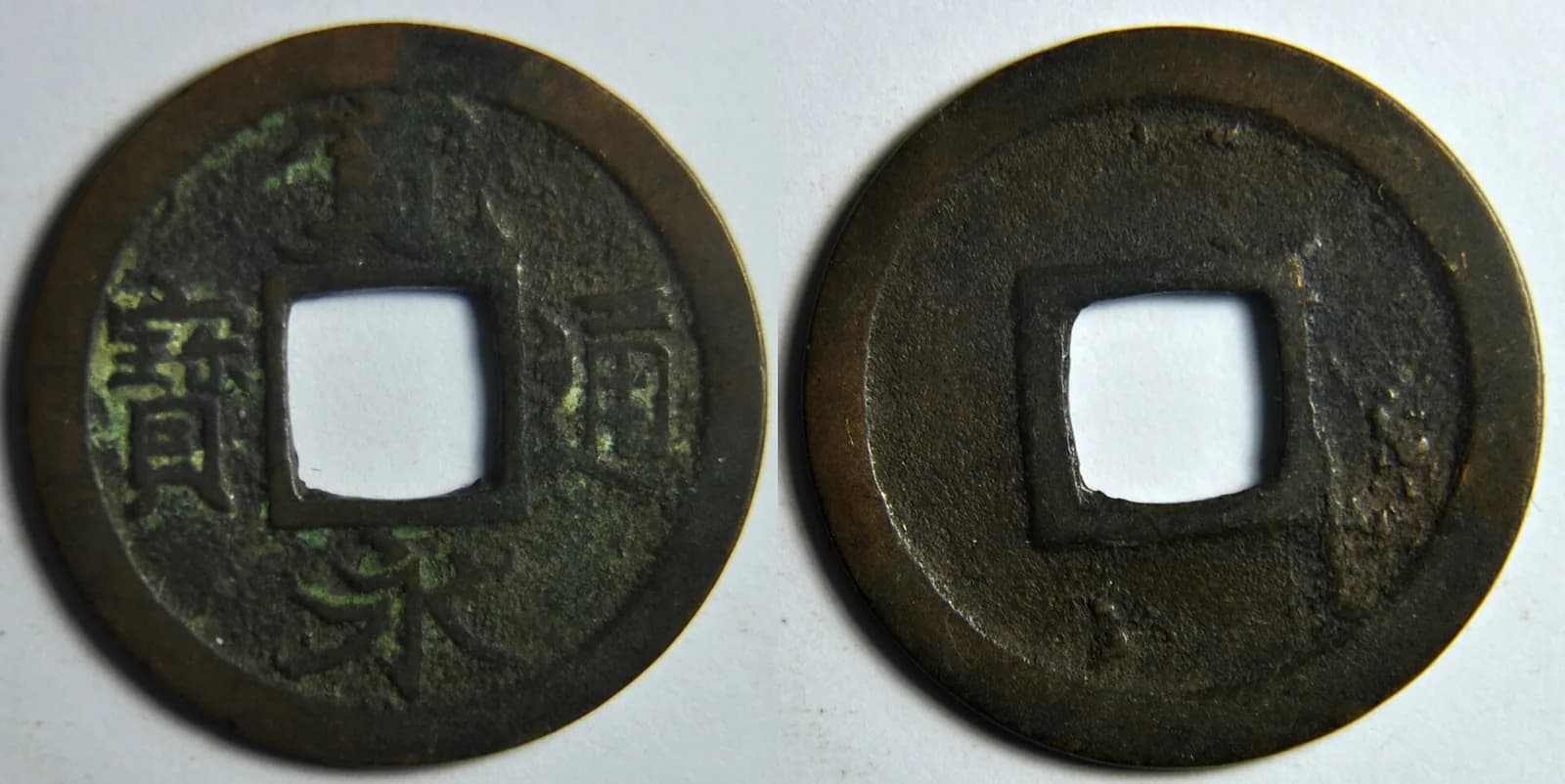
Image: Japanese holed coins (square-holed cash coins) / Jean-Michel Moullec from Vern sur Seiche (35, Bretagne), France / Wikimedia Commons / CC BY 2.0(source)
Eiraku Tsuho — The Chinese 'Standard Currency' that Moved Muromachi Japan
An Unknown Era When Foreign Coins Formed Japan's Economic Foundation
Subject coin: 永楽通宝の広域流通
Overview
In the Muromachi period, Japan was a time of internal conflict and confusion. However, the economic activities were surprisingly supported by a single copper coin minted by the distant Chinese Ming Emperor. This was the 'Eiraku Tsuho' (永楽通宝) initiated by Emperor Yongle in the 6th year of Yongle (1408). Through Japan-Ming trade, these coins were brought into Japan in large quantities and quickly permeated the entire archipelago. They deeply rooted in the lives of samurai, merchants, and farmers of the Warring States era, wielding an overwhelming presence that extended from rent collection to commercial transactions and even as the standard for Sengoku daimyo's domain wealth.<br><br>The impact Eiraku Tsuho brought to Japan is immeasurable. It stimulated the development of a monetary economy and functioned as the de facto 'standard currency' for about 200 years until Japan established its unique monetary system. The story of how this single copper coin moved Japan’s economy and changed people’s lives is a grand narrative we will now unravel. Understanding 'Types and Identification of Ansen' is crucial to deeply grasp the history of Japanese old coins. Additionally, exploring the 'Overview and Charm of Ancient Currency' will further deepen your understanding of how Japan's unique currency developed.
Specifications
- Denomination
- 銭貨(銅銭)
- Minting period
- 明・永楽6年(1408年)鋳造開始。日本での主要流通は15世紀〜16世紀末。
- Metal composition
- 銅(主に青銅)
- Weight
- 約3.5g〜4g(個体差あり)
- Dimensions
- 直径約24mm〜25mm(個体差あり)
- Mintage
- 不詳(膨大な量が鋳造されたとされる)
- Mint supervisor
- 不詳(明の鋳銭局)
- Market price
- 数千円〜数万円(状態や稀少な版による)
Chapter 1: The Birth of the Empire's Currency Sweeping East Asia — The Prelude of Eiraku Tsuho’s Arrival in Japan
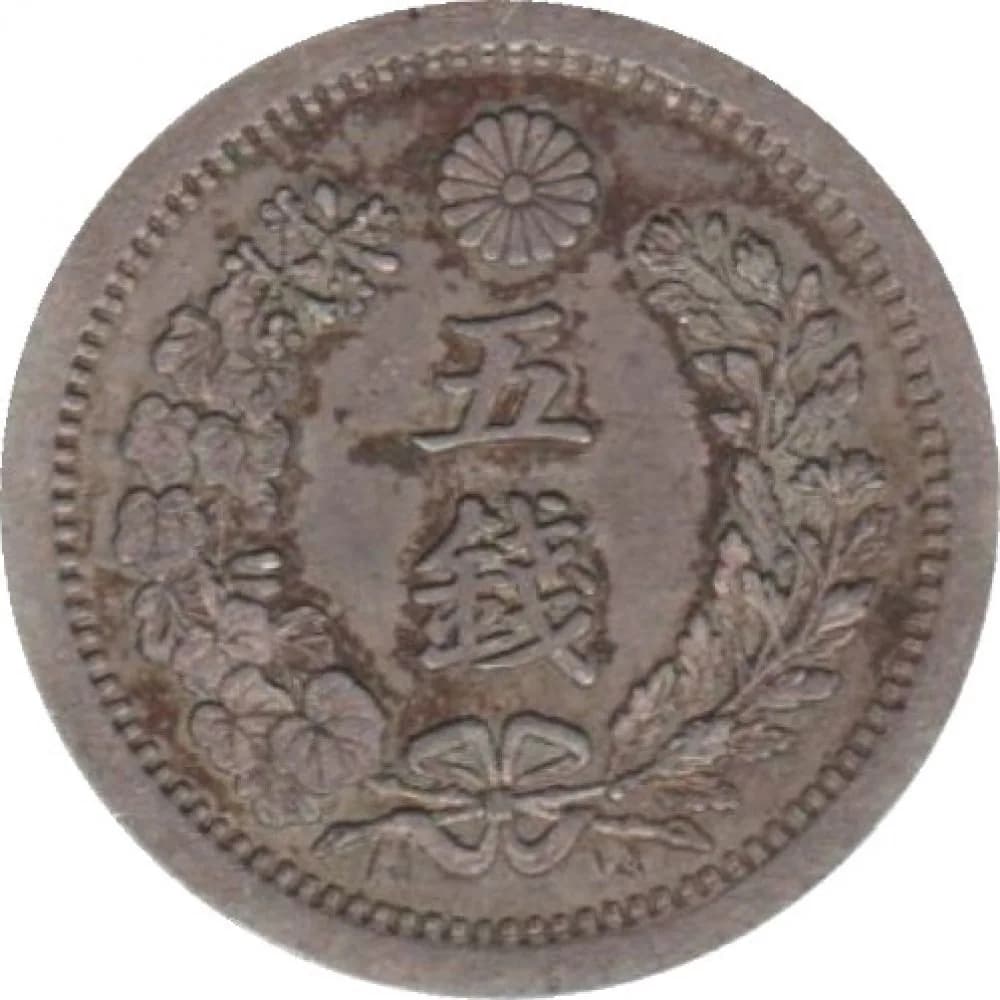
Image: Modern Japanese coinage / Coindesmonnaies / Wikimedia Commons / CC BY-SA 4.0(source)
In the early 15th century, the Chinese continent was at the zenith of the third Ming emperor, Yongle (Zhu Di). Building on the foundation laid by his father Hongwu, he actively promoted foreign policies to build an even more formidable empire. Yongle initiated the minting of what would become the cornerstone of the Japanese economy in the 6th year of Yongle (1408) with 'Eiraku Tsuho.' The backdrop to this coin’s creation was the economic challenges faced by Ming at the time. The paper currency 'Daming Baochao' issued during Hongwu's reign quickly lost credibility due to over-issuance, leading to soaring prices. Hence, Yongle encouraged the minting of copper coins as a stable currency to support the real economy.<br><br>Yongle actively engaged in the tributary trade to invigorate both domestic and international trade. Notably, the seven grand voyages led by Zheng He reached as far as Asia and Africa, showcasing Ming’s prestige and disseminating resources worldwide. Through this trade, 'Eiraku Tsuho' circulated widely, not just within China but also in the Korean Peninsula, Ryukyu, and eventually Japan.<br><br>Meanwhile, Japan was in the mid-Muromachi period. Ashikaga Yoshimitsu commenced Japan-Ming trade (Kango trade) and resumed diplomatic relations with Ming. Through trade with Ming, Yoshimitsu brought enormous wealth and culture to Japan, but his successor Ashikaga Yoshimochi temporarily halted the trade. However, trade resumed in Eikyō 4 (1432) during Ashikaga Yoshinori’s reign, leading to a massive inflow of imported coins, especially 'Eiraku Tsuho,' into Japan. Initially, various imported coins such as Song and Yuan coins circulated domestically, but 'Eiraku Tsuho,' because of its exquisite craftsmanship and uniform quality, gradually overwhelmed other coins. Japan at that time had limited domestic coin minting capabilities and heavily depended on imported coins from China. 'Eiraku Tsuho' was quietly preparing to serve as the 'standard currency' that Japanese economy craved.
Chapter 2: The Power of Copper Crossing the Sea — Mass Influx and Penetration into the Japanese Market
Image: Modern Japanese coinage / Coindesmonnaies / Wikimedia Commons / CC BY-SA 4.0(source)
The mass influx of 'Eiraku Tsuho' into Japan was backed by Ming’s enormous production capacity and active trade between Japan and Ming. The mints in Ming, especially the Baoquan Bureau in Nanking and the Baoquan Bureau in Beijing, used advanced technology of the time to mint vast quantities of 'Eiraku Tsuho.' The production process involved carving a prototype called a mother coin, making multiple sand molds from it, and pouring molten bronze (an alloy mainly composed of copper, tin, and lead) to cast the coins. With one sand mold, dozens of coins could be minted simultaneously, enabling efficient mass production.<br><br>These coins reached Japan through two main routes. One was the official 'Kango Trade' led by the Muromachi shogunate. Ships bearing trade licenses from Japan would enter Ningbo in Ming, bringing back large amounts of 'Eiraku Tsuho' along with raw silk, porcelain, and books. For instance, trade ships dispatched by Ashikaga Yoshinori in Eikyō 4 (1432) are recorded to have brought many Ming coins to Japan. Another route was through private trade or pirate activities known as Wokou, which also played a significant role in satisfying domestic currency demand.<br><br>From the 15th to 16th century, Japan’s domestic economy rapidly developed monetary systems. With the monetization of tax payments and the active trading activities, the demand for currency with stable quality and supply intensified. However, due to insufficient domestic technology and resources for coin minting, Japan relied heavily on imported coins from China. 'Eiraku Tsuho,' boasting exquisite quality and backed by the credibility of a great nation like Ming, quickly surpassed other imported coins (Hongwu Tsuho, Xuande Tsuho, etc.) and poor counterfeit coins, dominating the market rapidly. Consequently, 'Eiraku Tsuho' became an indispensable part of Japan’s economic activities, deeply rooting itself in people’s daily lives. In this era, Japan’s economy was indeed powered by the foreign copper that came across the sea.
Chapter 3: The Standard Currency Moving Japan — 'Goyosen' for the Shogunate and Sengoku Daimyo
Image: Modern Japanese coinage / Coindesmonnaies / Wikimedia Commons / CC BY-SA 4.0(source)
The flood of 'Eiraku Tsuho' into Japan established its status as the 'standard currency' that formed the backbone of the Japanese economy from the Muromachi to the Sengoku periods due to its excellent quality and stable supply. The Muromachi shogunate’s policies were decisive in this movement. The shogunate repeatedly issued 'Senzenrei' to eliminate poor quality privately minted coins and poorly treated imported coins (bad coins), to calm economic confusion. Among them, Ashikaga Yoshimasa in the Bunmei era (1469-1487) and Ashikaga Yoshitane in the Daiei era (1521-1528) officially recognized 'Eiraku Tsuho' as 'Seisen' or good coin, recommending it as 'Goyosen.' This cemented its position as the shogunate-certified key currency.<br><br>This 'Goyosen' designation significantly changed tax collection methods. Grain taxes previously collected in rice and goods transitioned to monetized tax payments using coins, such as 'Eiraku Tsuho.' As a result, even farmers became involved in the currency economy, animating market sales and purchases. Merchants’ ledgers, debts, and salary calculations generally used 'Eiraku Zentaka' units, greatly enhancing the efficiency of economic activities.<br><br>Notably, 'Eiraku Tsuho' maintained its authority even in the Sengoku period. Various Sengoku daimyo, following the shogunate’s 'Senzenrei,' treated 'Eiraku Tsuho' as good coin to stabilize their regional economy. For example, Takeda Shingen of Kai focused on 'Eiraku Tsuho' as the standard currency within his domain, setting 'Eiraku Kan' as 1000 'Eiraku Tsuho' for the basis of taxes and military obligations. Oda Nobunaga also used 'Eiraku Zentaka' to indicate his retainers' fiefs' wealth, showcasing a more market-oriented evaluation method than the rice volume-dependent stone system, highlighting the permeation of 'Eiraku Tsuho' in the economic society of the time. 'Eiraku Tsuho' indeed served as a common language connecting economies across Japan even in the chaotic Sengoku era. For various currencies existing in Japan in this period, comparing with the 'Types and Identification of Edo Gold Coins' and 'Details of Edo Silver Coins' reveals their differences and further insights.
Chapter 4: End and Legacy — The Footprint Left by Eiraku Tsuho on Japan’s Monetary Economy
Image: Modern Japanese coinage / Coindesmonnaies / Wikimedia Commons / CC BY-SA 4.0(source)
'Eiraku Tsuho' enjoyed its status as Japan's key currency for over 200 years. However, its prosperity eventually ended. As the Sengoku period concluded and Toyotomi Hideyoshi achieved national unification, significant waves of change swept over the monetary system. Hideyoshi ordered the minting of large Japanese gold and silver coins such as Tensho large coins and Bunroku-Keicho silver coins, aiming for nationwide currency unification. This was an attempt to establish an independent economic system, freeing Japan from its reliance on imported coins from China.<br><br>Tokugawa Ieyasu, who opened the Edo period, cemented this transition. In Keicho 6 (1601), Ieyasu initiated the minting of Keicho gold and silver coins, including the 'Keicho Koban' as the national unified currency, and implemented policies to gradually prohibit the circulation of imported Chinese coins such as 'Eiraku Tsuho.' Thus, Japan shifted fully to a currency system based on domestically minted gold and silver coins, leading to the gradual disappearance of 'Eiraku Tsuho' from the market. The emergence of Keicho coins marked a watershed moment that terminated Japan’s era of relying on foreign currencies and established an independent economic sphere.<br><br>Even after the circulation of 'Eiraku Tsuho' ceased, its influence lingered long in Japanese society. Notably, the concept of 'Eiraku Zentaka' as a measure of land productivity and economic value persisted in some areas till the early Edo period. Moreover, the most crucial legacy brought by 'Eiraku Tsuho' to Japan’s currency economy was people’s perception of coins and the deep penetration of a monetary economy nationwide. This experience laid the groundwork for the mass minting and national circulation of subsequent domestic coins such as 'Kanei Tsuho.' 'Eiraku Tsuho' was not merely a Chinese copper coin but is engraved in Japanese monetary history as a rare instance where foreign culture significantly contributed to domestic economic development. Even today, collectors find 'Eiraku Tsuho' appealing due to its historical background and diverse variations.
Value & Rarity
Due to the large volume in circulation, 'Eiraku Tsuho' is generally considered relatively easy to obtain among old coins. However, its market value varies greatly depending on the coin's condition, mint location and period, and rarity.<br><br>The most common 'Eiraku Tsuho' might be traded for several thousand yen to about 10,000 yen if in good condition. However, some have exceptionally rare characteristics. For instance, those with specific features like the 'three-dot 永' are highly valued among collectors. Error coins minted due to production mistakes or those in near-unused condition can sometimes fetch values exceeding tens of thousands of yen.<br><br>Determining the authenticity of 'Eiraku Tsuho' requires examining factors like minting skill, lettering styles, copper quality, and the presence of natural aging (patina). Coarse counterfeits and later replicas exist, so seeking advice from trustworthy coin dealers or experts during purchase is wise. Knowledge about 'Identifying Fakes and Altered Coins' is also useful.<br><br>'Eiraku Tsuho' holds historical significance as the foundation of Japan's monetary economy, so its value surpasses the mere price of the metal. Many collectors are drawn to the romance of its history, enjoying the collection. When adding to your collection, consider the grand story behind it.
Conclusion
The story of 'Eiraku Tsuho' teaches us the astonishing historic truth that a single copper coin could cross borders and possess the power to move the economy of a distant foreign country. Minted during the era of Emperor Yongle of Ming, traveling to Muromachi Japan, and supporting the economy for nearly 200 years under the Ashikaga shogunate and Sengoku daimyo, 'Eiraku Tsuho' was more than just a tale of coin circulation. It provides valuable evidence of the international relations of East Asia at the time, the reality of trade, and how Japanese society adapted to the monetary economy. The grand historical romance embedded within this small copper coin might be a worthy addition to your coin collection. ITTENDO will continue to explore each coin that narrates history.
Related Stories
The Coin Selection Edict of the Sengoku Period — Tracing the History of Medieval Currency
"Only Accept Good Coins" — The Coin Selection That Spread During the Sengoku Period Was an Economic Terror That Troubled the Daimyo. Responses by Nobunaga, Ieyasu, and Shingen
Coin Story60th Anniversary of Local Autonomy Law 500 Yen Bicolor – 10-Year Journey Across 47 Prefectures
Commemorative Coin Series Born from the Law of 1947
Coin StoryCounterfeiting and Crackdowns on the Eiraku Tsūhō (永楽通宝) — The Most Widely Circulated and Most Counterfeited Coin
A History of Counterfeiting and Regulation from the Kamakura Period through the Edo Period
Dealers
Dealers Handling This Category
A reference when considering a sale or appraisal. All are dealers and auction houses with a proven track record.
Ginza Coins
Ginza, Chuo-ku, Tokyo
One of Japan's most established numismatic dealers. The scale and variety of their regular auctions is among the largest in the country. Their catalogs are considered a benchmark for market pricing.
Japan Coin Auction (JCA)
Tokyo
Holds regular auctions with reliable hammer price data, making it a useful resource for tracking market values. Caters to a wide range of collectors from beginners to advanced buyers.
Taisei Coins
Tokyo
A dealer with an international network. Offers advanced services such as consignment to overseas auctions and NGC/PCGS grading submission. Recommended for high-value or internationally recognized coins.