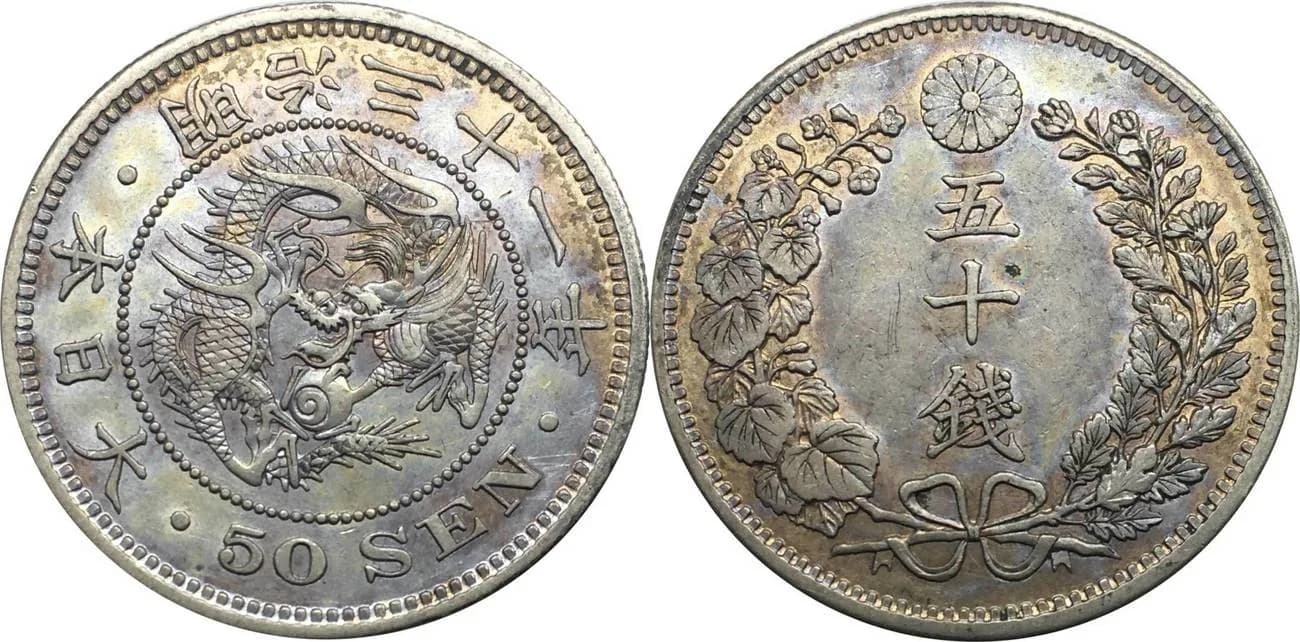
Image: Modern Japanese coinage / The government of the Empire of Japan. / Wikimedia Commons / Public domain(source)
Wadō Kaichin Silver Coin (和同開珎銀銭) — Japan's Oldest Currency: A Short-Lived Experiment
The Little-Known Silver History That Speaks to Monetary Policy of the Nara Period
Subject coin: 和同開珎銀銭
Overview
The Wadō Kaichin Ginsen (和同開珎銀銭) holds a place in history as one of the first officially issued currencies in Japan. Issued in Wadō 1 (708) ahead of the copper coin, this silver coin was attempted as part of a distinctive economic policy in the early Nara period. The primary sources of silver were Tajima Province (present-day northern Hyogo Prefecture) and Izumo Province (present-day Shimane Prefecture), and production from these regions supported the state's coin minting. However, as early as Wadō 2 (709), the circulation of the silver coin was banned and unified into the copper coin alone. Behind this decision was the difficulty of standardizing face value, as transactions based on weight were the norm. Surviving examples of the Wadō Kaichin silver coin are extremely few, making them rare exhibits even in museums. The issuance and abolition of this silver coin tells the story of how Japan at the time was searching for the shape of its monetary system. Referring to the detailed commentary on Wadō Kaichin will provide a deeper understanding.
Specifications
- Denomination
- 不詳(諸説あり)
- Minting period
- 和銅元年〜和銅2年(708-709年)
- Metal composition
- 銀(品位不詳)
- Weight
- 平均1.8g(諸説あり)
- Dimensions
- 直径約24mm(諸説あり)
- Mintage
- 不詳(現存数極少)
- Mint supervisor
- 不詳(鋳造地:但馬・出雲)
- Market price
- 博物館級の希少品、価格は不明
Chapter 1: The Birth of the Wadō Kaichin Silver Coin — Background of Economic Policy
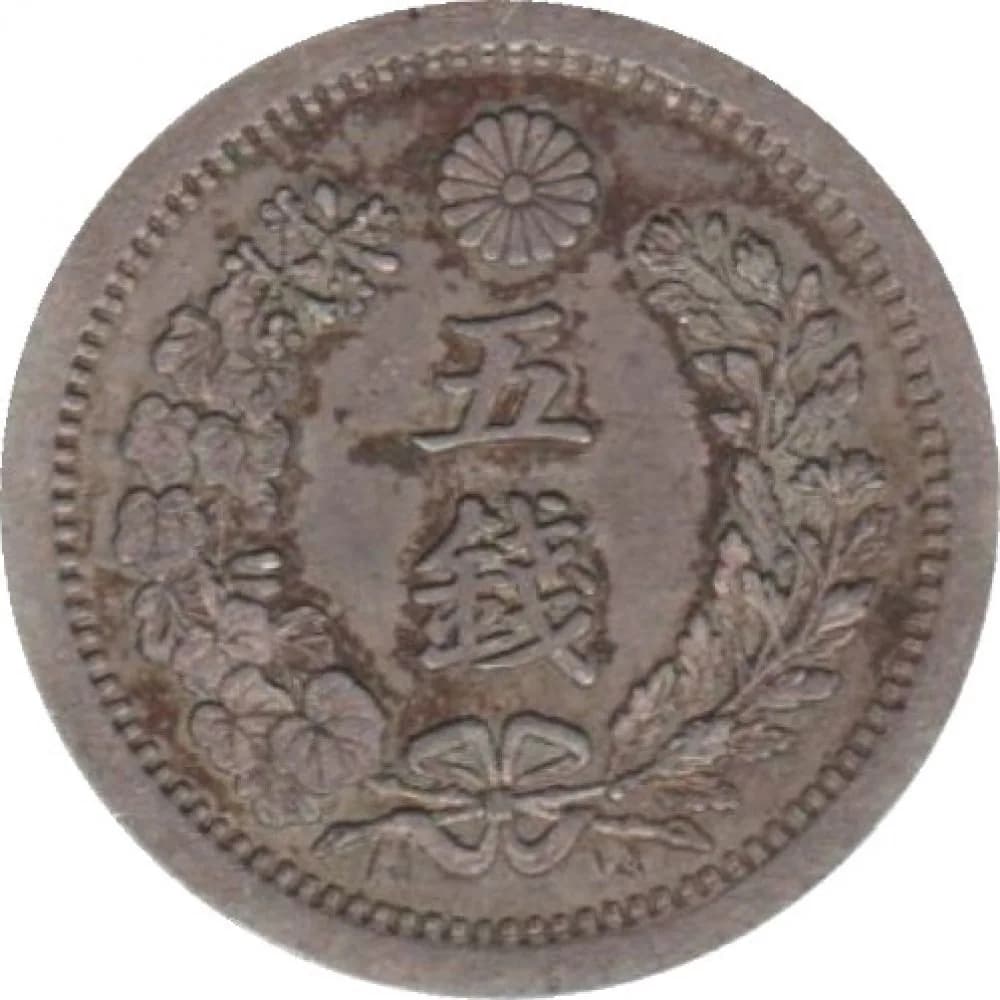
Image: Modern Japanese coinage / Coindesmonnaies / Wikimedia Commons / CC BY-SA 4.0(source)
In Wadō 1 (708), influenced by Tang China, Japan decided to issue the Wadō Kaichin silver coin in order to establish its own monetary system. In the political context surrounding the court at this time, the ritsuryo system was being strengthened under the grip of Fujiwara no Fuhito's power. Fujiwara no Fuhito placed great importance on the issuance of currency in order to establish the financial foundation of the state. As Japan's first official currency, Wadō Kaichin came to lay that groundwork. Behind the issuance of the silver coin, silver production from Tajima Province and Izumo Province was an important factor. These regions possessed abundant mineral resources and were chosen as sources of silver. While modeled on Tang China's monetary system, a policy that took Japan's own economic environment into consideration was attempted. The silver coin was often traded by weight, which posed the challenge of difficulty in unifying its value. In this era, the introduction of a monetary system held significance not only as an economic measure, but also as a symbol demonstrating the governing power of the state. Under Fujiwara no Fuhito, the issuance of the silver coin was also an attempt to raise the prestige of the nation. The fact that a switch from silver coin to copper coin was made the following year suggests that the economic policy of the time was a continuous process of trial and error. Referring to the overview and appeal of ancient coinage will make the overall picture of the monetary system of that era easier to understand.
Chapter 2: The Minting Process of the Silver Coin — Technology and Human Effort
Image: Modern Japanese coinage / Coindesmonnaies / Wikimedia Commons / CC BY-SA 4.0(source)
The minting of the Wadō Kaichin silver coin was a process that made full use of the most advanced technology of the time. The main minting locations were Tajima Province and Izumo Province, where many craftsmen engaged in the production of silver coins day and night. Silver was obtained by smelting ore from these regions, and its purity was said to be high, though specific figures are not clear. The minting was based on technology transmitted from Tang China, with uniquely Japanese improvements added. At the minting sites, work was carried out melting silver in furnaces and pouring it into molds. This work required skilled technique and experience, and many craftsmen competed in their craft. The molds were produced at workshops in various locations, and advanced technique was required to achieve accurate shapes. The surface of the silver coins bore the characters 「和同開珎」, which functioned as a kind of state seal. Such minting techniques came to lay the foundation for the monetary system that followed, playing an important role in Japan's monetary history. The efforts and ingenuity of the craftsmen held historical significance in the minting of Japan's first silver coins, however brief that period was. Comparing the details of silver coin minting with the details on Edo silver coins gives a clear understanding of how the technology evolved.
Chapter 3: Circulation of the Silver Coin and Its Economic Impact — The Voices and Reactions of the People
Image: Modern Japanese coinage / Coindesmonnaies / Wikimedia Commons / CC BY-SA 4.0(source)
How was the Wadō Kaichin silver coin, issued in Wadō 1, received in the everyday life of the Nara period? The silver coin initially attracted expectations as a new form of currency, but in actual circulation it faced many challenges. Because the value of the silver coin depended on its weight, it was necessary to use scales to measure it during transactions. For this reason, it was cumbersome for merchants and citizens to handle, and people accustomed to barter found it inconvenient. Furthermore, since the value of silver differed by region and the unification of prices was difficult, it struggled to earn trust. Such a situation ran counter to the economic stabilization that Fujiwara no Fuhito had intended. The circulation of the silver coin came to an end in a short period of time, and the following year it was unified into the copper coin. The copper coin enabled wider circulation and allowed for the unification of value, making it possible to build a stable economic foundation. The voices of the citizens reflect the anxieties and expectations surrounding the monetary policy of the time. The failure of circulation prompted a review of Fujiwara no Fuhito's policies and, as a result, contributed to the construction of a more stable economic system. By referring to types of ana-sen and how to identify them, this historical context will help one understand the role and evolution of currency.
Chapter 4: The Abolition of the Wadō Kaichin Silver Coin and Its Aftermath — Influence on Later Generations
Image: Modern Japanese coinage / Coindesmonnaies / Wikimedia Commons / CC BY-SA 4.0(source)
Although the Wadō Kaichin silver coin was short-lived, it had a profound influence on the monetary system that followed. In Wadō 2 (709), the circulation of the silver coin was swiftly banned and the transition to the copper coin took place. This decision was part of Fujiwara no Fuhito's review of economic policy and his reform of Japan's monetary system into something more efficient and stable. The introduction of the copper coin promoted trade with Tang China and invigorated economic activity within Japan. The failure of the Wadō Kaichin silver coin became an important lesson for the next step, bringing about technological and institutional advances in subsequent coin minting as well. In later generations, the Wadō Kaichin silver coin has become a valuable subject of study for those learning about Japan's monetary history. In particular, archaeological discoveries have advanced in recent years, providing important clues for understanding the economic conditions and policy background of the Nara period. Such historical lessons have relevance to modern economic policy and have also been referenced in the construction of new monetary systems. Though it existed for only a short period, the Wadō Kaichin silver coin symbolically illustrates the growth process of Japan's monetary system. Surviving examples may have their value reassessed through the basics of old coin auctions.
Value & Rarity
The Wadō Kaichin silver coin is known as an extremely rare old coin due to its short period of issuance and the small number of surviving examples. It is held in particularly high regard for its historical value among museums and old coin collectors. Of the surviving silver coins, only a handful have been confirmed to exist, and as a result they almost never appear on the market. At auction, the very act of a piece being offered for sale becomes news, and it is said that hammer prices can reach several million to tens of millions of yen, though specific transaction examples are limited. The Wadō Kaichin silver coin, along with its rarity, is an attractive subject for researchers and collectors as a precious record symbolizing the monetary policy of the Nara period. Since the value of a silver coin also changes depending on the location and circumstances of its discovery, it holds important archaeological significance as well. For details on rarity, referring to the standards for old coin grading will help one understand the evaluation methods.
Conclusion
The Wadō Kaichin silver coin occupies a very singular place in Japan's monetary history. Its short-lived history reflects the trial and error of economic policy in the early Nara period. Under Fujiwara no Fuhito, an attempt was made to establish a monetary system, but the difficulty of unifying the value of the silver coin and the challenges of circulation forced its abolition within a short period of time. However, the attempt provided important insights for the development of the monetary system that followed, and through the transition to copper coins it contributed to the strengthening of Japan's economic foundation. Even today, the Wadō Kaichin silver coin continues to attract attention as a subject of research and collecting due to its historical background and rarity. The story of this silver coin is a key to understanding how Japan built its monetary system, and its appeal will continue to be explored by many researchers and collectors going forward.
Related Stories
Bunkyū Eihō — Tracing the History of Ansen
The last Ansen of the late Edo period. The 4-mon coin minted in Bunkyū 3 began circulating just shy of two years before the Meiji Restoration.
Coin StoryChikusen Jowi no Rei — An Ancient Japanese Attempt to Spread Currency
Wadō 4 (711): An Unprecedented System to Promote Currency Use
Coin StoryNaga-nen Taihō — Tracing the History of Ancient Coinage
The 7th coin of the Kōchō jūni-sen, issued in Shōwa 15 (848) during the reign of Emperor Ninmyō. From this time, the gap between the actual and nominal value of coins became serious.
Dealers
Dealers Handling This Category
A reference when considering a sale or appraisal. All are dealers and auction houses with a proven track record.
Japan Coin Auction (JCA)
Tokyo
Holds regular auctions with reliable hammer price data, making it a useful resource for tracking market values. Caters to a wide range of collectors from beginners to advanced buyers.
Ginza Coins
Ginza, Chuo-ku, Tokyo
One of Japan's most established numismatic dealers. The scale and variety of their regular auctions is among the largest in the country. Their catalogs are considered a benchmark for market pricing.