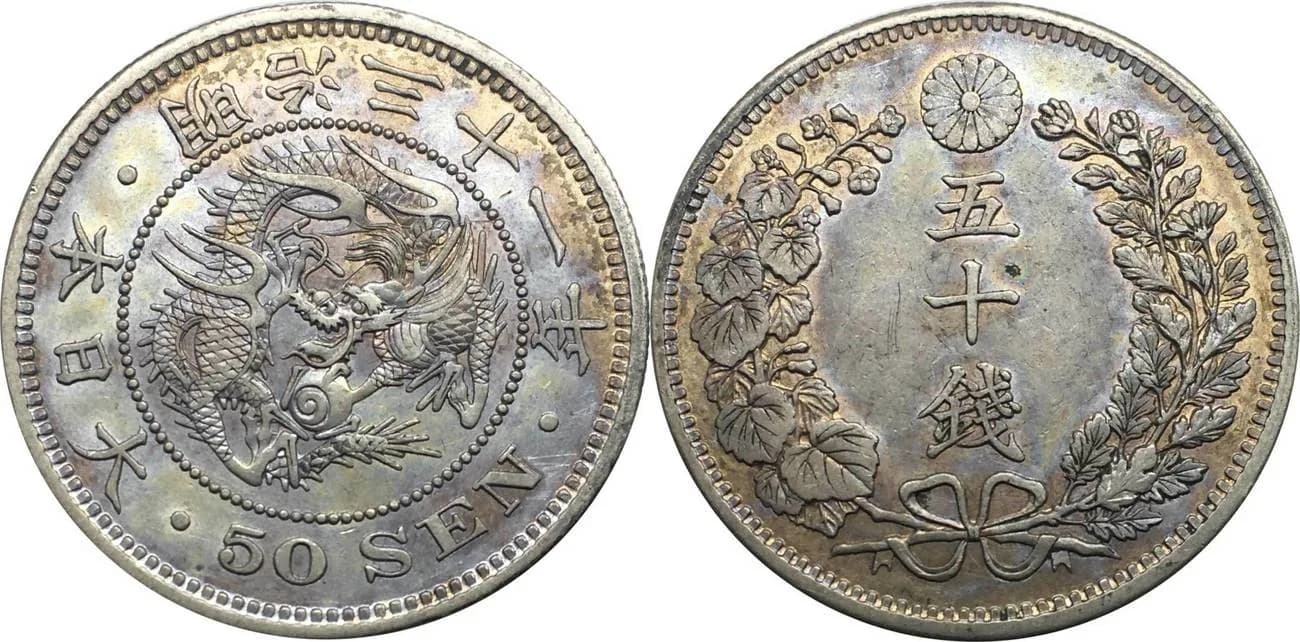
Image: Modern Japanese coinage / The government of the Empire of Japan. / Wikimedia Commons / Public domain(source)
Chikusen Jowi no Rei — An Ancient Japanese Attempt to Spread Currency
Wadō 4 (711): An Unprecedented System to Promote Currency Use
Subject coin: 蓄銭叙位令
Overview
In Wadō 4 (711), the Japanese court issued the 'Chikusen Jowi no Rei', a system aimed at spreading the use of currency. This policy was unprecedented as it involved granting official ranks to those who accumulated a certain amount of coins, such as granting the rank of Jushichiinojo to those who saved 10 kan or more. The background of this system was Japan's attempt to introduce a monetary economy under the influence of China at the time. However, the impact was limited, and it was effectively abolished by the mid-Nara period. The Chikusen Jowi no Rei is an example of trial and error in the circulation of money in ancient Japan, and exploring its historical significance is important for understanding modern monetary systems. The complex background of the Nara period's monetary economy is explained in detail in Overview and Charm of Ancient Coinage.
Specifications
- Denomination
- 不明(諸説あり)
- Minting period
- 和銅4年〜奈良中期(711-760年)
- Metal composition
- 銅
- Weight
- 不明(諸説あり)
- Dimensions
- 不明(諸説あり)
- Mintage
- 不詳(諸説あり)
- Mint supervisor
- 不詳
- Market price
- 市場価値は不明(諸説あり)
Chapter 1: Background of Wadō 4 — Politics and Economy
Image: Modern Japanese coinage / Coindesmonnaies / Wikimedia Commons / CC BY-SA 4.0(source)
In Wadō 4 (711), the Japanese court enacted a new system, the 'Chikusen Jowi no Rei'. At that time, Japan was heavily influenced by China's Tang Dynasty and was establishing a centralized government system based on the ritsuryō system. The spread of a currency-based economy was considered an important measure to strengthen the nation's economic foundation. However, money was not yet widespread in Japan, and bartering was the mainstream. Thus, the spread of a monetary economy was extremely difficult, leading the court to enact the Chikusen Jowi no Rei to encourage the accumulation of money.
In this system, an unprecedented method was adopted where official ranks were granted to those who accumulated a certain amount of coins, such as granting the rank of Jushichiinojo to those who collected 10 kan or more. The introduction of such a system aimed to promote the distribution of money and stimulate economic activity. However, in reality, the system did not function as desired, and many citizens could not save money. The limited effectiveness of the Chikusen Jowi no Rei is evident as it was virtually abolished by the mid-Nara period. For more about the political and economic conditions at the time, refer to Detailed Explanation of Wadōkaichin.
Chapter 2: Establishment and Background of Chikusen Jowi no Rei
Image: Modern Japanese coinage / Coindesmonnaies / Wikimedia Commons / CC BY-SA 4.0(source)
The establishment of the Chikusen Jowi no Rei in Wadō 4 (711) was a crucial moment in early Nara period Japan. During this period, Japan was adopting many cultural and technological elements from China's Tang Dynasty. The introduction of a monetary economy was part of this trend. However, Japanese society was not yet accustomed to using money, and bartering was still prevalent, making the spread of a monetary economy challenging.
Amidst these circumstances, the court issued the Chikusen Jowi no Rei as a policy to forcibly propagate a monetary economy. The policy aimed to encourage the accumulation of money, ultimately invigorating economic activity. Specifically, it involved granting official ranks to those who accumulated a certain amount of coins, with a regulation that those who saved 10 kan or more would receive the rank of Jushichiinojo.
The policy was based on the belief that using money would strengthen the nation's economic foundation and support a centralized state system. However, the system failed to achieve the expected results, as many people were unable to save money. As a result, the Chikusen Jowi no Rei was effectively abolished by the mid-Nara period. For more on the ancient Japanese monetary system, refer to Overview and Charm of Ancient Coinage.
Chapter 3: Impact of Chikusen Jowi no Rei and Public Response
Image: Modern Japanese coinage / Coindesmonnaies / Wikimedia Commons / CC BY-SA 4.0(source)
The Chikusen Jowi no Rei was issued in the early Nara period to promote a currency-based economy. However, its effects were limited, and for many people, it became an unattainable goal. Accumulating 10 kan or more was extremely difficult for commoners at the time, and the system only benefited a segment of the wealthy.
While the amount of currency in circulation increased under this system, bartering remained dominant, and it did not lead to an activation of economic activities. Additionally, some people resorted to fraud to accumulate money for seeking official ranks, resulting in rampant dishonest practices. This led to a decline in the trust of the Chikusen Jowi no Rei, and many people became skeptical of the system.
Consequently, the Chikusen Jowi no Rei was effectively abolished by the mid-Nara period. Although it aimed to spread currency-based economy, its actual impact was limited and caused numerous issues. Nevertheless, the policy represents an example of trial and error in ancient Japan's monetary system, highlighting its historical significance. For the impact of the Chikusen Jowi no Rei, refer to Types and Identification of Holed Coins.
Chapter 4: The Abolition of Chikusen Jowi no Rei and Its Influence on Later Generations
Image: Modern Japanese coinage / Coindesmonnaies / Wikimedia Commons / CC BY-SA 4.0(source)
The Chikusen Jowi no Rei was effectively abolished by the mid-Nara period. The background to this includes the limited effectiveness of the policy and the widespread occurrence of fraudulent activities. Despite aiming to propagate a currency-based economy, the system did not achieve the desired results.
After the abolition of the Chikusen Jowi no Rei, Japan attempted anew to spread a monetary economy through different methods. In the Heian period, the Fujiwara clan issued its own currency, aiming for further propagation of a monetary economy. However, these attempts also had limited effects, failing to achieve a complete spread of currency economy.
Nevertheless, the Chikusen Jowi no Rei stands as an example of trial and error in ancient Japan's monetary system, with its influence extending into later generations. The policy provided lessons that influenced the formation of modern monetary systems. Following its abolition, Japan endeavored to introduce a more complex currency economy. Refer to Types and Market Trend of Koban for insights on the legacy of the Chikusen Jowi no Rei.
Value & Rarity
No specific coins related to the Chikusen Jowi no Rei exist today, but the system itself is of great historical interest. As an example of trial and error in the monetary system of ancient Japan, its value is highly regarded from an academic standpoint. In today's market, there are almost no direct items related to the Chikusen Jowi no Rei, hence they are rarely traded. However, literature and historical materials related to this system occupy an important position in the study of ancient Japan's monetary economy, thus possessing high scholarly value and attracting attention among researchers and history enthusiasts. Understanding the background of the Chikusen Jowi no Rei aids in considering the origins of modern monetary systems, making its historical significance particularly substantial. For an overview of ancient currency, refer to Value and Identification of Modern Currency.
Conclusion
The Chikusen Jowi no Rei was one of the policies in ancient Japan's attempt to propagate a currency-based economy, with significant historical importance. The system, unprecedented in its approach to promote currency circulation by awarding ranks to those who accumulated a certain amount of money, had limited effects and raised numerous issues. Nevertheless, this policy represents an example of trial and error within the ancient Japanese monetary system, influencing later generations. Studying the history of the Chikusen Jowi no Rei helps in understanding the formation process of modern monetary systems. History repeats itself, and past lessons serve as important guides in shaping future policies. Therefore, it is crucial to continue learning from history to improve contemporary monetary systems.
Related Stories
Naga-nen Taihō — Tracing the History of Ancient Coinage
The 7th coin of the Kōchō jūni-sen, issued in Shōwa 15 (848) during the reign of Emperor Ninmyō. From this time, the gap between the actual and nominal value of coins became serious.
Coin StoryFuhonsen — Solving the Mystery of the Oldest Coin from the Asuka Period
Japan's oldest circulating currency unearthed in Nara, Asuka
Coin StoryFuhon-sen — Tracing the History of Ancient Coins
In 1999, excavations in Asuka unearthed 'Japanese coins older than Wadōkaichin'. Why was Fuhon-sen made and why was it forgotten?
Dealers
Dealers Handling This Category
A reference when considering a sale or appraisal. All are dealers and auction houses with a proven track record.
Japan Coin Auction (JCA)
Tokyo
Holds regular auctions with reliable hammer price data, making it a useful resource for tracking market values. Caters to a wide range of collectors from beginners to advanced buyers.
Ginza Coins
Ginza, Chuo-ku, Tokyo
One of Japan's most established numismatic dealers. The scale and variety of their regular auctions is among the largest in the country. Their catalogs are considered a benchmark for market pricing.