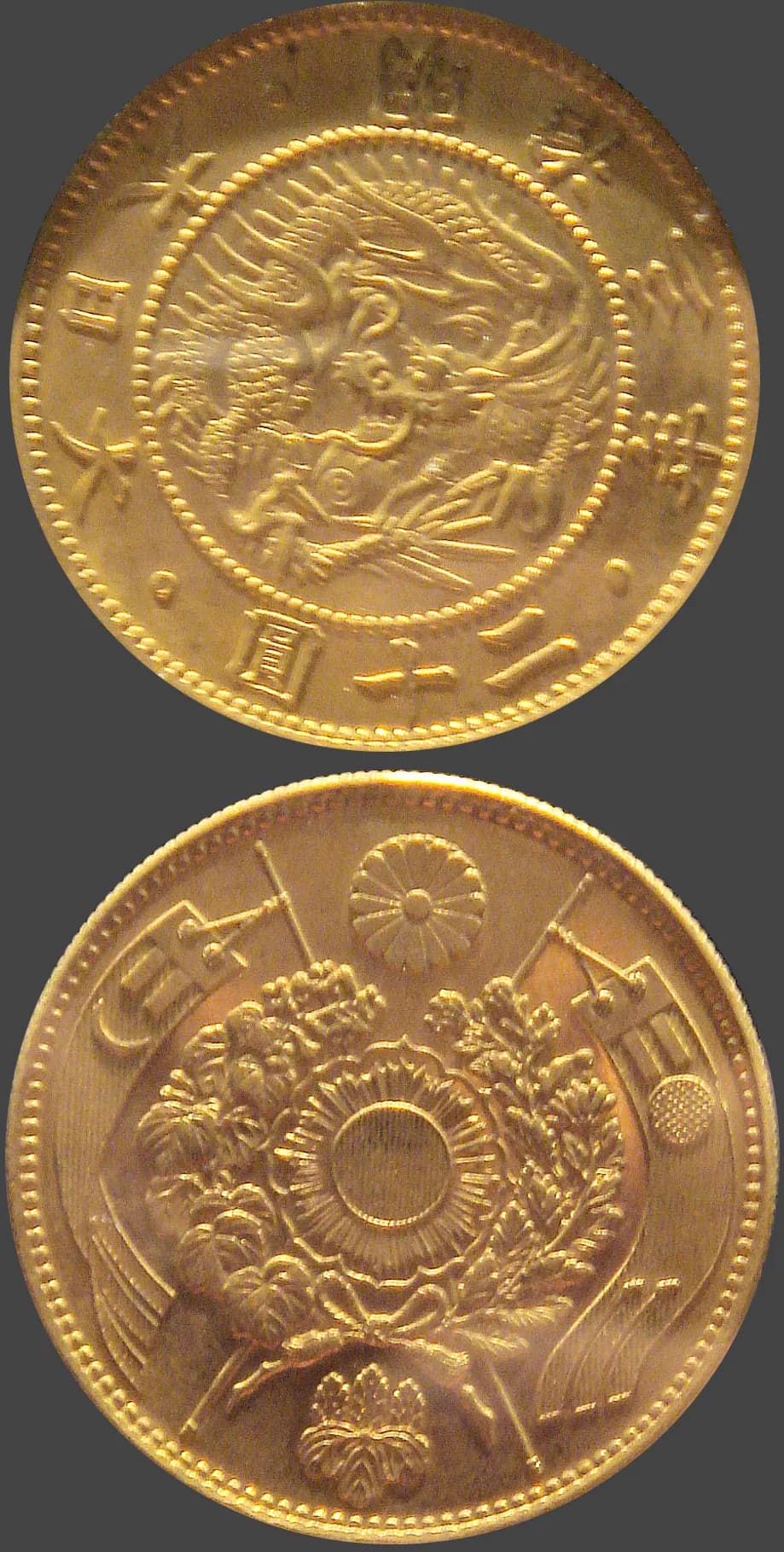
Image: Modern Japanese coinage / PHGCOM / Wikimedia Commons / CC BY-SA 3.0(source)
Bunsei Chōgin (文政丁銀) — The Economic Shadow Closing In on the End of Edo
How the Bunsei Chōgin, with Its Roughly 36% Silver Purity, Laid Bare the Shogunate's Fiscal Crisis
Subject coin: 文政丁銀
Overview
The Bunsei Chōgin (文政丁銀) emerged against the backdrop of a severe fiscal crisis gripping the shogunate in the closing years of the Edo period. In Bunsei 2 (1819), the shogunate drastically reduced the silver content from approximately 80% — the standard of the Keichō Chōgin (慶長丁銀) — down to about 36%, embarking on a recoinage to shore up its finances. This recoinage, carried out in conjunction with the simultaneous debasement of the Bunsei Koban (文政小判), had a profound impact on merchants of the day. The monetary system of the Edo period was intricately intertwined through trade silver at Nagasaki and the minting operations of the Gold Mint (金座) and Silver Mint (銀座). The appearance of the Bunsei Chōgin was part of the shogunate's attempt to maintain monetary credibility even at the cost of silver purity, as it struggled to sustain its finances. Looking back at the details of Edo silver coinage and the details of the Keichō Koban (慶長小判) brings this background into sharper relief. The Bunsei Chōgin eventually vanished from history with the transition to the Tenpō Chōgin (天保丁銀) in Tenpō 8 (1837), yet its effects lingered long in the Japanese economy.
Specifications
- Denomination
- 1丁銀
- Minting period
- 文政2年〜天保8年(1819-1837年)
- Metal composition
- 銀約36%(貨幣博物館 常設展示図録)
- Weight
- 不定(秤量貨幣)
- Dimensions
- 不定形
- Mintage
- 不詳(諸説あり)
- Mint supervisor
- 不詳(幕府鋳造所)
- Market price
- 5万円〜30万円(状態による)
Chapter 1: The Bunsei Recoinage — A Painful Choice for the Shogunate
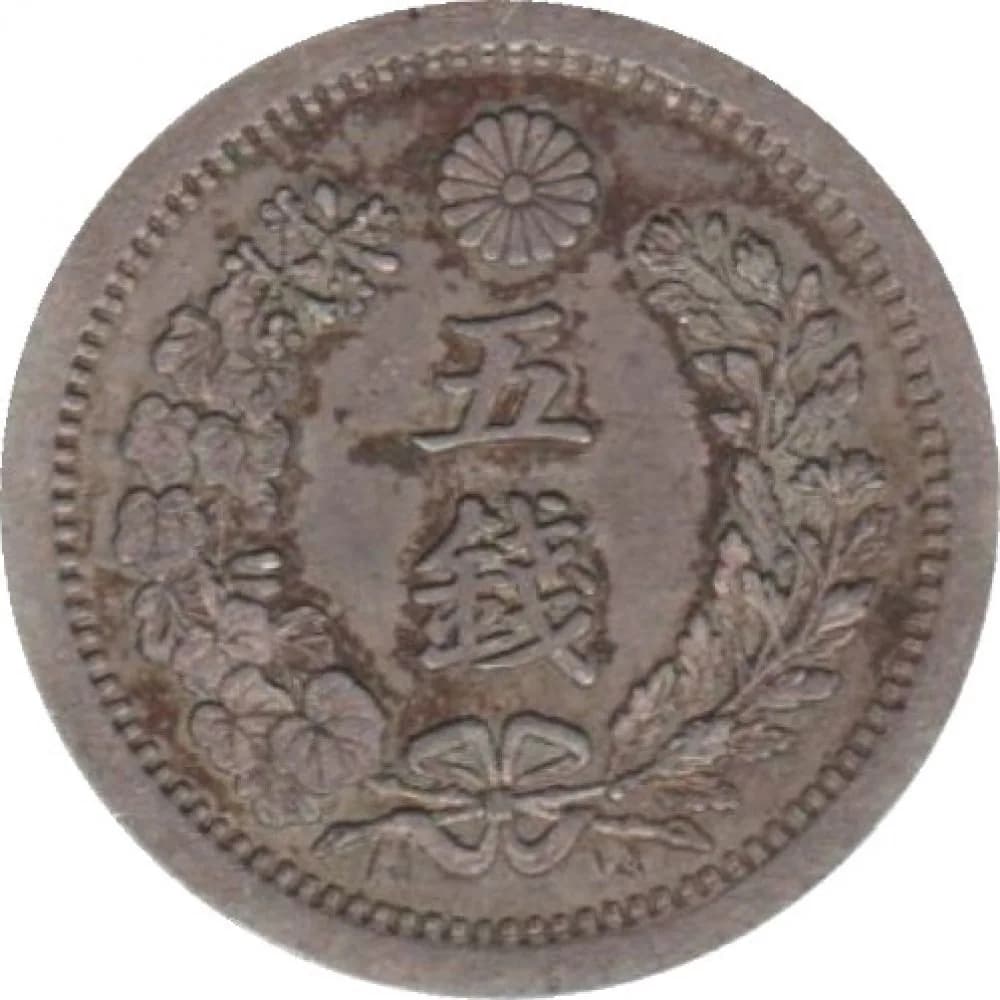
Image: Modern Japanese coinage / Coindesmonnaies / Wikimedia Commons / CC BY-SA 4.0(source)
In 1819, Bunsei 2, the shogunate issued the Bunsei Chōgin. The backdrop was the severe fiscal deficit the Edo shogunate was carrying at the time. In the latter part of the Edo period, well before the Tenpō Reforms began, the shogunate's finances had been deteriorating, and the outflow of silver from within Japan had become a particular problem. With silver growing scarce due to the effects of trade, the shogunate devised a strategy of reducing the purity of other gold and silver coins in order to increase revenue. The silver purity of the Bunsei Chōgin stood at about 36% (per the Currency Museum catalog), a figure that represented a dramatic drop from the approximately 80% of the Keichō Chōgin. The shogunate sought to stabilize the economy by tightening its control over the Gold and Silver Mints and increasing minting volumes, but this policy brought only short-term fiscal improvement. What the shogunate faced was the formidable challenge of maintaining the economy without forfeiting public trust. Minting operations at the Silver Mint magistracy (銀座奉行所) had reached the limits of available refining technology, and many craftsmen confronted that difficulty head-on. Although the Bunsei Chōgin resembled the Keichō Chōgin in appearance, its weight and purity differed markedly, and the trust of merchants began to waver. In this way, the Bunsei recoinage was carried out as part of the shogunate's fiscal policy, yet it also served to create new sources of economic instability.
Chapter 2: The Reality of Minting — The Shogunate's Behind-the-Scenes Circumstances
Image: Modern Japanese coinage / Coindesmonnaies / Wikimedia Commons / CC BY-SA 4.0(source)
Minting of the Bunsei Chōgin was conducted primarily at the Silver Mint magistracy in Edo. There, craftsmen worked day and night on the refining of silver. In the production process of the Bunsei Chōgin, work proceeded according to mixing ratios directed by the shogunate, adding copper and lead to silver to lower its purity. This work was extremely difficult given the technical standards of the day, and many artisans spent their days in repeated trial and error. In order to maintain silver purity while reducing costs, they repeatedly reviewed their raw materials. What emerged from this process was the distinctive composition of the Bunsei Chōgin, resulting in a silver purity reduced to about 36%. This was a figure less than half of the approximately 80% high purity that the Keichō Chōgin had boasted, representing the culmination of monetary debasement stretching back to the early Edo period. The Bunsei recoinage of Bunsei 2 (1819) was also linked to the concurrent debasement of the Bunsei Koban, and with both gold and silver coinage losing value simultaneously, it dealt a double blow to the Kamigata economy. Money-changers and merchants in Osaka were confronted by sudden swings in the gold-silver exchange rate and found themselves compelled to question the very reliability of the currency that served as the standard for their transactions. Although silver supply did increase as a result, monetary credibility declined and it became a factor destabilizing silver exchange rates in the market. Minting at the Silver Mint magistracy played an important role as part of the shogunate's economic policy, but behind it lay much hardship and inner conflict. There was also a deceptive aspect: while the coin retained an external shape closely resembling the Keichō Chōgin, it was substantially inferior in both weight and purity — a circumstance that, according to various theories, is said to have made it difficult for the general public to distinguish between the two. The Bunsei Chōgin subsequently circulated as the primary silver coin supporting shogunate finances for approximately 18 years, until the Tenpō Chōgin was minted and put into circulation in Tenpō 8 (1837). The technicians of the day endeavored to meet the shogunate's exacting demands while striving to contribute to economic stability.
Chapter 3: Impact on the Economy — The Reaction of Kamigata Merchants
Image: Modern Japanese coinage / Coindesmonnaies / Wikimedia Commons / CC BY-SA 4.0(source)
The appearance of the Bunsei Chōgin delivered a severe shock to merchants. In particular, the Kamigata merchants of Osaka, then the economic center of Japan, harbored deep misgivings about this debasement of the currency. They conducted their commercial transactions using the Keichō Koban and Keichō Chōgin as benchmarks and took issue with the fact that the value of the Bunsei Chōgin was markedly inferior by comparison. Whereas the silver purity of the Keichō Chōgin had stood at approximately 80%, the Bunsei Chōgin issued through the recoinage of Bunsei 2 (1819) had seen its purity fall to a mere 36% or so — less than half. Moreover, the Bunsei Koban issued at the same time also underwent debasement, making it a double blow to the Kamigata economy as both gold and silver coinage deteriorated simultaneously. After the Bunsei Chōgin entered circulation, merchants struggled with how to set its exchange rate. Because its outward appearance closely resembled the Keichō Chōgin, verifying weight and stampings anew upon receipt became necessary, and it is said that confusion spread even at Osaka trading venues including the Dōjima Rice Exchange (堂島米会所). In the market, the value of silver grew unstable and price fluctuations became frequent. In the Edo market as well, commodity prices rose and directly affected the lives of ordinary people. Specifically, prices of daily necessities such as rice and cloth soared, and the lives of commoners fell into dire straits. The shogunate attempted to stabilize the situation by fixing currency exchange rates, but could not dispel the distrust among merchants and ended up increasing the instability of the economy as a whole. Such turmoil continued for approximately 18 years until the transition to the Tenpō Chōgin in Tenpō 8 (1837), and among various theories there exists the view that this situation was not unrelated to social unrest exemplified by the Ōshio Heihachirō Rebellion (大塩平八郎の乱) of Tenpō 8 (1837). In this way, the Bunsei Chōgin came to symbolize the failure of the shogunate's fiscal policy, transcending its role as mere currency. The reaction of merchants exceeded the shogunate's intentions and became the trigger for a major destabilization of the economic framework.
Chapter 4: Impact on Posterity — The Transition to the Tenpō Chōgin and Its Assessment
Image: Modern Japanese coinage / Coindesmonnaies / Wikimedia Commons / CC BY-SA 4.0(source)
In 1837, Tenpō 8, the shogunate carried out another currency recoinage, transitioning from the Bunsei Chōgin to the Tenpō Chōgin. The Tenpō Chōgin was issued as an attempt to raise silver purity once again, and behind this lay the various problems that had been exposed by the Bunsei Chōgin. Through this recoinage the shogunate attempted to restore trust, but among merchants a deep sense of distrust had already taken hold. The issuance of the Tenpō Chōgin brought a temporary calming of market confusion, but no fundamental resolution was achieved. The shogunate's monetary policy continued to lose credibility through the repeated recoinages that had been carried out. Later historians have frequently viewed the failure of the Bunsei Chōgin as a symbolic event in the shogunate's decline. As a result, Japan's monetary system was compelled to undergo major reform on the road toward modernity. From the end of the Edo period through the Meiji Restoration, Japan became incorporated into the international economic sphere as imports and exports increased. In this process, the lessons learned from the experience of the Bunsei Chōgin and Tenpō Chōgin were put to use in the construction of a modern monetary system. By comparing these historical backgrounds with the details of Edo silver coinage, one can gain an understanding of the impact of monetary policy of the era.
Value & Rarity
The market value of the Bunsei Chōgin depends greatly on condition and rarity. Specimens in particularly good states of preservation are frequently highly regarded among collectors, and it is not uncommon for them to change hands at auction for anywhere from 50,000 yen to over 300,000 yen. The Bunsei Chōgin is a symbolic presence in the monetary policy of the late Edo period, and its historical background constitutes its appeal to collectors. By understanding the basics of antique coin auctions in particular, one can grasp market trends and changes in value over time. The Bunsei Chōgin was issued as part of the shogunate's fiscal policy, yet its influence has been passed down through the generations as a lesson in economic policy. In recent years the market has seen a trend toward reassessment of late-Edo coinage, and the Bunsei Chōgin is no exception. By collecting coins of this era, collectors can acquire a piece that embodies the economic history of the late Edo period.
Related Guide: Details on Chōgin and Mameitagin (丁銀・豆板銀)
Conclusion
The Bunsei Chōgin is not merely a coin; it is a precious historical document that tells the story of the shogunate's fiscal policy failures and their consequences. With its silver purity having fallen to about 36%, this chōgin symbolizes the severity of the fiscal problems the shogunate faced. The reaction of merchants in circulation and the subsequent transition to the Tenpō Chōgin provide important historical lessons showing how Japan's monetary system walked the path toward modernization. The Bunsei Chōgin continues to attract the attention of collectors even in today's market, valued for its historical worth. This coin, which played a part in history, will continue to tell its story across the ages.
Related Stories
Ansei Chōgin — The Final Edo Era Silver Bullion Coin amidst the Turbulence of the Bakumatsu
A Short-lived yet Historical Silver Bullion Created Amidst the Turmoil of Opening Japan
Coin StoryAnsei Nibus Gin — A Silver Coin Born Amidst Port Opening and Fiscal Crisis
The Role of Subsidiary Silver Coins Issued in the Turbulent Closing Years of the Edo Period
Coin StoryBunkyū Eiho and the End of the Gold Coin System — Tracing the History of Edo Gold Coins
Bunkyū 2 (1862) marks the final currency reform of the shogunate, with a gold coin series issued alongside the Bunkyū Eiho (copper coins) as a symbol of late shogunate monetary chaos
Dealers
Dealers Handling This Category
A reference when considering a sale or appraisal. All are dealers and auction houses with a proven track record.
Japan Coin Auction (JCA)
Tokyo
Holds regular auctions with reliable hammer price data, making it a useful resource for tracking market values. Caters to a wide range of collectors from beginners to advanced buyers.
Ginza Coins
Ginza, Chuo-ku, Tokyo
One of Japan's most established numismatic dealers. The scale and variety of their regular auctions is among the largest in the country. Their catalogs are considered a benchmark for market pricing.
Osaka Numismatic Auction
Osaka
A Kansai-based coin auction house with particular strength in regional and hole coins.