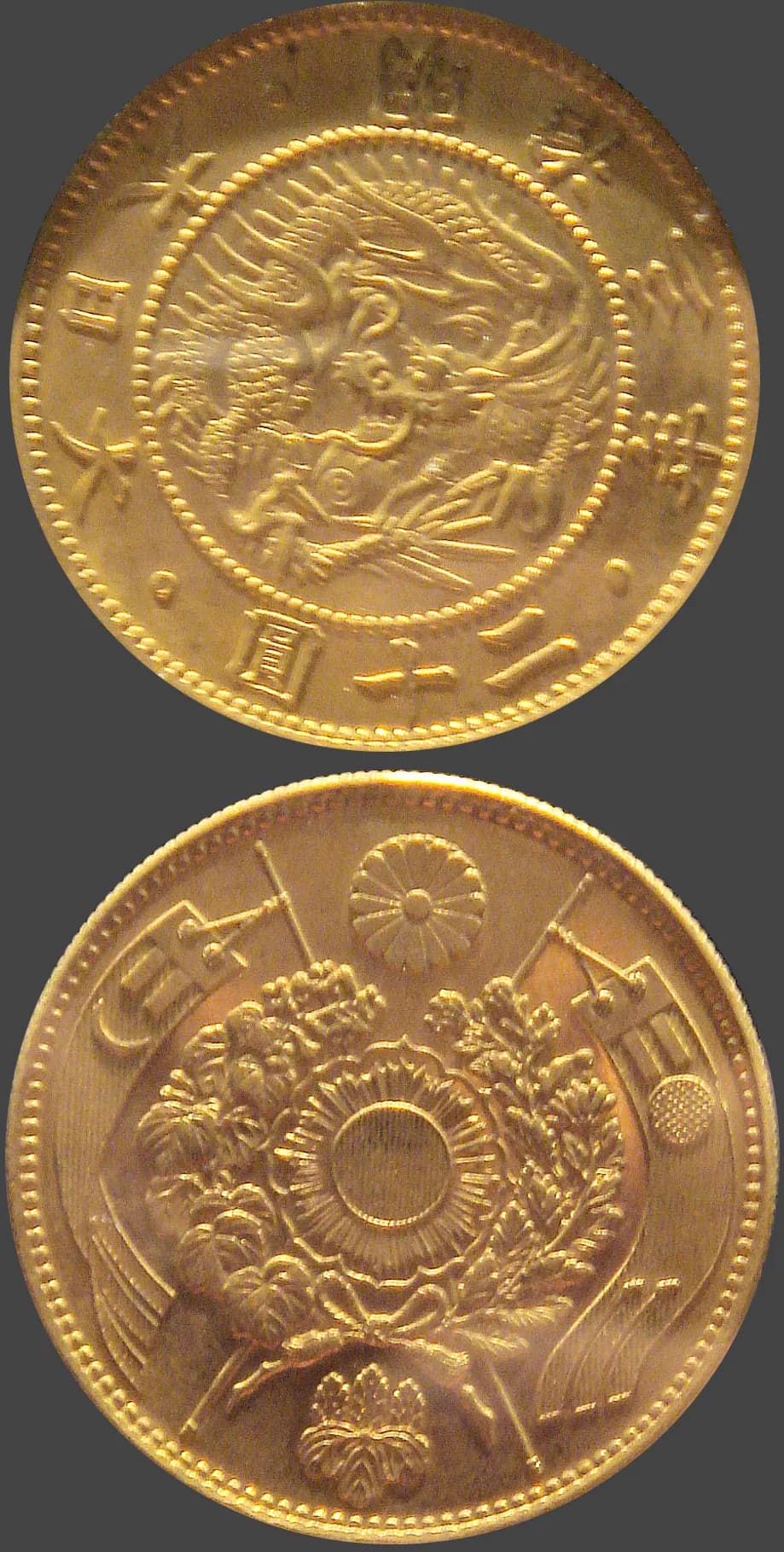
Image: Modern Japanese coinage / PHGCOM / Wikimedia Commons / CC BY-SA 3.0(source)
Tenpō Ichibugin — Bakufu's Last-ditch Effort in a Tumultuous Era
A silver coin aimed to overcome the financial crisis amid the Ōshio Heihachirō Rebellion and the Tenpō Famine
Subject coin: 天保一朱銀
Overview
The Tenpō Ichibugin is a silver coin issued in 1837 against the backdrop of the Bakufu's financial crisis. That year, the Ōshio Heihachirō Rebellion broke out, highlighting societal instability. The Bakufu opted to reduce the coin's silver content and produce it in large quantities to replenish finances. As the Tenpō Famine persisted, this silver coin played a vital role in supporting the common people's lives. However, with declining silver value and rising prices, interest grew in the details of Edo silver coins. The Tenpō Ichibugin is often compared to the later Ansei Ichibugin and is discussed as part of the late Edo currency policy. From these circumstances, the Tenpō Ichibugin holds historical significance beyond mere currency.
Specifications
- Denomination
- 一朱
- Minting period
- 天保8年〜安政元年(1837-1854年)
- Metal composition
- 銀(純度低)
- Weight
- 不詳(諸説あり)
- Dimensions
- 不詳(諸説あり)
- Mintage
- 不詳(諸説あり)
- Mint supervisor
- 後藤家(銀座)/ 不詳
- Market price
- 5,000円〜50,000円(状態による)
Chapter 1: Financial Crisis of the Bakufu and Birth of the Tenpō Ichibugin
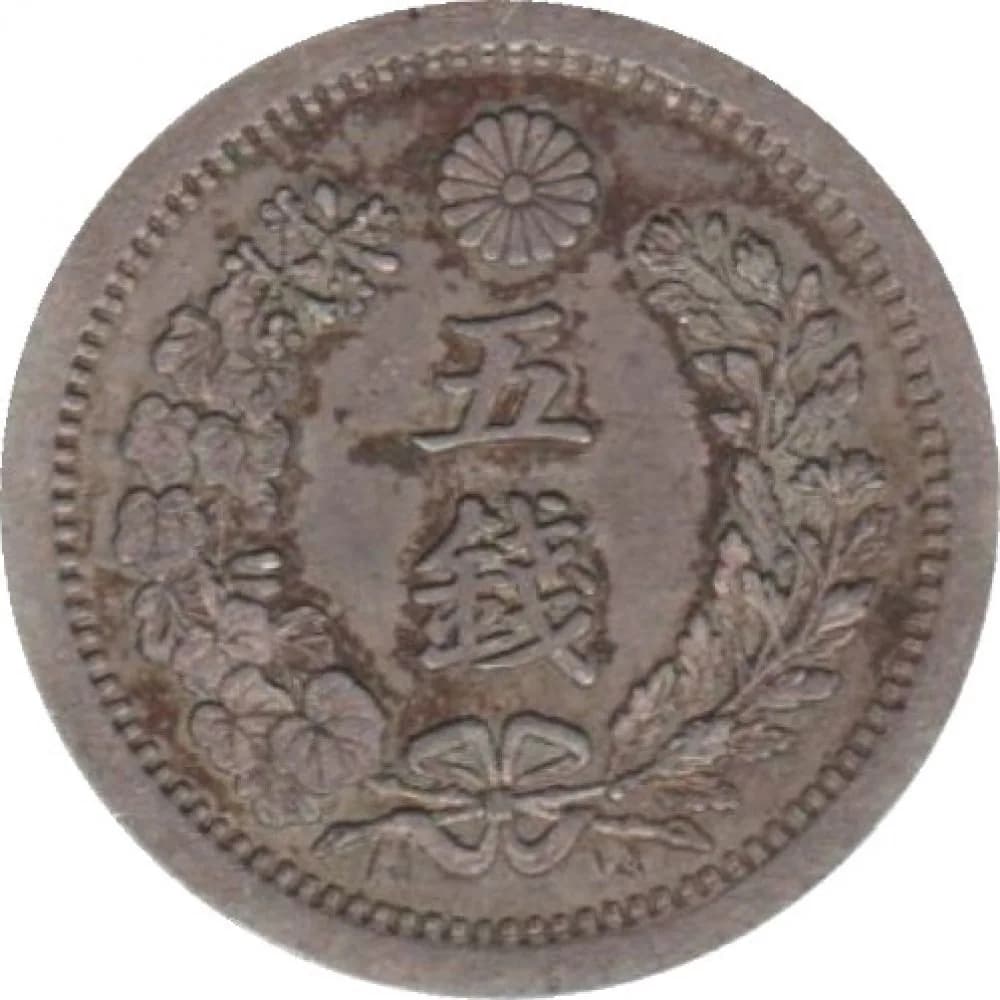
Image: Modern Japanese coinage / Coindesmonnaies / Wikimedia Commons / CC BY-SA 4.0(source)
In the early 1830s, the Edo Bakufu faced a severe financial crisis. During this period, as attention turned to the types and identification of Edo gold coins, the Bakufu decided to issue silver coins. The Tenpō Ichibugin, issued in 1837, Tenpō 8, emerged in this context. That year, the Ōshio Heihachirō Rebellion erupted in Osaka, manifesting dissatisfaction with Bakufu policies. Although the rebellion was suppressed, the Bakufu's prestige was severely shaken, necessitating social stability. The then-regent, Mizuno Tadakuni, decided to issue new currency to restructure finances, but with limited silver supply, reducing its purity was unavoidable. Amid the ongoing Tenpō Famine, it was crucial to take measures to support common people's lives, and the Tenpō Ichibugin was tasked with that role. The Bakufu's decision was both an effort to stabilize society and a last-ditch effort to refill finances. Given the era's circumstances, the Tenpō Ichibugin is seen not merely as a currency but as a reflection of the challenges faced by that era. Understanding the necessity of the Tenpō Ichibugin during the period from Tenpō 8 to Ansei 1 (1837-1854) deepens appreciation of its significance.
Chapter 2: Minting and Technology of the Tenpō Ichibugin
Image: Modern Japanese coinage / Coindesmonnaies / Wikimedia Commons / CC BY-SA 4.0(source)
The minting of the Tenpō Ichibugin was carried out at the Ginza in Edo. The influential Gotō family was responsible for the design and minting of this coin. The Gotō family, a prestigious lineage, had been involved in the Bakufu's coin minting for years and was highly valued for their technical expertise. However, given the 1837 context, using high-purity silver was challenging; thus, low-purity silver was chosen for financial replenishment. Maintaining silver coin purity was typically important, yet the financial crisis necessitated this decision. The minting process demanded efficient mass production, in addition to existing techniques. The Tenpō Ichibugin had the inscription "一朱銀" on its surface, and its reverse bore the "銀座" seal. These inscriptions form a part of traditional Japanese currency design, as seen in overview and appeal of ancient coins. The minting of the Tenpō Ichibugin marked a turning point in Edo period currency policy and symbolized the Bakufu's financial reconstruction plan. The traces of craftsmanship from the period found in the Tenpō Ichibugin serve as crucial clues in modern authentication and lineage assessments.
Chapter 3: Circulation of the Tenpō Ichibugin and the Commoner's Life
Image: Modern Japanese coinage / Coindesmonnaies / Wikimedia Commons / CC BY-SA 4.0(source)
The Tenpō Ichibugin began circulating in 1837 during the ongoing Tenpō famine. Many rural areas suffered poor harvests, leading to a spike in rice prices. Commoners struggled with everyday life, gathering eagerly in markets for any affordable goods. Under such circumstances, the Tenpō Ichibugin became essential in supporting the daily lives of the populace. While some showed interest in the details of Edo silver coins due to its low silver content, its ease of circulation was more critical to commoners. In the market, one bushel of rice exchanged for about 100 mon, with the Tenpō Ichibugin being used routinely. Merchants accepted this coin, cooperating to ensure the flow of goods. However, the low silver value also led to inflation. Dissatisfaction with the Bakufu grew among commoners, who increasingly voiced criticism of the policy. Despite these economic impacts, the Tenpō Ichibugin continued to play its role amidst Bakufu policies and common livelihoods. The movement of the Tenpō Ichibugin in the city was inextricably linked to the lives and prices of the people then, serving as a key to understanding currency history.
Chapter 4: Legacy of the Tenpō Ichibugin
Image: Modern Japanese coinage / Coindesmonnaies / Wikimedia Commons / CC BY-SA 4.0(source)
In 1854, with the issuance of the Ansei Ichibugin, the Tenpō Ichibugin concluded its role. The Ansei Ichibugin, with higher purity than the Tenpō Ichibugin, reflected the slight improvement in Bakufu finances, stabilizing silver coin value and gradually restoring commoner's lives. As currency symbolizing the financial crisis of its time, the Tenpō Ichibugin made its mark for posterity. In the modern era, this silver coin is popular among collectors, praised for its rarity and historical significance. At coin auctions, prices vary significantly based on condition, with well-preserved coins often fetching high prices. The Tenpō Ichibugin is also intriguing to collectors interested in identifying forgeries and processed pieces. Given this context, the Tenpō Ichibugin holds historical significance beyond mere currency, becoming an indispensable piece in understanding the transitions of Edo period currency policy. Looking back from later times, the influence left by the Tenpō Ichibugin quietly breathes within the history of successive currencies and collections. Considering how the Tenpō Ichibugin is valued in today's market fosters a dual perspective of history and valuation.
Value & Rarity
The Tenpō Ichibugin remains notable in the modern coin market. Its value varies greatly depending on condition and rarity, generally trading within 5,000 yen to 50,000 yen. Particularly well-preserved coins attract high prices among collectors interested in historical contexts. Its rarity, evidenced by unknown mint quantities, suggests significant circulation due to mass issuance to counter Bakufu financial crises. In coin auctions, the Tenpō Ichibugin is evaluated based on coin grading standards, with detailed condition assessments. Such market transactions reconfirm the historical value of currency, becoming intriguing subjects for collectors.
Conclusion
The Tenpō Ichibugin emerged amid the Bakufu's financial crisis in the late Edo period. Since its issuance in 1837, it supported common lives and had economic impacts. As a symbol of its historical and financial policy context, its value remains high today. The Tenpō Ichibugin represents more than currency; it bears witness to the evolution of Edo period economic policies. For collectors and history enthusiasts, it offers insights into the tumultuous Bakumatsu period, and its historical significance is unlikely to fade.
Related Stories
Genroku Ichibuban Kin — The Small Gold Coins of Edo That Changed Overnight
The Drastic Drop in Gold Purity of Genroku Ichibuban and Its Impact
Coin StoryThe Genroku Koban — Shigehide Ogiwara's Financial Revolution and the Consequences of the Genroku Bubble
The man who halved the gold content to save the shogunate, and the merits and demerits of his actions
Coin StoryIchibu-gin — The 'Gold-Silver Ratio Trap' Exposed by Unequal Treaties and the Monetary Crisis of the Late Edo Period
The Systematic Outflow of Gold Coins Triggered by the Opening of Ports in 1858, and the Shogunate's Last Resort: The Manen Recoinage
Dealers
Dealers Handling This Category
A reference when considering a sale or appraisal. All are dealers and auction houses with a proven track record.
Japan Coin Auction (JCA)
Tokyo
Holds regular auctions with reliable hammer price data, making it a useful resource for tracking market values. Caters to a wide range of collectors from beginners to advanced buyers.
Ginza Coins
Ginza, Chuo-ku, Tokyo
One of Japan's most established numismatic dealers. The scale and variety of their regular auctions is among the largest in the country. Their catalogs are considered a benchmark for market pricing.
Osaka Numismatic Auction
Osaka
A Kansai-based coin auction house with particular strength in regional and hole coins.