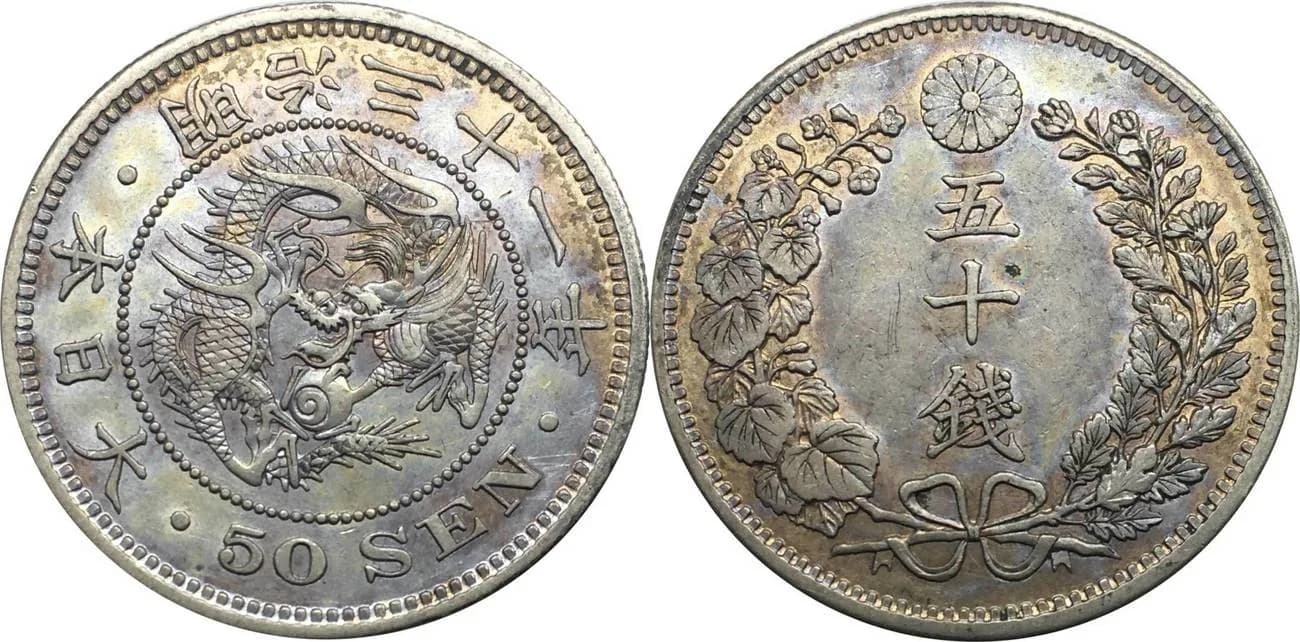
Image: Modern Japanese coinage / The government of the Empire of Japan. / Wikimedia Commons / Public domain(source)
The Mass Influx of Song Coins — Economic Reform in the Late Heian Period and Its Ripple Effects
The Trail of Chinese Copper Coins That Poured Through the Floodgates Opened by Taira no Kiyomori
Subject coin: 宋銭大量渡来
Overview
From the late 12th century into the 13th century, an event unfolded that would profoundly shape Japan's economy and culture. That event was the promotion of Japan–Song trade by Taira no Kiyomori, which caused large quantities of Song coins to flow into Japan. During this period, Japan was actively importing continental culture and technology, and a sweeping transformation took place in the realm of currency in particular. The influx of Song coins filled the "coin void" of nearly 200 years that had followed the discontinuation of the Kōchō Jūnisen (皇朝十二銭). Among Song coins, the Xining Yuanbao (熙寧元宝), Yuanyou Tongbao (元祐通宝), and Yuanfeng Tongbao (元豊通宝) are especially prevalent in excavations, and by the Kamakura period these coins had come to function as de facto legal tender. This flow of copper coins, which sustained the economic conditions of the time and invigorated commercial activity, exerted a major influence on Japan's later monetary system. It is an important chapter for understanding the overview and appeal of ancient coinage.
Specifications
- Denomination
- 不詳(諸説あり)
- Minting period
- 12世紀末〜13世紀
- Metal composition
- 銅
- Weight
- 不詳(諸説あり)
- Dimensions
- 不詳(諸説あり)
- Mintage
- 不詳(諸説あり)
- Mint supervisor
- 不詳
- Market price
- 数千円〜数万円(状態による)
Chapter 1: The Dawn of Japan–Song Trade — The Ambitions of Taira no Kiyomori
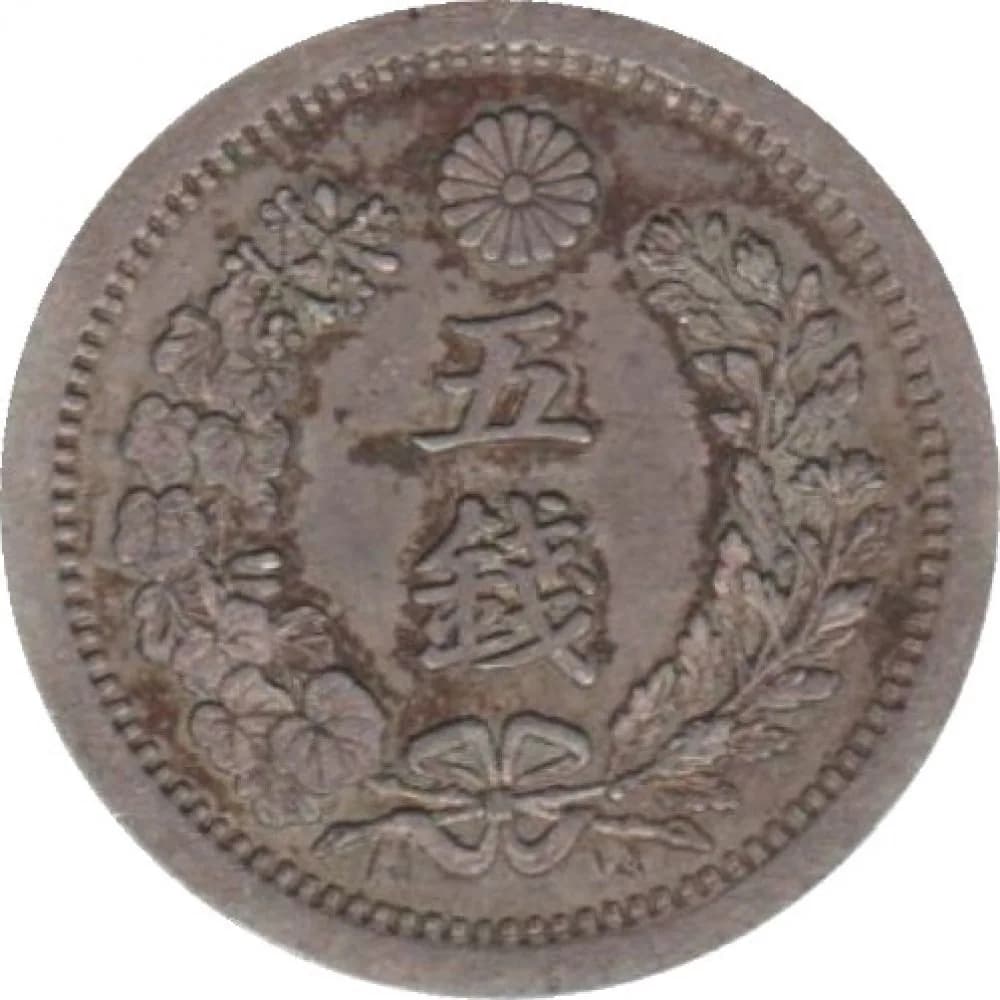
Image: Modern Japanese coinage / Coindesmonnaies / Wikimedia Commons / CC BY-SA 4.0(source)
At the close of the Heian period, Japan's politics and economy were at a major turning point. Taira no Kiyomori (1118–1181), backed by the power of the Taira clan, actively promoted trade with Song-dynasty China. This move was an important strategy for strengthening his political base. In the late 12th century, Kiyomori succeeded in forging close ties with Song China, and as a result, large quantities of Song coins began flowing into Japan. Within Japan, the Kōchō Jūnisen had been discontinued, and a "coin void" lasting 200 years had continued. During this period, barter was the dominant mode of exchange in Japan, and the need for currency was growing. Kiyomori envisioned using Song coins to invigorate the economy. The influx of Song coins included particularly large numbers of the Yuanfeng Tongbao (元豊通宝), Xining Yuanbao (熙寧元宝), and Yuanyou Tongbao (元祐通宝), which would later become established as the practical currency of the Kamakura period. Kiyomori's foreign policy carried great significance not merely as an economic policy but also as part of a broader cultural exchange. The expansion of trade during this period contributed to Japan's political stability and cultural development. A comparison with the detailed account of the Wadō Kaichin (和同開珎) is useful for understanding the evolution of the ancient Japanese monetary system.
Chapter 2: The Minting and Influx of Song Coins — Where Technology and Economy Intersect
Image: Modern Japanese coinage / Coindesmonnaies / Wikimedia Commons / CC BY-SA 4.0(source)
The influx of Song coins represented something beyond mere imported goods. China's minting technology was highly advanced, and its influence on Japan's monetary system was immeasurable. In Song China, copper-smelting technology had developed considerably, and the minting of Song coins demanded sophisticated craftsmanship. The Xining Yuanbao (熙寧元宝; issued 1068–1077), Yuanyou Tongbao (元祐通宝; issued 1086–1094), and Yuanfeng Tongbao (元豊通宝; issued 1078–1085) in particular were crafted with precision down to the finest details. These copper coins were minted in a unified process by the Song central government and maintained a high standard of finish. In Japan, these coins were initially used as a medium of exchange, and subsequently came to function as de facto legal tender during the Kamakura period (1185–1333). Song coins were highly attractive to Japanese merchants and traders, who used these copper coins to engage actively in commerce. Technologically, they exerted a major influence on Japan's minting techniques and would later contribute to the evolution of coinage production in Japan. The changes in currency during this period occupy a historically important position even when compared with later developments in the monetary system.
Chapter 3: The Circulation of Song Coins and Their Economic Impact — The Transformation of the Japanese Economy
Image: Modern Japanese coinage / Coindesmonnaies / Wikimedia Commons / CC BY-SA 4.0(source)
From the late 12th century into the 13th century, Japan's economy underwent a dramatic transformation through Song coins. At the time, barter was the dominant mode of exchange in Japan, but the influx of Song coins caused a monetary economy to advance rapidly. During the Kamakura period, Song coins functioned as de facto legal tender, and commercial and agricultural transactions became more active. In major cities such as Kyō and Kamakura in particular, transactions using Song coins were conducted as a matter of daily life, which spurred the development of commerce. Prices also stabilized through the circulation of Song coins, and merchants engaged in vigorous trading using these copper coins. During this period, a stabilization of prices benchmarked against Song coins was evident; the prices of goods such as rice and cloth were kept relatively consistent. As a result, the lives of ordinary people stabilized as well, and economic activity became more vigorous. Furthermore, the influx of Song coins provided a standard of monetary value and exerted a major influence on Japan's later monetary system. The economic transformation of this period is an important element for understanding historical significance even when compared with later periods in monetary history. The movement of this mass influx of Song coins in circulation was inseparably linked to the daily lives of people of the time and to prices, and it provides a key to reading monetary history. The very reactions to how the mass influx of Song coins was accepted or alternatively shunned speak to the economic realities of the age.
Chapter 4: Influence on Later Ages and Historical Assessment — The Legacy of Song Coins
Image: Modern Japanese coinage / Coindesmonnaies / Wikimedia Commons / CC BY-SA 4.0(source)
The influx of Song coins exerted an enormous influence on Japan's subsequent monetary system. During the Kamakura period, Song coins functioned as de facto legal tender, but their influence extended even into the Muromachi and Edo periods. Song coins laid the foundation of Japan's monetary system and influenced later minting techniques and economic policy as well. For example, it is said that the monetary policy of the Edo period took reference from the economic stability based on the circulation of Song coins. Furthermore, Song coins established a standard of monetary value in Japan and contributed to the development of a monetary economy in later times. Even today, Song coins attract the attention of many researchers for their historical significance and are highly popular among collectors of old coins. The history of Song coins is an indispensable element for understanding the evolution of Japan's monetary system, and their influence connects to later developments in coinage as well. Looking back from later ages, the influence left by the mass influx of Song coins lives on quietly in the history of successor currencies and collecting. Considering how the mass influx of Song coins is evaluated in today's market leads to the cultivation of an eye that sees both history and market value. The more one knows the background history, the more the depth of value unique to the mass influx of Song coins — a depth that cannot be measured by market figures alone — comes into view.
Value & Rarity
Song coins are very popular among old-coin collectors due to their historical background. Items in particularly good condition with high historical value are often traded at high prices. In the market, prices vary widely depending on condition and type, and transactions in the range of several thousand to tens of thousands of yen are common. The rarity of Song coins is seen especially in types such as the Xining Yuanbao (熙寧元宝), Yuanyou Tongbao (元祐通宝), and Yuanfeng Tongbao (元豊通宝). While excavated numbers of these are high, items in good condition are few, making them precious to collectors. Market transactions are often conducted through old-coin auctions and specialized old-coin dealers, and a basic knowledge of old-coin auctions is useful in these settings. A collection of Song coins is a deeply interesting subject for learning the history of Japan's monetary system, and their value is expected to continue rising.
Conclusion
The influx of Song coins brought a revolution to Japan's monetary system and exerted a major influence on subsequent economic development. These copper coins, brought about by Taira no Kiyomori's policy, functioned as de facto legal tender during the Kamakura period and supported the development of Japan's commerce and culture. Moreover, the minting technology and circulation methods of Song coins influenced Japan's later monetary system, and their legacy continues to the present day. This historical event carries meaning beyond the mere influx of currency and symbolizes the diversity and creativity of Japanese culture. Looking back on the history of Song coins will serve as an important key to understanding Japan's economic history.
Related Stories
Kan'ei Tsūhō — "Japan's Longest-Lived Coin" in Circulation for 230 Years
The history of the hole coin that continued to be used from the unification of Edo coinage in Kan'ei 13 (1636) to Meiji
Coin StoryKōchō Jūnisen — The Dream and Reality of the Ritsuryō State
The Rise and Fall of an Ancient State Over 250 Years of History
Coin StoryChōsen Tsūhō — The Mission of the Imported Coin that Filled 600 Years of Coin Blank in Japan
From the Muromachi to Sengoku Period, the Foreign Copper Coin that Crossed the Sea and Moved the Japanese Market
Dealers
Dealers Handling This Category
A reference when considering a sale or appraisal. All are dealers and auction houses with a proven track record.
Japan Coin Auction (JCA)
Tokyo
Holds regular auctions with reliable hammer price data, making it a useful resource for tracking market values. Caters to a wide range of collectors from beginners to advanced buyers.
Ginza Coins
Ginza, Chuo-ku, Tokyo
One of Japan's most established numismatic dealers. The scale and variety of their regular auctions is among the largest in the country. Their catalogs are considered a benchmark for market pricing.