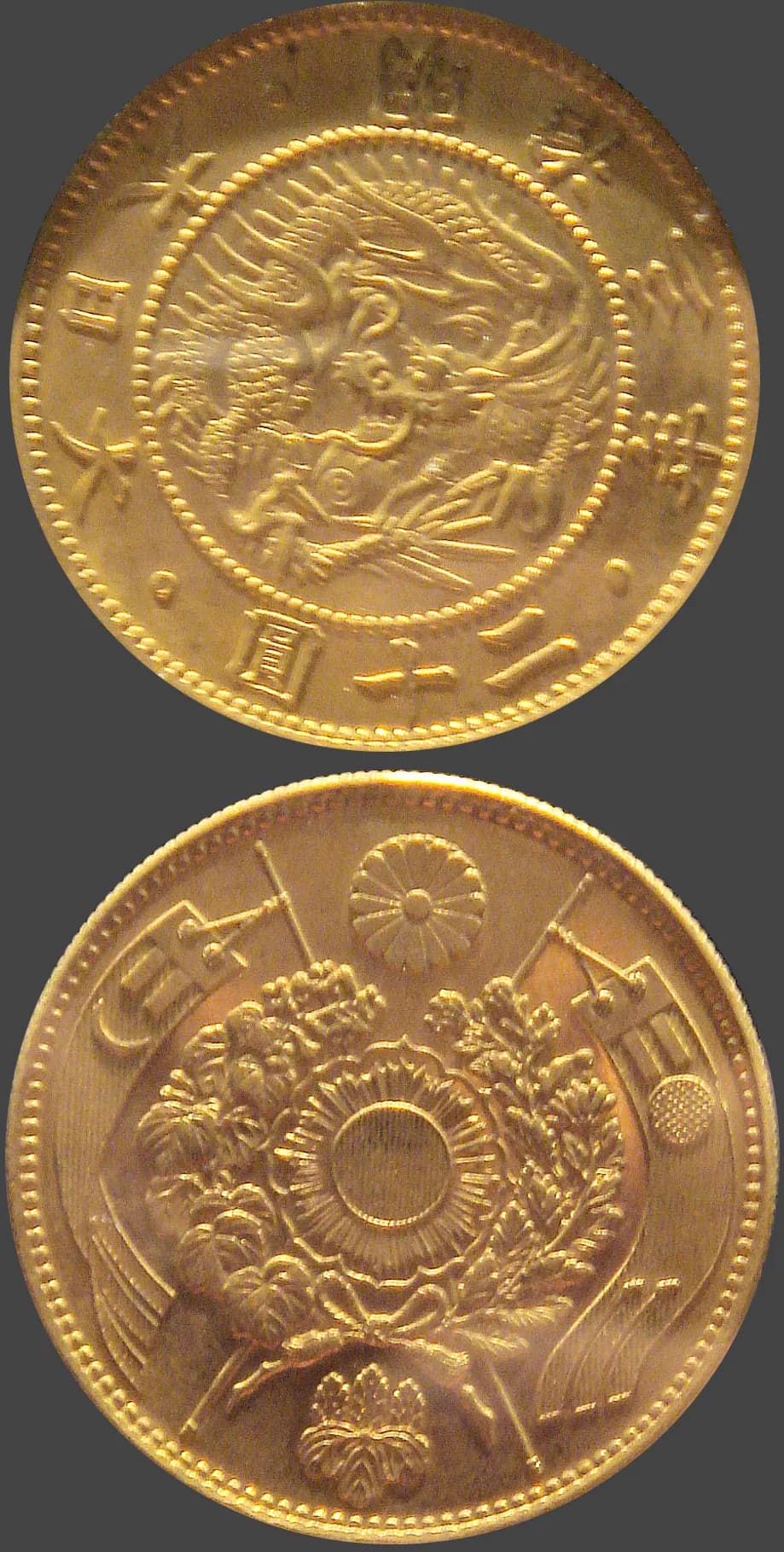
Image: Modern Japanese coinage / PHGCOM / Wikimedia Commons / CC BY-SA 3.0(source)
Ichibu-gin — The 'Gold-Silver Ratio Trap' Exposed by Unequal Treaties and the Monetary Crisis of the Late Edo Period
The Systematic Outflow of Gold Coins Triggered by the Opening of Ports in 1858, and the Shogunate's Last Resort: The Manen Recoinage
Subject coin: 一分銀
Overview
The Ichibu-gin (一分銀) was a rectangular silver coin issued by the Edo shogunate, with a face value of one bu (4 coins being equivalent to one gold ryō). From its first issue in Bunsei 10 (1827) through to the end of the Edo period, it was minted in the hundreds of millions and served as an everyday means of payment. However, it was the conclusion of the Ansei Five-Nation Treaties (安政五ヶ国条約) in Ansei 5 (1858) and the opening of the ports the following year that thrust this silver coin onto the stage of history.
The problem lay in the difference between Japan's gold-silver exchange ratio and that of the international community. Domestically, the exchange rate had settled at roughly 1 part gold to 4–5 silver coins (i.e., 4–5 Ichibu-gin equaling one gold ryō), whereas on international markets the general ratio was approximately 1 part gold to 15 parts silver. Exploiting this gap, foreign merchants began a systematic campaign of buying up and exporting gold coins, and within just a few years a massive quantity of gold drained out of Japan.
In Manen 1 (1860), the shogunate enacted the Manen Recoinage (万延改鋳) as an emergency measure, drastically reducing the gold content of coins such as the Manen Koban (万延小判). Although this eliminated the international discrepancy in the gold-silver ratio, the sudden currency debasement brought severe domestic inflation in its wake. The Ichibu-gin stands as a 'witness to history,' at the very center of the collapse of the late Edo monetary system.
This article traces in narrative form the role of the Ichibu-gin in the late Edo period, Harris's negotiations and the Ansei Treaties, the mechanism by which the gold-silver ratio trap caused gold to flow out of the country, and the last resort of the Manen Recoinage.
Specifications
- Denomination
- 1分(4枚=1両)
- Minting period
- 文政10年〜明治3年(1827〜1870)
- Metal composition
- 銀(品位約.988〜.990)
- Weight
- 約8.63g(目方2匁3分)
- Dimensions
- 縦約21mm × 横約30mm(長方形、面取りあり)
- Mintage
- 文政・天保・安政・元治・慶応・明治各版を含む数億枚(推定)
- Mint supervisor
- 江戸幕府銀座
- Market price
- 照合済みの落札記録が揃うまで提示しません
The Ichibu-gin in the Bunsei and Tenpō Eras — The Core Currency of the Edo Silver Coin System
Image: Modern Japanese coinage / Coindesmonnaies / Wikimedia Commons / CC BY-SA 4.0(source)
The predecessors of the Ichibu-gin were the Chōgin (丁銀) and Mameitagin (豆板銀). The Chōgin, which had been in use since the Keichō era (early 17th century), was an irregularly shaped lump silver coin that required weighing each time it was used—a considerable inconvenience. The shogunate worked to transition to 'counted silver coins' (計数銀貨, keisū ginka) of uniform weight and fixed shape, moving through the Gomomme-gin (五匁銀) of Kyōhō 13 (1728) before finally issuing the Ichibu-gin in Bunsei 10 (1827).
The Bunsei Ichibu-gin (文政一分銀) was a high-quality rectangular silver coin weighing approximately 8.63 g with a silver fineness of approximately .988. An exchange rate was established whereby 4 coins equaled one gold ryō (one koban), and it was widely accepted as a 'reliable commercial means of payment' with fixed weight, shape, and fineness. It was particularly welcomed by merchants in Osaka and the Kamigata region. The Kamigata area operated on a silver-based economy, and the Ichibu-gin established itself as the leading silver coin to replace the Chōgin.
The Tenpō Ichibu-gin (天保一分銀) was issued in Tenpō 8 (1837) as the successor to the Bunsei Ichibu-gin, with virtually no change in fineness or weight. In the late Edo period, the Ichibu-gin circulated widely as the 'commercial infrastructure of Edo,' from the commodity exchanges of Osaka (such as the Dōjima Rice Market) to the money changers of Edo and the rural merchants of the countryside.
Within the Edo silver coin system (江戸銀貨の体系), the Ichibu-gin occupied a central position between the large-format Chōgin and Mameitagin on one hand, and the smaller Nibu-gin (二分銀) and Isshu-gin (一朱銀) on the other. This stable position would be shaken to its foundations by the 'external pressure' of the opening of the ports in 1858.
Harris's Negotiations and the Ansei Treaties — The Monetary Distortions Brought by the Opening of the Ports
Image: Modern Japanese coinage / Coindesmonnaies / Wikimedia Commons / CC BY-SA 4.0(source)
In Ansei 3 (1856), Townsend Harris arrived at Shimoda as the first Consul-General of the United States. Through a tenacious diplomatic negotiation process quite different from Perry's hardline approach, he concluded the Treaty of Amity and Commerce between Japan and the United States in Ansei 5 (1858). That same year, similar treaties were concluded with Britain, France, Russia, and the Netherlands, collectively known as the Ansei Five-Nation Treaties (安政五ヶ国条約).
One point Harris pressed strongly during the treaty negotiations was the clause on 'equal exchange with foreign currencies.' This was the principle of exchanging the same type of metal (gold for gold, silver for silver) by weight, meaning that the domestic Japanese currency conversion rates would be applied to foreign merchants. While this appeared reasonable at first glance, it contained a fatal problem, since Japan's unique gold-silver ratio (the domestic exchange rate between gold and silver) diverged greatly from international rates.
At the time, Japan's domestic gold-silver ratio was approximately 1 part gold to 5 parts silver (4–5 Ichibu-gin equaling one koban). By contrast, the international (Western) gold-silver ratio was approximately 1 part gold to 15 parts silver—a difference of roughly threefold by simple calculation.
Following the conclusion of the treaty, in Ansei 6 (1859), the three ports of Yokohama, Nagasaki, and Hakodate were opened. Foreign merchants were aware of the gold-silver ratio discrepancy from the outset and were prepared to profit from it in an organized manner. The problem of silver coin outflows in the late Edo period (幕末の銀貨流出問題) began simultaneously with the opening of the ports.
The principle of 'same metal, same weight' to which Harris adhered was written explicitly into the treaty text as: foreign currencies shall be exchanged at parity by weight for Japanese currencies of the same type of metal. When this clause was applied to customs procedures at Yokohama and Nagasaki, foreign merchants obtained the legal basis to exchange foreign silver coins they had brought—such as Mexican silver dollars—for Ichibu-gin. The shogunate accepted this clause under diplomatic pressure, but at the time of the treaty's conclusion it had not fully recognized that it would lead to a systematic outflow of gold coins through the gold-silver ratio differential.
The Gold-Silver Ratio Trap — Systematic Gold Outflow by Foreign Merchants
Image: Modern Japanese coinage / Coindesmonnaies / Wikimedia Commons / CC BY-SA 4.0(source)
After the ports opened, foreign merchants moved swiftly. The outline of the method they employed was as follows. First, they exercised their treaty right to exchange foreign silver coins they had brought (such as Mexican silver dollars) for Ichibu-gin, on the basis of 'same type of metal—silver—exchanged at equal weight.' Next, they exchanged the Ichibu-gin they had obtained, at 4 coins to the ryō, for koban (gold coins). At the domestic rate of approximately 1 part gold to 5 parts silver, this meant that 20 Ichibu-gin yielded 5 koban.
Finally, they took the koban they had obtained out of the country and sold them on international markets at the high gold price (approximately 1 part gold to 15 parts silver). Through this series of transactions, foreign merchants were able to nearly triple the silver they had started with. This was the essence of the 'gold-silver ratio trap.'
According to records, within just a few months of the ports opening, hundreds of thousands of ryō (some accounts suggest over 1,000,000 ryō) in koban flowed out of the country (the exact figures vary across sources). To meet the robust demand from foreign merchants, the shogunate's gold mint was forced to issue additional koban, and gold production from mines such as the Sado Gold Mine could not come close to keeping pace.
Domestically, the rapid shortage of gold coins brought rising prices. In particular, a 'internationalization of prices' occurred in which the prices of export goods such as rice, cotton, and raw silk were pushed up to international market levels, dealing a direct blow to the daily lives of ordinary people in Edo. The Ichibu-gin itself flooded the market through exchange with the large volume of foreign silver coins flowing in, and a localized reversal—'high silver, low gold'—also occurred. The shogunate struggled over how to resolve this structural problem.
The scale of the gold coins that flowed out in the year or so after the ports opened is also recorded in reports by the British Minister Alcock of the time, conveying the reality that large quantities of gold were taken out of the country through the systematic exchange of foreign currency for shogunate gold coins. The forced measure of the Manen Recoinage was required in order to bring Japan's gold-silver ratio into line with the international rate (approximately 1 gold to 15 silver).
The Manen Recoinage — A Last Resort and Its Price
Image: Modern Japanese coinage / Coindesmonnaies / Wikimedia Commons / CC BY-SA 4.0(source)
In response to the structural problem of gold coin outflow, the solution the shogunate chose was the drastic remedy of 'lowering the value of gold coins to the international level.' In Manen 1 (1860), the shogunate enacted the Manen Recoinage (万延改鋳), drastically reducing the gold content of gold coins.
The content of the recoinage was radical. The Manen Koban (万延小判) saw its weight slashed from that of the preceding Ansei Koban (安政小判)—which had a fineness of approximately 57% and a weight of approximately 9 g—to approximately 3.3 g, with the fineness left roughly unchanged (reducing the pure gold content from approximately 5.1 g to approximately 1.9 g). By reducing the 'actual gold content' of the koban to approximately one-fifth, the aim was to bring the value of the koban in the domestic market closer to the gold value on international markets, making it unprofitable to export.
The recoinage achieved its objective. Arbitrage transactions exploiting the international gold-silver ratio differential became unviable, and the outflow of gold coins dropped sharply. However, the price paid was severe. The replacement of large quantities of old gold coins (such as the Ansei Koban) with Manen Koban effectively caused a major increase in the money supply in circulation, triggering rapid inflation. Some accounts hold that, in the period surrounding the opening of the ports and the Manen Recoinage, prices in Edo rose several-fold (specific figures vary across historical sources).
The Ichibu-gin experienced confusion in its exchange ratio with gold coins throughout this process, yet continued to be issued with its fineness maintained at a high level until Meiji 3 (1870). Meanwhile, the sudden devaluation of currency caused by the Manen Recoinage also provided a pretext for anti-shogunate criticism by the sonnō jōi and loyalist factions. The emotional argument that 'the shogunate, bowing to foreign demands, has even destroyed the economy' became linked with political discontent and, in an indirect sense, contributed to the movement to overthrow the shogunate in the late Edo period.
Value & Rarity
The valuation of Ichibu-gin in the collector market is determined by the combination of edition (Bunsei, Tenpō, Ansei, Genji, and Keiō editions) and condition (grade).
The edition with the highest mintage and the greatest number of surviving examples is the Ansei Ichibu-gin (安政一分銀, from Ansei 6 [1859] onward); ordinary specimens are relatively affordable, at approximately 5,000 to 20,000 yen. The Bunsei Ichibu-gin (文政一分銀, from Bunsei 10 [1827] onward) is valued by collectors as the earliest issued edition, and examples in Fine or better condition can exceed 20,000 to 100,000 yen. The Genji Ichibu-gin (元治一分銀, from Genji 1 [1864] onward) was issued during a short period in the late Edo era, leaving few in circulation, and can command prices of 50,000 to over 300,000 yen.
In terms of condition, the corners of the rectangular Ichibu-gin are prone to contact marks, making examples that retain all four corners perfectly—grading as 'Extremely Fine'—quite scarce. The sharpness of the characters on the surface (the inscriptions 「一分銀」 and 「銀座」) is also an important criterion for grading.
From a historical value perspective, the Ansei Ichibu-gin possesses a uniqueness as 'a currency that experienced the historical turning point of the opening of the ports.' Many examples are said to have passed through the hands of foreign merchants and made their way abroad in the course of circulation, making them a focus of interest for collectors both in Japan and overseas.
From an investment perspective, Fine-to-Extremely Fine examples of the Genji Ichibu-gin are worthy of long-term holding from the standpoint of rarity and historical significance. Ordinary specimens of the Bunsei and Ansei editions also offer high cost-performance value for beginners. It is recommended to consult auction results data to grasp the price trends for each edition.
Conclusion
The Ichibu-gin is a rare silver coin whose historical context underwent a dramatic transformation—from 'the everyday currency of Edo' to 'the epicenter of the late Edo economic crisis.' The contradiction in the gold-silver ratio exposed by the external pressure of the Ansei Treaties, the shogunate's last resort of the Manen Recoinage, and the eventual replacement by a modern monetary system—a single Ichibu-gin coin is a microcosm of the structural problems that late Edo Japan faced.
From a collecting perspective, the rarity of the Genji Ichibu-gin stands out, while the Ansei edition combines suitable affordability with historical depth, making it well suited to beginners. As an indispensable presence in any discussion of late Edo economic history, the value of the Ichibu-gin is expected to remain stable going forward.
Related Stories
Former 20-Yen Gold Coin (Meiji 3) — The Highest-Denomination Gold Coin That Stamped Modern Japan's 'Gold Standard'
The Story of the New Currency Regulations and the Osaka Mint Born from the Scars of the Boshin War, and the Enigmatic Meiji 3 Issue
Coin StoryTenpō Tsūhō — The Ambition and Forgery Storm of 'Tōhyaku Sen' Created by Financial Crisis
The Elliptical Coin Born from Famine and Financial Struggle in Late Edo Period, A Tumultuous 40 Years and Its End
Coin StoryGenbun Chōgin (元文丁銀) — The 'Secret Recoinage' That Rescued the Shogunate's Finances
In the First Year of Genbun, the Shogunate's Bold Strategy to Drastically Lower the Silver Purity
Related Encyclopedia Entries
Ichibu Silver
Conclusion: Ichibu Silver is a highly valuable antique coin for both beginners and advanced collectors, offering historical significance, stable prices, and easy authentication.
EncyclopediaSystem of Edo Silver Coins
Conclusion: Understanding the two systems (weighed and counted) and complex fineness changes of Edo silver coins, along with appraisal points and market prices, enables smart collecting and investing.
EncyclopediaMan'en Koban
Conclusion: Man'en Koban, the "Hina Koban" born from the late Edo period's gold outflow crisis, is an excellent piece for collectors to enjoy historical value and a compelling narrative at an affordable price.
Dealers
Dealers Handling This Category
A reference when considering a sale or appraisal. All are dealers and auction houses with a proven track record.
Japan Coin Auction (JCA)
Tokyo
Holds regular auctions with reliable hammer price data, making it a useful resource for tracking market values. Caters to a wide range of collectors from beginners to advanced buyers.
Ginza Coins
Ginza, Chuo-ku, Tokyo
One of Japan's most established numismatic dealers. The scale and variety of their regular auctions is among the largest in the country. Their catalogs are considered a benchmark for market pricing.
Osaka Numismatic Auction
Osaka
A Kansai-based coin auction house with particular strength in regional and hole coins.