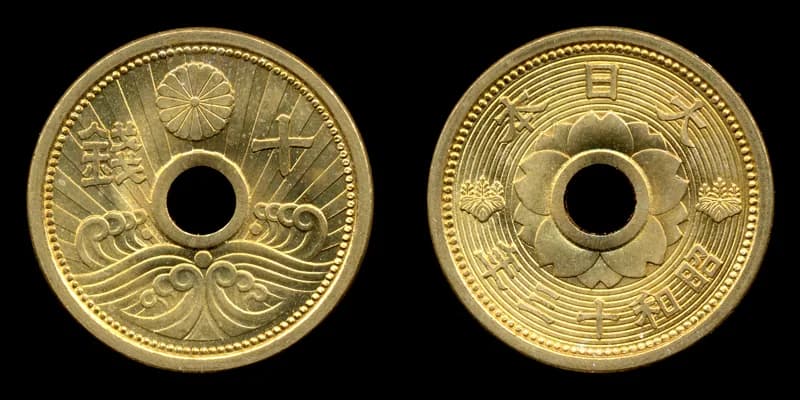
Image: Modern Japanese coinage / As6673 / Wikimedia Commons / CC BY-SA 3.0(source)
The Genroku Koban — Shigehide Ogiwara's Financial Revolution and the Consequences of the Genroku Bubble
The man who halved the gold content to save the shogunate, and the merits and demerits of his actions
Subject coin: 元禄小判
Overview
The Genroku Koban is a reformed gold coin minted in Genroku 8 (1695) under the leadership of Shigehide Ogiwara, the accounting officer of the Edo shogunate. It was a bold policy that drastically lowered the gold purity of the Keichō Koban, which had been in circulation since Keichō 6 (1601), from 84.29% to 57.37%. The weight was set at 17.78g, almost unchanged from the Keichō Koban's 17.73g, minimizing changes in appearance. This recoinage generated a vast 'demerit (seigniorage)' for the shogunate but also prompted a price hike, laying the groundwork for the Genroku Bubble. Refer to the overview of Edo gold coins and types and identification of koban. Shigehide Ogiwara's idea that 'currency is determined by the state' is highly regarded as a modern concept leading to today's managed currency system, while at the time it immediately hit people's lives through inflation. The cultural flourishing of the Genroku era—Matsuo Bashō's 'Oku no Hosomichi' (1689), Ihara Saikaku's 'ukiyo-zōshi', and Chikamatsu Monzaemon's puppet theater—coincided with this economic expansion period. After Ogiwara's downfall in Hōei 7 (1710), the Shōtoku Koban was issued in Shōtoku 2 (1712), restoring quality. Check the modern market index.
Specifications
- Denomination
- 1両
- Minting period
- 元禄8年〜宝永7年(1695年〜1710年)
- Metal composition
- 金57.37% / 銀42.63%
- Weight
- 17.78g
- Dimensions
- 縦約56mm × 横約34mm
- Mintage
- 不詳(諸説あり)
- Mint supervisor
- 荻原重秀主導 / 後藤家(金座)鋳造
- Market price
- 照合済みの落札記録が揃うまで提示しません
Chapter 1: The Limitations of the Keichō Koban and the Rise of Shigehide Ogiwara
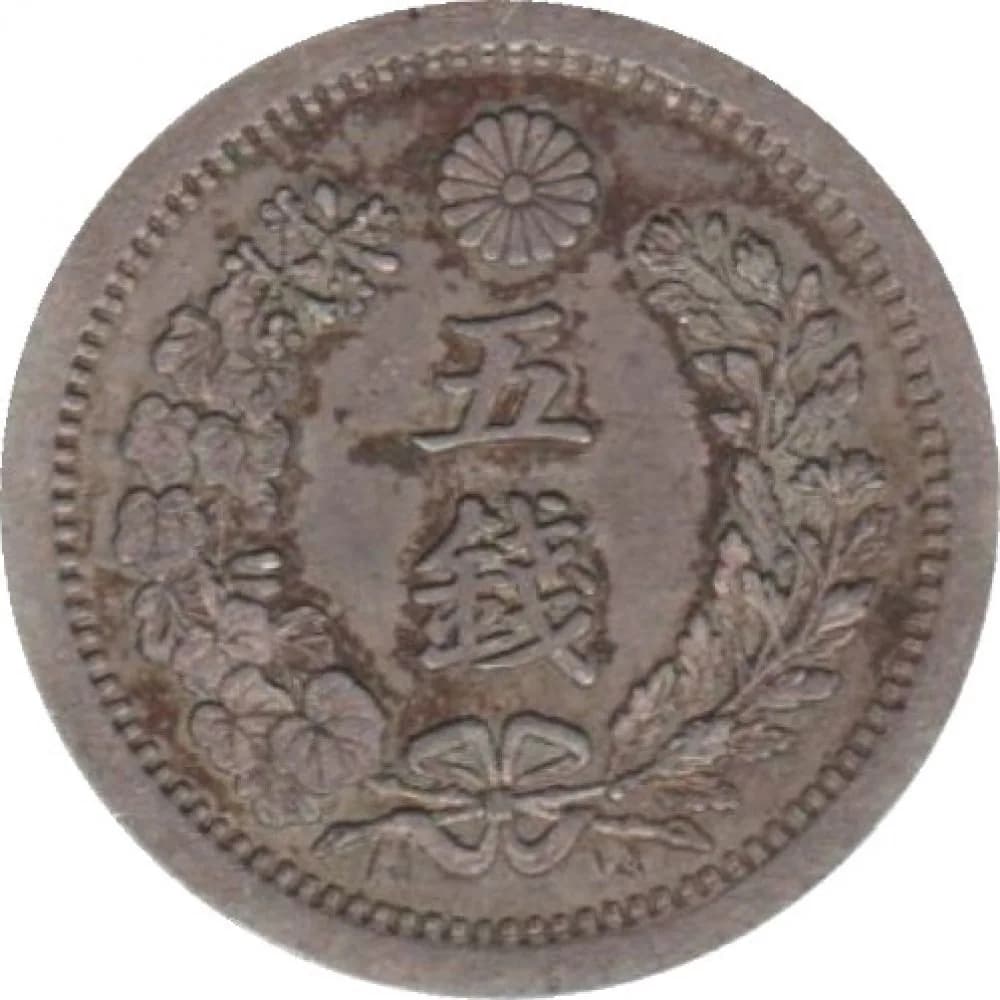
Image: Modern Japanese coinage / Coindesmonnaies / Wikimedia Commons / CC BY-SA 4.0(source)
In Keichō 6 (1601), after the unification of the nation, Tokugawa Ieyasu issued the Keichō Koban to establish economic order. This koban, with a gold purity of 84.29% and a weight of 17.73g, functioned as the backbone of the shogunate's economy for over 90 years. However, by the latter half of the 17th century, the shogunate's finances were plunging into a serious crisis.
From Kanbun 8 (1668) onward, large-scale repairs of Edo Castle and various domains stressed finances, along with preparations for the Genroku Earthquake (Genroku 16, 1703). During Shogun Tsunayoshi's era, expenses for donations to temples and shrines due to deep Buddhist devotion and the enforcement of the "Edicts on Compassion for All Living Things" also increased. Declining gold mine yields reached a critical point where fiscal actions without gold backing had reached their limit.
It was in this situation that Shigehide Ogiwara (1658-1713), the accounting officer, emerged onto the historical stage. Ogiwara held economic thoughts that were considered unorthodox in Japan at the time. His idea that 'currency is determined by the state' encapsulates his ideology, which preluded modern managed currency theory—advocating currency value supported by state authority rather than intrinsic metal value.
Ogiwara proposed his recoinage plan to Shogun Tsunayoshi. The plan was to mint new koban with significantly reduced gold content and cover the fiscal deficit with the seigniorage. Melting one Keichō Koban to create 1.5 Genroku Koban was calculated. The shogunate approved this proposal, and recoinage began in Genroku 8 (1695). Learn coin grading standards to understand the quality differences firsthand.
Thus, the Genroku Koban was born. Gold 57.37%, silver 42.63%—a quality drop of an astonishing 27 points from the Keichō Koban's 84.29%. Though the same shape and weight, its brilliance was noticeably duller. Whether Ogiwara's gamble was wise or foolish, history's judgment would soon be rendered.
Chapter 2: The Shock of 5 Million Ryō in Seigniorage and the Beginning of the Genroku Bubble
Image: Modern Japanese coinage / Coindesmonnaies / Wikimedia Commons / CC BY-SA 4.0(source)
The recoinage that started in Genroku 8 (1695) garnered the shogunate profits of approximately 5 million ryō, according to various estimates—comparable to several years of the shogunate's annual revenue at the time, providing a respite for the struggling finances.
Short-term 'success' was achieved by Shigehide Ogiwara's policy, but the consequence emerged delayed in the market. From immediately after the recoinage in Genroku 8 (1695), prices began to rise slowly. Rice prices particularly surged in the years surrounding the reform, with records by late-Edo researchers indicating substantial inflation during the Genroku 10s (1697-1706), though exact figures vary by sources.
Despite lower coin quality with the same face value, the actual amount of gold circulating in the market increased. Merchants quickly noticed this, adjusting their prices upward. The rise in essential commodity prices—rice, sake, oil—hit the common folk hard, while urban magnates and the upper classes accumulated wealth, benefiting from rising prices. This 'widening gap' was also a factor behind the cultural flourishing of the Genroku era.
The flowering of Genroku culture is inextricably linked to this economic expansion period. Matsuo Bashō concluded his 'Oku no Hosomichi' journey in Genroku 2 (1689), just years before the recoinage. The merchant world depicted by Ihara Saikaku in 'Nippon Eitaigura' (1688), and the everyday people portrayed by Chikamatsu Monzaemon in 'Sonezaki Shinju' (1703)—these works emerged against a background of societal fluctuations induced by changes in currency value.
While the financial stability expected from the recoinage materialized, it soon bred new problems. As the market began recognizing the quality difference between old and new koban, good money (Keichō Koban) started disappearing from circulation. This typifies Gresham's Law, 'Bad money drives out good.' Those holding Keichō Koban refrained from parting with them, preferring to use Genroku Koban for transactions. Understand auction basics to see the value disparity with Keichō Koban.
Chapter 3: The Downfall of Shigehide Ogiwara and the Transition to Shōtoku Koban
Image: Modern Japanese coinage / Coindesmonnaies / Wikimedia Commons / CC BY-SA 4.0(source)
Fifteen years after the recoinage in Genroku 8 (1695), in Hōei 7 (1710), Shigehide Ogiwara was ousted by command of the then-shogun Tokugawa Ienobu. The support behind this was from Confucian scholar Arai Hakuseki (1657-1725), who fiercely criticized Ogiwara's 'currency manipulation' and denounced him as the root cause of inflation. Arai Hakuseki's book 'Oritaku Shiba no Ki' contains detailed criticisms of Ogiwara.
Following Shigehide Ogiwara's ousting, the shogunate, under Arai Hakuseki's leadership, shifted its monetary policy. In Shōtoku 2 (1712), the 'Shōtoku Koban' was issued, restoring gold purity to 84.29%, the level of the Keichō Koban. Yet, this paradoxically resulted in adverse effects. As purity increased, the number of koban that could be minted with the same amount of gold decreased, causing the currency supply in the market to contract sharply. Prices turned to deflation, leading to new forms of economic turmoil.
Who was Shigehide Ogiwara? Contemporary economic historians' evaluations diverge. He is seen by some as the 'villain' who undermined currency trust for short-term fiscal gains. Conversely, others see him as a 'pioneer' implementing a managed currency theory unshackled by the intrinsic value of gold during the Edo period. His assertion that 'currency is determined by the state' remarkably aligns with modern monetary theory.
The Genroku Koban existed for about 15 years, from Genroku 8 (1695) to Hōei 7 (1710). Although the exact number minted is unknown, calculations from records indicating the shogunate gained 'about 5 million ryō in seigniorage' suggest a significant amount was supplied to the market. Consequently, among the Edo period's ovals and koban, the Genroku Koban is relatively abundant, with opportunities to encounter them in today's antique coin market, though its condition varies compared to the Keichō Koban. However, quality pieces are scarce, and careful selection is warranted, guided by types and identification of koban.
Chapter 4: Modern Evaluation of the Genroku Koban — Sought by Collectors as a 'Witness of Economic Experimentation'
Image: Modern Japanese coinage / Coindesmonnaies / Wikimedia Commons / CC BY-SA 4.0(source)
If in top condition (near-uncirculated), it might fetch even higher prices (varies by sources).
The most crucial feature in identifying Genroku Koban is its 'faint gold color.' The gold purity of 57.37% presents an obvious difference compared to the Keichō and Shōtoku Koban (both 84.29%). Under strong light, a Genroku Koban reveals a pale yellow mixed with silver's whiteness. Also, the surface stamps like 'paulownia crest' or 'bamboo crest' are authentic marks by the Gotō family, critical in authenticity verification.
As for counterfeits, the Genroku Koban is no exception. Even during the Edo period, counterfeit circulation was an issue, and today, precise replicas can be found. When purchasing, expert appraisal is essential. Understand coin grading standards, and choose transactions through reliable appraisal organizations or major antique coin auction houses.
From a historical significance perspective, the Genroku Koban uniquely signifies 'an economic experiment product of the Edo period.' It is not just a low-purity coin, but 'evidence' of a reform led by an outstanding economic thinker, Shigehide Ogiwara, intriguing collectors and researchers alike. Comparative exhibitions with the Keichō Koban (1601-) offer one of the most intuitive ways to understand Edo period monetary policy visually. Check the modern market index while planning your collection wisely.
The era of the Genroku Koban, from Genroku 8 (1695) to Shōtoku 2 (1712)—a mere 17 years—continues to spark discussions among researchers as Japan's first 'fiscal inflation experiment' in economic history.
Individual prices and auction results are listed only once verifiably matched records — with sale, lot, source URL and review date — exist.
Value & Rarity
The market evaluation of the Genroku Koban is shaped by its historical background and distinctive purity. With a gold purity of 57.37%, it is clearly lower than the Keichō Koban (84.29%) and Shōtoku Koban (84.29%). However, it should be viewed not as a 'deteriorated product,' but as a 'product of its time.' As the legacy of Shigehide Ogiwara's financial policy, the Genroku Koban is indispensable in narrating Edo period economic history.
See types and identification of koban for a clear understanding of positioning among Keichō, Kyōhō, and Meiwa koban. Regarding authenticity, the presence of Gotō family's stamps, gold color tone, weight, and size are main criteria. Due to the existence of detailed forgeries and later replicas, relying on trusted appraisal agencies is essential.
On rarity, it is said there was more circulation compared to the Keichō Koban, but pieces in good condition are limited. Of the coined money circulated during the Genroku era, many were practically used, so worn or damaged items often enter the market. Near-mint condition rarity is high, and competition in major auctions is fierce.
Individual prices and auction results are listed only once verifiably matched records — with sale, lot, source URL and review date — exist.
Conclusion
The Genroku Koban symbolizes Shigehide Ogiwara's progressive idea that 'currency is determined by the state,' as well as the inflation that arose as its consequence, representing an economic experiment of the Edo period. For about 15 years from Genroku 8 (1695) to Hōei 7 (1710), this coin supported shogunate finances while concurrently fostering the cultural renaissance of the Genroku period. With the purity restoration in Shōtoku 2 (1712), its role ended, yet in modern times it holds significant esteem as a key name in the antique coin market. Encountering this gold coin allows one to literally feel the successes and failures of economic policy from over 300 years ago, in the palm of one's hand.
Related Stories
Keichō Koban (慶長小判) — The Symbol of the Early Modern Monetary System Built by Tokugawa Ieyasu
The year after Sekigahara, Japan's first nationally unified gold coin was born
Coin StoryIchibu-gin — The 'Gold-Silver Ratio Trap' Exposed by Unequal Treaties and the Monetary Crisis of the Late Edo Period
The Systematic Outflow of Gold Coins Triggered by the Opening of Ports in 1858, and the Shogunate's Last Resort: The Manen Recoinage
Coin StoryKyōhō Koban — The High-Purity Gold Coin Born of Yoshimune's Reforms
The Elusive Koban That Shone During the Kyōhō Reform Era
Related Encyclopedia Entries
System and Overview of Edo Gold Coins
Conclusion: Edo gold coins are a stable and attractive investment/collection target, combining historical background, intrinsic gold value, and collector's premium.
EncyclopediaTypes and Evolution of Koban
Conclusion: Koban reflects the transitions of the Edo economy; understanding each type's characteristics and market value is crucial for purposeful collection and investment strategies.
Dealers
Dealers Handling This Category
A reference when considering a sale or appraisal. All are dealers and auction houses with a proven track record.
Ginza Coins
Ginza, Chuo-ku, Tokyo
One of Japan's most established numismatic dealers. The scale and variety of their regular auctions is among the largest in the country. Their catalogs are considered a benchmark for market pricing.
Japan Coin Auction (JCA)
Tokyo
Holds regular auctions with reliable hammer price data, making it a useful resource for tracking market values. Caters to a wide range of collectors from beginners to advanced buyers.
Taisei Coins
Tokyo
A dealer with an international network. Offers advanced services such as consignment to overseas auctions and NGC/PCGS grading submission. Recommended for high-value or internationally recognized coins.