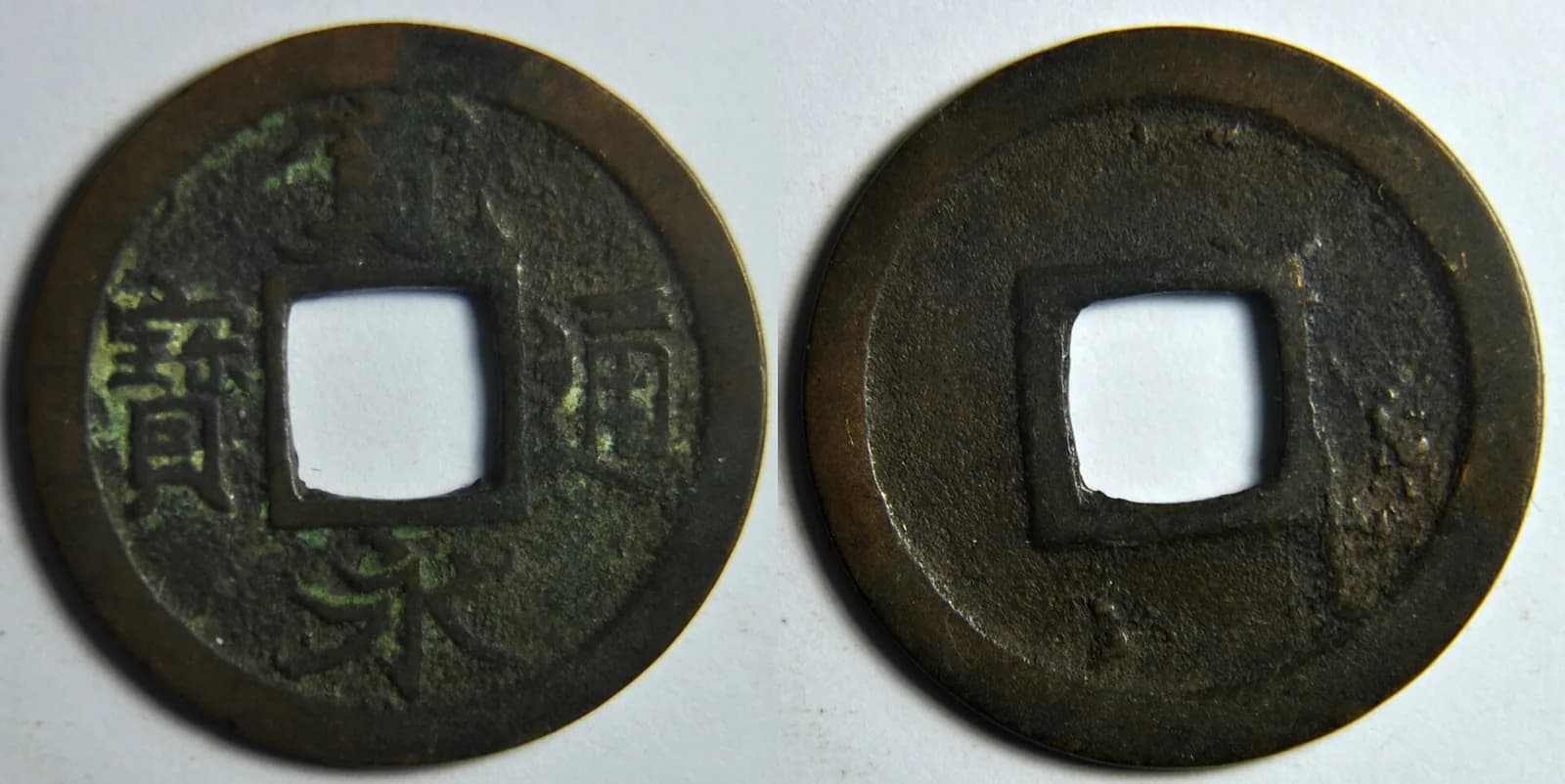
Image: Japanese holed coins (square-holed cash coins) / Jean-Michel Moullec from Vern sur Seiche (35, Bretagne), France / Wikimedia Commons / CC BY 2.0(source)
Private Minting Coin Problem — The Dark Side of 'Bita-sen' Shaking Medieval Japan's Economy
Counterfeit coins resembling the real thing abounded, highlighting the chaotic truth of a monetary economy
Subject coin: 私鋳銭問題
Overview
Travelers visiting markets in medieval Japan must have been struck by the unusual sight. Merchants, faced with piles of coins, would groan, furrow their brows, and meticulously scrutinize the quality of each coin. In their hands were finely crafted 'Toraisen' imported from distant China and the poorly made 'private minted coins' produced domestically as imitations. These private minted coins, often called 'Bita-sen', were the root cause of the turmoil that threatened the very foundation of medieval Japan's currency economy. From the late Kamakura period to the early Edo period, spanning about 300 years, Japan suffered from a chronic coin shortage and the consequent rampant circulation of private minted coins. The chaos peaked during the Muromachi period, with the court and the shogunate repeatedly issuing 'Eri-zeni Re' (coin selection ordinances) in attempts to address the issue, albeit without fundamental resolution. Amidst the mingling of high-quality and poor-quality coins, people relied on money changers, experts in coin quality identification, to navigate the complex exchange rates like 1 refined coin for 2-4 bita coins. This tumultuous monetary situation persisted until the Tokugawa Shogunate began minting the nationwide unified currency of Kan'ei Tsuho. This article unravels the grand tale of how the private minting issue emerged, its impacts on medieval Japanese society, and its eventual resolution. Understanding this historical context is also crucial for knowing the types and identification of medieval hole coins.
Specifications
- Denomination
- 不定(宋銭・明銭の模倣、品質による)
- Minting period
- 鎌倉時代末期〜江戸時代初期(13世紀末〜17世紀前半)
- Metal composition
- 銅、鉛、錫など(配合は私鋳者による)
- Weight
- 不定(宋銭・明銭の模倣)
- Dimensions
- 不定(宋銭・明銭の模倣)
- Mintage
- 不詳(膨大な量が鋳造されたとされる)
- Mint supervisor
- 不詳(各地の鋳物師、職人など)
- Market price
- 数百円〜数千円(品質や種類による、学術的価値は別途評価)
Chapter 1: The Influx of Imported Coins and the Birth of Private Minting — The Demand for Currency during the Kamakura and Muromachi Periods
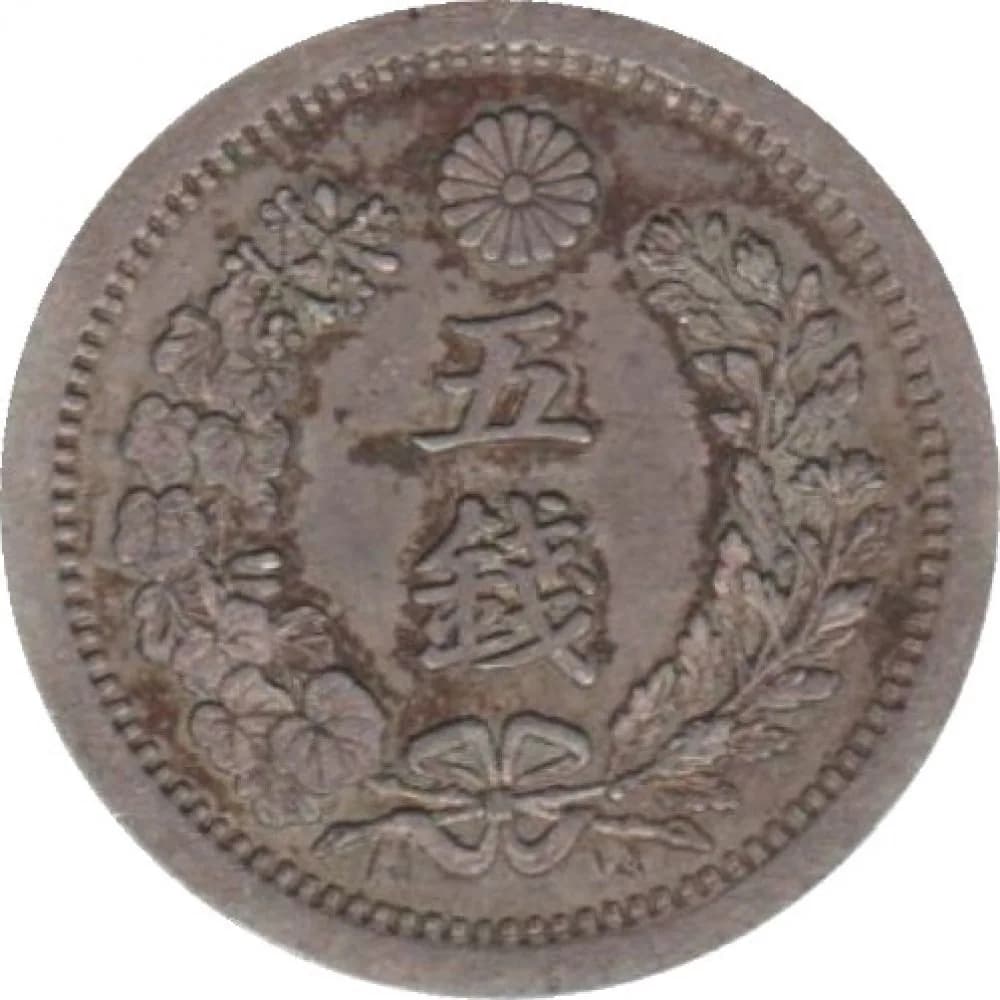
Image: Modern Japanese coinage / Coindesmonnaies / Wikimedia Commons / CC BY-SA 4.0(source)
At the end of the 13th century, Japan was in a tumultuous era with the samurai-dominated Kamakura period nearing its end. Beneath the surface, commercial activities gradually became more vibrant, and a monetary economy quietly began permeating urban areas. The economy, which was primarily based on barter, saw an influx of 'Toraisen', particularly 'Song coins' from China, from the late Heian to the Kamakura period. Through Japan-Song trade, these coins like Yongle Tongbao and Hongwu Tongbao, considered ancient currency, significantly met the currency needs of Japan at the time. However, entering the 14th century, with recurring internal strife such as the Mongol invasions and the Nanboku-chō conflict (1336-1392), the domestic production system became chaotic, and the supply of imported coins became unstable. Particularly during the late 14th to early 15th centuries when Ashikaga Yoshimitsu reigned as the shogun of the Muromachi Shogunate, the increase in Ming coins through tribute trade temporarily alleviated the situation, yet it was insufficient to meet nationwide currency demand. In major cities like Kyoto, Nara, Hakata, and Sakai, commercial activities soared, and coins became indispensable as a means of payment, replacing rice or cloth. For example, in 15th century Kyoto, it was common for 1 koku of rice to be traded for 1,000 to 2,000 coins. In this scenario, central powers like the court or shogunate lacked the capacity to mint and supply a unified currency themselves. Although there was a time during the Heian period when official coins like the Wado Kaichin were minted, this had since been discontinued. Faced with a currency shortage, merchants and lords across regions took the bold step of manufacturing coins themselves to break out of this predicament. This was the initial stirrings of the 'private minting' that would later plunge the Japanese economy into chaos. They believed that by imitating imported coins, they could easily supply currency.
Chapter 2: The Shadowy Minting Operators — Production Sites and Techniques of Bita-sen
Image: Modern Japanese coinage / Coindesmonnaies / Wikimedia Commons / CC BY-SA 4.0(source)
The growing demand for currency and the lack of central control in rural areas created a hotbed for private minting. From the 14th to the 15th century, groups known as 'coin shops' or 'casters' started appearing in places like Sakomoto in Omi Province (present-day Otsu City, Shiga Prefecture), Kawachi Province (present-day eastern Osaka Prefecture), and Tanba Province (present-day central Kyoto Prefecture and eastern Hyogo Prefecture), manufacturing private minted coins mimicking imported coins, especially Song and Ming coins. These groups used casting technologies like sand mold casting to produce large quantities of coins modeled after authentic coins. However, the quality of these coins was mixed. Originally, coins were primarily composed of copper, but the private minters, aiming to maximize profits, mixed in cheap lead and tin. For instance, while the copper content in typical Song coins was about 70-80%, there were bita coins where lead and tin accounted for over 50%, making the coins brittle with unclear inscriptions or prone to chipping. The rough quality of the script, sometimes with misspellings, contributed to the coined term 'bita-sen' for low-quality coins. The production of private minted coins involved not only professional casters but occasionally influential local lords and temples participated as well. There are records that warlord Mōri Motonari encouraged private minting within his domain during the Sengoku period, using them for local economic revitalization or military funding. The secretive or sometimes blatant minting operations, often conducted under the cover of night, led to enormous production. Records suggest that by the mid-15th century, more than half of the coins circulating in the market were private minted, underscoring their significant influence. These clues on identifying fakes and forgeries are valuable knowledge even for contemporary collectors.
Chapter 3: Market Dominating Bita-sen — A Troubled Economy and the People's Plight
Image: Modern Japanese coinage / Coindesmonnaies / Wikimedia Commons / CC BY-SA 4.0(source)
The rampant private minting of coins caused severe chaos in medieval Japan's monetary economy. With markets flooded by high-quality imported coins 'Seisen' and poor-quality private minted 'Bita-sen', disputes over coin quality erupted frequently during commercial transactions. Merchants accepting bita-sen as payment suffered actual losses due to their reduced value. As a result, people practiced 'Eri-zeni', meticulously selecting coins to ensure quality, significantly stalling commercial transactions. This selection process became a social issue notably during the late 15th to the 16th-century Sengoku period, leading to frequent issuance of 'Eri-zeni Re'. For instance, coin selection bans were already seen during the Oei era (1394-1428), though they had limited effect. In the Eisho period (1504-1521), the Muromachi Shogunate issued stringent 'Eri-zeni Re', forbidding the use of any coins except Eiraku-sen, but the abundance of circulating bita-sen rendered these directives ineffective. The Tenmon era (1532-1555) saw further specific ordinances classifying coins into good and bad and attempting to set exchange rates. Amidst the chaos, money changers specializing in appraising and exchanging coin quality emerged. They established exchange rates between refined and bita coins, earning a living from transaction fees. By the late Muromachi period, it was common practice for the exchange rate to be 1 refined coin for 2, or even 3-4 bita coins, with official records listing such arrangements. Consequently, merchants faced complex calculations with each transaction, leading to unstable prices. Prices for rice and other goods fluctuated based on the volume and quality of circulating bita-sen, keeping the lives of common people fraught with uncertainty. For instance, though 1 kanmon (1,000 mon) represented the same nominal value, the purchasing power between 1 kanmon of refined coins and 1 kanmon of bita-sen varied greatly, leaving the market in a constant state of confusion. This situation became a major impediment to the economic development of medieval Japan.
Chapter 4: Towards the End of Endless Chaos — The Resolution of the Private Minting Issue and Kan'ei Tsuho
Image: Modern Japanese coinage / Coindesmonnaies / Wikimedia Commons / CC BY-SA 4.0(source)
The private minting issue that plagued Japan's economy throughout the medieval era finally saw resolution with the establishment of a unified government and an accompanying monetary system reform. In the late 16th century, Toyotomi Hideyoshi unified the nation and embarked on a currency system unification with his authority, prior to the emergence of Keicho Kobans. He minted exclusive coins like the Tensho Oban and Bunroku Tsuhō to attempt nationwide circulation, although his ambition ended halfway due to his brief reign. It was Tokugawa Ieyasu's establishment of the Edo Shogunate in the early 17th century that truly resolved the issue. Ieyasu recognized that a stable currency system was essential for national unification. In Keicho 6 (1601), he minted Keicho Gold and Silver, including the Keicho Koban, as the national standard currency, streamlining large-scale transactions' chaos. However, for the small change used by commoners daily, imported coins and bita-sen remained dominant, perpetuating the turmoil. To fundamentally solve this, the Edo Shogunate began minting the official 'Kan'ei Tsuho' in Sakamoto coin mint starting in Kan'ei 3 (1626), with full-scale mass production commencing in Kan'ei 13 (1636). The shogunate established mints across the nation to supply abundant, quality-consistent Kan'ei Tsuho. Notable examples were the Edo Shiba mint and the Kyoto Shichijo mint. Concurrently, the shogunate rigorously cracked down on private minting, imposing harsh penalties on violators. Gradually bita-sen were eliminated from the market, with Kan'ei Tsuho gaining nationwide prevalence. Public trust grew due to the consistent quality of Kan'ei Tsuho and the shogunate's strong backing. This consolidation of unified currency not only almost completely resolved the private minting issue that persisted since the medieval period but also played an extremely crucial role in establishing the stable economic foundation of the Edo era. The resolution of the private minting issue marks a groundbreaking turning point in Japan's currency history.
Value & Rarity
In discussing medieval Japan's currency economy, the "Private Minted Coins", commonly known as "Bita-sen", are intriguing to modern coin collectors. The value varies greatly based on the era, region of minting, and most notably, the "quality" of the coins. Poor quality bita-sen, characterized by indecipherable inscriptions, high lead or tin content instead of copper, or crude craftsmanship leading to fragility, are generally traded in the market for several hundred to several thousand yen. However, rare bita-sen minted in specific regions, intricately made imitations close to official coins, or those deemed to have high historical value can fetch prices upwards of tens of thousands of yen. The nature of private minted coins, lacking standardized specification, results in a wide variety of designs and quality, requiring expert knowledge for classification and appraisal. Many private minted coins imitate Song or Ming coins, wherein knowledge of identification is helpful. Of particular note are those imitating Song's "Kaiyuan Tongbao" and "Yuanfeng Tongbao" or Ming's "Yongle Tongbao". In the modern market, these private minted coins are treated as "ancient coins", appreciated as evidence narrating the historical background and lives of people from that era. Regarding rarity, it varies significantly by individual type of private minted coin. Generally, poorly made bita-sen that were produced in large quantities are relatively easy to acquire, but those attributed to specific casters or possessing rare designs or being in good condition have increased rarity. Additionally, distinguishing between fakes and originals can be challenging due to their nature. The knowledge of casting techniques and materials of the time is crucial for differentiating genuine article from modern forgeries. When considering purchase, consulting trustworthy coin dealers or experts is recommended.
Conclusion
The private minting issue in medieval Japan was a complex phenomenon that deeply affected the fabric of society, economy, and the lives of people, beyond mere monetary confusion. Starting with the scarcity of imported coins, the 'Bita-sen' created by private minters across regions led to market chaos, the creation of unique ordinances like Eri-zeni Re, and gave birth to a new profession in money changers. This nearly 300-year currency chaos was finally brought to an end with the unifying minting of the Kan'ei Tsuho by the Tokugawa shogunate. The tale of private minted coins reminds us that currency is not merely a medium of exchange but a symbol of national trust and authority, and serves as a valuable historical testimony urging the importance of economic stability even today.
Related Stories
Eiraku Tsuho — The Chinese 'Standard Currency' that Moved Muromachi Japan
An Unknown Era When Foreign Coins Formed Japan's Economic Foundation
Coin StoryThe Reality of Sengoku Bansen — Tracing the History of Medieval Currency
During the Sengoku period, bansen (板銭), made from finely cut copper plates, appeared across the regions. An era when metal pieces without coin shapes served as 'money'.
Coin StoryThe Coin Selection Edict of the Sengoku Period — Tracing the History of Medieval Currency
"Only Accept Good Coins" — The Coin Selection That Spread During the Sengoku Period Was an Economic Terror That Troubled the Daimyo. Responses by Nobunaga, Ieyasu, and Shingen
Dealers
Dealers Handling This Category
A reference when considering a sale or appraisal. All are dealers and auction houses with a proven track record.
Ginza Coins
Ginza, Chuo-ku, Tokyo
One of Japan's most established numismatic dealers. The scale and variety of their regular auctions is among the largest in the country. Their catalogs are considered a benchmark for market pricing.
Japan Coin Auction (JCA)
Tokyo
Holds regular auctions with reliable hammer price data, making it a useful resource for tracking market values. Caters to a wide range of collectors from beginners to advanced buyers.
Taisei Coins
Tokyo
A dealer with an international network. Offers advanced services such as consignment to overseas auctions and NGC/PCGS grading submission. Recommended for high-value or internationally recognized coins.