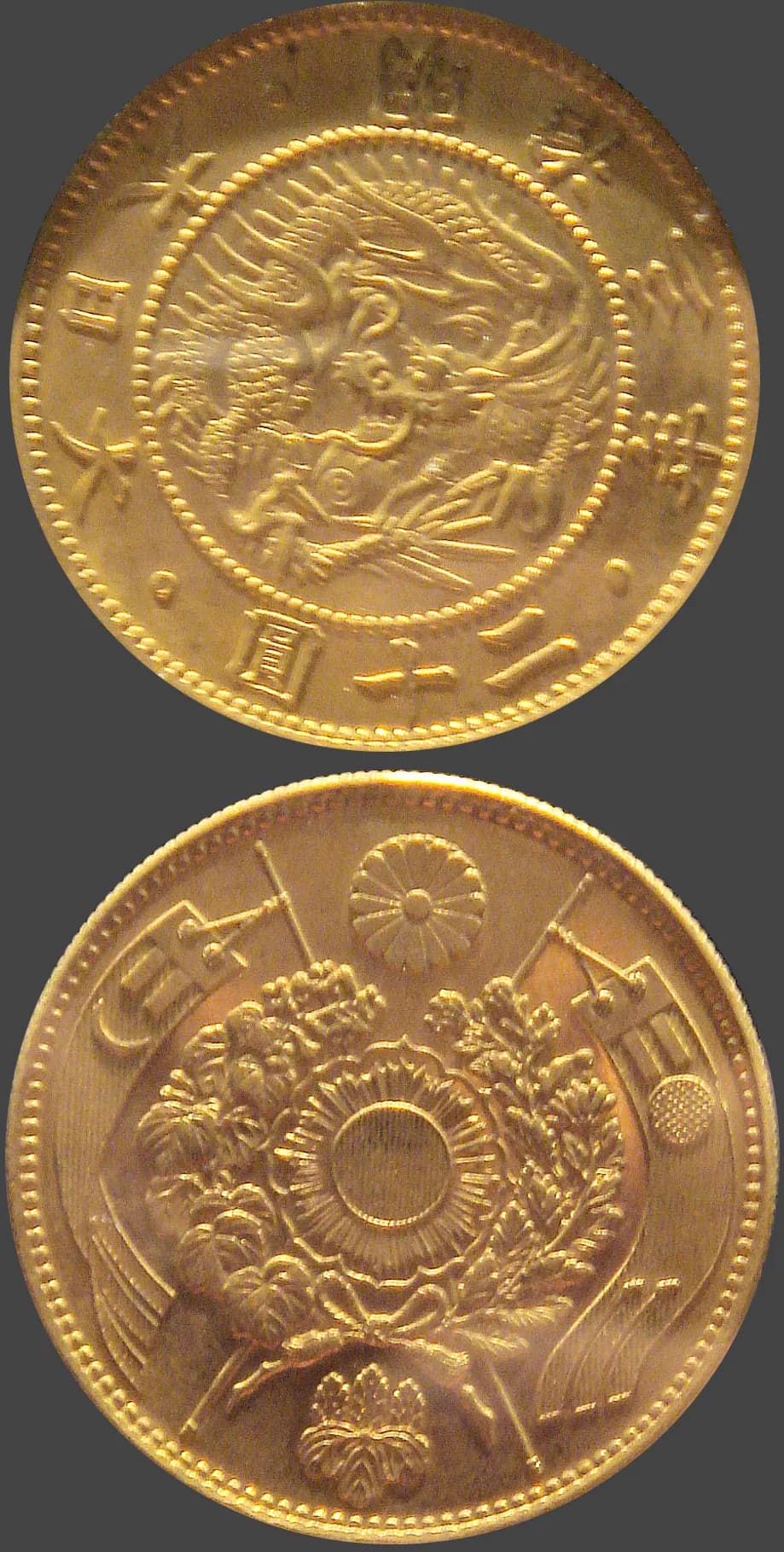
Image: Modern Japanese coinage / PHGCOM / Wikimedia Commons / CC BY-SA 3.0(source)
Ansei Chōgin — The Final Edo Era Silver Bullion Coin amidst the Turbulence of the Bakumatsu
A Short-lived yet Historical Silver Bullion Created Amidst the Turmoil of Opening Japan
Subject coin: 安政丁銀
Overview
During the tumultuous end of the Edo period, as Japan moved from the arrival of the Black Ships to the opening of the country, a coin was born in the midst of international upheaval and domestic economic turbulence. This is the "Ansei Chōgin," which began minting in Ansei 6 (1859). This chōgin belongs to the newest generation in the history of the weighted silver currency that supported the Japanese economy throughout the Edo period. The silver purity was only about 13% — the lowest of any chōgin (per the Currency Museum catalog), a desperate measure to curb the imbalance in gold-silver exchange rates due to the opening of the country and the subsequent gold outflow overseas. However, its circulation lasted only about 10 years. The Ansei Chōgin was issued right after the significant historical turning point of the opening of the ports and holds extremely important meaning as a record just before the old coinage system made way for modern currency. Indeed, as the "last chōgin" in Japanese numismatic history, it is a precious entity that conveys the memories of the confusion and transformation of the Bakumatsu era to this day. For those interested in learning about the entire Edo period coinage system, please see Details of Edo Silver Coins. Also, as koban were used alongside chōgin in the Edo period, reading Types and Market of Koban will deepen your understanding of the monetary situation at the time.
Specifications
- Denomination
- 秤量貨幣(時価)
- Minting period
- 安政6年〜明治4年(1859-1871年)
- Metal composition
- 銀約13%(貨幣博物館 常設展示図録)
- Weight
- 不定(秤量貨幣)
- Dimensions
- 不定(長さ約10〜15cm、幅約4〜6cmのなまこ形)
- Mintage
- 不詳(諸説あり)
- Mint supervisor
- 後藤家(銀座)
- Market price
- 個別の価格は、照合済みの記録(出典つき)が得られたものだけを市場記録に掲載する方針です。
Chapter 1: The Waves of Opening the Country — The Crisis of Gold-Silver Ratio that Shook the Shogunate
Image: Modern Japanese coinage / Coindesmonnaies / Wikimedia Commons / CC BY-SA 4.0(source)
Since the arrival of the Black Ships in the 6th year of Kaei (1853), Japan faced an unprecedented national crisis. In Ansei 5 (1858), the Treaty of Amity and Commerce between Japan and the United States was signed, and in the following Ansei 6 (1859), Yokohama, Nagasaki, and Hakodate were opened. The country's isolation was lifted, and trade with foreign countries began in earnest. However, this opening posed a serious crisis to Japan's monetary system. While the international gold-silver ratio at the time was around gold 1 to silver 15, in Japan, an independent ratio where gold was relatively cheap at gold 1 to silver 5 had long been maintained. Foreign merchants took advantage of this disparity, bringing silver from their countries, exchanging it for Japanese gold coins (particularly the major gold coin of the time, Details of Keichō Koban), acquiring them cheaply and exporting them abroad for huge profits. As a result, Japan's gold began rapidly flowing out across the borders, significantly shaking the shogunate's finances.
In response to this crisis, the shogunate, led by Roju Ando Nobumasa, enacted a policy of debasement, lowering the quality of gold coins and increasing the amount minted. Ansei Koban and later Man'en Koban are examples of this. However, if the quality of gold coins was lowered, the quality of silver coins also needed to be lowered accordingly; otherwise, the domestic gold-silver ratio would once again deviate from the international ratio, causing confusion. Thus, in Ansei 6 (1859), the minting of this Ansei Chōgin began. The silver purity of the Ansei Chōgin was set at approximately 13%, lower than any previous chōgin (below even the Tenpō Chōgin's 26%, and far below Genroku Chōgin's 64% or Shōtoku Chōgin's 80%), aiming to balance them with the circulating gold coins. However, this rapid currency debasement not only aimed to stem the gold outflow but also caused significant turmoil in the domestic economy.
Chapter 2: The Struggle of Ginza — The Decline in Purity and the Inheritance of Traditional Techniques
Image: Modern Japanese coinage / Coindesmonnaies / Wikimedia Commons / CC BY-SA 4.0(source)
The production of Ansei Chōgin was undertaken by "Ginza," which had been central to coin production throughout the Edo period. Ginza was founded in Fushimi in the 6th year of Keichō (1601), then moved to Suruga and later to Kyobashi in Edo, before relocating to Kakiwarichi. As a weighted currency, chōgin's value is determined by its weight and purity, requiring strict manufacturing processes. Initially, high-purity silver bullion, known as haifukigin collected from across the country, was melted in a furnace, with base metals such as copper added to adjust it to the specified purity in a process known as "fukiwake." During this process, Ansei Chōgin was adjusted to about 13% — the lowest silver purity of any chōgin. The molten silver was then poured into molds, cooled, solidified, and formed into the distinctive namako shape. In this stage, skilled artisans would strike the still hot silver bullion with a hammer, applying the unique hammer marks to the surface of the chōgin.
The most crucial process was "gokuin-uchi." On the chōgin's surface, the characters "常是," indicating the guarantee of Oguro Joze (the head of Ginza), were stamped, while the reverse was stamped with characters representing the era like "保," "文," "安," and marks such as "大," "小." For Ansei Chōgin, the character "安" was stamped, marking it as identifiable as Ansei Chōgin. These processes required advanced skills and experience, but even amid the Bakumatsu chaos, the artisans of Ginza endeavored to preserve traditional techniques and maintain currency supply. However, the repeated debasement and decline in purity began to undermine public trust in the currency. Furthermore, alongside chōgin, Identifying Edo Gold Coins were also of declining quality, and the credibility of the entire monetary system was questioned during this era.
Chapter 3: Turbulent Circulation — Inflation and the End of Weighted Currency
Image: Modern Japanese coinage / Coindesmonnaies / Wikimedia Commons / CC BY-SA 4.0(source)
The year when Ansei Chōgin was issued, Ansei 6 (1859), was an extremely unstable period just after the opening of the ports. The commencement of foreign trade brought about great confusion in the domestic economy, particularly with the imbalance in gold-silver exchange rates leading to sharp inflation. Although Ansei Chōgin was issued in conjunction with the decline in purity of gold coins, its low purity of about 13% made the decline in currency value starkly apparent to Japanese accustomed to previously higher purity chōgin. Merchants were compelled to measure the weight and ascertain the purity of each chōgin during transactions, due to differing values by purity and weight, presenting a cumbersome task. The traits of weighted currency were highly inconvenient in everyday small transactions, and especially inefficient amidst the active international trade following the ports' opening.
In open port areas like Yokohama, transactions with foreign merchants were active, but they were bewildered by Japan's complex monetary system, particularly the handling of weighted currency such as chōgin. Additionally, debasement intended to stem the outflow of gold and silver ultimately reduced the domestic supply, further exacerbating inflation. For example, rice prices surged throughout the Ansei era, burdening the lives of common people. Chōgin's value was contingent on its weight and purity, causing continuous doubt over whether "this chōgin meets the stipulated purity" or "the weight is sufficient" with every transaction, shaking trust in currency. Under these circumstances, people began to gradually prefer more convenient and fixed-denomination currency. Ansei Chōgin was about to end its role merely about 10 years post-issuance. At the time, copper coins such as Types and Identification of Anasen were also widely circulating, but they too were affected by the era of upheaval.
Chapter 4: The End of an Era — The Guidepost to Modern Currency
Image: Modern Japanese coinage / Coindesmonnaies / Wikimedia Commons / CC BY-SA 4.0(source)
Ansei Chōgin became the very "last" in the series of chōgin issued in the Edo period. Born amidst the international wave of opening the country and the ensuing domestic economic turmoil, this chōgin bears important historical significance as it symbolizes the transition from the old weighted currency system reaching its limits, towards a modern currency system. After the Meiji Restoration, the new government embarked on fundamental reforms of the currency system as part of building a modern nation. The old, complex, and diverse currencies (koban, chōgin, zeni, etc.) were replaced with a new unified system.
In Meiji 4 (1871), the new government proclaimed the "New Currency Regulations," establishing a modern currency system using units of yen, sen, and rin. This enabled Japan to adopt a currency system conforming to international standards. By this new currency regulation, Ansei Chōgin and all old currencies were abolished, initiating exchanges for new currency. Ansei Chōgin, after a short circulation period of just about 10 years, vanished from the stage of history. This represented not simply a change of currency, but symbolized Japan's major shift from a feudal society to a modern nation. Ansei Chōgin can be seen as a currency at precisely the turning point leading to Assessing the Value and Identification of Modern Currency.
Presently, Ansei Chōgin is a significant specimen in Japanese numismatic history, sought after by many coin collectors. As a "last chōgin" reflecting the turmoil of the Bakumatsu, the opening of the country, and transition to modernity, its presence remains undiminished. This namako-shaped silver bullion is more than just a lump of metal; it is a precious legacy narrating a huge transitional phase in Japanese history.
Value & Rarity
Ansei Chōgin, due to its historical significance as the last chōgin of the Edo era, maintains a certain demand in the numismatic market. However, its rarity tends to be slightly lower compared to other older chōgin. This is because of the relatively high issuance volume and short circulation period, resulting in many existing specimens in less worn condition. Market prices vary widely depending on the chōgin's weight, silver purity, and particularly its state of preservation and type of inscribed mark. Specifically, specimens with clear "常是" or "安" marks on the surface, or those with rare markings like "大黒," are often highly valued. However, as chōgin is a weighted currency, individual differences are significant, and forgeries or altered pieces exist. Thus, when considering purchase, buying from a trusted expert or dealer is essential, and knowledge about How to Identify Fakes and Altered Products is also important. Checking market price trends through resources like Price Charts for Monitoring Market Trends is also advisable. Ansei Chōgin, with its historical background and unique shape, attracts a wide range of collectors from beginners to advanced enthusiasts.
Individual prices are listed only once verifiably matched, sourced records exist.
Conclusion
Ansei Chōgin is not just a silver bullion. It is the testament to the shogunate's efforts to protect the national economy amidst unprecedented international circumstances during the opening of the country and represents the last gleam of the old weighted currency system just before its transformation into a modern monetary system. Despite its short life of only about 10 years, the historical weight that this silver bullion has witnessed and touched is immeasurable. The Ansei Chōgin, traversing the turbulence of the Bakumatsu and the Meiji Restoration, is a precious historical witness eloquently narrating Japan's great transformational period. As the editor-in-chief of ITTENDO, I hope this silver coin's story leaves a deep imprint on your hearts.
Related Stories
Two-System of Chōgin and Mameitagin — Tracing the History of Edo Silver Coins
Edo silver coins were always circulated as a set of 'Chōgin (丁銀, Large)' and 'Mameitagin (豆板銀, Small)'. Why was this peculiar two-system created?
Coin StoryThe Window of the Closed Country, Ripples of Silver — How VOC Coins Transformed Japan's Economic Map
A Collision of Foreign Silver and Japanese Wealth on Dejima, Nagasaki
Coin StoryGenroku Chōgin - Tracing the History of Edo Silver Coins
Following the debasement of the Koban, silver was also counterfeited. The shock of the Genroku 8 (1695) Chōgin recoinage on Edo prices
Dealers
Dealers Handling This Category
A reference when considering a sale or appraisal. All are dealers and auction houses with a proven track record.
Japan Coin Auction (JCA)
Tokyo
Holds regular auctions with reliable hammer price data, making it a useful resource for tracking market values. Caters to a wide range of collectors from beginners to advanced buyers.
Ginza Coins
Ginza, Chuo-ku, Tokyo
One of Japan's most established numismatic dealers. The scale and variety of their regular auctions is among the largest in the country. Their catalogs are considered a benchmark for market pricing.
Osaka Numismatic Auction
Osaka
A Kansai-based coin auction house with particular strength in regional and hole coins.