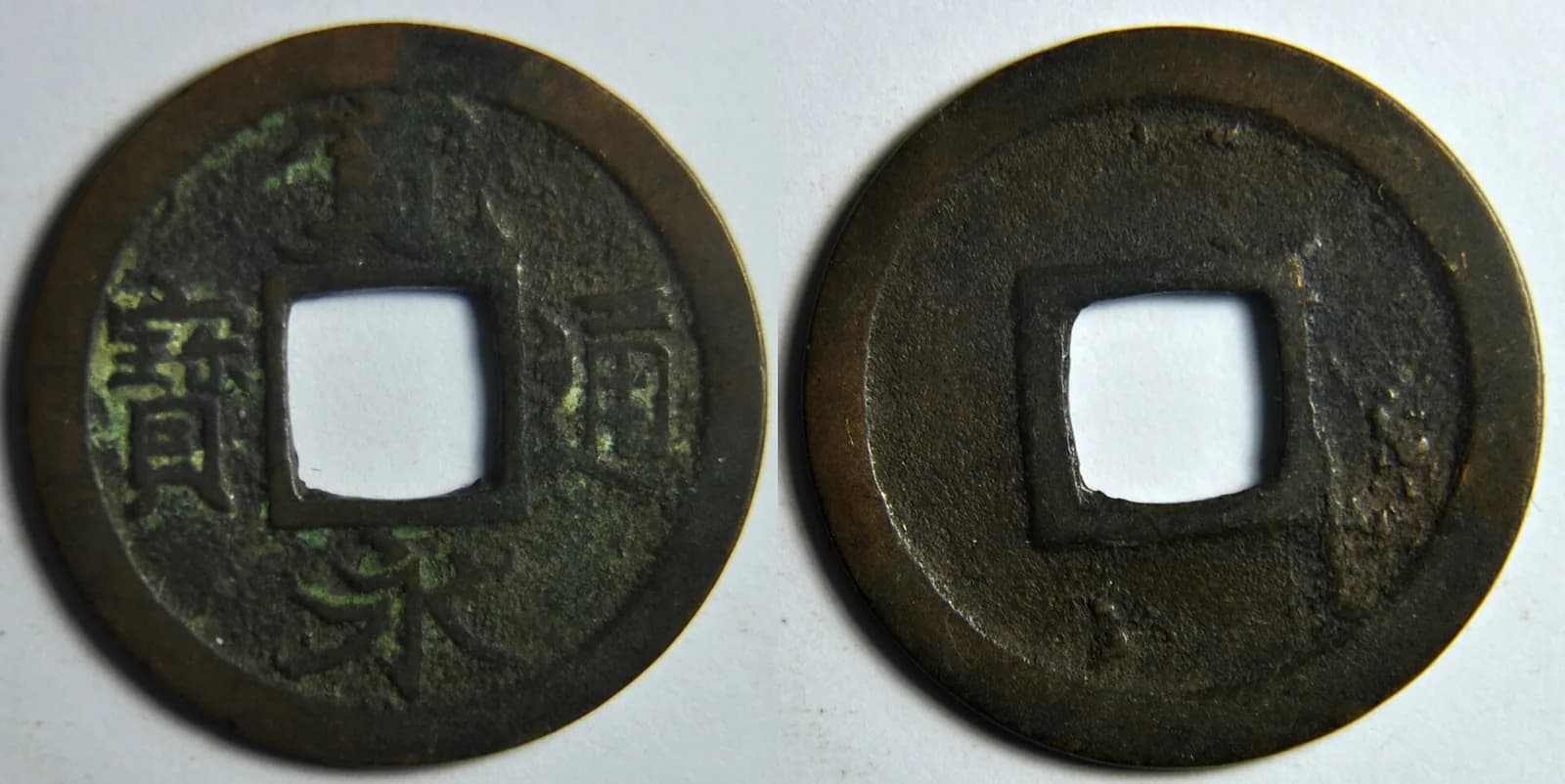
Image: Japanese holed coins (square-holed cash coins) / Jean-Michel Moullec from Vern sur Seiche (35, Bretagne), France / Wikimedia Commons / CC BY 2.0(source)
The Reality of Sengoku Bansen — Tracing the History of Medieval Currency
During the Sengoku period, bansen (板銭), made from finely cut copper plates, appeared across the regions. An era when metal pieces without coin shapes served as 'money'.
Subject coin: 戦国板銭(バンセン)の実態
Overview
The reality of Sengoku Bansen (板銭) is an invaluable page in the history of Japanese currency from 1500-1600. During the Sengoku period, bansen (板銭), made from finely cut copper plates, appeared across different regions. It was an era when metal pieces without coin shapes circulated as money. This article traces the reality of Sengoku Bansen (板銭) as medieval currency, following its historical context, casting technology, circulation, and influence on later generations, all based on historical facts. Understanding the historical context beyond just market numbers will significantly change how we perceive its value. The history of Japanese currency begins with Wado Kaichin cast during the Nara period, through various gold and silver coins of the Edo period, and leads to modern coins of the Meiji period. For those wanting to learn from the basics, also refer to The Value and Identification of Modern Currency and Overview of Meiji Period Coins.
Specifications
- Denomination
- —
- Minting period
- 1500-1600
- Metal composition
- —
- Weight
- —
- Dimensions
- —
- Mintage
- 不詳(諸説あり)
- Mint supervisor
- 不詳
- Market price
- 状態により変動(落札履歴を参照)
The Era of Sengoku Bansen — Casting Background
Image: Modern Japanese coinage / Coindesmonnaies / Wikimedia Commons / CC BY-SA 4.0(source)
The emergence of Sengoku Bansen (板銭) is deeply intertwined with the political and economic circumstances of its time. Medieval currency was minted in response to fiscal and circulation challenges faced by rulers, arising from the societal needs of that era. We begin by examining the starting point of why this currency became necessary under specific historical conditions. The fact that simple exchange media like copper and iron plates were cut to a certain weight is crucial for understanding the historical position of this currency. The fact that it disappeared after the unification of currency by the shogunate during the Keichō period is crucial for understanding the historical position of this currency. Referring to Checking Auction Prices for Old Coins can deepen your understanding. Given the prices and systems of the time it was minted, we can see that the meaning of the same-named currency can vary greatly depending on its issue period. Existing specimens wear and oxidize over time, making those in their original state at the time of minting increasingly rare as time progresses. Market evaluation is determined by a combination of rarity, preservation state, and collector popularity; no single factor can explain the price.
How Was Sengoku Bansen Crafted? — Material and Technique
Image: Modern Japanese coinage / Coindesmonnaies / Wikimedia Commons / CC BY-SA 4.0(source)
Understanding the value of Sengoku Bansen (板銭) is impossible without discussing its casting material and manufacturing methods. Medieval currency retains the diligent craftsmanship of artisans in its metal composition and finishing techniques, which directly influence modern evaluations. Tracing the careful selection of materials and manufacturing processes reveals the accumulation of technology embedded in each piece. The fact that it was predominantly used in Eastern Japan and the Tohoku region is crucial in understanding its historical positioning. Referring to Checking Price Trends with Market Charts can further deepen the understanding. Existing specimens wear and oxidize over time, making those in their original state at the time of minting increasingly rare as time progresses. Market evaluation is determined by a combination of rarity, preservation state, and collector popularity; no single factor can explain the price. Recognizing basic features such as font style, color tone of the metal, dimensions, and weight is the first step in verifying authenticity or lineage. Learning the historical background allows one to perceive the cultural depth unique to the currency, beyond just market numbers. As collecting continues, the historical context and circumstances of minting for each denomination connect intricately, and knowledge grows three-dimensionally.
Sengoku Bansen in Everyday Life — Circulation and Economy
Image: Modern Japanese coinage / Coindesmonnaies / Wikimedia Commons / CC BY-SA 4.0(source)
The reality of Sengoku Bansen (板銭) is that, after issuance, it passed hand to hand among people, being used in daily life. Understanding how medieval currency circulated in the market and impacted prices and transactions is at the heart of currency history. Through the movements of the economy and popular reactions of the time, we interpret the role this currency played. The fact that it functioned as an alternative currency in 'areas unreachable by imported coins' is crucial for understanding its historical position. Referring to Standards for Grading Old Coins can further deepen your understanding. Market evaluation is determined by a combination of rarity, preservation state, and collector popularity; no single factor can explain the price. Recognizing basic features such as font style, color tone of the metal, dimensions, and weight is the first step in verifying authenticity or lineage. Learning the historical background allows one to perceive the cultural depth unique to the currency, beyond just market numbers. As collecting continues, the historical context and circumstances of minting for each denomination connect intricately, and knowledge grows three-dimensionally. A single old coin serves as a document reflecting the economic policies and lives of people during its time, and the more the background is understood, the way its value is perceived changes.
Legacy of Sengoku Bansen — Impact on Later Generations
Image: Modern Japanese coinage / Coindesmonnaies / Wikimedia Commons / CC BY-SA 4.0(source)
Though Sengoku Bansen (板銭) ended its era, it left influences in the history of successive currencies and collection. We reflect on how medieval currency was positioned within re-casting, abolition, and inheritance, and how it is evaluated today. Considering what past pieces mean in today's market enhances the precision of value judgment. The fact that confusion arose with multiple weight units of the same metal coexisting is crucial to understanding its historical position. Referring to Price Monitoring of Interesting Coins with Vault can further deepen your understanding. Recognizing basic features such as font style, color tone of the metal, dimensions, and weight is the first step in verifying authenticity or lineage. Learning the historical background allows one to perceive the cultural depth unique to the currency, beyond just market numbers. As collecting continues, the historical context and circumstances of minting for each denomination connect intricately, and knowledge grows three-dimensionally. A single old coin serves as a document reflecting the economic policies and lives of people during its time, and the more the background is understood, the way its value is perceived changes. Considering the prices and systems of the time the currency was minted, the meaning of the same-named currency can greatly vary depending on its issue period.
Value & Rarity
The market value of Sengoku Bansen (板銭) is determined by three factors: rarity, condition (grade), and collector demand. Even among medieval currencies, prices can vary severalfold to multiples depending on the minting period, differences in script, or whether it is close to unused condition. Fewer existing brands have fewer opportunities to appear on the market, and well-preserved pieces increase in rarity over time. When reading market prices, it is prudent to check not the asking price but the actual successful auction prices across multiple cases. The latest price movements can be confirmed with Price Monitoring of Interesting Coins with Vault. Market evaluation is determined by a combination of rarity, preservation state, and collector popularity; no single factor can explain the price. Recognizing basic features such as font style, color tone of the metal, dimensions, and weight is the first step in verifying authenticity or lineage.
Conclusion
The reality of Sengoku Bansen (板銭) was born from the needs of the 1500-1600 era, played a role in people's daily lives, and left its mark on later generations. Understanding the history behind a single currency helps develop a reliable discernment beyond market numbers alone. For those interested in medieval currency, it is recommended to cultivate your judgment axis gradually by patiently comparing multiple transaction data.
Related Stories
Eiraku Tsuho — The Chinese 'Standard Currency' that Moved Muromachi Japan
An Unknown Era When Foreign Coins Formed Japan's Economic Foundation
Coin StoryThe Coin Selection Edict of the Sengoku Period — Tracing the History of Medieval Currency
"Only Accept Good Coins" — The Coin Selection That Spread During the Sengoku Period Was an Economic Terror That Troubled the Daimyo. Responses by Nobunaga, Ieyasu, and Shingen
Coin StoryCounterfeiting and Crackdowns on the Eiraku Tsūhō (永楽通宝) — The Most Widely Circulated and Most Counterfeited Coin
A History of Counterfeiting and Regulation from the Kamakura Period through the Edo Period
Dealers
Dealers Handling This Category
A reference when considering a sale or appraisal. All are dealers and auction houses with a proven track record.
Ginza Coins
Ginza, Chuo-ku, Tokyo
One of Japan's most established numismatic dealers. The scale and variety of their regular auctions is among the largest in the country. Their catalogs are considered a benchmark for market pricing.
Japan Coin Auction (JCA)
Tokyo
Holds regular auctions with reliable hammer price data, making it a useful resource for tracking market values. Caters to a wide range of collectors from beginners to advanced buyers.
Taisei Coins
Tokyo
A dealer with an international network. Offers advanced services such as consignment to overseas auctions and NGC/PCGS grading submission. Recommended for high-value or internationally recognized coins.