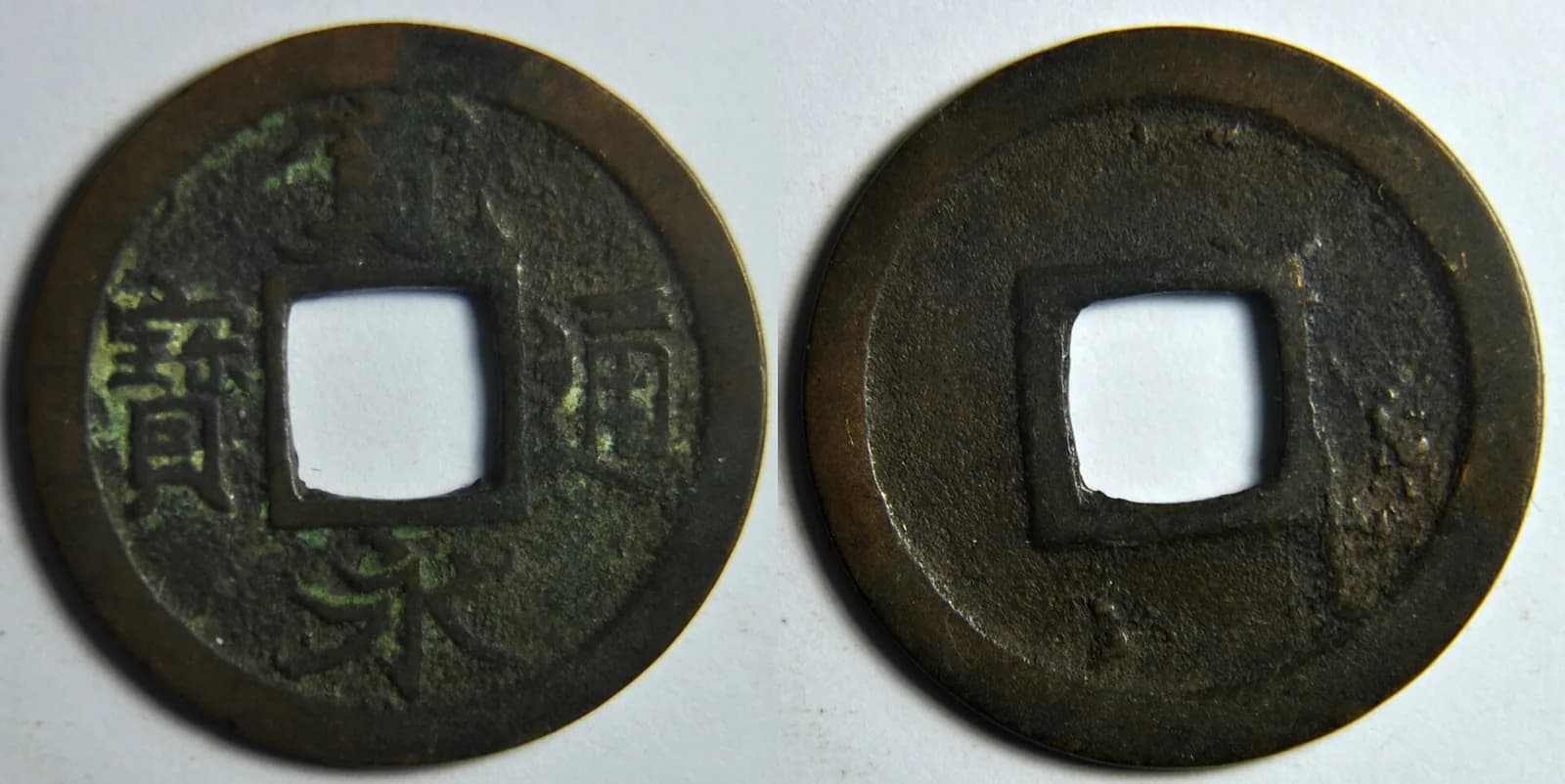
Image: Japanese holed coins (square-holed cash coins) / Jean-Michel Moullec from Vern sur Seiche (35, Bretagne), France / Wikimedia Commons / CC BY 2.0(source)
Wartime Tin 5-Sen Coin — A Lightweight Coin Born of Late-War Privation
1944: The Realities of Wartime Inscribed on a 1-Gram Coin
Subject coin: 戦時錫5銭貨
Overview
The wartime tin 5-sen coin (戦時錫5銭貨) was minted in Japan in 1944 (Shōwa 19). At that time, Japan was in the final stages of the Second World War, and the shortage of resources had become severe. Because tin was a relatively obtainable metal, it was adopted as the material for the 5-sen coin, along with the 10-sen coin. Weighing just 1.0 g with a diameter of 19 mm, the coin is emblematic of the desperate material conditions of the era. Although it continued to circulate for a time after the end of the war, it was demonetized in 1946 (Shōwa 21) with the introduction of the new yen. To this day, the coin is highly regarded among collectors as a precious testament to Japan's impoverishment in the final years of the war. For more background and information on its economic impact, please refer to An Overview of Modern Coin Values and Identification.
Specifications
- Denomination
- 5銭
- Minting period
- 昭和19年〜21年(1944-1946年)
- Metal composition
- 錫
- Weight
- 1.0g
- Dimensions
- 直径19mm
- Mintage
- 不詳(諸説あり)
- Mint supervisor
- 不詳
- Market price
- 3,000円〜10,000円(状態による)
Wartime Japan — The Background of the Tin 5-Sen Coin's Birth
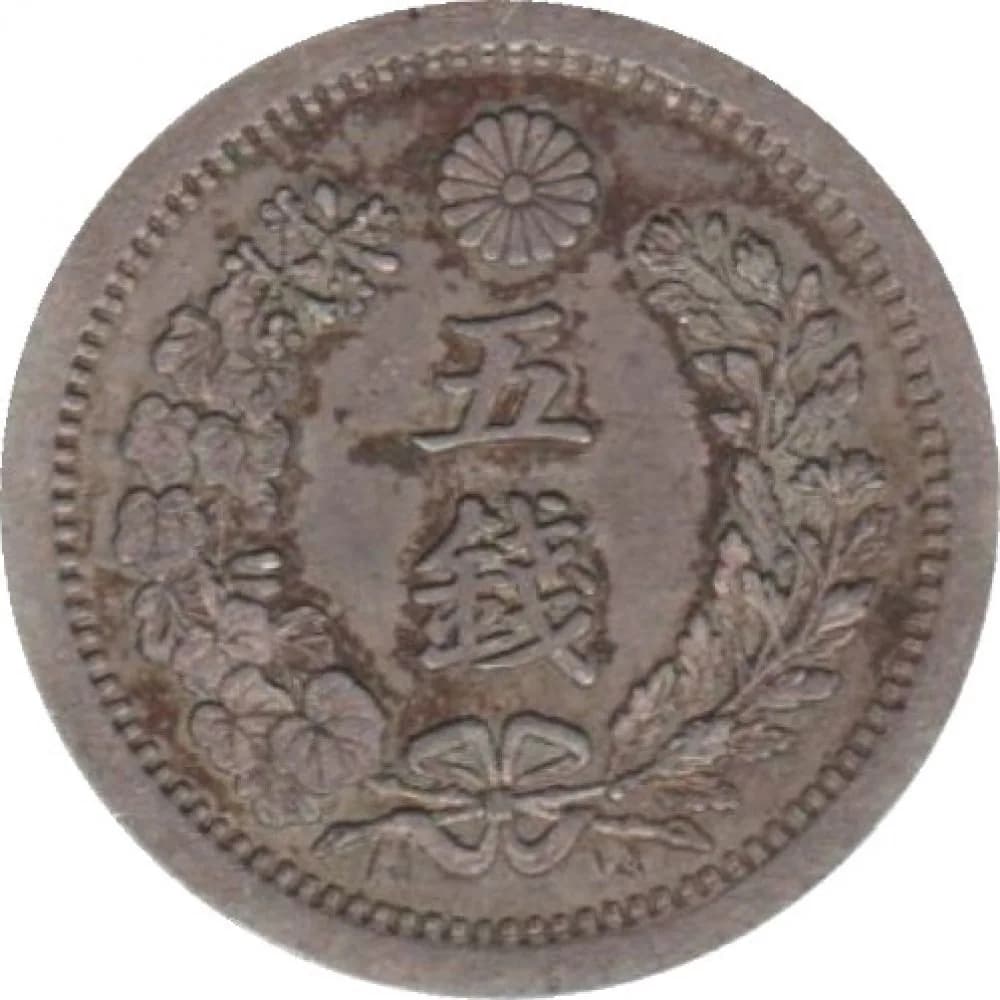
Image: Modern Japanese coinage / Coindesmonnaies / Wikimedia Commons / CC BY-SA 4.0(source)
In 1944, Japan was entering a grave phase of the Second World War. By Shōwa 19, the depletion of resources had become pronounced, and the use of copper and nickel that had been standard until then grew increasingly difficult. In particular, the loss of naval supremacy in the Pacific theater disrupted the transport of raw materials from Southeast Asia, severely constraining the supply of metals to the Mint (Osaka). The government therefore decided to mint coins using tin, which was comparatively easier to obtain at the time. Because a certain quantity of tin could be expected to be secured from occupied territories such as the Malay Peninsula, it was adopted for two denominations: the 10-sen and 5-sen coins. Thus the tin 5-sen coin was born. The Japanese government of the time, acting under the name of Emperor Shōwa, demanded strict saving and frugality from the populace in order to allocate resources efficiently. The 5-sen coin was symbolic of this, and its lightness of just 1.0 g and small diameter of 19 mm plainly reflected the deprivation of wartime Japan. Minted in 1944, this coin subsequently circulated alongside the tin 10-sen coin. As the war dragged on, prices soared and the face value of 5 sen gradually lost its purchasing power in the daily lives of ordinary people; nonetheless, the coin continued to play a part in the country's economic circulation. After the end of the war it remained in circulation for a time, but it was demonetized by the new-yen conversion implemented in 1946 (Shōwa 21), bringing its brief role to a close. For more detail on the economic conditions of the wartime period, please see Details on the Keichō Koban (慶長小判).
The Minting Process — Wartime Technology and Challenges
Image: Modern Japanese coinage / Coindesmonnaies / Wikimedia Commons / CC BY-SA 4.0(source)
The minting of the 5-sen coin was the crystallization of Japan's technological capability at the time. Minting was carried out primarily at the Osaka Mint, where technicians poured their efforts into producing high-quality coins from limited resources. Tin, as a metal, is soft and easy to work but lacks durability, so specialized techniques were required for minting. Craftsmen made fine adjustments to casting temperature and cooling speed in order to preserve the coin's strength while making use of tin's properties. Minting of the coin, which began in Shōwa 19 (1944), was set to the compact specifications of 1.0 g in weight and 19 mm in diameter. At a time when metals such as copper and nickel were being requisitioned as priority military supplies, tin attracted attention as a comparatively obtainable metal; together with the tin 10-sen coin issued the same year, it was adopted for two types of subsidiary currency: the 5-sen and the 10-sen. The design of the tin 5-sen coin was emblematic of wartime simplicity: on the obverse the characters「五銭」are inscribed, and on the reverse the chrysanthemum crest. This design reflected the militarism of Japan at the time and was meant to project the dignity of the state. The minted coins subsequently circulated nationwide and supported Japan's wartime economy. Even after Japan's defeat in August 1945 (Shōwa 20), the tin 5-sen coin continued to circulate for a time as legal tender, but it was demonetized by the new-yen conversion implemented in 1946 (Shōwa 21), bringing its brief role to a close. Those who wish to learn more about the minting techniques of the tin 5-sen coin may refer to Types of Edo Gold Coins and How to Identify Them.
Circulation and Economic Impact — The Reality of the Wartime Tin 5-Sen Coin
Image: Modern Japanese coinage / Coindesmonnaies / Wikimedia Commons / CC BY-SA 4.0(source)
How did the 5-sen coin circulate in wartime Japan? The economy of the time was suffering under material shortages and inflation caused by the war. The tin 5-sen coin issued in 1944 (Shōwa 19), though compact at 1.0 g in weight and 19 mm in diameter, played an important role in everyday transactions; in practice, however, its value was declining rapidly. Due to soaring prices, a face value of 5 sen was of little use for purchasing daily necessities. Even so, this coin was indispensable for small-value transactions, and was still widely used especially in regional markets.
Behind the adoption of tin as a material was the fact that metals such as copper and nickel were being requisitioned as priority military supplies. The Treasury Mint, having explored alternative materials, chose tin — which was comparatively obtainable within the domestic circulation of the period — and adopted it for two denominations: the 10-sen and the 5-sen. However, as the war situation deteriorated, the supply of tin itself became unstable, and it is said that maintaining production quantities and quality posed considerable difficulties (accounts vary).
After the war, when the new-yen conversion was implemented in February 1946 (Shōwa 21), existing banknotes and coins were progressively demonetized, and the tin 5-sen coin was among them. The new-yen conversion was an economic measure centered on the issuance of new Bank of Japan notes and the freezing of deposits on old notes, carried out with the aim of suppressing rampant inflation. Until it was demonetized, the tin 5-sen coin continued to circulate even through the confusion of the immediate postwar period. The economic conditions of this era have been analyzed from various perspectives by historians and economists. For information on the economic situation and currency circulation during the war, please also refer to Types of Holed Coins and How to Identify Them.
Legacy — The Appraisal and Significance of the Tin 5-Sen Coin
Image: Modern Japanese coinage / Coindesmonnaies / Wikimedia Commons / CC BY-SA 4.0(source)
The wartime tin 5-sen coin continued to circulate for a time after the end of the war, but was officially abolished by the new-yen conversion of 1946 (Shōwa 21). This new-yen conversion was implemented in March of that year, and existing currency was successively collected and demonetized. The coin subsequently came to occupy an important place in Japan's postwar monetary history. As a coin issued during wartime, its historical value began to be reassessed in postwar Japan. Collectors recognized it as a symbol of the horrors of war and the hardships endured by the people, and its collectible value grew. In particular, the small tin form — weighing just 1.0 g with a diameter of 19 mm — has attracted the attention of numismatic researchers as evidence of the resource shortages of 1944 (Shōwa 19), when copper and cupronickel were being compelled into military requisition. Together with the tin 10-sen coin issued at the same time, the circumstances under which tin was adopted for two denominations — the 5-sen and the 10-sen — as a comparatively obtainable metal are evaluated as primary source material illustrating the realities of wartime economic policy. The wartime tin 5-sen coin occupies a unique place in modern Japan's monetary history: against a backdrop of war, it nonetheless fulfilled the role of supporting the daily lives of the people. The significance of this coin's issuance and circulation is a testament to how postwar Japan looked back on its past and began to move forward toward the future. Even today, coins with such historical backgrounds are popular among collectors, and particularly fine specimens can change hands at high prices. For the historical significance of the wartime tin 5-sen coin, please also refer to Basic Knowledge of Old Coin Auctions.
Value & Rarity
The wartime tin 5-sen coin is popular among collectors due to its issuance background. In particular, well-preserved examples can command high prices. On the market, they frequently change hands in the range of 3,000 to 10,000 yen, and especially fine or uncirculated specimens can fetch even higher amounts. Because this coin plainly reflects Japan's economic conditions during the war, its historical value is also high, making it an important item for collectors. When collecting the wartime tin 5-sen coin, it is important to verify its condition and rarity. As counterfeits and altered pieces do exist, it is advisable to request authentication from a trusted specialist. For basic knowledge regarding market transactions, please also refer to Basic Knowledge of Old Coin Auctions.
Conclusion
The wartime tin 5-sen coin is a coin that symbolizes the resource shortages and economic hardship of Japan in the final stages of the war. Through this coin, one can glimpse the difficult circumstances that Japan faced at the time. Although it was abolished by the new-yen conversion after the war, its historical significance has not been lost, and it has become a treasured collectible for modern collectors. The wartime tin 5-sen coin is not merely a piece of currency; as a fragment that speaks to Japanese history, it teaches us a great deal. By holding this coin in one's hands, one can touch the feelings of those who lived through the harsh era of war.
Related Stories
Wartime 10-sen Aluminum Coin — A Witness in Metal Reflecting Tumultuous Times
From 1940 to 1943, metal went to the battlefield. Aluminum 10 sen in the hands of the public
Coin StoryWartime Tin 10 Sen Coin — Japan's Dismal Outlook Etched in Tin of 1944
In an era when copper and nickel became weapons, the tin 10 sen coin narrates the last throes of wartime economy
Coin StoryWartime 1 Sen Aluminum Coin (Late Period) — Testimony from Times of War
The Trajectory and Significance of Coins Minted During 1941-1942 Wartime
Dealers
Dealers Handling This Category
A reference when considering a sale or appraisal. All are dealers and auction houses with a proven track record.
Japan Coin Auction (JCA)
Tokyo
Holds regular auctions with reliable hammer price data, making it a useful resource for tracking market values. Caters to a wide range of collectors from beginners to advanced buyers.
Ginza Coins
Ginza, Chuo-ku, Tokyo
One of Japan's most established numismatic dealers. The scale and variety of their regular auctions is among the largest in the country. Their catalogs are considered a benchmark for market pricing.