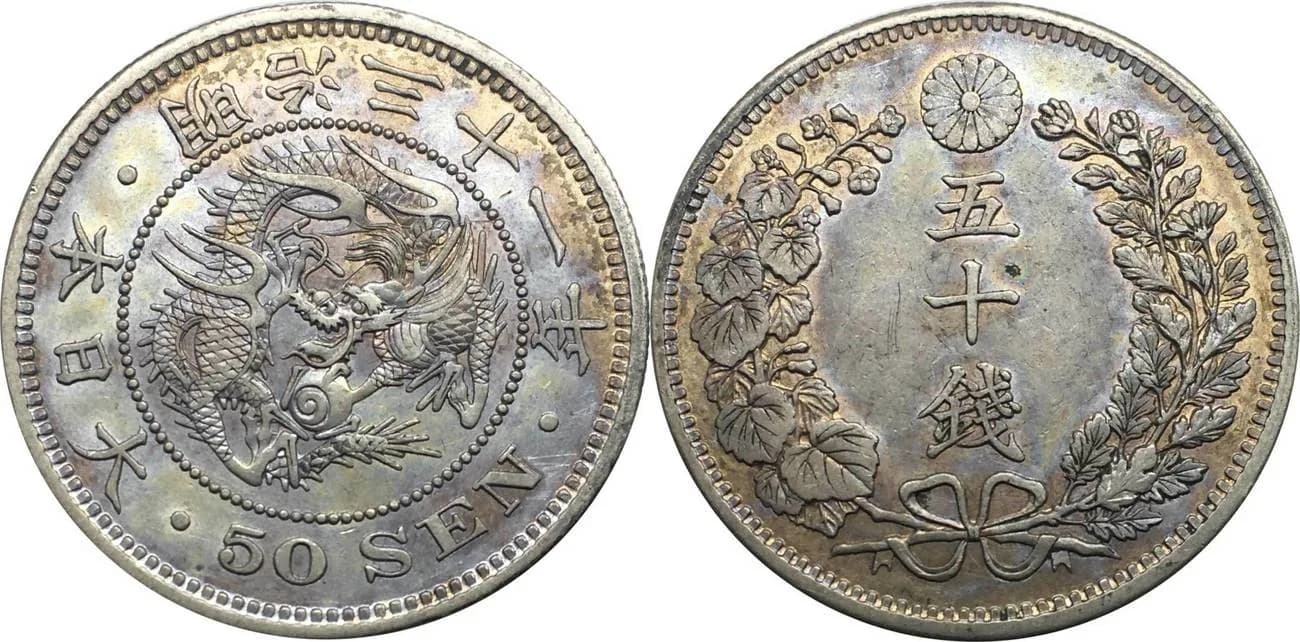
Image: Modern Japanese coinage / The government of the Empire of Japan. / Wikimedia Commons / Public domain(source)
Jōwa Shōhō — The Auspicious Inscription that Shone in the Twilight of the Ritsuryō State
The Sixth Imperial Coin Born During the Decline of the Ritsuryō System
Subject coin: 承和昌宝
Overview
Jōwa Shōhō, minted in the year Jōwa 2 (835), is an ancient Japanese coin known as the sixth among the 'Imperial Twelve Coins'. This era was marked by the reign of Emperor Ninmyō and the gradual decline of the Ritsuryō state. The coin was minted in a politically unstable situation three years before the 'Jōwa Disturbance' occurred. The inscription 'Shōhō' signifies prosperity and auspiciousness, believed to carry political intent at the time. Issued 17 years after its predecessor, the Fujushinhō (富寿神宝) in 818, its circulation range is believed to have narrowed, reflecting the decline of the Ritsuryō system. Jōwa Shōhō, with such a historical background, remains an important testament to the changes of its time, handed down to this day. For more details on the charm of ancient coins, refer here.
Specifications
- Denomination
- 不明(諸説あり)
- Minting period
- 承和2年〜承和15年(835-848年)
- Metal composition
- 銅(諸説あり)
- Weight
- 不明(諸説あり)
- Dimensions
- 直径約24mm(諸説あり)
- Mintage
- 不詳(諸説あり)
- Mint supervisor
- 不明
- Market price
- 数万円〜数十万円(状態による)
The Era of Jōwa — Coin Born Amidst Political Turbulence
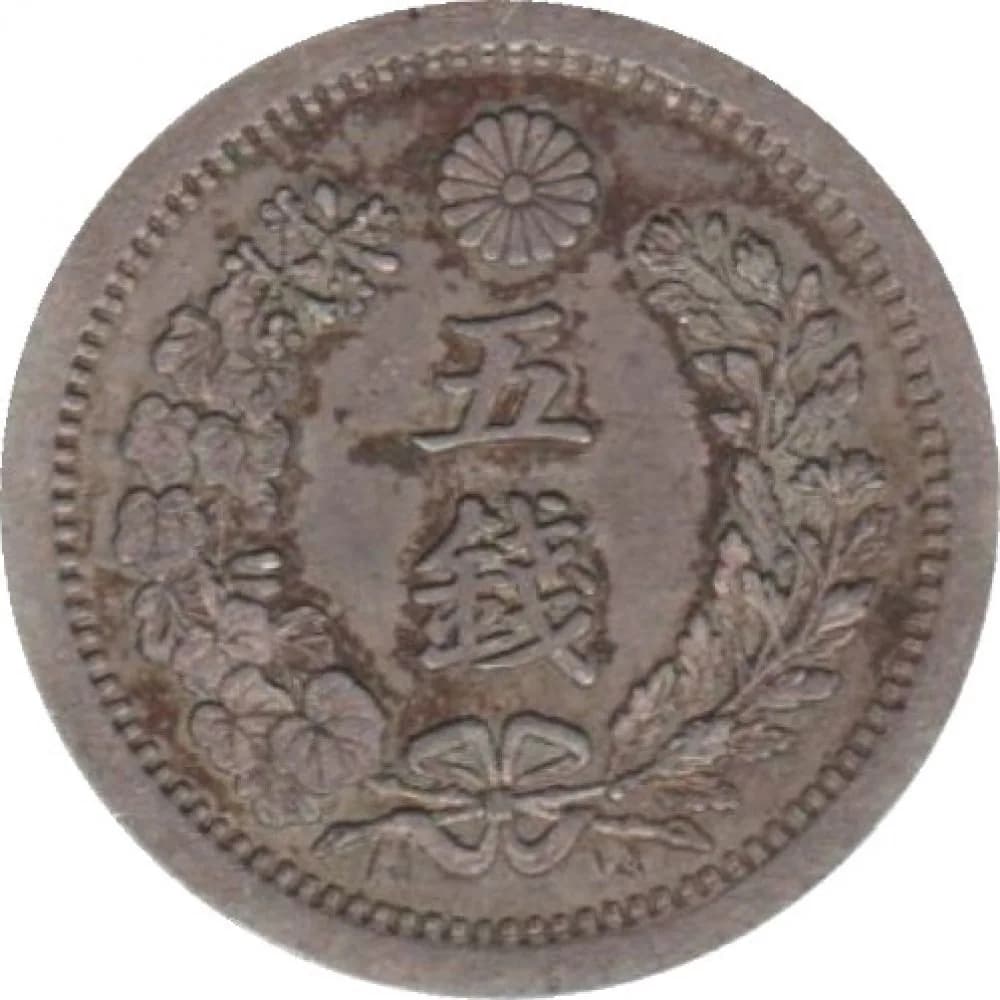
Image: Modern Japanese coinage / Coindesmonnaies / Wikimedia Commons / CC BY-SA 4.0(source)
The year 835, when Jōwa Shōhō was minted, was a significant turning point in Japanese history. At this time, a few years after the ascension of Emperor Ninmyō, the Ritsuryō system began showing signs of decline. Emperor Ninmyō, who ascended as the son of Emperor Saga, sought political stability amidst intensified power struggles among the nobility. On the eve of the Jōwa Disturbance in 838, political tension was high.
In this background, Jōwa Shōhō was minted as a symbol of political stability and economic prosperity. The inscription 'Shōhō' was imbued with a wish for national stability and prosperity, carrying a strong political message. Given that its predecessor, Fujushinhō, was issued in 818, the 17-year interval suggests the issuance of a new currency was an economically necessary decision. Thus, Jōwa Shōhō held significance beyond its role as a mere currency, becoming a symbolic reflection of the political and economic conditions of the time.
For more on the political backdrop of this era, refer to the detailed explanation of Wadōkaichin.
The Secret of Minting — Technology and People's Efforts
Image: Modern Japanese coinage / Coindesmonnaies / Wikimedia Commons / CC BY-SA 4.0(source)
The minting of Jōwa Shōhō was a crystallization of the efforts and ingenuity of the artisans of the time. Japanese ancient coins often employed techniques influenced by China, and Jōwa Shōhō was no exception. The exact minting location remains unknown, but it is presumed to have occurred in regions near Nagaoka-kyō or Heian-kyō.
Technologically, an alloy with copper as the main component was used, with the minting process involving pouring molten metal into molds at high temperatures. These molds were precisely crafted by skilled artisans to accurately reproduce inscriptions and designs. The artisans involved had a sense of mission to support national development and stability, operating under circumstances that allowed no failure.
The minting of Jōwa Shōhō was also heavily influenced by the economic policies of the time. Against a backdrop of financial distress, the aim was to invigorate the monetary economy with the issuance of coins. Knowing the minting process of Jōwa Shōhō provides valuable insights into the technical levels and social contexts of ancient Japan.
For details on the minting technology of this era, refer to the overview and charm of ancient coins.
The Shrinking Circulation Range — Market and Public Response
Image: Modern Japanese coinage / Coindesmonnaies / Wikimedia Commons / CC BY-SA 4.0(source)
The economic situation from 835 to 848, during which Jōwa Shōhō was minted, changed alongside the decline of the Ritsuryō system. Even in this era when the monetary economy was being established, the circulation of Jōwa Shōhō reportedly remained limited. This indicates financial stringency and questioned the reliability of the coins themselves.
At the time Jōwa Shōhō was issued, bartering was still common among the populace, and the use of currency was confined to urban areas or some wealthy individuals. Thus, the limited circulation range is understandable. Moreover, due to price fluctuations and distrust in currency value, dependence on currency was limited.
Economically, the intent was to control inflation and stimulate trade by increasing the amount of currency circulating in the market with coin issuance. However, in reality, the expected effects were limited, and public acceptance of Jōwa Shōhō seemed sluggish. Such economic backgrounds led to later currency re-coinages and abolitions.
For insights on market trends and public reactions, see Basics of Old Coin Auction.
Jōwa Shōhō in History — Influence and Evaluation in Later Generations
Image: Modern Japanese coinage / Coindesmonnaies / Wikimedia Commons / CC BY-SA 4.0(source)
Jōwa Shōhō has continually had its significance questioned amid shifts in times. Historically, it is emphasized as a coin symbolizing the end of the Ritsuryō state, influencing later monetary systems.
After Jōwa Shōhō, currency reforms continued, with coins minted to adapt to changes in the era. For instance, in the mid-Heian period, with the reign of Emperor Shōhei, a new currency called 'Kengen Taihō' emerged, developing in continuity with Jōwa Shōhō. This way, the monetary system gradually became more complex, playing a role as part of economic activity.
In contemporary times, due to its rarity and historical background, Jōwa Shōhō is highly valued by collectors. On the other hand, the circulation of counterfeits or altered goods is a concern, making authentication crucial. The historical significance of Jōwa Shōhō exceeds its value as mere currency, serving as an important material for understanding the political and economic conditions of the time.
For evaluations based on such historical backgrounds, refer to How to Distinguish Counterfeits and Altered Goods.
Value & Rarity
The market value and rarity of Jōwa Shōhō are highly regarded among collectors and historical researchers. Its rarity stems from the unknown issuance number and its minting close to the end of the Ritsuryō period. Currently, Jōwa Shōhō trades from several tens of thousands to hundreds of thousands of yen, with value significantly varying depending on condition and authenticity.
Particularly, the clarity of the inscriptions and the preservation of the surface are evaluation points, and collectors emphasize these aspects. In the market, issues related to the authenticity of Jōwa Shōhō also exist, with counterfeits and altered goods circulating at times. Thus, expert appraisal during purchase is recommended.
Additionally, Jōwa Shōhō holds high academic value as an ancient Japanese coin, utilized as a research material in economic history and archaeology. Consequently, it exceeds being a mere collection item, fulfilling demand as a historical research subject. Due to this, the value of Jōwa Shōhō transcends mere economic worth, serving a role as a witness to history.
For market trends and evaluation criteria, refer to Standards of Old Coin Grading.
Conclusion
Jōwa Shōhō is a unique entity in the history of ancient Japanese coins, having been minted during the decline of the Ritsuryō system. Its background of birth intertwines political instability and economic necessity, with its circulation reality vividly illustrating the complexity of society at the time. Furthermore, because of its rarity and historical value, it is an appealing subject for contemporary collectors and researchers.
Jōwa Shōhō surpasses the value of merely a coin, serving as an important document for understanding the political and economic conditions of Japan at that time. Through it, one can glimpse the lives of people and the operation of the state, with its position in history continually being re-evaluated. The historical significance of Jōwa Shōhō will surely continue to be told in the history of Japanese currency.
Related Stories
Bunkyū Eihō — Tracing the History of Ansen
The last Ansen of the late Edo period. The 4-mon coin minted in Bunkyū 3 began circulating just shy of two years before the Meiji Restoration.
Coin StoryChikusen Jowi no Rei — An Ancient Japanese Attempt to Spread Currency
Wadō 4 (711): An Unprecedented System to Promote Currency Use
Coin StoryNaga-nen Taihō — Tracing the History of Ancient Coinage
The 7th coin of the Kōchō jūni-sen, issued in Shōwa 15 (848) during the reign of Emperor Ninmyō. From this time, the gap between the actual and nominal value of coins became serious.
Dealers
Dealers Handling This Category
A reference when considering a sale or appraisal. All are dealers and auction houses with a proven track record.
Japan Coin Auction (JCA)
Tokyo
Holds regular auctions with reliable hammer price data, making it a useful resource for tracking market values. Caters to a wide range of collectors from beginners to advanced buyers.
Ginza Coins
Ginza, Chuo-ku, Tokyo
One of Japan's most established numismatic dealers. The scale and variety of their regular auctions is among the largest in the country. Their catalogs are considered a benchmark for market pricing.