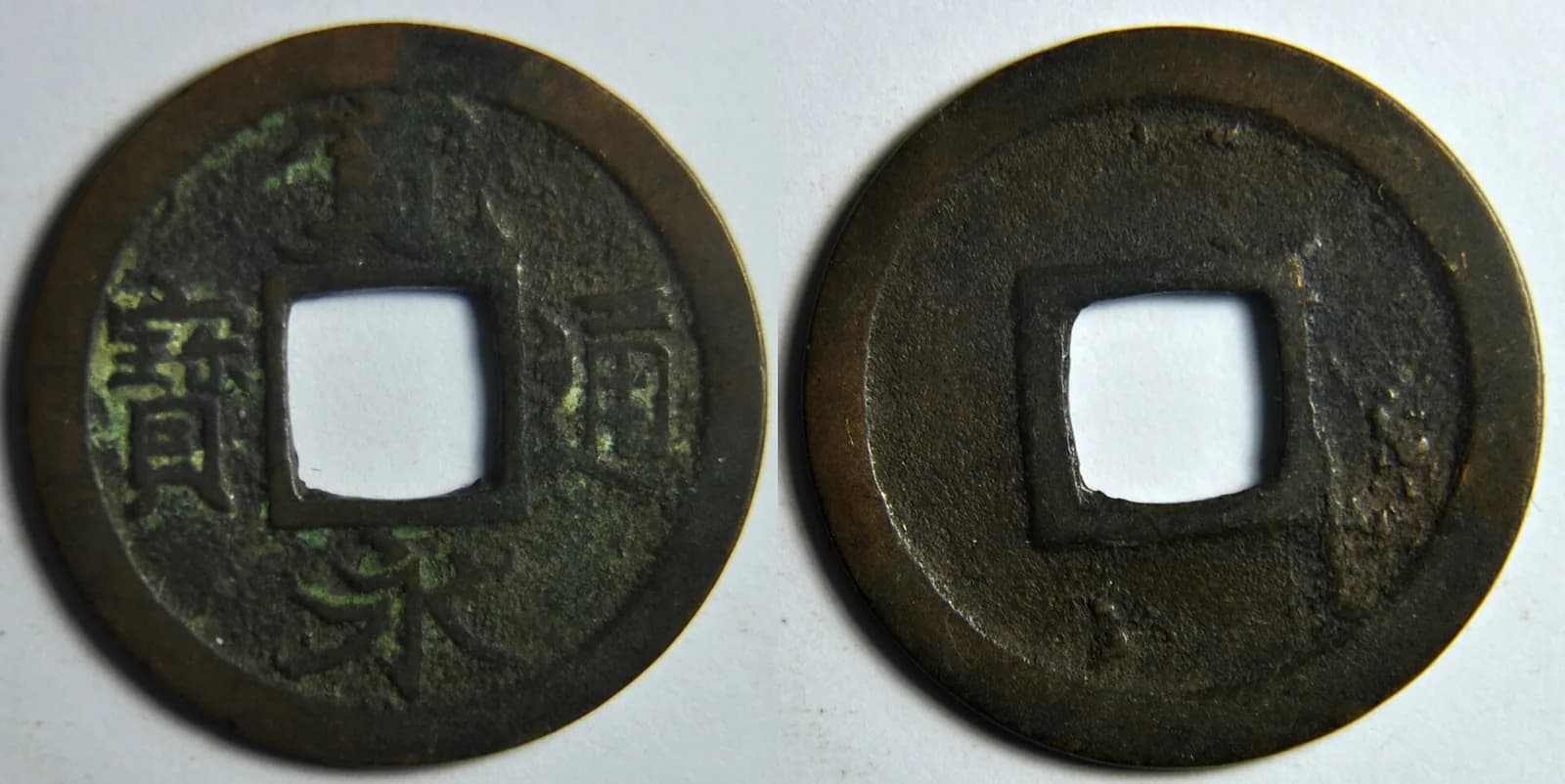
Image: Japanese holed coins (square-holed cash coins) / Jean-Michel Moullec from Vern sur Seiche (35, Bretagne), France / Wikimedia Commons / CC BY 2.0(source)
Wartime Tin 10 Sen Coin — Japan's Dismal Outlook Etched in Tin of 1944
In an era when copper and nickel became weapons, the tin 10 sen coin narrates the last throes of wartime economy
Subject coin: 戦時錫10銭貨(昭和19年)
Overview
The Wartime Tin 10 Sen Coin is an extremely unique currency made of tin (Sn) minted in Japan from 1944 (Shōwa 19) to 1945 (Shōwa 20). With the intensification of the Pacific War (1941-1945), metals like copper and nickel were prioritized for military use. After the 'Metal Collection Order' of 1941, securing metals for currency became increasingly difficult each year. As a last resort, the soft metal tin with a melting point of 231.9°C was chosen.
Weighing just 1.5g with a diameter of 22mm, its surprising lightness is immediately noticeable compared to the copper-nickel 10 sen coin series that began in 1934 (Shōwa 9). Tin is soft and easily corrodes, causing coins to oxidize and get scratched during circulation, making well-preserved specimens rare. One can verify the historical context of this currency in Modern Japanese Currency History and Changes in Coins Since Meiji. It became void in the 1946 currency changeover, concluding its short lifespan. Evaluating its condition based on Coin Grading Standards is the first step in purchasing.
Specifications
- Denomination
- 10銭
- Minting period
- 昭和19年〜昭和20年(1944年〜1945年)
- Metal composition
- 錫(スズ:Sn)
- Weight
- 1.5g
- Dimensions
- 直径22mm
- Mintage
- 不詳(諸説あり)
- Mint supervisor
- 不詳
- Market price
- 並品:300円〜1,000円 / 美品:2,000円〜5,000円 / 未使用品:数万円(状態による)
Chapter 1: The Metal Collection Order & Changes in Coin Materials — From 1941 to 1944
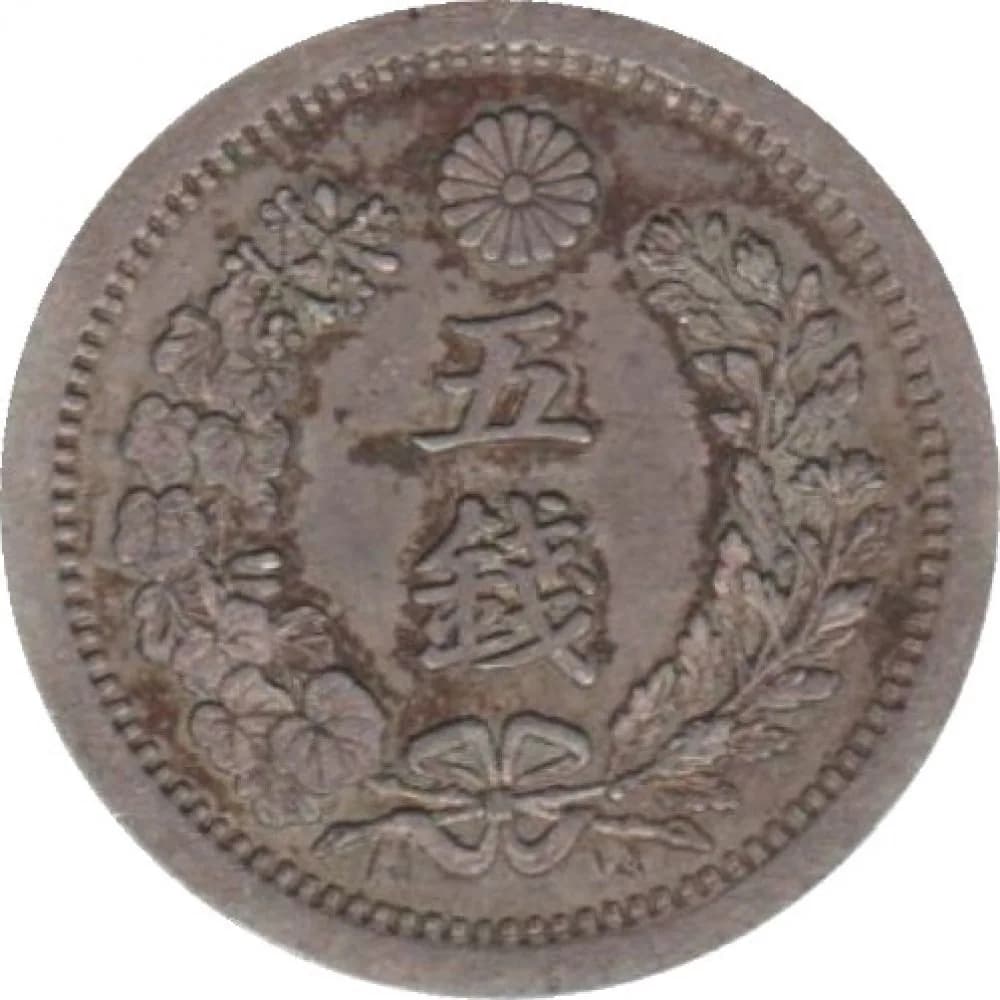
Image: Modern Japanese coinage / Coindesmonnaies / Wikimedia Commons / CC BY-SA 4.0(source)
Before 1934 (Shōwa 9), Japan's 10 sen coins were made of 100% nickel. With the escalation of the Second Sino-Japanese War in 1938 (Shōwa 13), nickel was prioritized for military needs, introducing the aluminum 10 sen coin. As the Pacific War commenced in December 1941 (Shōwa 16), the government issued the 'Metal Collection Order' (1941), promoting the collection of copper, nickel, lead, and other metals essential for military use from civilians, redirecting them for arms production.
This order had a profound impact on daily life. Anything made of metal — pots, pans, altars, temple bells — was collected. In 1943 (Shōwa 18), temple bells of historical significance were compelled to be donated, a loss remembered as a post-war tragedy. The procurement of metals for currency shared this fate, causing production of copper and aluminum alloy 10 sen coins to plummet around 1943.
In 1944 (Shōwa 19), the government decided to mint the 'Tin 10 Sen Coin'. Tin (Sn, symbol Sn) has a melting point of 231.9°C, making it relatively easy to process. Its hardness is about a third of copper, making it soft and malleable, with a specific gravity of 7.3, lighter than the copper version (specific gravity 8.9). This 'lightness' is the tin 10 sen coin's hallmark, with its 'flimsy' feel starkly different from copper coins.
The tin supply was concentrated in what were then Japan's southern occupied territories (modern-day Malaysia and Indonesia). A flow was established to secure and transport tin from these territories for coin minting on the mainland. However, by 1944, sea control was already threatened, making material transport challenging. The tin 10 sen coin was truly a 'wartime end product'. The overall situation of the era can be understood in Modern Japanese Currency History.
Chapter 2: The Nature of Tin and Its Impact on Currency
Image: Modern Japanese coinage / Coindesmonnaies / Wikimedia Commons / CC BY-SA 4.0(source)
The physical properties of tin posed numerous problems as a coin material. The greatest issue was its 'softness'. With a Mohs hardness of about 1.5, it was half as hard as copper (about 3.0), making it prone to scratches and wear from simply being jostled in a wallet or dropped.
Another concern was 'tin pest'. Tin is stable under normal conditions but, when exposed to temperatures below -13°C for an extended period, its crystal structure changes to 'gray tin', leading to physical disintegration (Tin Pest). The issuance period of 1944-1945 saw Japan moving towards surrender amidst turmoil, suggesting that tin 10 sen coins left in cold post-war environments may have succumbed to tin pest (details are under research).
Corrosion was also problematic. Tin oxidizes with air to form a white patina called 'tin rust', which obscured beauty and blurred inscriptions and designs, making poorly preserved coins unrecognizable.
During its circulation in 1944-1945, the tin 10 sen coin functioned as money but was inconvenient for everyday use. Weighing clearly less than copper coins (1.5g), they lacked wallet presence and their surfaces scratched easily, eroding designs rapidly. Nonetheless, in a period devoid of copper or silver coins, the tin 10 sen coin circulated as legal currency, upholding the tail end of the Japanese economy. Details on pre-war and wartime coin material changes can be confirmed in Changes in Coins Since Meiji.
Extreme alternatives to tin were considered, such as 'porcelain coins', but these prototypes never circulated. The tin 10 sen coin remains the last 'exceptional material' currency to circulate, holding a unique place in Japan's coin history.
Chapter 3: Defeat and Demonitization of 1945 — The End of the Tin 10 Sen Coin
Image: Modern Japanese coinage / Coindesmonnaies / Wikimedia Commons / CC BY-SA 4.0(source)
On August 15, 1945 (Shōwa 20), the Japanese public was informed of surrender through the Emperor's broadcast. The Pacific War ended, and GHQ's (General Headquarters) occupation began, immediately affecting Japan's currency system.
In February 1946 (Shōwa 21), under GHQ's directive, the Japanese government initiated the 'New Yen Conversion'. This swapped old yen notes and coins for new yen to curb inflation and rebuild the economy. Withdrawal limits were imposed on cash, and old notes and coins were to be exchanged at banks by a set deadline.
The tin 10 sen coin and other old coins lost their legal tender status through this conversion. They were banned from use in March 1946 (Shōwa 21), formally becoming 'demonetized'. Their lifespan from issuance to demonetization was extremely brief, lasting only 1–2 years.
During the post-defeat chaos, moves emerged to collect tin 10 sen coins as 'scrap metal'. Tin has industrial use, leading private collectors to buy and recycle old coins, contributing to their limited availability in today's numismatic market.
After 1946, Japan gradually established a new yen system. By 1948 (Shōwa 23), 5 and 10 sen coins were abolished as inflation diminished the role of small change. The 1953 (Shōwa 28) currency reform shaped the current coin system's outline, relegating the tin 10 sen coin to history. Post-war reconstruction flow is covered in Modern Japanese Currency History.
The tin 10 sen coin from 1944 to 1945 circulated during Japan's wartime regime's final days, amidst air raids and shortages. This lightweight tin disc indeed passed through people's hands as money during those desperate times. Check Coin Auction Basics for modern trading methods.
Chapter 4: Evaluation in the Collectors' Market — Acquiring a Witness of War
Image: Modern Japanese coinage / Coindesmonnaies / Wikimedia Commons / CC BY-SA 4.0(source)
In today's numismatic market, the evaluation of the wartime tin 10 sen coin varies greatly with its condition. Average coins with wear and corrosion range from 300 to 1,000 yen. Well-preserved coins with clear inscriptions and minimal corrosion are valued between 2,000 and 5,000 yen, while near-uncirculated pieces can command tens of thousands of yen. Despite the lack of detailed records on mint numbers and circulation, the post-defeat chaos and tin's corrosion and degradation mean well-preserved specimens are rare.
The most crucial aspect of assessing the tin 10 sen coin is identifying the 'material'. It appears silver-white and feels noticeably lighter than other coins (1.5g). Its surface lacks the luster of copper or cupronickel coins and is easily scratched. Genuine tin coins are non-magnetic (tin is non-ferromagnetic). Understanding these attributes and assessing condition against Coin Grading Standards is key.
The tin 10 sen coin's greatest value lies not merely in economic rarity but in its 'historical testimony'. It represents the phase from the Metal Collection Order (1941), tin adoption (1944), to defeat and demonetization (1945-1946), embodying historical artifacts that transcend mere numismatic collections.
For collectors specializing in wartime coins, the tin 10 sen coin is the 'final chapter' in their collection. From the 1934 (Shōwa 9) nickel 10 sen coin to the 1938 (Shōwa 13) aluminum 10 sen coin, and finally the 1944 (Shōwa 19) tin 10 sen coin, the progression of materials visualizes the war’s impact on Japan's economy and society.
Utilize Market Index to check prices, and acquire through trustworthy means. Be wary of counterfeits and 'cleaned coins' (chemically treated to remove tarnish) present in wartime currency. Choosing untreated, naturally preserved coins is crucial. Within a tiny tin disc lies a condensed moment in Japan's history—1944.
Value & Rarity
The wartime tin 10 sen coin's rarity stems from the specific temporal backdrop of 1944 and its fragile material (prone to corrosion and deformation), limiting the number of well-preserved examples. The value varies significantly with condition: coins with corrosion and wear range from 300 to 1,000 yen, while those with clear inscriptions and minor corrosion fetch 2,000 to 5,000 yen, and uncirculated ones can reach tens of thousands.
Tin easily degrades over time, leading poorly preserved specimens to become corroded and illegible. Thus, the scarcity of well-preserved coins with clear inscriptions is high. Learning Coin Grading Standards to enhance evaluation precision is the first step towards trading at optimal prices.
Its worth is higher as 'historical testimony' rather than investment due to its portrayal of the economic history and material shortages during the Pacific War (1941-1945). Enthusiasts and wartime researchers value it as a collection piece conveying those realities. Utilize Coin Auction Basics for safe purchases from reliable sources. Check the Market Index for current valuations.
Conclusion
The wartime tin 10 sen coin was produced amid the extreme shortages of metal resources during Japan's late war regime in 1944. From 1941's Metal Collection Order, replacing copper and nickel for weapons, soft tin was chosen as a final resort. Weighing 1.5g, with a diameter of 22mm—this remarkably light and unreliable coin supported Japan's economy until Japan's defeat in 1945. Even after its demonetization in the 1946 currency changeover, this small silver-white disc continues narrating a scar etched into Japanese society by the war.
Related Stories
Prince Shōtoku 100 Yen Silver Coin — The 'Ideal Face' Chosen by Postwar Japan in Shōwa 32
The first 100 yen coin engraved with an ancient saint vanished in just two years.
Coin StoryWartime Tin 5-Sen Coin — A Lightweight Coin Born of Late-War Privation
1944: The Realities of Wartime Inscribed on a 1-Gram Coin
Coin StoryWartime 1 Sen Aluminum Coin (Late Period) — Testimony from Times of War
The Trajectory and Significance of Coins Minted During 1941-1942 Wartime
Dealers
Dealers Handling This Category
A reference when considering a sale or appraisal. All are dealers and auction houses with a proven track record.
Japan Coin Auction (JCA)
Tokyo
Holds regular auctions with reliable hammer price data, making it a useful resource for tracking market values. Caters to a wide range of collectors from beginners to advanced buyers.
Ginza Coins
Ginza, Chuo-ku, Tokyo
One of Japan's most established numismatic dealers. The scale and variety of their regular auctions is among the largest in the country. Their catalogs are considered a benchmark for market pricing.