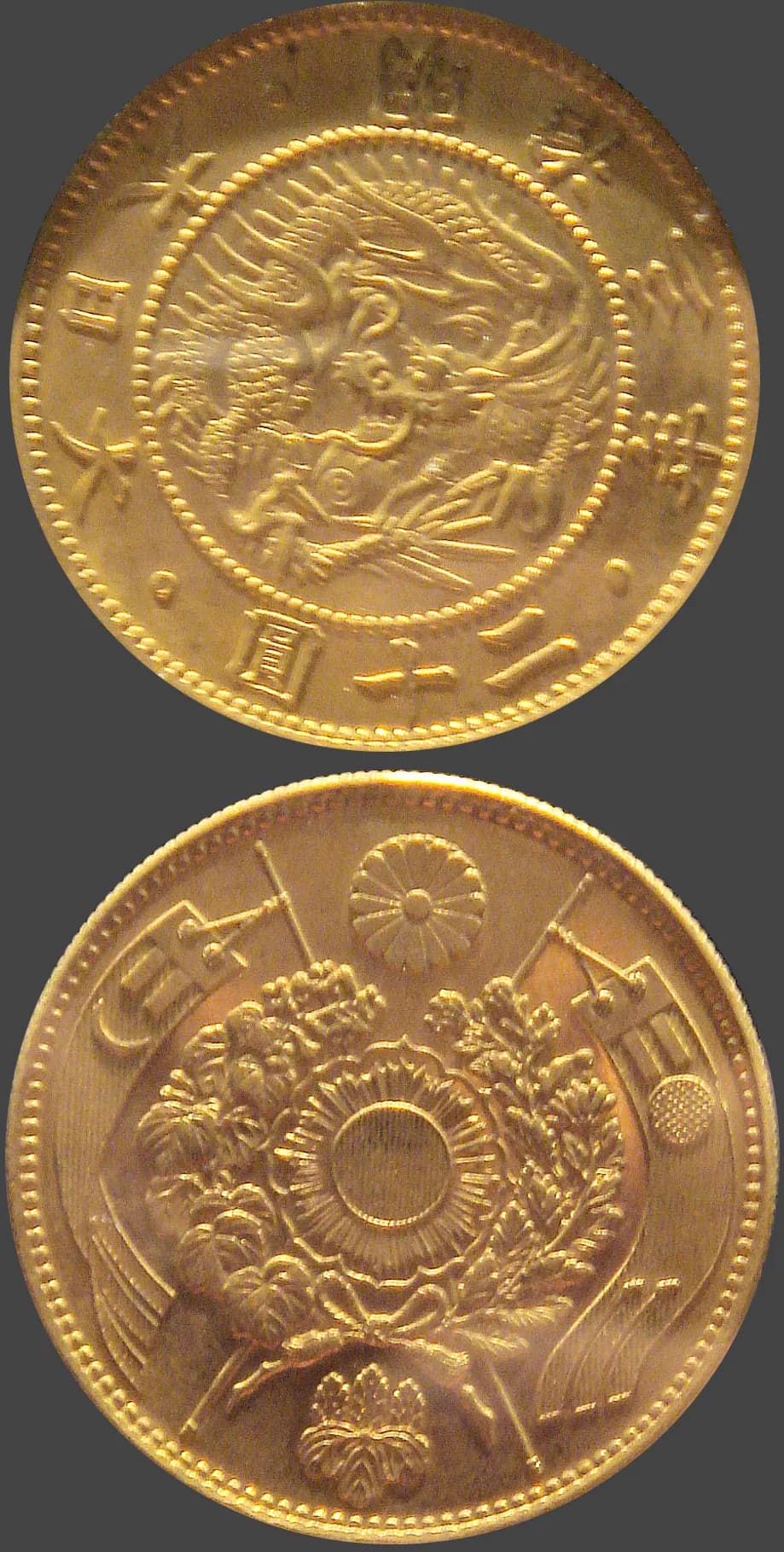
Image: Modern Japanese coinage / PHGCOM / Wikimedia Commons / CC BY-SA 3.0(source)
Mexican Dollar Circulation in Late Edo Japan — The Opening of Ports and the Upheaval of the Monetary System
The Economic Turmoil and Reform Brought About by Mexican Silver Coins Flowing into Late Edo Japan
Subject coin: メキシコドルの幕末流通
Overview
In late Edo Japan, as the country opened its ports in Ansei 5 (1858) and trade with foreign nations gradually intensified, one silver coin came to greatly shake Japan's monetary system. That coin was the Mexican Dollar. Minted in Spanish colonies, this silver coin exerted a tremendous influence on the Japanese market due to its high silver purity and weight. In particular, the official exchange rate—under which 4 ichibu-gin equaled 1 Mexican Dollar—led to a large outflow of gold from Japan. Western merchants exploited this rate differential to conduct gold-silver arbitrage on a massive scale, destabilizing the Japanese economy. Eventually, in Meiji 4 (1871), the Japanese government enacted the New Currency Regulations (新貨条例) and restricted the circulation of the Mexican Dollar, but its effects lingered for a long time. This silver coin, which brought economic transformation and monetary upheaval through the opening of the ports, continues to be held in high regard among collectors today.
Specifications
- Denomination
- メキシコドル
- Minting period
- 安政5年〜明治4年(1858-1871年)
- Metal composition
- 銀(約92%)
- Weight
- 27g
- Dimensions
- 直径約38mm
- Mintage
- 不詳(諸説あり)
- Mint supervisor
- スペイン植民地当局
- Market price
- 150,000円〜500,000円(状態による)
The Opening of Ports in Late Edo and the Influx of Mexican Dollars — Economic Transformation
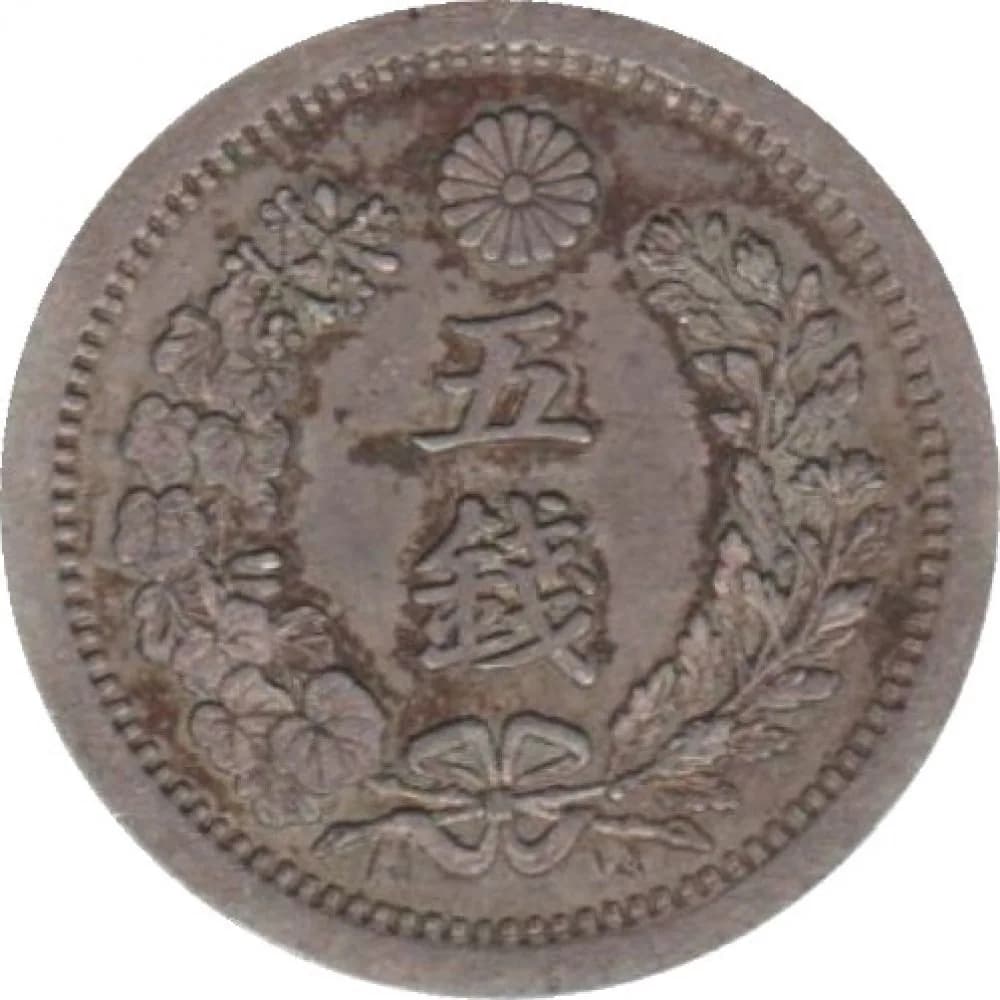
Image: Modern Japanese coinage / Coindesmonnaies / Wikimedia Commons / CC BY-SA 4.0(source)
In 1858, the Edo Shogunate concluded the Treaty of Amity and Commerce with the United States, and Japan began its path toward opening its doors to the world. This year—Ansei 5—saw the rapid expansion of commerce with foreign nations, partly as a result of Commodore Perry's earlier arrival. Of particular note was the influx of Mexican Dollar silver coins minted in Spanish colonies. In order to facilitate trade with foreign countries, the Shogunate decided to exchange Mexican Dollars for Japanese currency at an official rate. The rate of 4 ichibu-gin to 1 Mexican Dollar shook the relative value of the gold and silver coins then in use within Japan. Exchanges based on this rate led to a massive outflow of Japanese gold, inflicting serious damage on the economy. During this period of late Edo turmoil, Tokugawa Iesada bore responsibility for the government as Shogun, but amid the political upheaval he was unable to make major changes to economic policy. Commodore Perry first arrived in Japan in 1853, and in the years that followed Japan's ports were opened and the value of Edo silver coins (江戸銀貨) began to fluctuate. The influx of Mexican Dollars brought great disruption to the domestic monetary system and threatened the financial foundations of the Shogunate.
The Minting of the Mexican Dollar and Its Background — The Technology and History of a Silver Coin
Image: Modern Japanese coinage / Coindesmonnaies / Wikimedia Commons / CC BY-SA 4.0(source)
The origins of the Mexican Dollar trace back to colonial-era Mexico under Spanish rule. In the latter half of the 16th century, backed by Mexico's abundant silver mines, the Spanish Crown promoted the minting of silver coins in the New World. Minted at the Mexico City mint, these silver coins measured approximately 38 mm in diameter, weighed approximately 27 g, and boasted a high silver purity of approximately 92%. These high-quality silver coins also played an extremely important role in Asian trade. In late Edo Japan, the Mexican Dollar attracted attention not only for its value as a silver coin but also for its minting technology (鋳造技術). During the Edo period, Japan's coin-manufacturing technology was still limited, and the minting techniques used for the Mexican Dollar were considered highly advanced. Japan at the time had institutions such as the gold mint (金座) and silver mint (銀座) responsible for producing currency, primarily involved in the composition and design of gold and silver coins, but no silver coins produced in mass quantities comparable to the Mexican Dollar existed. Having been influenced by Spanish colonial practices, this silver coin rapidly penetrated the Japanese market owing to its high quality and international acceptability.
When the Treaty of Amity and Commerce between Japan and the United States—along with the other Ansei Five-Power Treaties—was concluded in Ansei 5 (1858) and ports such as Yokohama, Nagasaki, and Hakodate were opened, the volume of Mexican Dollars (墨銀) flowing into Japan increased sharply. Under the official exchange rate set by the Shogunate at that time, 4 ichibu-gin were to be exchanged for 1 Mexican Dollar. However, because the silver content of the ichibu-gin fell far short of the approximately 27 g of pure silver in a Mexican Dollar, Western merchants cleverly exploited this difference in fineness. Specifically, large-scale gold-silver arbitrage transactions became rampant—centered on the open ports—in which Mexican Dollars were exchanged for ichibu-gin, and those ichibu-gin were then used to purchase domestic gold coins (koban) that were taken abroad, causing a rapid outflow of gold coins from Japan. This problem placed serious pressure on Shogunate finances, and while estimates vary, it has been pointed out that gold amounting to several million ryō in scale flowed out of the country. In order to bring this turmoil under control, the Meiji government promulgated the New Currency Regulations in Meiji 4 (1871), established a new monetary system with the yen as its base unit to restrict the domestic circulation of the Mexican Dollar, and brought the era of the墨銀 to an end.
The Circulation of the Mexican Dollar and Its Economic Impact — The Late Edo Japanese Market
Image: Modern Japanese coinage / Coindesmonnaies / Wikimedia Commons / CC BY-SA 4.0(source)
In the late Edo Japanese market, Mexican Dollars began to circulate rapidly. When the Treaty of Amity and Commerce between Japan and the United States—along with the other Ansei Five-Power Treaties—was concluded in Ansei 5 (1858) and ports such as Yokohama, Nagasaki, and Hakodate were opened, this silver coin was brought into Japan by foreign merchants as trade expanded with the opening of the ports. The Mexican Dollar (墨銀) was a high-quality silver coin containing approximately 27 grams of pure silver, and owing to its high silver purity and weight it was accepted as a highly valuable currency and used actively in commercial transactions both domestic and foreign. However, this circulation brought disruption to the economy. In particular, the problem lay in the fixed exchange rate between Japan's ichibu-gin and the Mexican Dollar. The rate of 4 ichibu-gin to 1 Mexican Dollar within Japan differed greatly from actual market value. The ichibu-gin of the time contained far less pure silver than the Mexican Dollar, and it was precisely this difference in fineness that became the breeding ground for arbitrage transactions. As a result, Western merchants exploited this rate differential to conduct gold-silver arbitrage on a massive scale. Specifically, a practice of exchanging Mexican Dollars for ichibu-gin and then exchanging those ichibu-gin for koban in order to obtain gold at undervalued prices became rampant, centered on Yokohama. Consequently, large quantities of gold flowed out of Japan, placing pressure on Shogunate finances. For ordinary people as well, fluctuations in prices and instability in currency value affected daily life. In the marketplace, a cautious attitude toward accepting foreign currencies including the Mexican Dollar was observed, and questions were raised regarding their reliability and value. In response to such turmoil, the Meiji government enacted the New Currency Regulations in Meiji 4 (1871), established a new monetary system with the yen as its base unit to restrict the domestic circulation of the Mexican Dollar, and brought the approximately 13-year era of the墨銀 to an end.
The New Currency Regulations and the End of the Mexican Dollar — Economic Restructuring and Its Effects
Image: Modern Japanese coinage / Coindesmonnaies / Wikimedia Commons / CC BY-SA 4.0(source)
In Meiji 4 (1871), the Japanese government enacted the New Currency Regulations in order to establish a new monetary system. Led by Grand Minister of Finance Ōkuma Shigenobu and others, these regulations adopted a decimal system of yen, sen, and rin, with the gold standard as its cornerstone. This was intended to restrict the circulation of foreign currencies such as the Mexican Dollar and to strengthen Japan's own monetary system. Under this new framework, a currency system centered on the yen was introduced, and as a result the circulation of Mexican Dollars gradually declined.
To begin with, since the opening of the ports in Ansei 5 (1858), the Mexican Dollar (墨銀)—containing approximately 27 grams of pure silver—had been circulating at an official rate treating it as equivalent to 4 ichibu-gin coins of lower fineness. The large-scale gold-silver arbitrage transactions conducted by Western merchants exploiting this imbalance had become rampant, leading to the serious situation of large quantities of gold coins flowing out of the country. The enactment of the New Currency Regulations was an important step toward bringing this economic turmoil that had continued since the late Edo period to an end. The government issued new gold and silver coins and aimed to unify the circulation of currency within the country. The minting of the new coins was undertaken by the Osaka Mint Bureau (大阪造幣寮; present-day Mint Bureau), which commenced operations in March of the same year. Through this process, the Mexican Dollar came to the end of its role and disappeared from the stage of history.
However, its effects lingered for a long time. During the period before the new monetary system took hold, confusion and irregularities arose domestically in connection with the exchange of old currencies. In rural areas in particular, anxiety and distrust toward the new currency ran deep, and cases of people continuing to use old currencies were observed. This economic restructuring was an unavoidable ordeal for Japan as it advanced along the path of becoming a modern nation-state.
Value & Rarity
The Mexican Dollar, owing to its historical background, is an extremely attractive silver coin for collectors. Thanks to its high silver purity and its influence on the late Edo Japanese market, it continues to command high value today. While prices differ depending on condition and year of minting, it is generally traded in the market for approximately 150,000 to 500,000 yen. Its value stands out even when compared to Edo silver coins (江戸銀貨) and silver coins of other periods. The Mexican Dollar is a symbol of international trade in late Edo Japan and can be said to be a precious piece of evidence that tells the story of the economic turmoil of the era. For collectors, the Mexican Dollar is one of those currencies that is extremely rare and difficult to obtain, owing to its historical significance.
Related Guide: Details on Chōgin and Mameita-gin (丁銀・豆板銀)
Conclusion
The circulation of the Mexican Dollar in late Edo Japan had a major impact on Japan's monetary system and economy. As international trade expanded with the opening of the ports, the Mexican Dollar penetrated the market due to its high silver purity and weight, triggering the outflow of gold from Japan. This monetary turmoil led to reforms through the New Currency Regulations and became an important ordeal for Japan in its advance as a modern nation-state. The Mexican Dollar is now recognized as an extremely valuable silver coin for collectors owing to its historical background. We must not forget the important role this silver coin—symbolizing the tumultuous era of late Edo Japan—played in the history of Japanese currency.
Related Stories
Ansei Chōgin — The Final Edo Era Silver Bullion Coin amidst the Turbulence of the Bakumatsu
A Short-lived yet Historical Silver Bullion Created Amidst the Turmoil of Opening Japan
Coin StoryAnsei Nibus Gin — A Silver Coin Born Amidst Port Opening and Fiscal Crisis
The Role of Subsidiary Silver Coins Issued in the Turbulent Closing Years of the Edo Period
Coin StoryBunkyū Eiho and the End of the Gold Coin System — Tracing the History of Edo Gold Coins
Bunkyū 2 (1862) marks the final currency reform of the shogunate, with a gold coin series issued alongside the Bunkyū Eiho (copper coins) as a symbol of late shogunate monetary chaos
Dealers
Dealers Handling This Category
A reference when considering a sale or appraisal. All are dealers and auction houses with a proven track record.
Japan Coin Auction (JCA)
Tokyo
Holds regular auctions with reliable hammer price data, making it a useful resource for tracking market values. Caters to a wide range of collectors from beginners to advanced buyers.
Ginza Coins
Ginza, Chuo-ku, Tokyo
One of Japan's most established numismatic dealers. The scale and variety of their regular auctions is among the largest in the country. Their catalogs are considered a benchmark for market pricing.
Osaka Numismatic Auction
Osaka
A Kansai-based coin auction house with particular strength in regional and hole coins.