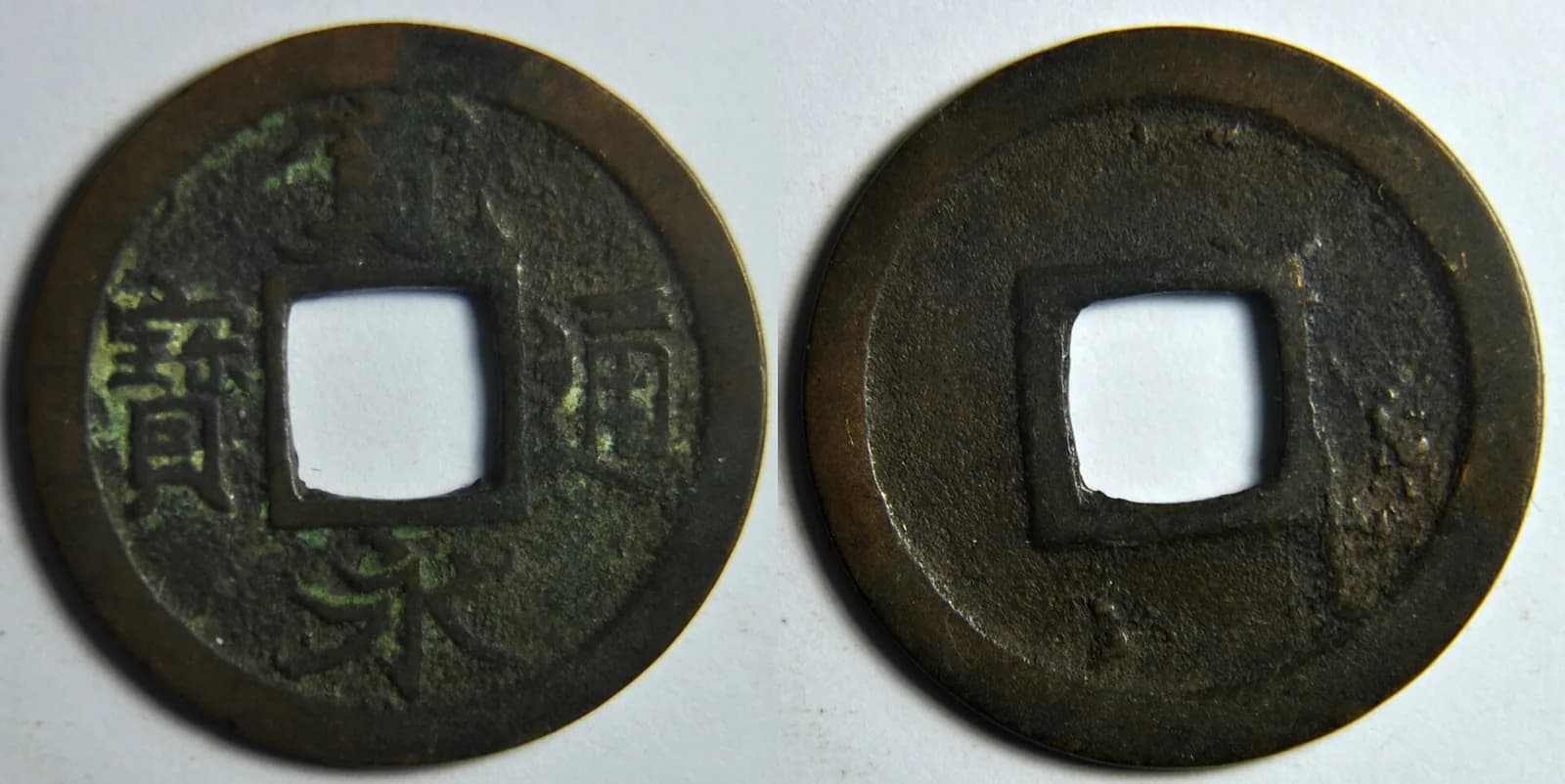
Image: Japanese holed coins (square-holed cash coins) / Jean-Michel Moullec from Vern sur Seiche (35, Bretagne), France / Wikimedia Commons / CC BY 2.0(source)
Eiraku Tsūhō (永楽通宝) — The Journey of a Chinese Coin That Adorned the Muromachi Period
The Economic Revolution Promoted by the Ashikaga Shogunate and Its Impact
Subject coin: 室町の永楽通宝経済
Overview
The Eiraku Tsūhō (永楽通宝) was a currency that played a unique economic role in Muromachi-period Japan. This copper coin was originally minted beginning in 1403, when the Yongle Emperor ascended the throne in China. It flowed into Japan in large quantities during the reign of Ashikaga Yoshimasa (1449–73), and its domestic use expanded accordingly. Its circulation was especially pronounced in eastern Japan, and the accounting unit known as 'Eiraku-zeni-daka' became widely recognized across the country. During this period, Song coins and Ming coins were also in simultaneous use in western Japan, yet the Eiraku Tsūhō carved out its own distinct position. Through this coin, the Ashikaga Shogunate aimed to achieve economic stability and commercial development. The historical significance of this currency is further illuminated through comparison with works such as Types and Identification of Edo Gold Coins and Types and Identification of Holed Coins.
Specifications
- Denomination
- 永楽通宝
- Minting period
- 室町時代中期〜戦国時代(1400-1570年)
- Metal composition
- 銅
- Weight
- 3.5g(諸説あり)
- Dimensions
- 直径約24mm
- Mintage
- 不詳(諸説あり)
- Mint supervisor
- 不詳(中国明朝政府)
- Market price
- 1,000円〜10,000円(状態による)
Chapter 1: The Ashikaga Shogunate and the Introduction of the Eiraku Tsūhō
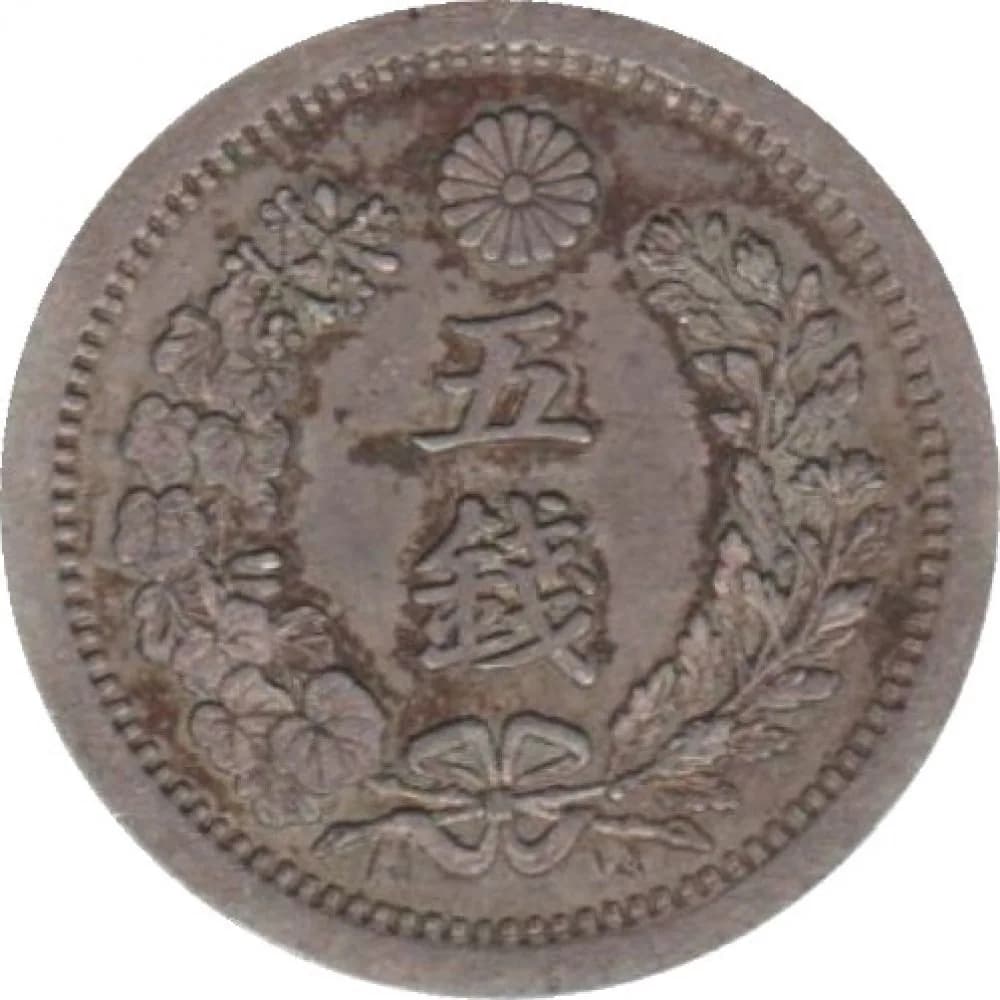
Image: Modern Japanese coinage / Coindesmonnaies / Wikimedia Commons / CC BY-SA 4.0(source)
The background to the Ashikaga Shogunate's adoption of the Eiraku Tsūhō was shaped by the political and economic conditions of the time. During the Muromachi period, Japan was in a state of fragmentation, and the authority of the central government was wavering. Ashikaga Yoshimasa (1449–73) needed to implement economic stabilization measures to restore the shogunate's authority. It was in this context that the Eiraku Tsūhō, an import from China, came to be noticed. The Eiraku Tsūhō was a coin whose minting had begun under the Ming dynasty's Yongle Emperor, who had ascended the throne in 1403, and its abundant circulation domestically was anticipated. Particularly after the Ōnin War, which began in 1467, there was a domestic shortage of coinage, and the introduction of the Eiraku Tsūhō contributed to economic stabilization. Ashikaga Yoshimasa positioned this copper coin as the key currency and encouraged its nationwide circulation. As a result, the accounting unit 'Eiraku-zeni-daka' spread throughout eastern Japan in particular and became the standard for commercial transactions. In an environment where the Eiraku Tsūhō circulated in eastern Japan while Song coins and Ming coins coexisted in western Japan, the Eiraku Tsūhō was widely accepted among merchants and commoners alike due to its reliability and stability. A detailed explanation of the Wadō Kaichin makes the evolutionary process of such currencies all the clearer.
Chapter 2: The Minting and Circulation of the Eiraku Tsūhō
Image: Modern Japanese coinage / Coindesmonnaies / Wikimedia Commons / CC BY-SA 4.0(source)
The minting of the Eiraku Tsūhō was carried out under the centralized system of the Ming dynasty, and the coins flowed into Japan primarily through trade. By order of the Ming dynasty's Yongle Emperor, full-scale minting began in 1403, and the coin became an important currency supporting the economic foundations both within China and abroad. Imports to Japan increased sharply from the 1460s onward, and particularly during the reign of Ashikaga Yoshimasa, large quantities were circulated through the hands of merchants. During this period, Japan's domestic production had stagnated due to repeated internal conflicts, and dependence on imported coins was increasing. In port towns such as Sakai and Hakata in particular, the Eiraku Tsūhō was actively traded and supported commercial development. The primary minting sites were centered in the Jiangnan region of China, and a high level of technical skill was required. Copper was the main material used, and it is said that strict standards were set for the alloy composition. Within Japan, supervision was carried out through coin mints held by the shogunate in order to promote the circulation of this currency. The circulation of the Eiraku Tsūhō also underpinned the economic foundations of the Sengoku daimyo and became one factor in the formation of distinct regional circulation zones. The formation of these circulation zones later connected to Toyotomi Hideyoshi's currency unification policy, and by comparing with the Value and Identification of Modern Currency, the evolution of monetary policy can be understood.
Chapter 3: The Economic Impact of the Eiraku Tsūhō
Image: Modern Japanese coinage / Coindesmonnaies / Wikimedia Commons / CC BY-SA 4.0(source)
The Eiraku Tsūhō had a profound impact on the Japanese economy during the Muromachi period. Particularly during the reign of Ashikaga Yoshimasa, the Eiraku Tsūhō contributed to economic stabilization and promoted commercial development. During this period, the shortage of currency became serious, and domestic coin production alone could not meet demand. It was thus that the Eiraku Tsūhō, an imported coin from Ming China, became the foundation supporting Japan's economy. Merchants used this coin to conduct transactions, and its value was recognized especially in major commercial cities such as Kyoto and Kamakura. The introduction of the accounting unit 'Eiraku-zeni-daka' promoted the standardization of commercial transactions and brought about greater efficiency in economic activity. Prices stabilized and markets regained their vitality. Trust in the Eiraku Tsūhō also grew among the general populace, and ordinary people began using this coin for everyday purchases and transactions. In an environment where the Eiraku Tsūhō circulated in eastern Japan while Song coins and Ming coins coexisted in western Japan, the circulation of the Eiraku Tsūhō became a factor supporting the expansion of commerce. This led to the formation of distinct circulation zones within each daimyo domain across Japan and to the development of commercial networks. Such economic impacts would eventually come to influence monetary policies such as those described in Details of Edo Silver Coins.
Chapter 4: The Eiraku Tsūhō's Influence on Later Ages and Its End
Image: Modern Japanese coinage / Coindesmonnaies / Wikimedia Commons / CC BY-SA 4.0(source)
The Eiraku Tsūhō also influenced the subsequent history of Japanese currency. Having established its position as the key currency throughout the Muromachi period, the Eiraku Tsūhō further strengthened that position as the Sengoku period began and daimyo formed their own independent economic spheres. However, as time progressed, Toyotomi Hideyoshi's currency unification policy was launched and the multiple circulation zones came to an end. Hideyoshi sought to stabilize the economy by constructing a unified monetary system, and as a result, traditional coins including the Eiraku Tsūhō gradually disappeared. Entering the 1590s in particular, Hideyoshi advanced the unification of gold and silver coinage, and new currencies such as those described in Details of the Keichō Koban were introduced. Through this policy, the Eiraku Tsūhō was excluded from circulation, yet its influence remained in later ages. The circulation of the Eiraku Tsūhō contributed to the development of regional economies and the formation of commercial networks, and it played a part in establishing the economic foundations of modern Japan. Today, the Eiraku Tsūhō is a popular ancient coin among collectors owing to its historical value and is also appreciated as a cultural property of historical significance. The evolution of such currencies serves as a key to understanding the overall flow of monetary history as described in works such as An Overview and Appeal of Ancient Currencies.
Value & Rarity
The Eiraku Tsūhō currently holds value primarily as a collector's item. Transaction prices on the market vary considerably depending on condition and rarity. Generally, coins trade in the range of 1,000 to 10,000 yen, though those in particularly good condition or with a clearly documented historical background may fetch even higher prices. The Eiraku Tsūhō exists in many variations, each carrying a different value, making it an attractive subject for collectors. In particular, those associated with specific minting locations or historical contexts receive high appraisal due to their rarity. Current market popularity derives from the coin's historical background and the impact it had on the Japanese economy of its time. Considering the economic-historical significance of the Eiraku Tsūhō and the influence it exerted on subsequent monetary policy, one can develop a deeper understanding of its value by studying Basic Knowledge of Ancient Coin Auctions. For collectors, it is valued as a precious piece carrying historical context that goes beyond being a mere old coin.
Conclusion
The Eiraku Tsūhō played an important economic role in Muromachi-period Japan. The introduction of this currency, promoted by Ashikaga Yoshimasa, contributed greatly to domestic economic stability and commercial development. In particular, the spread of the Eiraku Tsūhō throughout Japan advanced the standardization of commercial transactions and promoted the development of regional economies. Subsequently, the era of the Eiraku Tsūhō came to an end with Toyotomi Hideyoshi's currency unification policy, but its influence extended into later ages and contributed to the establishment of Japan's economic foundations. Even today, the Eiraku Tsūhō continues to attract the interest of collectors owing to its historical significance. Beyond its value as an ancient coin, when one considers the impact it had on Japanese society of that time, its importance cannot be overstated. In this way, the Eiraku Tsūhō continues to shine to this day as a historical legacy that is more than a mere currency.
Related Stories
Eiraku Tsuho — The Chinese 'Standard Currency' that Moved Muromachi Japan
An Unknown Era When Foreign Coins Formed Japan's Economic Foundation
Coin StoryThe Monetization of Kamakura Estates — Innovations in the Medieval Currency Economy
The Transformation of the Japanese Economy Triggered by the Kamakura Shogunate and the Advancement of Monetized Tribute
Coin StoryThe Import and Circulation of Ming Coins — Tracing the History of Medieval Currency
Beyond Yongle Tongbao, Ming coins such as Hongwu Tongbao and Xuande Tongbao were issued in dozens. Their quality and trust discrepancies caused chaos in the Japanese market.
Dealers
Dealers Handling This Category
A reference when considering a sale or appraisal. All are dealers and auction houses with a proven track record.
Ginza Coins
Ginza, Chuo-ku, Tokyo
One of Japan's most established numismatic dealers. The scale and variety of their regular auctions is among the largest in the country. Their catalogs are considered a benchmark for market pricing.
Japan Coin Auction (JCA)
Tokyo
Holds regular auctions with reliable hammer price data, making it a useful resource for tracking market values. Caters to a wide range of collectors from beginners to advanced buyers.
Taisei Coins
Tokyo
A dealer with an international network. Offers advanced services such as consignment to overseas auctions and NGC/PCGS grading submission. Recommended for high-value or internationally recognized coins.