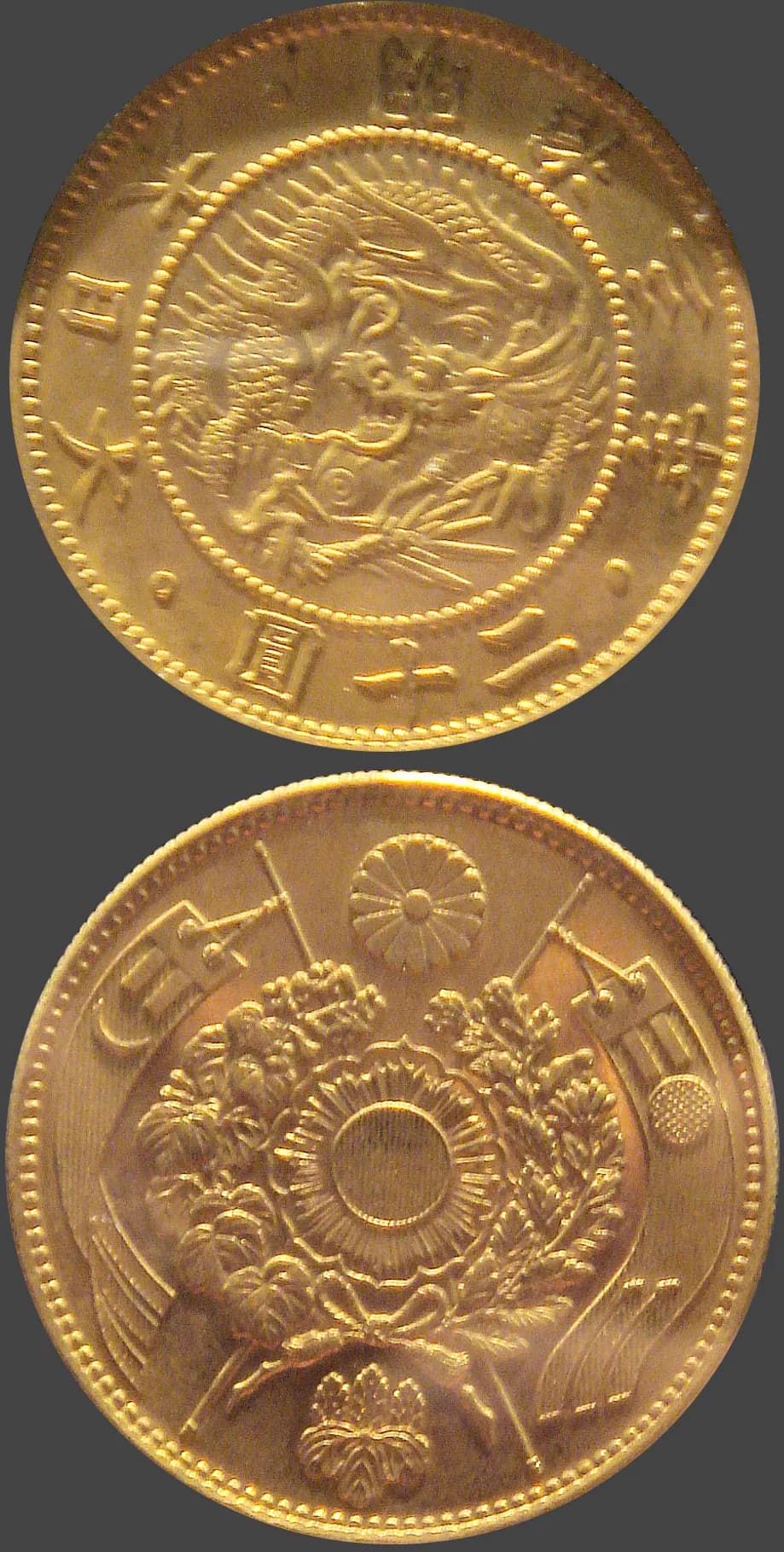
Image: Modern Japanese coinage / PHGCOM / Wikimedia Commons / CC BY-SA 3.0(source)
Ansei Nibus Gin — A Silver Coin Born Amidst Port Opening and Fiscal Crisis
The Role of Subsidiary Silver Coins Issued in the Turbulent Closing Years of the Edo Period
Subject coin: 安政二分銀
Overview
In Ansei 5 (1858), Japan, by signing the Treaty of Amity and Commerce with the United States, began full-scale trade with foreign countries. During this period, the shogunate, in an effort to prevent the outflow of domestic silver and supplement finances, issued a new subsidiary silver coin, the Ansei Nibus Gin. The face value of 2 bu was equivalent to 0.5 ryō, playing an important role in the currency system of the time. However, the issuance took place amid fierce competition with foreign silver coins, particularly the Mexican dollar, and its circulation faced various challenges. After the Meiji Restoration, it was abolished with the introduction of a modern monetary system, but due to its short circulation period, it is now a particularly rare item among detailed Edo silver coins. In this way, the Ansei Nibus Gin serves as a valuable testament to the economic transition in Japan from the closing years of the Edo period to the Meiji Restoration and is being passed down to future generations.
Specifications
- Denomination
- 2分(0.5両)
- Minting period
- 安政5年〜明治2年(1858-1869年)
- Metal composition
- 銀
- Weight
- 不詳(諸説あり)
- Dimensions
- 不詳(諸説あり)
- Mintage
- 不詳(諸説あり)
- Mint supervisor
- 不詳
- Market price
- 50,000円〜300,000円(状態による)
Chapter 1: The Birth Background of Ansei Nibus Gin Amidst Port Opening and Silver Outflow
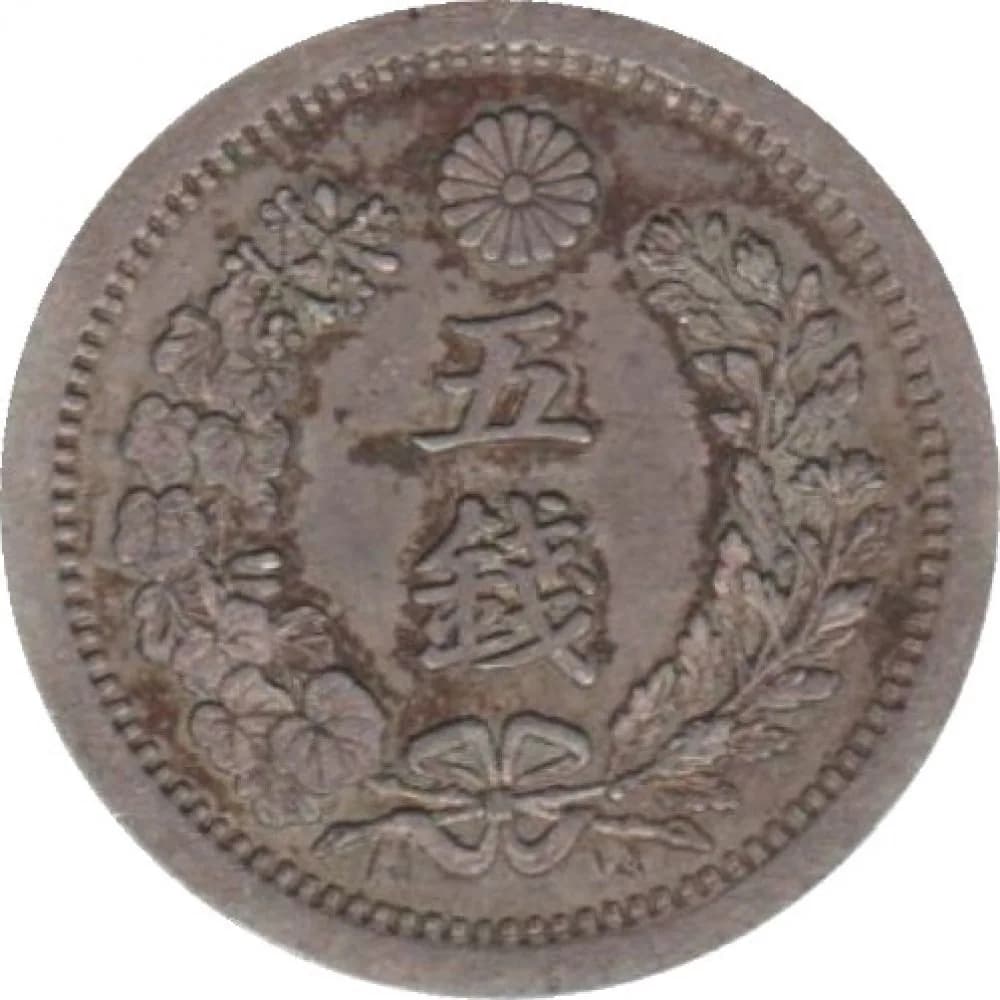
Image: Modern Japanese coinage / Coindesmonnaies / Wikimedia Commons / CC BY-SA 4.0(source)
In 1858, the shogunate signed the Treaty of Amity and Commerce with the United States, leading to the opening of major Japanese ports including Yokohama. This opening resulted in a massive influx of foreign products into domestic markets, causing a rapid outflow of silver coins. The shogunate's finances became strained, necessitating measures to address the situation. At this time, the financial affairs of the shogunate were overseen by Senior Councillor Hotta Masayoshi. He decided to issue new currency to prevent the outflow of silver while supplementing finances. This was the Ansei Nibus Gin. The Ansei Nibus Gin held a value of 2 bu, equivalent to 0.5 ryō, and was introduced into the market as a subsidiary silver coin. Through this, the shogunate attempted to protect domestic silver resources and stabilize the economy. However, the issuance of this silver coin was not merely a fiscal measure but symbolized the shogunate’s struggles amid international economic competition due to port openings. At the time, foreign silver coins, particularly the Mexican dollar, circulated within Japan, and Ansei Nibus Gin was issued to compete with these. For the shogunate, introducing this silver coin was a desperate measure to stabilize the domestic economy and part of the trial and error in port opening policy.
Chapter 2: The Minting Process and Technicians
Image: Modern Japanese coinage / Coindesmonnaies / Wikimedia Commons / CC BY-SA 4.0(source)
The minting of Ansei Nibus Gin was conducted at the Kinza and Ginza, which were responsible for coin production during the Edo period. Kinza was managed by the Gotō family, while Ginza was managed by the Mitsui family, and Ginza was involved in the minting of Ansei Nibus Gin. Ginza was located in Honjo, Edo, bringing together skilled craftsmen with precise minting techniques. Manufacturing the Ansei Nibus Gin required higher techniques than usual silver coins. Considering the competition with foreign silver coins, it was necessary to ensure intricate design and high silver purity. The silver used as raw material was supplied from Sado mines and Iwami mines managed by the shogunate. These resources were crucial for supporting the shogunate's fiscal base, and their high quality upheld the reliability of Ansei Nibus Gin. The minting process involved melting the silver, pouring it into molds, and cooling it. Craftsmen utilized advanced techniques and experience to fulfill the challenging task of minting a large number of silver coins in a limited time. The issuance of Ansei Nibus Gin was a maneuver by the shogunate to escape fiscal adversity, and it was underpinned by excellent craftsmanship and the efforts of craftsmen in the Edo period. This minting technique later influenced detailed Keichō Koban and modern coinage.
Chapter 3: Circulation and Economic Impact
Image: Modern Japanese coinage / Coindesmonnaies / Wikimedia Commons / CC BY-SA 4.0(source)
Once Ansei Nibus Gin was issued, its circulation began primarily in major markets. In major cities like Edo and Osaka, merchants were particularly keen to test the value of this new silver coin. However, in actual circulation, competition with foreign silver coins was intense, and since the exchange rate with the Mexican dollar was unstable, merchants handled it cautiously. Although the shogunate temporarily succeeded in curbing silver outflow through the circulation of this silver coin, its long-term effect was limited. The economy at the time was rapidly changing due to the impact of international trade post-port opening, leading to value fluctuations not only in silver coins but also in gold and copper coins. Among the common people, Ansei Nibus Gin was rarely used in daily transactions, mainly handling major commercial transactions and as gifts. However, the stabilization measure aimed by the shogunate is said to have had little impact on the lives of the common people. On the other hand, merchants and wealthy individuals attempted to profit from the introduction of new currency, yet were dissatisfied with excessive restrictions in the form of rate differences and circulation constraints with foreign currencies. Thus, while Ansei Nibus Gin played a limited role amid the tumultuous economic environment of the closing Edo period, it provided a subtle balance in society. This experience served as a lesson in later value and identification of modern coins.
Chapter 4: Abolition and Influences on Posterity
Image: Modern Japanese coinage / Coindesmonnaies / Wikimedia Commons / CC BY-SA 4.0(source)
In Meiji 2 (1869), Japan aimed to modernize its monetary system, abolishing Edo-period currency including Ansei Nibus Gin. Consequently, Japan introduced a modern monetary system, and yen was issued as new currency. Through this reform, Ansei Nibus Gin ended its short circulation period, becoming part of history. Nonetheless, Ansei Nibus Gin played an important role in Japanese monetary history. It held value as an example of how to reconcile traditional systems with new international environments during the port-opening policy and fiscal crisis in the closing years of the Edo period. The experiences of issuing and abolishing this silver coin later became crucial lessons when Japan faced internationalization of currency and economic reforms. Today, Ansei Nibus Gin holds high value among antique coin collectors due to its rarity. The short circulation period and designs reflecting the economic situation of Japan at the time are appreciated, making it a valuable piece for collectors who feel the history of Japan. In this way, Ansei Nibus Gin holds significance beyond that of mere currency, drawing particular attention in basic knowledge of antique coin auctions.
Value & Rarity
The Ansei Nibus Gin is an extremely attractive target for coin collectors due to its rarity and historical background. The circulation period of this silver coin was merely 11 years, and being issued during the turbulent closing years of the Edo period, the number in existence is extremely limited. Therefore, those in good condition are especially highly rated, and sometimes traded at auction for prices ranging from 50,000 yen to over 300,000 yen. Conversely, there are also poor condition pieces and counterfeits, so when purchasing, it is necessary to carefully judge while referencing how to identify fakes and processed items. In this way, due to its rarity and historical value, the Ansei Nibus Gin is treated as a special presence for collectors.
Conclusion
The Ansei Nibus Gin is a significant testament to how Japan, during the turbulent closing years of the Edo period, responded to the international community and attempted to stabilize its economy. Its issuance was not merely a fiscal measure but demonstrated the shogunate's trial and error in addressing the economic challenges faced after the opening of ports. Due to the short circulation period and limited issuance number, it now draws attention as a rare old coin, attracting collectors. Through this historical silver coin, we can learn about the challenges Japan faced at the end of the Edo period and the efforts made to overcome them. Researching coins like Ansei Nibus Gin aids in understanding how Japan has shaped its modern currency system.
Related Stories
Ansei Chōgin — The Final Edo Era Silver Bullion Coin amidst the Turbulence of the Bakumatsu
A Short-lived yet Historical Silver Bullion Created Amidst the Turmoil of Opening Japan
Coin StoryBunkyū Eiho and the End of the Gold Coin System — Tracing the History of Edo Gold Coins
Bunkyū 2 (1862) marks the final currency reform of the shogunate, with a gold coin series issued alongside the Bunkyū Eiho (copper coins) as a symbol of late shogunate monetary chaos
Coin StoryTwo-System of Chōgin and Mameitagin — Tracing the History of Edo Silver Coins
Edo silver coins were always circulated as a set of 'Chōgin (丁銀, Large)' and 'Mameitagin (豆板銀, Small)'. Why was this peculiar two-system created?
Related Encyclopedia Entries
System of Edo Silver Coins
Conclusion: Understanding the two systems (weighed and counted) and complex fineness changes of Edo silver coins, along with appraisal points and market prices, enables smart collecting and investing.
EncyclopediaThe World of Chogin
Conclusion: Chogin is a fascinating weighing silver coin from the Edo period, whose value is determined by its fineness changes, hallmarks, and condition, making it an attractive collectible and investment.
Dealers
Dealers Handling This Category
A reference when considering a sale or appraisal. All are dealers and auction houses with a proven track record.
Japan Coin Auction (JCA)
Tokyo
Holds regular auctions with reliable hammer price data, making it a useful resource for tracking market values. Caters to a wide range of collectors from beginners to advanced buyers.
Ginza Coins
Ginza, Chuo-ku, Tokyo
One of Japan's most established numismatic dealers. The scale and variety of their regular auctions is among the largest in the country. Their catalogs are considered a benchmark for market pricing.
Osaka Numismatic Auction
Osaka
A Kansai-based coin auction house with particular strength in regional and hole coins.