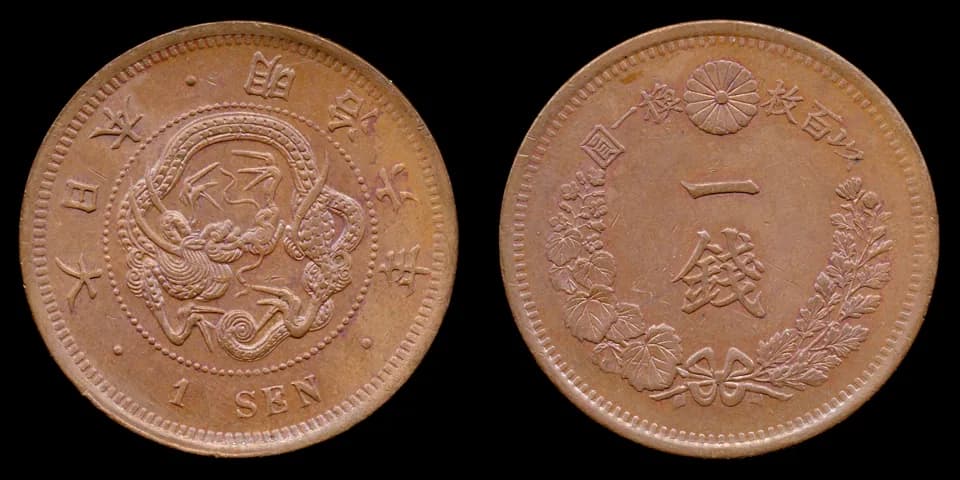
Image: Modern Japanese coinage / As6673 / Wikimedia Commons / CC BY-SA 3.0(source)
Meiji Dragon 20 Sen Silver Coin — The Small Giant that Built the Foundation of Modern Japan
The Dragon 20 Sen that Circulated as the Main Player in Daily Transactions for Nearly 40 Years
Subject coin: 明治竜20銭銀貨
Overview
The Meiji Dragon 20 Sen silver coin, minted from Meiji 3 (1870) to Meiji 38 (1905), was an important coin that supported the economic foundation of modern Japan. With a weight of 5.39g and a silver purity of 80%, its specifications were set based on the New Currency Act, reflecting the Meiji government's intention to transition to an international currency system. The front featured a powerful dragon, and the back the rising sun and the inscription 20 SEN, establishing the design language of the Meiji era. This coin circulated widely as a major subsidiary silver coin in daily transactions for nearly 40 years, supporting the economic development of the Meiji era. The continued use of the dragon design over a long period symbolized stable values and influenced later banknote designs. Alongside the Keichō Koban details and Value and Identification of Modern Coins, it is a coin of historical significance.
Specifications
- Denomination
- 20銭
- Minting period
- 1870年〜1905年
- Metal composition
- 銀80%(新貨条例基準)
- Weight
- 5.39g
- Dimensions
- 直径約23mm
- Mintage
- 不詳(諸説あり)
- Mint supervisor
- 不詳
- Market price
- 10,000円〜50,000円(状態による)
Historical Background and Motives for Minting — Establishment of the New Currency Act and the Dragon 20 Sen
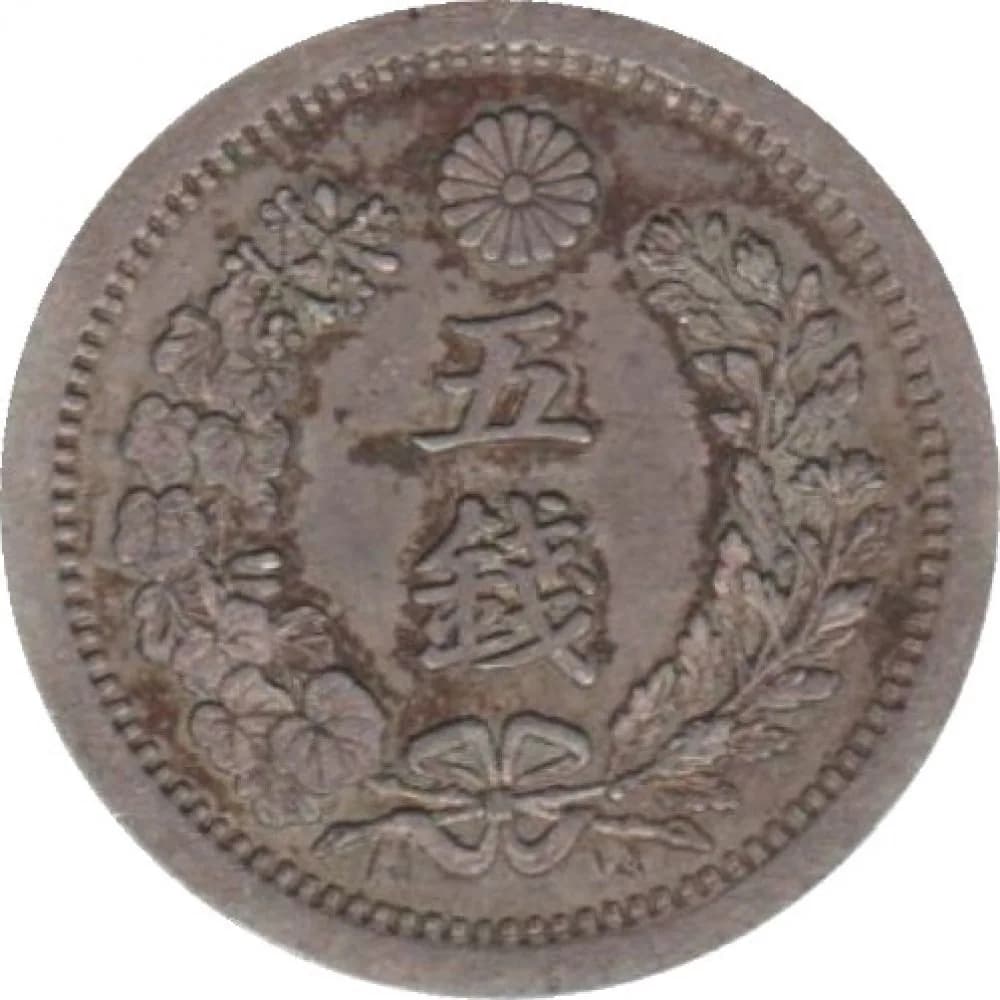
Image: Modern Japanese coinage / Coindesmonnaies / Wikimedia Commons / CC BY-SA 4.0(source)
After the Meiji Restoration, Japan embarked on refreshing its currency system to lay the foundation as a modern nation. In 1868, the Meiji government abolished the complex old currency system and sought to introduce a new currency system based on the international gold standard. In 1871, the New Currency Act was enacted, establishing a decimal currency system based on the yen. The Dragon 20 Sen silver coin was minted as part of this new currency system, playing an important role in stabilizing the economy and modernizing the nation.
In 1870, the government established a mint, where the Meiji Dragon 20 Sen silver coin was born. The mint was set up in Yokohama and, with the cooperation of foreign technicians and modern technology, precision minting became possible. At this time, Japan was expanding international trade and needed reliable silver coins to facilitate transactions with foreign countries. The Dragon 20 Sen silver coin was utilized as the main player in daily transactions and as a standard for foreign exchange.
Politically, a stable currency supply was required to strengthen the financial foundation of the Meiji government. By enforcing the New Currency Act, the government aimed for economic independence by collecting the old currency such as gold and silver coins from the Edo period and transitioning to a new currency system. The Dragon 20 Sen silver coin was born in this historical context, serving its role as a coin symbolizing Japan's modernization.
The Minting Process and Craftsmen — The Secret Birth of the Dragon 20 Sen
Image: Modern Japanese coinage / Coindesmonnaies / Wikimedia Commons / CC BY-SA 4.0(source)
The minting process of the Dragon 20 Sen silver coin employed the latest technology of the time. The Yokohama Mint played a central role, gathering technicians invited from the West. They were instructed by the Meiji government to transmit the latest minting techniques to Japan and guide the production of the Dragon 20 Sen silver coin.
A steam engine imported from the United Kingdom was used for minting, enabling mass production. In the factory, silver bullion was first melted at high temperatures and poured into molds to form each coin. In this process, the weight of 5.39g and silver purity of 80% for the 20 Sen silver coin were strictly managed, ensuring compliance with international standards.
During this period, Japan was expanding international trade and required reliable silver coins to facilitate smooth transactions with foreign countries. The Dragon 20 Sen silver coin was utilized as the main player in daily transactions and as a standard for foreign exchange.
The craftsmen working at the mint were required to have advanced skills and patience. They diligently produced coins daily, paying the utmost attention to maintain quality. Especially, the dragon design required precise engraving skills, testing the craftsmen's technical abilities.
The Dragon 20 Sen silver coin, born through such efforts, supported economic activity as an important currency in Meiji-era Japan. This silver coin, a crystallization of the mint's efforts and technology, was widely accepted as a trusted currency and a symbol of a new era for the people of that time.
Circulation and Economic Impact — The Role of the Dragon 20 Sen
Image: Modern Japanese coinage / Coindesmonnaies / Wikimedia Commons / CC BY-SA 4.0(source)
The Dragon 20 Sen silver coin became indispensable in daily transactions in Meiji-era Japan due to its refined design and high reliability. It was widely used over approximately 35 years from 1870 to 1905, contributing to the stabilization of the domestic economy.
During this time, the Japanese economy was riding the wave of rapid modernization following the Meiji Restoration, and with industrial development, currency circulation was becoming more active. The Dragon 20 Sen silver coin was utilized in all kinds of commercial transactions, from rural areas to urban centers, and its value was particularly prized in the trade of agricultural and handicraft products. For example, in rice trading, it was approximately 1 yen per 1 to (斗), equivalent to about five 20 Sen silver coins.
Furthermore, the Dragon 20 Sen coin was frequently used in private small shops and markets, playing an important role in supporting the everyday life of the common people. In many households, this silver coin was saved as savings and used as cash when needed. In one family, there was a custom of saving for children's education with Dragon 20 Sen coins.
Thus, the Dragon 20 Sen silver coin was deeply rooted in Japanese economic activity, and its circulation contributed to revitalizing local economies. As the value of currency was stable, merchants and farmers could trade with confidence, which was a factor supporting the economic growth of Japan as a whole. The Dragon 20 Sen silver coin was more than just currency, and for Japanese people of the Meiji era, it was a symbol of a new era.
Influence on Later Generations and Design Changes — Continuation and Transformation
Image: Modern Japanese coinage / Coindesmonnaies / Wikimedia Commons / CC BY-SA 4.0(source)
In 1905, the design of the Meiji Dragon 20 Sen silver coin underwent a change with the advent of a new era. In Meiji 38, the government reviewed the coin design, which led to the disappearance of the dragon motif. This was an important step for Japan to shift to a design that conformed to a more international currency system.
The role of the Dragon 20 Sen silver coin had been fully achieved over the past 40 years, and its design left a deep impact on Japanese coin culture. Especially, the combination of the dragon and the rising sun was an iconic design of the Meiji era, etched in many people's memories. The change in design was not simply a renewal of the motif but a strategic choice to enhance Japan's international standing and earn trust domestically and internationally.
After the design change, a new design 20 Sen silver coin appeared, adopting motifs symbolizing Japan, such as cherry blossoms and Mount Fuji, in place of the dragon. This emphasized Japan's cultural identity and was accepted among citizens as the dawn of a new era.
However, the Dragon 20 Sen silver coin continued to be loved by many collectors, with its historical value being re-evaluated. Particularly, as a coin symbolizing the Meiji era, its position remained unshaken, and due to its rarity and beautiful design, it continues to attract the attention of many coin enthusiasts today. In this way, the Dragon 20 Sen silver coin continued to influence subsequent coin designs and played an important role in Japan's history.
Value & Rarity
The Dragon 20 Sen silver coin's market value varies greatly depending on the coin's condition and year. Specifically, coins from the initial minting year of 1870 or certain subsequent years are highly popular among collectors. Even coins in general condition start at around 10,000 yen, and those with good preservation or rare years can be traded for more than 50,000 yen. Furthermore, coins that receive special appraisal evaluations may fetch even higher prices at auctions. Thus, the Dragon 20 Sen silver coin continues to attract considerable interest from collectors due to its historical background and beautiful design. The design of the Dragon 20 Sen silver coin reflects the culture and values of the Meiji era, which captivates collectors. Refer to Basics of Coin Auction for more detailed information on bidding.
Related Guides: Overview of Meiji Period Coins / Check Price Trends with a Market Chart
Conclusion
The Meiji Dragon 20 Sen silver coin, as more than just currency, had a significant impact on the economy and culture of Meiji Japan. Circulating for about 40 years, it supported economic stabilization and modernization during that time. This silver coin was the crystallization of contemporary technology, produced through the skills and efforts of craftsmen. Its design, as a symbol of the Meiji era, was passed down through generations and contributed to the evolution of currency design. Still cherished by collectors today, the Dragon 20 Sen silver coin is particularly important among ancient coins due to its historical value and beautiful design. Its value will continue to be passed down through the ages. The Dragon 20 Sen silver coin, having played its role in history, continues to shine in the present day.
Related Stories
60th Anniversary of Local Autonomy Law 500 Yen Bicolor – 10-Year Journey Across 47 Prefectures
Commemorative Coin Series Born from the Law of 1947
Coin StoryPhoenix 100 Yen Silver Coin - The Final Edition Tells the Transition of the Showa Era
1964, The End of Silver Coins and the Dawn of a New Era
Coin StoryHōō 100-Yen Silver Coin — Wings of Recovery, and the End of the Silver Coin Era
The Brilliance of the High-Growth Period and the Short Life of a Silver 100-Yen Coin Buffeted by Soaring Silver Prices
Dealers
Dealers Handling This Category
A reference when considering a sale or appraisal. All are dealers and auction houses with a proven track record.
Ginza Coins
Ginza, Chuo-ku, Tokyo
One of Japan's most established numismatic dealers. The scale and variety of their regular auctions is among the largest in the country. Their catalogs are considered a benchmark for market pricing.
Taisei Coins
Tokyo
A dealer with an international network. Offers advanced services such as consignment to overseas auctions and NGC/PCGS grading submission. Recommended for high-value or internationally recognized coins.
Tokyo Coin Club
Tokyo
A membership-based coin dealer known for carefully selected, quality inventory.