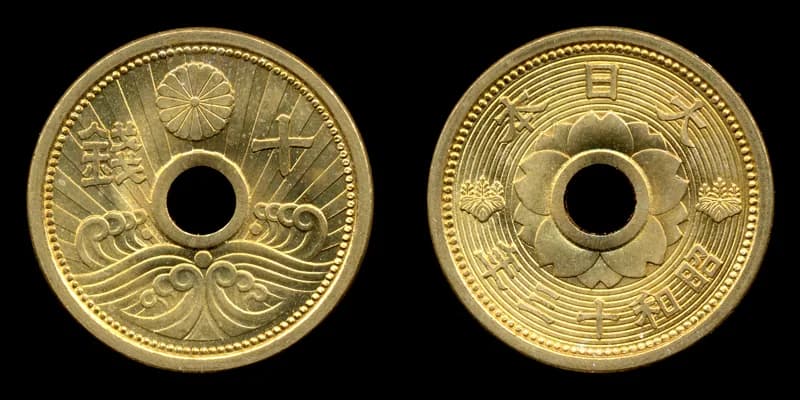
Image: Modern Japanese coinage / As6673 / Wikimedia Commons / CC BY-SA 3.0(source)
The Tragedy of the Man'en Nibu Koban (万延二分判金)
Gold purity 22.97%, weight 3.0g. A desperate measure to stop gold outflow that led to trust collapse
Subject coin: 万延二分判金
Overview
In October 1860 (Ansei 7), the Edo Shogunate enacted a sudden and significant recoinage. It wasn't just the koban that was affected. The nibu koban also saw a dramatic decrease in gold purity from 56.77% to 22.97%, and its weight reduced from 3.75g to 3.00g. This is the Man'en Nibu Koban. Why was such an extreme recoinage forced through? The answer lies in the distortion of the gold-silver exchange rate that struck Japan at the end of the Edo period. The disparity in gold-silver exchange rates with the West, which surged in with the opening of the country, caused Japan's gold to rapidly flow overseas. Confronted with this crisis, the shogunate's financial administrators chose to prevent the outflow of gold coins by drastically reducing the gold content—a strategy intended to deter gold coins being taken overseas. However, this 'desperate measure' led to economic confusion domestically and significantly eroded public trust, similar to the types and value of koban. The Man'en Nibu Koban, which had a short life of only 9 years, tells the story of how the tumultuous times of the late Edo period dealt a devastating blow to the Japanese economy.
Specifications
- Denomination
- 2分(小判の1/2相当)
- Minting period
- 万延元年〜明治2年(1860-1869年)
- Metal composition
- 金22.97% / 銀・銅他77.03%
- Weight
- 3.00g
- Dimensions
- 縦約37mm × 横約21mm × 厚さ約2mm
- Mintage
- 不詳(諸説あり。数百万枚以上と推定)
- Mint supervisor
- 後藤家(金座)/ 江戸幕府勘定奉行
- Market price
- 80万円〜250万円(状態・鑑定書の有無による。未使用品は特に高く評価される)
Chapter 1 — The Shock of Opening the Country and the Collapse of Gold-Silver Ratios
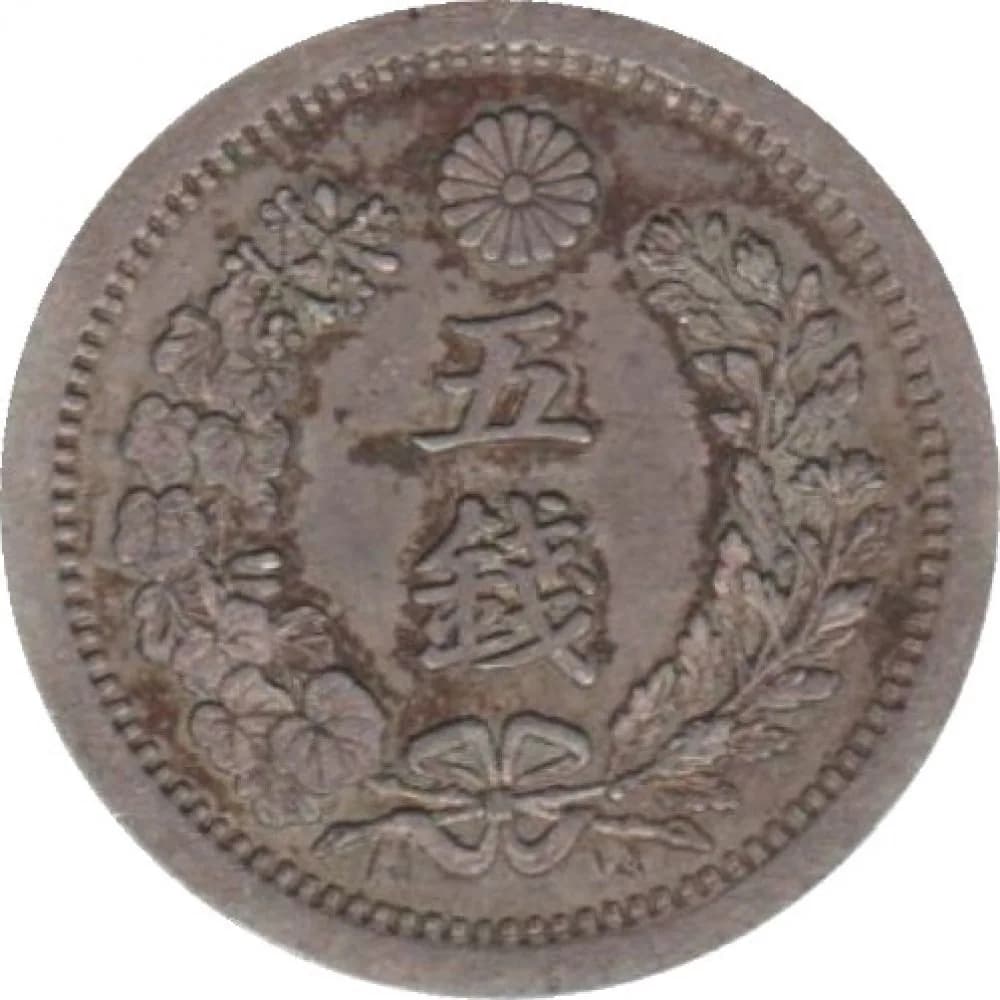
Image: Modern Japanese coinage / Coindesmonnaies / Wikimedia Commons / CC BY-SA 4.0(source)
In 1853 (Kaei 6), Commodore Perry's Black Ships brought the wave of opening up, fundamentally shaking Japan's economic order. The gold-silver ratio, stable under the closed Edo period, began to distort when faced with Western market principles. At that time, Japan's domestic exchange rate of gold to silver was approximately 1:5, while the international standard was over 1:15. Foreign merchants seized this inequality, bringing silver to exchange for gold, then taking the gold out of the country repeatedly for arbitrage. As a result, it's estimated that in just the two years from the signing of the Treaty of Amity and Commerce between Japan and the United States in 1858 (Ansei 5) to 1860 (Man'en 1), several million ryō of gold flowed out of Japan. The shogunate's finances rapidly faltered, and officials from the gold and silver exchanges were engulfed in a sense of crisis. Under this severe situation, a significant recoinage was decided in October of Man'en 1 under the leadership of Finance Magistrate Mizuno Tadanaka and Senior Counselor Andō Nobumasa. The existing Bunsei Nibu gold coin, with a gold purity of 56.77% and weight of 3.75g, was a relatively high-quality coin. However, the new Man'en Nibu Koban was an extreme recoinage, reducing gold purity to 22.97% and weight to 3.00g. The intention behind this decision was to reduce the gold content to prevent coins from flowing abroad. Simply put, the less gold they contained, the less valuable they would be for foreign merchants to take away—a simplistic yet desperate logic. However, this policy greatly complicated the variety and identification of Edo gold coins and caused significant confusion among domestic merchants.
Chapter 2 — Extreme Minting at Edo's Gold Mint
Image: Modern Japanese coinage / Coindesmonnaies / Wikimedia Commons / CC BY-SA 4.0(source)
From the recoinage decision in October of Man'en 1, within just a few weeks, a large-scale minting system was set up at Edo’s gold mint. Leading this was the head of the Goto family, who had been serving the shogunate as the chief of the mint for generations. Since the Keicho era, the Goto family had been involved in minting gold and silver coins, and their technology and credibility were absolute throughout the Edo period. However, this Man'en recoinage posed an unprecedented challenge to the Goto family’s technicians. The reduction of gold purity from the previous 56.77% to 22.97% wasn't merely a change in material composition but signified a fundamental loss of value as a gold coin. While the previous Bunsei Nibu gold coin had a roughly 3:2 ratio of gold to silver, the Man'en Nibu Koban had an extreme composition of approximately gold:silver:copper = 1:2.5:0.5. In the casting process, gold and silver bullions were melted in a high-temperature furnace and mixed according to the specified ratio. Temperature control was crucial, with even a single mistake resulting in a large number of defective products. Workers at the Edo mint labored day and night on these tasks, and from Man'en 1 to Keio 3 (1867), it's estimated that they cast over several million Man'en Nibu Koban. Post-minting, the gold coins were stamped with '万延' (Man'en) and a stylized signature, followed by weight inspection before being approved for circulation. The inspection standards required weights to be within ±0.05g of 3.00g, proving the high technical skill level of the Goto family's craftsmen. However, no matter how strict quality control was, the fundamental flaw of low gold content could not be concealed. Merchants noticed the lightness of the new Nibu Koban and began using touchstones to test their purity in the market.
Chapter 3 — Market Confusion and Public Distrust
Image: Modern Japanese coinage / Coindesmonnaies / Wikimedia Commons / CC BY-SA 4.0(source)
As the Man'en Nibu Koban began circulating in the market, confusion erupted immediately. Despite the similar appearances between the previous and new Man'en Nibu Koban, the significant difference in gold content forced money changers and merchants to strictly distinguish between the two. In major cities like Edo, Osaka, and Kyoto, it became common for money changers to use touchstones to check the purity of gold coins. A touchstone, used to measure gold purity, involved rubbing the coin against a black stone to judge purity by the color of the marks produced. When it became evident that the gold content of the Man'en Nibu Koban was only about 40% of the previous coin, it caused severe market upheaval. From November to December of Man'en 1, Edo's gold rates surged from 265 momme (匁) per ryō to 280 momme, with silver rates fluctuating in response. The daily lives of citizens were deeply affected. When exchanging gold coins at money changers, coins that were previously treated as the same 'Nibu gold' were suddenly categorized into 'old gold' (Bunsei Nibu Koban) and 'new gold' (Man'en Nibu Koban), each with different exchange rates. Records indicate that while both had a nominal '2 bu', 10 old gold coins were equivalent to 11 new gold coins, indicating the new gold's value was roughly 10% lower in reality. To the common people, this situation appeared exceedingly unfair. The contradiction of the Man'en Nibu Koban, officially issued by the shogunate yet discounted in the market, eroded the shogunate's credibility itself. Records from Osaka merchants expressed pessimism with phrases like 'new gold has no value beyond silver' and 'Man'en recoinage may trigger peasant uprisings'. In rural areas, as the Man'en Nibu Koban entered circulation, inflation accelerated. From Man'en 1 to the following year, rice prices rose about 20-30%, and essential goods like salt and soy sauce also saw price increases. It is believed that the widespread circulation of new gold with lower gold content effectively increased the money supply, driving inflation.
Chapter 4 — Abolishment of the Short-Lived Coin and the Transition of Late Edo Economy
Image: Modern Japanese coinage / Coindesmonnaies / Wikimedia Commons / CC BY-SA 4.0(source)
Nine years after the Man'en Nibu Koban began circulating, in 1869 (Meiji 2), the new government declared its abolishment. The new government established by the Meiji Restoration hurried to overhaul the old Edo era currency system with a modern monetary system. In July of Meiji 2, the government issued an 'Old Gold and Silver Coin Recall Order', targeting all Edo-era gold and silver coins for exchange into the new yen currency. During this exchange, the Man'en Nibu Koban, due to its low gold content, was likely exchanged at a lower rate than the previous Nibu Koban. Specific exchange rates are limited in documentation, with various theories existing, but it's generally thought that the new gold (Man'en Nibu Koban) was valued at about 90-95% compared to the old gold (Bunsei Nibu Koban). This discriminatory practice symbolized the failure of the shogunate’s recoinage policy. The Meiji government's currency system reform aimed to integrate the Japanese economy into the international market by adopting a Western gold standard system. With the new Coinage Act enacted in 1871 (Meiji 4), Japan transitioned to a new gold standard system of 1 ryō = 1.5g, and all Edo-era gold coins, including the Man'en Nibu Koban, lost their status as official circulation means. This transition marked a significant turning point in understanding the value and identification of modern currency. The abolishment of the Man'en Nibu Koban was not merely the sorting of old coins but symbolized the entire Japanese economy's transition from the Edo era to modern times. Amid the upheaval from the late Edo period to early Meiji, the Man'en Nibu Koban relayed the severity of the economic crisis faced by the shogunate, and the limits of their response, to future generations through its extreme reduction in gold content. Modern numismatists regard the Man'en Nibu Koban as 'living proof of the late Edo economic crisis', with its historical value far exceeding that of mere coin valuation.
Value & Rarity
The market value of the Man'en Nibu Koban varies greatly depending on its condition and the presence of a certificate of authenticity. Even commonly circulated ones fetch between 800,000 to 1,500,000 yen, while near-unused pieces in excellent condition can exceed 2,500,000 yen. Particularly, pieces with the Goto family's signature crisply stamped or precisely weighed at 3.00g are highly esteemed among collectors. From a rarity standpoint, the Man'en Nibu Koban, estimated to have been minted in millions, falls into a relatively accessible category among Edo gold coins. However, over 150 years, many have been melted down, worn out, or recast as counterfeit, significantly decreasing their current number. Especially unused pieces are extremely rare, with coins graded 'MS65' or higher by credentialing organizations fetching 5,000,000 to 10,000,000 yen. According to grading standards for old coins, the Man'en Nibu Koban is evaluated as follows: unused pieces (MS60 and above) are exceedingly rare and expensive; extremely fine pieces (AU55–AU58) range between 1,000,000 to 2,500,000 yen; fine pieces (XF40–XF45) range 800,000 to 1,500,000 yen; circulated pieces (VF20–VF35) range 500,000 to 800,000 yen. Market demand is stable, with constant purchases by collectors studying Japanese old coin history and researchers interested in late Edo economic history. Additionally, according to basics of coin auctions, the Man'en Nibu Koban is always a spotlight item in the auction market. However, identifying counterfeits and altered coins requires attention, as their low gold content made them easy targets for later processing or recasting. Receiving a credible credentialing organization's evaluation is indispensable when purchasing.
Conclusion
The Man'en Nibu Koban is not just a gold coin but a living testimony of the severe blows the tumultuous times of the late Edo period dealt to the Japanese economy. Its extreme specifications of gold purity at 22.97% and weight at 3.00g narrate the shogunate's desperate choice facing the distortion of the gold-silver ratio due to the opening of the country. Although short-lived for just nine years, this gold coin is highly esteemed in the old coin market today as a symbol of the collapse of the old order and the transition to a new era.
Related Stories
Two-System of Chōgin and Mameitagin — Tracing the History of Edo Silver Coins
Edo silver coins were always circulated as a set of 'Chōgin (丁銀, Large)' and 'Mameitagin (豆板銀, Small)'. Why was this peculiar two-system created?
Coin StoryGenroku Chōgin - Tracing the History of Edo Silver Coins
Following the debasement of the Koban, silver was also counterfeited. The shock of the Genroku 8 (1695) Chōgin recoinage on Edo prices
Coin StoryGenroku Ichibuban Kin — The Small Gold Coins of Edo That Changed Overnight
The Drastic Drop in Gold Purity of Genroku Ichibuban and Its Impact
Dealers
Dealers Handling This Category
A reference when considering a sale or appraisal. All are dealers and auction houses with a proven track record.
Ginza Coins
Ginza, Chuo-ku, Tokyo
One of Japan's most established numismatic dealers. The scale and variety of their regular auctions is among the largest in the country. Their catalogs are considered a benchmark for market pricing.
Japan Coin Auction (JCA)
Tokyo
Holds regular auctions with reliable hammer price data, making it a useful resource for tracking market values. Caters to a wide range of collectors from beginners to advanced buyers.
Taisei Coins
Tokyo
A dealer with an international network. Offers advanced services such as consignment to overseas auctions and NGC/PCGS grading submission. Recommended for high-value or internationally recognized coins.