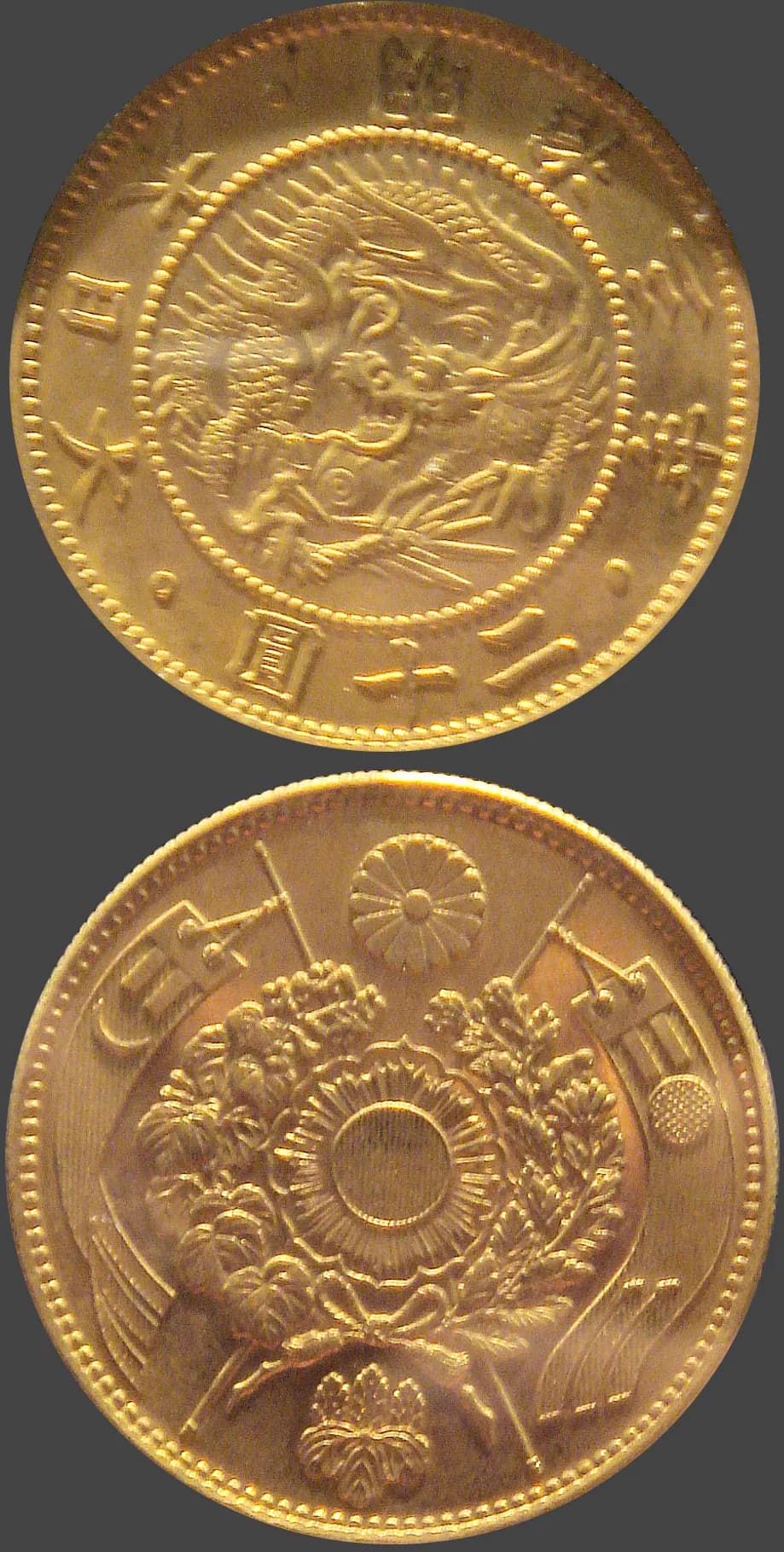
Image: Modern Japanese coinage / PHGCOM / Wikimedia Commons / CC BY-SA 3.0(source)
Genroku Chōgin - Tracing the History of Edo Silver Coins
Following the debasement of the Koban, silver was also counterfeited. The shock of the Genroku 8 (1695) Chōgin recoinage on Edo prices
Subject coin: 元禄丁銀
Overview
Genroku Chōgin is an indispensable piece in discussing Japanese monetary history from 1695 to 1706. After the debasement of the Koban, silver was also counterfeited. The Genroku 8 (1695) Chōgin recoinage's impact on Edo prices cannot be overlooked. This article traces Genroku Chōgin as an Edo silver coin, from its birth background, minting techniques, actual circulation, to its impact on later generations, in line with historical facts. By understanding the contextual history this coin carries, beyond just market numbers, its perceived value changes greatly. The history of Japanese currency began with Wadōkaichin minted in the Nara period, transitioned through a variety of gold and silver coins in the Edo period, and was passed down to modern cash in the Meiji era. For those who want to grasp the basics, please refer to Types of Edo Silver Coins and How to Identify Them and Details of Chōgin and Mameitagin.
Specifications
- Denomination
- —
- Minting period
- 1695-1706
- Metal composition
- —
- Weight
- —
- Dimensions
- —
- Mintage
- 不詳(諸説あり)
- Mint supervisor
- 不詳
- Market price
- 状態により変動(落札履歴を参照)
The Era When Genroku Chōgin was Born — The Background of Its Minting
Image: Modern Japanese coinage / Coindesmonnaies / Wikimedia Commons / CC BY-SA 4.0(source)
The background of Genroku Chōgin entering society is deeply tied to the political and economic circumstances of that time. Edo silver coins were minted in response to the fiscal and circulation challenges faced by rulers, arising from societal needs of the time. First, let’s look at the starting point of why this currency was necessary under such circumstances. The fact that it was implemented in Genroku 8 (1695) simultaneously with the Koban recoinage is essential for understanding its historical position. The shift to Shōtoku silver in Hōei 3 (1706) is also critical for understanding its historical position. By considering prices and systems of the minted era, it becomes clear that the meaning of the currency varies greatly depending on the time of issue even though it has the same name. Remaining specimens, as they wear and oxidize over the years, increase in rarity as time passes for those that retain their original minted condition. Market evaluations are determined by the intertwining of three axes: rarity, preservation state, and collection popularity; prices cannot be explained by just one of them.
How Genroku Chōgin Was Made — Materials and Techniques
Image: Modern Japanese coinage / Coindesmonnaies / Wikimedia Commons / CC BY-SA 4.0(source)
Materials and craftsmanship are indispensable when discussing the value of Genroku Chōgin. The alloy mix and finishing techniques of Edo silver coins are deeply influenced by the craftsmanship of artisans of that time, directly linked to contemporary evaluations. Carefully tracing the selection of materials and the crafting process brings to light the accumulation of techniques embedded in a single piece. The fact that silver purity decreased from about 80% of Keichō Chōgin to 64% is crucial for understanding its historical position. Referencing Price Trends on Market Charts helps to deepen understanding further. Existing specimens increase in rarity over time as they wear and oxidize, especially those that retain their state from the minting period. Market valuation depends on the intertwining of rarity, preservation state, and collectability; prices cannot be explained by only one of them. Grasping the basics such as the writing style of characters, the color of the base metal, dimensions, and weight is the first step in discerning authenticity and lineage. By learning the historical background, one can feel the cultural depth specific to that currency, which cannot be measured just by market numbers. As one continues to collect, the time backgrounds and minting circumstances for each denomination interconnect, cultivating multi-dimensional knowledge.
Genroku Chōgin and People's Lives — Circulation and Economy
Image: Modern Japanese coinage / Coindesmonnaies / Wikimedia Commons / CC BY-SA 4.0(source)
After being issued, Genroku Chōgin passed from hand to hand and was used in everyday life. Understanding how Edo silver coins circulated in the market and their impact on prices and transactions is the core of comprehending monetary history. Through the economic movements of that time and public reactions, we will decipher the role this currency played. The fact that Shigehide Ogiwara led the recoinage of both gold and silver is essential for understanding its historical position. Referencing Grading Standards for Old Coins helps deepen understanding further. Market evaluations rely on the intertwining of rarity, preservation state, and collectability; prices cannot be explained by just one of them. Grasping the basics such as the writing style of characters, the color of the base metal, dimensions, and weight is the first step in discerning authenticity and lineage. Learning about historical settings allows one to feel cultural depth specific to that currency, beyond market numbers. As one continues to collect, the time backgrounds and minting circumstances of each denomination interconnect, fostering multi-dimensional knowledge. An old coin is a document reflecting the economic policies and lives of the era, and understanding the background changes the perception of its value.
What Genroku Chōgin Left Behind — Impact on Later Generations
Image: Modern Japanese coinage / Coindesmonnaies / Wikimedia Commons / CC BY-SA 4.0(source)
Genroku Chōgin, even after ending its era, left its mark on successor currencies and the history of collection. Edo silver coins were positioned in the context of recoinage, abolition, and succession, and their modern evaluation is reviewed. Considering what meaning a coin from the past holds in today's market enhances the precision of value judgment. The fact that it caused rapid inflation in the Kyotō silver standard economic zone is crucial for understanding its historical position. Referencing Monitoring Coin Prices in the Vault helps deepen understanding further. Grasping the basics such as the writing style of characters, the color of the base metal, dimensions, and weight is the first step in discerning authenticity and lineage. Learning about historical settings allows one to feel cultural depth specific to that currency, beyond market numbers. As one continues to collect, the time backgrounds and minting circumstances of each denomination interconnect, cultivating multi-dimensional knowledge. An old coin is a document reflecting the economic policies and lives of its era, and understanding the background changes the perception of its value. By considering prices and systems of the minted period, one realizes that even though a currency has the same name, its meaning varies greatly depending on its issuance period.
Value & Rarity
The market value of Genroku Chōgin is determined by three factors: rarity, state of preservation (grade), and collection popularity. Even for the same Edo silver coin, prices can vary significantly - from several times to several tens of times - depending on the minting period, writing style differences, and whether it is in near-unused condition. Brands with a limited existing count rarely appear on the market, and well-preserved specimens gain rarity over the years. When reading market trends, it is prudent to verify actual achieved auction prices across multiple examples, rather than relying on quoted prices. The latest price movements can be monitored on Monitoring Coin Prices in the Vault. Market evaluations rely on the intertwining of rarity, preservation state, and collection popularity; prices cannot be explained by one factor alone. Understanding the basics such as the writing style of characters, the color of the base metal, dimensions, and weight is the first step in discerning authenticity and lineage.
Conclusion
Genroku Chōgin was born from the needs of the era 1695-1706, played a role in people's lives, and left a legacy for the future. Knowing the history behind a single piece of currency nurtures a discerning eye that cannot be obtained from market numbers alone. For those interested in Edo silver coins, it is recommended to take your time comparing multiple trade data, gradually developing your own judgment criteria.
Related Stories
Two-System of Chōgin and Mameitagin — Tracing the History of Edo Silver Coins
Edo silver coins were always circulated as a set of 'Chōgin (丁銀, Large)' and 'Mameitagin (豆板銀, Small)'. Why was this peculiar two-system created?
Coin StoryGenroku Ichibuban Kin — The Small Gold Coins of Edo That Changed Overnight
The Drastic Drop in Gold Purity of Genroku Ichibuban and Its Impact
Coin StoryThe Genroku Koban — Shigehide Ogiwara's Financial Revolution and the Consequences of the Genroku Bubble
The man who halved the gold content to save the shogunate, and the merits and demerits of his actions
Related Encyclopedia Entries
System of Edo Silver Coins
Conclusion: Understanding the two systems (weighed and counted) and complex fineness changes of Edo silver coins, along with appraisal points and market prices, enables smart collecting and investing.
EncyclopediaThe World of Chogin
Conclusion: Chogin is a fascinating weighing silver coin from the Edo period, whose value is determined by its fineness changes, hallmarks, and condition, making it an attractive collectible and investment.
Dealers
Dealers Handling This Category
A reference when considering a sale or appraisal. All are dealers and auction houses with a proven track record.
Japan Coin Auction (JCA)
Tokyo
Holds regular auctions with reliable hammer price data, making it a useful resource for tracking market values. Caters to a wide range of collectors from beginners to advanced buyers.
Ginza Coins
Ginza, Chuo-ku, Tokyo
One of Japan's most established numismatic dealers. The scale and variety of their regular auctions is among the largest in the country. Their catalogs are considered a benchmark for market pricing.
Osaka Numismatic Auction
Osaka
A Kansai-based coin auction house with particular strength in regional and hole coins.