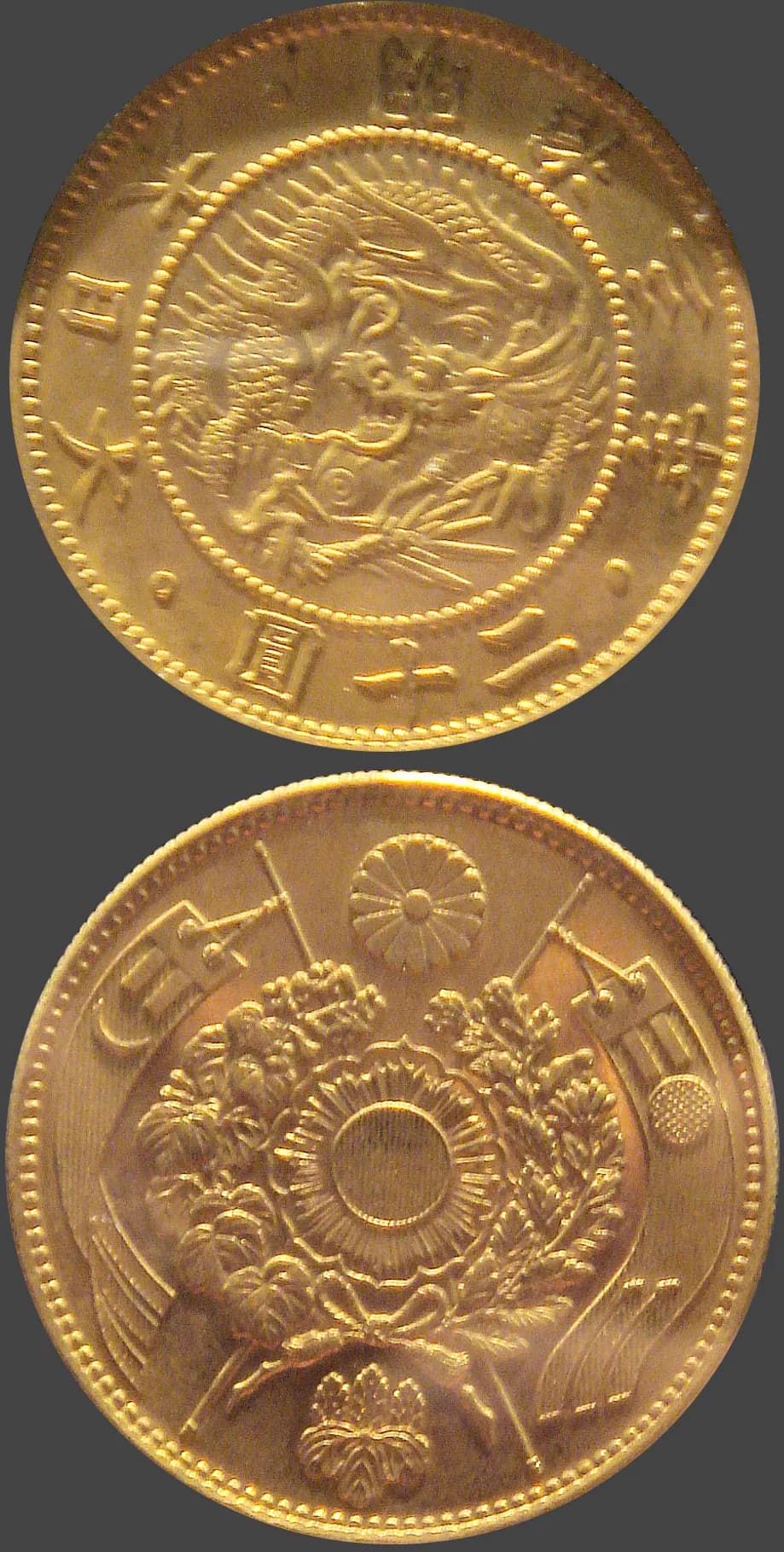
Image: Modern Japanese coinage / PHGCOM / Wikimedia Commons / CC BY-SA 3.0(source)
Ansei Ichibu Gin — A Small Measure in Response to the Late Edo Period Crisis
The Silver Coin 'Ansei Ichibu Gin' Symbolizing the Late Edo Period Financial Crisis
Subject coin: 万延一朱銀
Overview
In Ansei 1 (1860), the Edo Shogunate, facing financial difficulties, issued the Ansei Ichibu Gin alongside the Ansei Koban as a measure to revive the economy. This coin became a symbol of the financial crisis at the time, with its silver purity significantly reduced compared to previous Ichibu Gin. Specifically, where previous silver purity exceeded 80%, the Ansei Ichibu Gin decreased to 20%, with the remainder supplemented by lead. This recoinage was part of addressing the outflow of gold at the time and vividly represented the shogunate's dire straits. Today, due to its historical background, the Ansei Ichibu Gin draws great interest from collectors. The background of the Ansei Ichibu Gin is linked to a wealth of information involving details of Edo silver coins and types and identification of Edo gold coins.
Specifications
- Denomination
- 一朱
- Minting period
- 万延元年〜慶応3年(1860-1867年)
- Metal composition
- 銀20% / 鉛80%
- Weight
- 約1.5g
- Dimensions
- 縦約22mm × 横約12mm
- Mintage
- 不詳(諸説あり)
- Mint supervisor
- 不詳(江戸幕府銀座)
- Market price
- 5,000円〜50,000円(状態による)
Chapter 1: The Financial Crisis of the Late Edo Period — Background to the Recoinage
Image: Modern Japanese coinage / Coindesmonnaies / Wikimedia Commons / CC BY-SA 4.0(source)
In 1860, the Edo Shogunate was facing a financial crisis. During this period, trade with America and Europe intensified, and the outflow of gold became a serious issue. Notably, the Ansei Earthquake (1855) and subsequent reconstruction efforts, as well as the increased expenses from the opening of the country, put immense pressure on the shogunate's finances. In response, the shogunate carried out a monetary recoinage. In Ansei 1 (1860), the Ansei Ichibu Gin was recoined alongside the Ansei Koban. The aim was to curb the outflow of gold and stimulate the domestic economy. During this time, senior councilor Ii Naosuke advanced the policy of opening the country and was forced into signing unequal treaties with foreign countries, which prompted domestic backlash. Particularly, the devaluation of currency due to the recoinage had direct impacts on the lives of the common people. To prevent the outflow of silver, the shogunate drastically reduced the silver purity, promoting domestic circulation of silver coins. However, this measure was temporary and did not lead to a fundamental resolution. The issuance of the Ansei Ichibu Gin illustrates the severe financial condition the shogunate was in.
Especially, the currency system then was complex, with many types of currency in circulation. The Ansei Ichibu Gin, which significantly reduced its silver content, had less than half the silver purity compared to the previous Ichibu Gin. By lowering the silver purity, they attempted to suppress the outflow of silver as currency value decreased. Behind this lay the ever-expanding fiscal deficit of the shogunate, particularly the significant price discrepancy of gold and silver in imports and exports. Moreover, after the Meiji Restoration, these currencies were abolished under the new currency system, and many old coins were exchanged for new ones. However, many unexchanged pieces remained, becoming valuable items for future coin collectors. The monetary recoinage at the end of the Edo period not only affected the economy but also had significant social impacts, bringing major changes to people's lives at the time.
Chapter 2: The Coining Process — Technology and Artisans
Image: Modern Japanese coinage / Coindesmonnaies / Wikimedia Commons / CC BY-SA 4.0(source)
The coining of the Ansei Ichibu Gin was conducted at the Edo Shogunate's direct Ginza. This Ginza was the center of currency production at the time, where many skilled artisans gathered. The Ginza overseer, under the shogunate's command, supervised the recoinage process of the silver coins. To expedite the urgent currency recoinage aimed at fiscal recovery, the Ginza overseer selected artisans with particularly outstanding skills to direct the coining.
While traditional techniques were used for the production of the Ansei Ichibu Gin, a bold change was made by lowering the silver purity to 20%. This recoinage was closely tied to the issue of gold outflow at the time and was an urgent measure to protect domestic precious metal resources. The reduction of silver purity was a desperate measure to prevent the large outflow of gold through trade with Western countries. Given such circumstances, higher-level technologies than usual were required in the minting process, with artisans repeatedly trying and testing during manufacturing.
Because the Ginza was close to the center of Edo, there was a system in place to promptly address any technical problems that arose. The artisans possessed the technology to adjust the metal mix ratios to produce coins with appropriate hardness and durability. Thanks to their craftsmanship, the Ansei Ichibu Gin was mass-produced in a short time and circulated in the market. This efficient production system was crucial for the shogunate's finances. By lowering the silver purity, they aimed to increase the silver supply and smooth domestic currency circulation, but this undermined public trust and eventually led to economic turmoil.
After the Meiji Restoration, the Ansei Ichibu Gin was abolished under the new currency system and became exchangeable for new currency. Nonetheless, there remained many Ansei Ichibu Gin that were not exchanged, later becoming valuable in coin collecting.
Chapter 3: Public Reactions — Economic Impact and Circulation Realities
Image: Modern Japanese coinage / Coindesmonnaies / Wikimedia Commons / CC BY-SA 4.0(source)
When the Ansei Ichibu Gin started circulating, there were various reactions among the common people. As the coin's purity decreased, its actual value diminished, leading to a rise in prices. The fact that the silver content fell to less than half of the previous Ichibu Gin incited public anxiety. Many merchants and commoners were apprehensive about accepting the new Ichibu Gin and sometimes refused trades. Particularly, in regions where the exchange rate with old silver coins differed, a situation arose where the new currency had difficulty circulating. For instance, in commercial hubs like Edo and Osaka, exchanges with old coins were carried out with caution, and additional confusion spread in the provinces. At this time approaching the end of the Edo period, fluctuations in commodity prices and currency value markedly affected the lives of the common people. Many were forced to use the new currency, prices of necessities skyrocketed, and the common people's lives became increasingly harsh. Merchants, to avoid using new Ichibu Gin, preferred gold and old silver coins for transactions, but due to the shortage in circulation, they gradually had to accept the new currency. The economic turmoil at the time distinctly demonstrated how the shogunate's policies impacted the populace, and it contributed as one of the reasons for the later distrust in the Meiji government. After the Meiji Restoration introduced a new currency system, the Ansei Ichibu Gin was exchanged for new currency, but some unexchanged coins remained in various places and were subsequently used as historical materials. Thus, the impact of such economic policies of the time on later generations is immeasurable.
Chapter 4: After the Meiji Restoration — Abolition and Legacy
Image: Modern Japanese coinage / Coindesmonnaies / Wikimedia Commons / CC BY-SA 4.0(source)
After the Meiji Restoration, the government advanced the modernization of the currency system, leading to the abolition of old shogunate era coins one after another. The Ansei Ichibu Gin was no exception and was abolished by the New Currency Ordinance of 1871, becoming exchangeable with newly issued currency. However, because it was issued during the chaotic end of the Edo period, not all pieces were exchanged, with many remaining. These unexchanged coins became cherished among collectors for their historical worth later. Despite its low purity and thus low monetary value, the Ansei Ichibu Gin is considered historically important as it directly reflects the fiscal policies and economic conditions of the late Edo period. The reason many collectors seek this silver coin stems from its value exceeding mere currency; it tells the reality of Japan's economy of the past. Today, utilizing basic knowledge of coin auctions can enhance the enjoyment of collecting through appropriate value assessment. About how currency developed post-Meiji, Modern Currency Values and Identification can be referred to.
Value & Rarity
The Ansei Ichibu Gin, vividly reflecting the late Edo period's financial conditions, attracts high interest among collectors. Due to its historical background, it holds value beyond mere currency. Well-preserved examples can trade for over 50,000 yen, and especially unused or well-maintained pieces have increased rarity. On the other hand, due to the coinage technology and material properties of the time, many coins have deteriorated, resulting in widely varying values. In assessing market values, it's important to refer to Grading Standards for Old Coins. The Ansei Ichibu Gin is very meaningful as a clue to historic understanding, and as a symbol of the end of the Edo period, its value as a collector's item signifies this. Hence, it is regarded as a fragment of history whose rarity and value will unwaveringly continue.
Conclusion
The Ansei Ichibu Gin symbolizes the financial crisis the Edo Shogunate faced during the late Edo period, with its issuance background and economic impact being exceptionally intriguing. Through this silver coin, one can learn how the tumultuous period from the late Edo period to the Meiji Restoration transformed Japan's economy and society. Today, it garners collector's interest as a historically valuable old coin and serves as a clue to understanding the currency system's evolution and the background of the era in which it circulated. The story of this small silver coin in Japanese history continues to captivate many.
Related Stories
Ansei Chōgin — The Final Edo Era Silver Bullion Coin amidst the Turbulence of the Bakumatsu
A Short-lived yet Historical Silver Bullion Created Amidst the Turmoil of Opening Japan
Coin StoryAnsei Nibus Gin — A Silver Coin Born Amidst Port Opening and Fiscal Crisis
The Role of Subsidiary Silver Coins Issued in the Turbulent Closing Years of the Edo Period
Coin StoryBunkyū Eiho and the End of the Gold Coin System — Tracing the History of Edo Gold Coins
Bunkyū 2 (1862) marks the final currency reform of the shogunate, with a gold coin series issued alongside the Bunkyū Eiho (copper coins) as a symbol of late shogunate monetary chaos
Dealers
Dealers Handling This Category
A reference when considering a sale or appraisal. All are dealers and auction houses with a proven track record.
Japan Coin Auction (JCA)
Tokyo
Holds regular auctions with reliable hammer price data, making it a useful resource for tracking market values. Caters to a wide range of collectors from beginners to advanced buyers.
Ginza Coins
Ginza, Chuo-ku, Tokyo
One of Japan's most established numismatic dealers. The scale and variety of their regular auctions is among the largest in the country. Their catalogs are considered a benchmark for market pricing.
Osaka Numismatic Auction
Osaka
A Kansai-based coin auction house with particular strength in regional and hole coins.