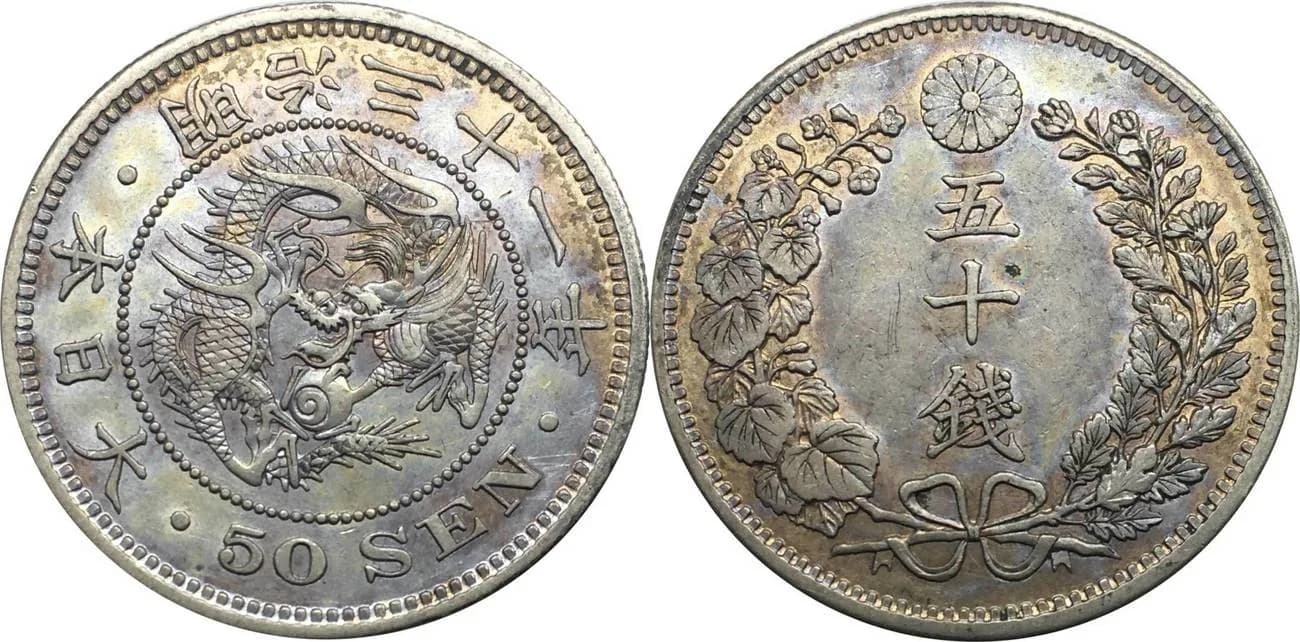
Image: Modern Japanese coinage / The government of the Empire of Japan. / Wikimedia Commons / Public domain(source)
The Age of Silk — The Story of the 'Currency' Trusted by Heian Aristocrats
The Monetary Affairs of the Heian Period, When Silk Was Valued More Than Coins
Subject coin: 絹・布の通貨機能
Overview
During the Heian period, the circulation of coins as currency was limited to urban areas, and in the provinces, silk and cloth functioned as the primary currency. In particular, one hiki (疋) of silk (approximately 20 meters) served as a standard unit of value akin to coinage, playing an important role as salary (roku) for court officials and as annual tribute (nengu) from landed estates (shōen). This developed as part of a uniquely Japanese economic system, while also reflecting Chinese influence. Heian aristocrats trusted silk more than coins, and its value was visible in every aspect of daily life. The approximately 200 years before Sino-Japanese trade with Song China began in earnest are referred to as the "Age of Silk," and the role of silk during this period formed an economic foundation that went far beyond mere textile. The economy of the Heian period was sustained precisely by this silk, and it exerted a tremendous influence on Japan's economy in later ages. This article unravels the monetary affairs of an era closely related to the General Overview and Appeal of Ancient Currency and the Detailed Explanation of the Wadō Kaichin.
Specifications
- Denomination
- 絹1疋
- Minting period
- 平安時代後期(900-1200年)
- Metal composition
- 絹・布
- Weight
- 不適用
- Dimensions
- 約20m(絹1疋)
- Mintage
- 不詳(諸説あり)
- Mint supervisor
- 不詳
- Market price
- 市場価値に基づく交換レート(諸説あり)
Chapter 1: The Economic Background of the Early Heian Period and the Value of Silk and Cloth
Image: Modern Japanese coinage / Coindesmonnaies / Wikimedia Commons / CC BY-SA 4.0(source)
In the early Heian period, Japan's economy was undergoing a major turning point. In 794, Emperor Kanmu moved the capital to Heiankyō, and Kyoto began to flourish as a new political center. However, the economy of the time was still developing, and the monetary system was immature. In this era, powerful figures in the provinces engaged in largely self-sufficient economic activity, sustaining their lives through the exchange of agricultural produce and handicrafts. Coins, as currency, were used mainly by merchants and in markets in urban areas, and their circulation in the provinces was limited. Silk and cloth, by contrast, were closely intertwined with daily life and were used as salaries (roku) for court officials and as annual tribute from shōen estates. One hiki of silk (approximately 20 meters) functioned as a standard unit of value, and its worth was stable. Heian aristocrats trusted silk even more than coins, and it is said that transactions involving silk were conducted routinely even within the imperial court. In the provinces in particular, silk and cloth were considered more valuable than coins, and they also served as an important life resource for farmers. The Heian economy was sustained precisely by this silk and cloth, exerting a tremendous influence on Japan's economy in later ages. Understanding this historical background reveals why silk was trusted more than coins. This article unravels the monetary affairs of an era also related to the General Overview and Appeal of Ancient Currency.
Chapter 2: The Circulation of Silk and Cloth and the Maintenance of Their Value
Image: Modern Japanese coinage / Coindesmonnaies / Wikimedia Commons / CC BY-SA 4.0(source)
Silk cloth in the Heian period played a role as currency that went beyond mere textile. In the markets of Kyoto and Nara, silk cloth was used as a common means of transaction, and in the shōen estates and farming villages of the provinces in particular, silk cloth functioned as a de facto currency. Silk distributed as salaries (roku) to court officials was used directly in market transactions and for exchange with other goods. For example, because provincial farmers could submit silk in lieu of the crops they were obligated to pay as annual tribute, demand for silk was consistently high and its value remained stable. One hiki of silk (approximately 20 meters) was used in many situations as a standard unit and became a measure by which the value of goods was assessed. Quality control was also strictly enforced to maintain the value of silk; because deteriorated silk lost its market value, aristocrats competed vigorously to obtain high-quality silk. The production of silk cloth flourished particularly in parts of present-day Nara Prefecture and Kyoto Prefecture, where skilled craftspeople wove high-quality silk. The silk thus supplied circulated throughout the country and became an important economic resource supporting the lives of ordinary people. The circulation of silk cloth became a pillar of the economy connecting the provinces and the cities, contributing greatly to economic development in the Heian period. It is against this backdrop that Heian-period silk cloth fulfilled its role not merely as a textile, but as an important "currency" supporting society and the economy.
Chapter 3: The Age of Silk and the Lives of the People
Image: Modern Japanese coinage / Coindesmonnaies / Wikimedia Commons / CC BY-SA 4.0(source)
In the Heian period, silk cloth was deeply embedded not only in the lives of aristocrats and court officials, but also in the lives of ordinary people. Because farmers could submit silk as annual tribute, they did not need to convert their harvested crops into cash, which contributed to stability in their lives. In provincial markets, silk cloth was traded as a matter of daily routine, with farmers bringing their own produced silk to exchange for necessary goods. In this way, silk cloth played an important role in supporting the foundation of the regional economy. Prices during the Heian period were often calculated using one hiki of silk as the standard, and it is said that one hiki of silk was required to obtain, for example, one koku of rice (approximately 150 kilograms). The value of silk was stable, and as a result prices were kept relatively constant. For ordinary people, silk was not merely a luxury textile but an important resource sustaining their lives, indispensable to daily existence. However, producing silk required advanced technique, and skilled craftspeople were essential for producing silk of particularly high quality. For this reason, silk production was concentrated in certain regions, and this scarcity was also a factor that elevated its value. The economic vitalization brought about by the circulation of silk influenced all of Heian society and was one factor that enriched the lives of the people. In this way, the lives of ordinary people in the Age of Silk enjoyed prosperity and stability through silk.
Chapter 4: The End of the Age of Silk and Its Subsequent Influence
Image: Modern Japanese coinage / Coindesmonnaies / Wikimedia Commons / CC BY-SA 4.0(source)
The Age of Silk in the Heian period gradually drew to a close from the late 12th century into the early 13th century. One of the factors was the revival of demand for coins brought about by the full-scale development of Sino-Japanese trade with Song China. As voices calling for imported goods from Song China grew louder, merchants increased their use of coins in transactions, and the role of silk and cloth gradually diminished. From this period until the establishment of the Kamakura shogunate, Japan's monetary system underwent major change. Entering the Kamakura period, Song coins began to circulate in earnest, establishing a new position as currency in place of silk and cloth. This change represents the process by which the economic center shifted from the provinces to cities, and the process by which Japan's economic foundation tilted increasingly toward a monetary economy. Nevertheless, the provincial economic foundation nurtured during the Age of Silk and the trust that aristocrats had placed in silk continued to influence later ages. In particular, the fact that silk maintained its status as a luxury item exerted a major influence on Japanese culture and the arts as well, and silk textiles continue to this day to be highly regarded as traditional crafts. In this way, the Age of Silk is not merely a single period in the past but is deeply rooted in Japanese culture and the economy up to the present day. The role played by the Age of Silk was an important turning point in Japanese history, and its influence continues even now.
Value & Rarity
Silk cloth in the Heian period held extremely important value in the socioeconomy of the time. Today, silk itself is no longer used as currency, but the silk cloth of that era continues to be highly regarded as aristocratic attire and as craft objects. Ancient silk textiles in particular are extremely rare in terms of well-preserved examples, and their scarcity gives them high market value. Considering their historical background, it is clear that silk cloth served not merely as a fabric but as an important currency that sustained the Heian economy. For this reason, the collection and study of silk cloth has become an indispensable element in understanding the ancient Japanese economy and culture. In today's market, Heian-period silk textiles are highly regarded as antiques, and their prices fluctuate significantly depending on their state of preservation and historical value. The appeal of Heian-period silk cloth speaks to the culture and way of life of that era, and its value will surely be passed down without change into the future. For those with an interest in the General Overview and Appeal of Ancient Currency, the historical value of this silk cloth will also hold great appeal.
Related Guide: Check Realized Prices at Antique Coin Auctions
Conclusion
The role of silk cloth as currency in the Heian period occupies an important place in Japan's economic history. Silk transcended mere textile, fulfilled a function as currency, and became the foundation sustaining the economy of the time. This Age of Silk promoted the development of regional economies and exerted a tremendous influence on Japan's economy in later ages. Moreover, the shift toward a monetary economy following the full-scale development of Sino-Japanese trade with Song China was an important process illustrating the transition of Japan's monetary system. The influence brought about by the Age of Silk is deeply rooted in contemporary Japanese culture and the economy, and its value is still being passed down today. Through this article, we hope that many readers will come to understand the role of Heian-period silk cloth and its historical significance, and rediscover the appeal of Japan's ancient economy.
Related Stories
Bunkyū Eihō — Tracing the History of Ansen
The last Ansen of the late Edo period. The 4-mon coin minted in Bunkyū 3 began circulating just shy of two years before the Meiji Restoration.
Coin StoryChikusen Jowi no Rei — An Ancient Japanese Attempt to Spread Currency
Wadō 4 (711): An Unprecedented System to Promote Currency Use
Coin StoryNaga-nen Taihō — Tracing the History of Ancient Coinage
The 7th coin of the Kōchō jūni-sen, issued in Shōwa 15 (848) during the reign of Emperor Ninmyō. From this time, the gap between the actual and nominal value of coins became serious.
Dealers
Dealers Handling This Category
A reference when considering a sale or appraisal. All are dealers and auction houses with a proven track record.
Japan Coin Auction (JCA)
Tokyo
Holds regular auctions with reliable hammer price data, making it a useful resource for tracking market values. Caters to a wide range of collectors from beginners to advanced buyers.
Ginza Coins
Ginza, Chuo-ku, Tokyo
One of Japan's most established numismatic dealers. The scale and variety of their regular auctions is among the largest in the country. Their catalogs are considered a benchmark for market pricing.