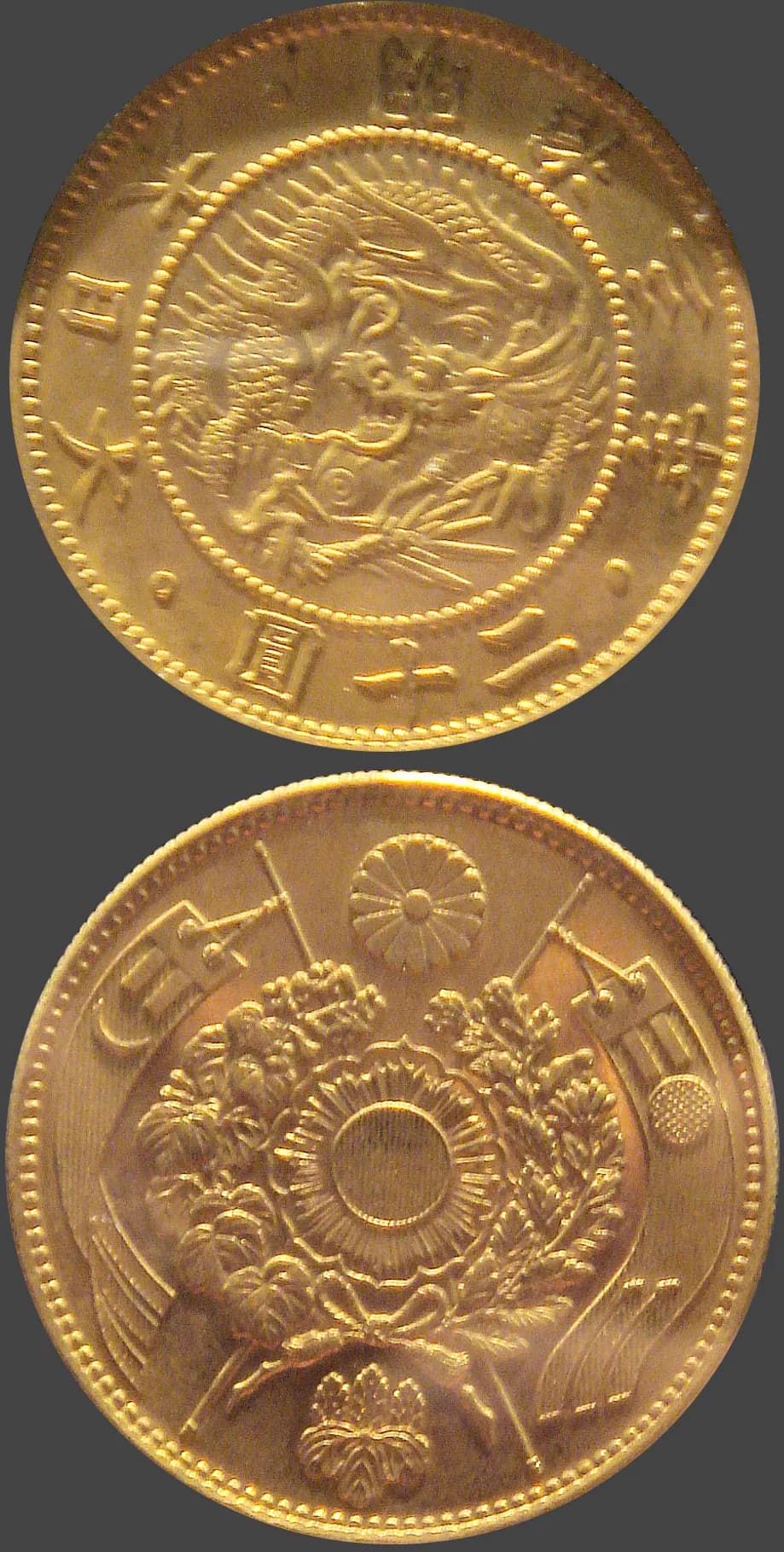
Image: Modern Japanese coinage / PHGCOM / Wikimedia Commons / CC BY-SA 3.0(source)
Genbun Chōgin (元文丁銀) — The 'Secret Recoinage' That Rescued the Shogunate's Finances
In the First Year of Genbun, the Shogunate's Bold Strategy to Drastically Lower the Silver Purity
Subject coin: 元文丁銀
Overview
In 1736, the Tokugawa shogunate was confronted with a financial crisis. Years of warfare and extravagant spending had strained its coffers, and some form of countermeasure was urgently needed. The shogunate made the audacious decision to drastically reduce the purity of silver. The Genbun Chōgin (元文丁銀) was the coin born of that decision, with its silver fineness lowered from the conventional 80% to 46%. However, the fact of the recoinage was initially kept secret, causing confusion in the marketplace. Through this policy, the shogunate was able to obtain a minting profit (deме, 出目) and shore up its finances, but the move had an adverse effect on the Edo economy. This story traces in detail the history of the Genbun Chōgin, from its minting and circulation through to its lasting consequences. The Genbun Chōgin would remain in circulation for more than 80 years, until the Bunsei Chōgin (文政丁銀) appeared in 1819.
Specifications
- Denomination
- 丁銀
- Minting period
- 元文元年〜文政2年(1736-1819年)
- Metal composition
- 銀46% / 銅54%
- Weight
- 不詳(諸説あり)
- Dimensions
- 不詳(諸説あり)
- Mintage
- 不詳(諸説あり)
- Mint supervisor
- 銀座役所
- Market price
- 10万円〜30万円(状態による)
Chapter 1: The Background of the Recoinage — The Shogunate's Financial Destitution
Image: Modern Japanese coinage / Coindesmonnaies / Wikimedia Commons / CC BY-SA 4.0(source)
It was 1736, the era of Tokugawa Yoshimune. During his reign, the shogunate faced severe financial hardship, brought on by years of warfare and the extravagant lifestyle of the shogunate itself. In the mid-Edo period, the shogunate sought to rebuild its finances, yet curbing expenditure was no easy task. Yoshimune's various policies known as the Kyōhō Reforms (享保の改革, 1716–1745) — encompassing reclamation of new farmland and edicts of frugality, among many other measures — nonetheless failed to fundamentally resolve the chronic shortage of revenue. The shogunate therefore chose the means of currency recoinage, a decision that entailed drastically reducing the purity of silver. The newly issued Genbun Chōgin had its fineness lowered from the roughly 80% purity of previous silver coins all the way down to 46%. Minting was carried out by the shogunate-controlled Ginza (銀座), and official issuance began in Genbun 1 (1736). This enabled the shogunate to secure a substantial minting profit (deme, 出目), though that success proved temporary. This profit was applied to supplement the shogunate's finances, serving to prop up the strained revenues of the finance office. The fact of the recoinage was initially concealed, and confusion broke out in the marketplace. Behind this decision lay the aim of restoring the shogunate's finances, but the impact on the market economy was immeasurable. The populace harbored distrust toward these new silver coins, and the result was a rise in commodity prices. The Genbun Chōgin thereafter continued to circulate as the principal silver coin for more than 80 years, until the Bunsei Chōgin was issued in 1819. It is also said that the shogunate did not fully grasp the economic consequences that a change in a coin's fineness could bring about.
Chapter 2: The Minting Process — The Role and Technology of the Ginza
Image: Modern Japanese coinage / Coindesmonnaies / Wikimedia Commons / CC BY-SA 4.0(source)
The minting of the Genbun Chōgin was carried out at the Edo Ginza office. The Ginza office was located on the south side of Kyōbashi (in what is now the Ginza district of Chūō Ward, Tokyo) and functioned as the shogunate's direct-controlled currency-minting institution. It was the center of the era's minting technology and was also known for its high level of technical skill. The Ginza employed many craftsmen and oversaw a complex minting process. In 1736, the decision to drastically lower the purity of silver posed a major challenge even for the craftsmen of the Ginza. This recoinage order, led by Senior Councillor (Rōjū) Matsudaira Norisato and others in Genbun 1 (1736), was an emergency measure to break through chronic financial difficulty, and its true purpose was to apply the minting profit (deme, 出目) arising from production to supplement the shogunate's finances. The manufacture of the Genbun Chōgin employed an alloy of 46% silver and 54% copper. This composition represented a sharp reduction from the roughly 80% silver purity that the preceding Shōtoku-Kyōhō Chōgin (正徳・享保丁銀) had maintained, and because the melting point and malleability of the material changed significantly, innovations in minting technique were required. The craftsmen of the Ginza developed new techniques for handling lower-purity silver, enabling efficient production. Through their hands, the Genbun Chōgin was produced in large quantities and became an important coin supporting the shogunate's finances. However, because the fact of the recoinage was initially concealed from the public, the Genbun Chōgin began circulating at the same face value as the old chōgin; as its reduced fineness gradually came to light, distrust spread among merchants and money-changers, and serious confusion ensued. Contrary to the shogunate's intentions, this recoinage brought disorder to the market economy. The reduction in silver purity greatly undermined confidence in the currency and triggered a rise in commodity prices. Even so, the Genbun Chōgin continued to circulate as the principal silver coin for more than 80 years, until the Bunsei Chōgin was issued in 1819.
Chapter 3: Circulation and Economic Impact — The Rise in Prices in Edo
Image: Modern Japanese coinage / Coindesmonnaies / Wikimedia Commons / CC BY-SA 4.0(source)
The Genbun Chōgin circulated widely in the Edo marketplace from the time of its issuance in 1736 (Genbun 1). However, its circulation was accompanied by serious problems. With the silver purity reduced to 46%, distrust spread among the people. The shogunate had initially concealed the fact of the recoinage and released the coins into circulation as though they held value equivalent to the old Keichō Chōgin (慶長丁銀) and Genroku Chōgin (元禄丁銀). As a result, merchants and commoners who had accepted the coins without knowing of the reduced fineness later learned the truth, and confusion broke out in both the Edo and Osaka markets. Since the value of the coins was lower than that of conventional silver currency, commodity prices rose. Rice prices, for example, climbed sharply, placing pressure on the lives of ordinary people. In the marketplace, debate arose over how the Genbun Chōgin should be exchanged against conventional silver coins, causing confusion. Merchants were uncertain whether to accept the new silver coins, and commercial transactions sometimes stalled. Meanwhile, the shogunate was applying the minting profit (deme, 出目) generated by the recoinage to supplement its finances; prioritizing the plugging of its chronic fiscal shortfall, its response to the confusion in the marketplace was reactive rather than proactive. This situation had an adverse effect on economic activity as a whole. The shogunate found it necessary to take additional measures to support the circulation of the Genbun Chōgin — for example, efforts were made through the Ginza office to regulate supply to the market and underpin the value of the silver coins. However, the fundamental problems remained unresolved, and economic instability continued. Even so, the Genbun Chōgin continued to circulate as the principal silver coin for more than 80 years, until the Bunsei Chōgin was issued in 1819 (Bunsei 2). The experience of this period left many lessons for posterity.
Chapter 4: Impact on Later Generations — The Transition to the Bunsei Chōgin
Image: Modern Japanese coinage / Coindesmonnaies / Wikimedia Commons / CC BY-SA 4.0(source)
The Genbun Chōgin continued to exert a profound influence on the Edo economy for more than 80 years thereafter. The recoinage at the time of its issuance in Genbun 1 (1736) — which drastically reduced the silver purity from the conventional roughly 80% to 46% — initially had its details concealed from the public, causing confusion among money-changers and merchants. The shogunate utilized this profit, the deme (出目), as a source of funds for fiscal supplementation, keeping the strained shogunate finances afloat. In 1819, the more stable Bunsei Chōgin was issued, but the influence of the Genbun Chōgin remained deeply ingrained. This new currency was intended to address the problems of the Genbun Chōgin. The issuance of the Bunsei Chōgin was accompanied by an improvement in silver purity and represented the shogunate's attempt to achieve economic stability. The fact that the Genbun Chōgin continued to circulate as the principal silver coin for truly more than 80 years — despite its low fineness — demonstrates that demand for it in the marketplace was maintained, and, though various theories exist, it is also pointed out that the large volume in circulation was one factor that sustained public confidence in it. Nevertheless, the influence left by the Genbun Chōgin ran deep, and distrust of new coinage lingered among the people. The lessons of the Genbun Chōgin served as an important guideline in subsequent currency policy, and the shogunate devoted greater attention to enhancing the trustworthiness of coinage, including its fineness. Having passed through the era of the Genbun Chōgin, the shogunate reaffirmed the importance of monetary policy and aimed for economic stability. The Genbun Chōgin was a pivotal event in the monetary history of the Edo period, and its influence was to continue long into later generations.
Value & Rarity
Because the Genbun Chōgin was minted in large quantities as part of the monetary policy of its day, it appears on the market with relative frequency. However, owing to its low silver purity, well-preserved examples are scarce and their rarity is correspondingly high. On the market, Genbun Chōgin in good condition can trade at high prices. In general, the market value of a Genbun Chōgin ranges from approximately 100,000 to 300,000 yen, though examples in particularly fine condition or with notable historical provenance may command even higher prices. The fact that the silver purity was reduced to 46% is an important element for understanding the economic policy of the time and makes the coin an intriguing subject of research. The Genbun Chōgin is an indispensable presence in narrating the monetary history of the Edo period, and its value and rarity are unlikely to diminish going forward.
Conclusion
The Genbun Chōgin emerged as a last resort to rescue the shogunate's finances. However, the result was confusion in the Edo economy and a rise in commodity prices. The history of this coin illuminates one aspect of the shogunate's fiscal policy and serves as important material for understanding the economic environment of the time. The existence of the Genbun Chōgin also influenced subsequent monetary policy and led to the appearance of the Bunsei Chōgin. As a historical lesson, the Genbun Chōgin stands as an important example of the impact that a coin's purity can have on an economy, and its study deserves to continue into the future. The story of the Genbun Chōgin will serve as a key to deepening our understanding of the economic history of the Edo period.
Related Stories
Ansei Chōgin — The Final Edo Era Silver Bullion Coin amidst the Turbulence of the Bakumatsu
A Short-lived yet Historical Silver Bullion Created Amidst the Turmoil of Opening Japan
Coin StoryAnsei Nibus Gin — A Silver Coin Born Amidst Port Opening and Fiscal Crisis
The Role of Subsidiary Silver Coins Issued in the Turbulent Closing Years of the Edo Period
Coin StoryBunkyū Eiho and the End of the Gold Coin System — Tracing the History of Edo Gold Coins
Bunkyū 2 (1862) marks the final currency reform of the shogunate, with a gold coin series issued alongside the Bunkyū Eiho (copper coins) as a symbol of late shogunate monetary chaos
Dealers
Dealers Handling This Category
A reference when considering a sale or appraisal. All are dealers and auction houses with a proven track record.
Japan Coin Auction (JCA)
Tokyo
Holds regular auctions with reliable hammer price data, making it a useful resource for tracking market values. Caters to a wide range of collectors from beginners to advanced buyers.
Ginza Coins
Ginza, Chuo-ku, Tokyo
One of Japan's most established numismatic dealers. The scale and variety of their regular auctions is among the largest in the country. Their catalogs are considered a benchmark for market pricing.
Osaka Numismatic Auction
Osaka
A Kansai-based coin auction house with particular strength in regional and hole coins.