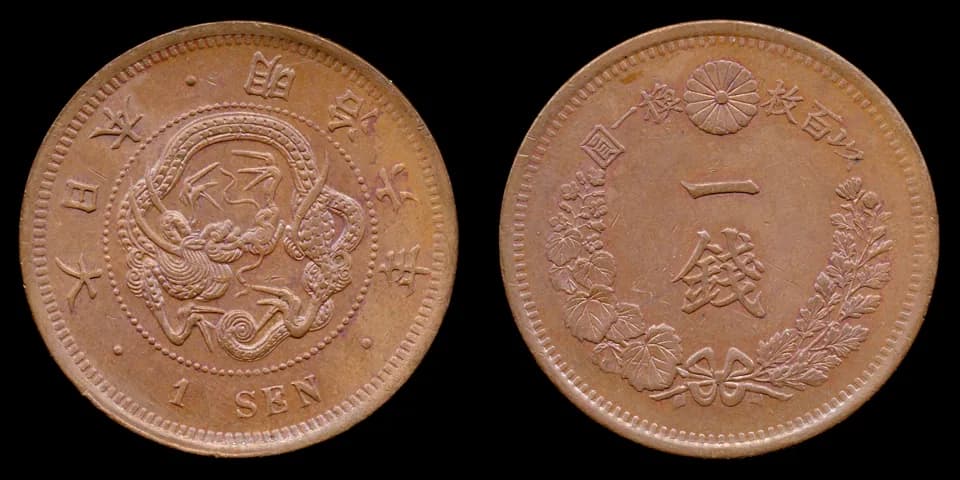
Image: Modern Japanese coinage / As6673 / Wikimedia Commons / CC BY-SA 3.0(source)
Meiji Shin-ka Jōrei — The Challenge of Retiring the Old Gold and Silver Coinage
The Currency Reform of Modern Japan Brought About by the New Currency Regulations
Subject coin: 明治新貨条例と旧金銀貨の整理
Overview
In Meiji 4 (1871), the Shin-ka Jōrei (新貨条例; New Currency Regulations) were enacted, revolutionizing Japan's monetary system. The three-currency system of the Edo period was brought to an end, and the country transitioned to a decimal system of en, sen, and rin. This reform was a crucial measure in Japan's first steps toward becoming a modern state; however, retiring the old koban and ichibukin entailed considerable difficulty. The gold and silver coins of the former shogunate era were not uniform in fineness or weight, making conversion to the new gold coinage complicated and posing a major challenge for both the government and merchants. Exchange offices were established throughout the country and the work of swapping old coins for new proceeded, yet it took more than ten years before the old coinage disappeared entirely from circulation. This story depicts in detail the hardships and successes of the Meiji government's currency reform, together with its historical background and economic impact. Please also refer to Types and Identification of Edo Gold Coins and Details on Edo Silver Coins.
Specifications
- Denomination
- 圓・銭・厘
- Minting period
- 1871年〜1897年
- Metal composition
- 金本位制
- Weight
- 不詳(諸説あり)
- Dimensions
- 不詳(諸説あり)
- Mintage
- 不詳(諸説あり)
- Mint supervisor
- 不詳(大蔵省主導)
- Market price
- 50万円〜300万円(状態による)
Chapter 1: The Meiji Restoration and the Enactment of the New Currency Regulations
Image: Modern Japanese coinage / Coindesmonnaies / Wikimedia Commons / CC BY-SA 4.0(source)
The dawn of the Meiji era was an unprecedented period of transformation for Japan. With the Meiji Restoration of 1868, a new age succeeding the Edo period began. The new government, however, inherited the fiscal foundations of the former shogunate and found itself facing the grave challenge of monetary disorder. To address this challenge, the Shin-ka Jōrei (新貨条例) was enacted in May of Meiji 4 (1871). These regulations introduced a decimal system of en, sen, and rin, and were premised on the gold standard. This was a vital measure to align with the international monetary system and to lay the groundwork for Japan as a modern state.
Behind the enactment of the New Currency Regulations lay the legacy of the former shogunate: a diverse array of gold and silver coins. These were not uniform in fineness or weight and, as illustrated by Types and Market Values of Koban, came in a wide variety of forms, causing confusion in circulation. In particular, coins from the former shogunate era—such as koban, ichibukin (一分金), ichishugin (一朱銀), and ichibugin (一分銀)—each carried different values, complicating commercial transactions. To resolve this disorder, the Meiji government established exchange offices throughout the country and set deadlines for exchanging old coins for new. In practice, however, it took time for old coins to disappear from general circulation, and they continued to circulate into the 1880s.
Thus, while the New Currency Regulations were enacted as part of the Meiji government's modernization policy, their implementation was accompanied by many challenges. This chapter examines in depth the political background following the Meiji Restoration and the motivations behind the enactment of the New Currency Regulations.
Chapter 2: The Minting Process for New Coins and Technological Innovation
Image: Modern Japanese coinage / Coindesmonnaies / Wikimedia Commons / CC BY-SA 4.0(source)
After the Meiji government enacted the New Currency Regulations, its next challenge was minting the new coinage. To support the new monetary system, a stable supply of coins based on the standards of en, sen, and rin was necessary. The government established minting facilities throughout the country, aiming for efficient and high-quality coin production.
At the time, coin-minting technology had advanced considerably, yet the skills of craftsmen and technicians carried over from the former shogunate era were still indispensable. In particular, technicians from the former Kinza (金座; gold mint) played an important role in the design and minting of the new coinage. They succeeded in producing high-quality coins by fusing the latest techniques with traditional craftsmanship.
In minting the new coins, the purity and weight of gold were strictly controlled. For example, the 1-yen gold coin was required to contain 90% gold and was set at a weight of 1.5 grams. This ensured a stable value in accordance with the principles of identifying and valuing modern coinage.
The minting process, however, involved much trial and error. Improvements in the supply of metals and in processing technology were particularly demanded, and the government invested effort in introducing foreign technology and in training personnel. As a result, domestic minting technology advanced dramatically, and Japan became capable of producing coins that met international standards.
This chapter explores in detail the minting technology challenges faced by the Meiji government and the efforts made to overcome them.
Chapter 3: The Circulation of Old and New Coins and Their Economic Impact
Image: Modern Japanese coinage / Coindesmonnaies / Wikimedia Commons / CC BY-SA 4.0(source)
Although the New Currency Regulations had been enacted and new coins minted, it took time for old coins to disappear entirely from the market. In particular, the former shogunate's ichibugin (一分銀) and nishugin (二朱銀) continued to be used as units of account in rural farming communities even into the 1870s and 1880s. This gave rise to disparities in monetary value between regions and sometimes caused confusion in transactions.
To advance the recovery of old coins, the government established exchange offices throughout the country and promoted the exchange of old coins for new. At these offices, koban and ichibukin from the former shogunate era were brought in and exchanged for new coins. However, because the types and values of old coins were so varied, merchants struggled with conversion and sometimes suffered losses.
Furthermore, the circulation of new coins was accompanied by fluctuations in prices. Merchants were pressed to reset prices according to the new monetary values, and in this process—particularly in rural farming communities—the old coinage continued to circulate, making price stabilization a time-consuming affair.
On the other hand, the introduction of new coins contributed to the modernization of the Japanese economy. The stabilization of monetary value based on the gold standard promoted international trade, enabling Japan to enter world markets. As a result, the Japanese economy achieved dramatic growth and established its standing as a modern state.
This chapter explores in detail the actual conditions of old and new coin circulation and the impact they had on the Japanese economy.
Chapter 4: The Completion of Old Gold Coin Retirement and Its Subsequent Impact
Image: Modern Japanese coinage / Coindesmonnaies / Wikimedia Commons / CC BY-SA 4.0(source)
The retirement of old gold coins was ultimately completed with the enforcement of the Kahei Hō (貨幣法; Currency Act) in Meiji 30 (1897). Through this law, Japan officially established the gold standard, and the gold coin system of the Edo period came to an end. This reform gave Japan a monetary system aligned with the international currency order and laid the foundation for promoting economic stability and growth.
With the enforcement of the Currency Act, the koban, ichibukin, and nishugin of the former shogunate era were officially abolished and disappeared from the market. Their influence, however, continued into later generations. The collecting and study of old coins carried on, and they came to be valued as objects of historical significance. In particular, as shown by Details on the Keichō Koban and Details on Edo Silver Coins, these coins have been positioned as important heritage through which Japan's history is told.
Moreover, the currency reforms of the Meiji period also influenced Japan's subsequent monetary policy. Further improvements to the monetary system were advanced—including the establishment of the Bank of Japan and the introduction of a banknote system—contributing to the development of the Japanese economy.
This chapter explores in detail the completion of old gold coin retirement and its subsequent impact, and considers how the currency reforms of the Meiji period have influenced Japan in the present day.
Value & Rarity
Coins issued under the Meiji New Currency Regulations are an important presence supporting the modern Japanese monetary system, and their historical value is immeasurable. In particular, coins denominated in en, sen, and rin were indispensable for Japan to possess a monetary system viable in the international arena, and their significance is great. In the market as well, these coins are highly regarded by collectors. Those in good condition or issued in small quantities can trade in a price range of 500,000 to 3,000,000 yen. However, because many counterfeits of these coins also circulate, it is important to learn how to identify fakes and altered pieces. Because the market value of modern coins varies greatly depending on historical background, condition, and rarity, consulting the opinion of a specialist is recommended.
Conclusion
The Meiji New Currency Regulations and the retirement of the old gold and silver coinage represented an important turning point in Japan's monetary system. The efforts to lay the groundwork for Japan as a modern state became the foundation supporting the growth of the Japanese economy and were indispensable in aligning with the international currency order. The success of this reform is valued as part of the Meiji government's economic policy, and it can be said to have built the foundations of the monetary system in Japan today. While retiring the old coinage entailed many difficulties, its historical significance is great and deserves to be passed down to future generations. It is hoped that by considering how the currency reforms of the Meiji period have influenced the Japanese economy of the present day, a reassessment of their historical value will continue to advance.
Related Stories
60th Anniversary of Local Autonomy Law 500 Yen Bicolor – 10-Year Journey Across 47 Prefectures
Commemorative Coin Series Born from the Law of 1947
Coin StoryAichi Expo Commemorative Silver Coin — Hope for the Future Carved with the Wisdom of Nature
The History and Value of the 1000-yen Silver Coin Commemorating the 2005 Aichi Expo
Coin StoryCommemorative 500 Yen Cupronickel Coin for the Enthronement of the Heisei Emperor — A Bridge from Heisei to Reiwa
The Story of a Historic Commemorative Coin Celebrating the Enthronement of the Heisei Emperor
Dealers
Dealers Handling This Category
A reference when considering a sale or appraisal. All are dealers and auction houses with a proven track record.
Ginza Coins
Ginza, Chuo-ku, Tokyo
One of Japan's most established numismatic dealers. The scale and variety of their regular auctions is among the largest in the country. Their catalogs are considered a benchmark for market pricing.
Taisei Coins
Tokyo
A dealer with an international network. Offers advanced services such as consignment to overseas auctions and NGC/PCGS grading submission. Recommended for high-value or internationally recognized coins.
Tokyo Coin Club
Tokyo
A membership-based coin dealer known for carefully selected, quality inventory.