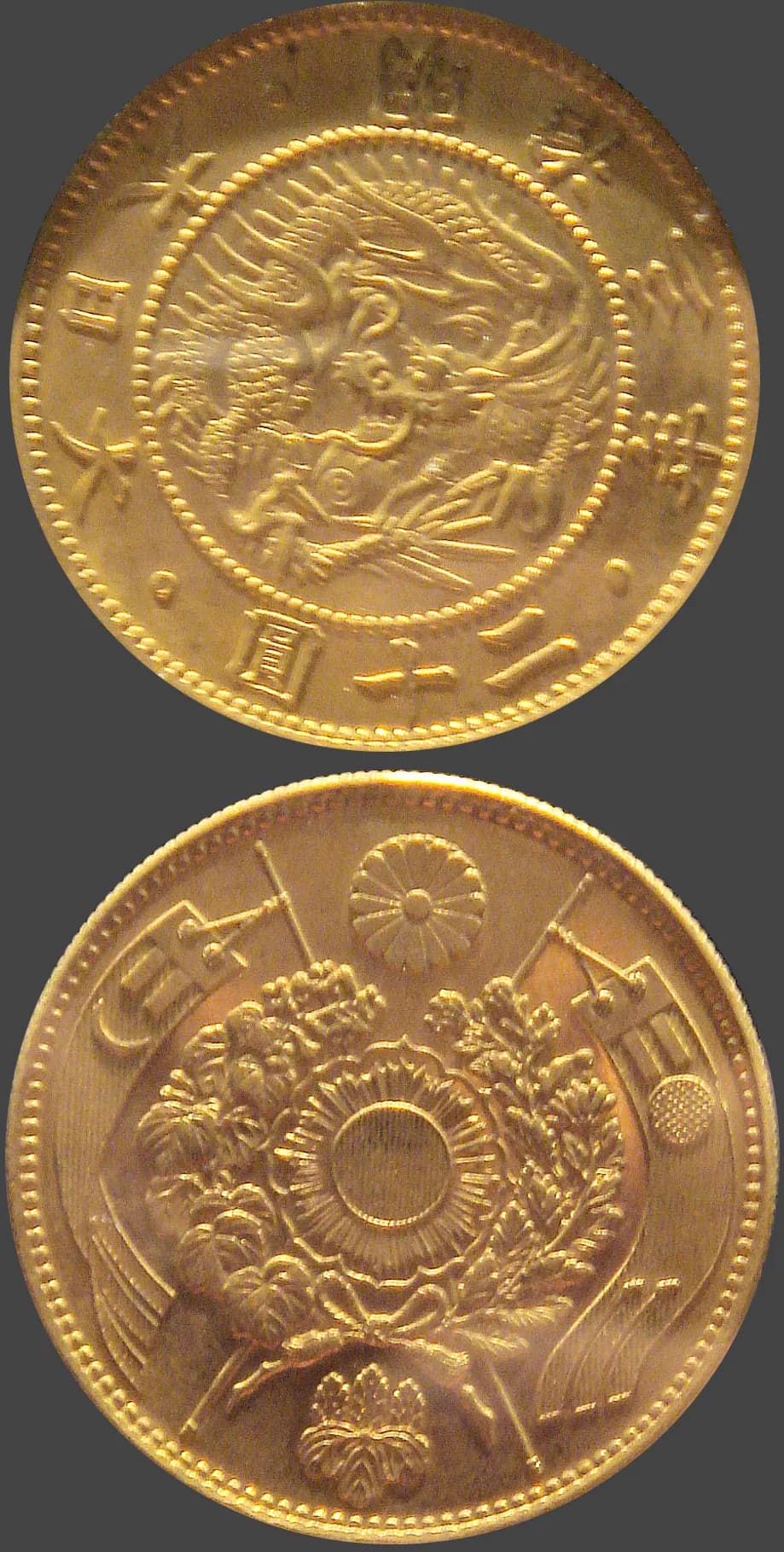
Image: Modern Japanese coinage / PHGCOM / Wikimedia Commons / CC BY-SA 3.0(source)
Foundation of the Ginza — The Story of Silver that Supported the Edo Period
Exploring the Currency System of the Edo Period and Its Historical Significance
Subject coin: 銀座の創設
Overview
During the Edo period, the Ginza played a central role in the currency system. The first Ginza, established in Fushimi in Keichō 6 (1601) by Tokugawa Ieyasu's order, later expanded to Kyoto, Edo, and Osaka, becoming a vital economic base with nationwide influence in Japan. Particularly, the Edo Ginza, located in what is now Chuo-ku, Tokyo, minted various silver coins like Chōgin and Mameita Gin. As recorded in details of the Keichō Koban, silver coins of this era were indispensable for economic development. Specialist sealers verified the quality of silver coins and affixed guarantee stamps to maintain their credibility. After the Meiji Restoration, the Ginza was abolished, but only the place name remains today, continuing as an important element in Japan's economic history. Through the foundation of Ginza and its impact, one can gain a deep understanding of the economic conditions and culture of Japan at that time.
Specifications
- Denomination
- 丁銀・豆板銀
- Minting period
- 慶長6年〜明治2年(1601-1869年)
- Metal composition
- 銀
- Weight
- 不詳(諸説あり)
- Dimensions
- 不詳(諸説あり)
- Mintage
- 不詳(諸説あり)
- Mint supervisor
- 銀座組(幕府の役人)
- Market price
- 不詳(状態と種類による)
Chapter 1: Establishment of the Edo Ginza — Foundation for Economic Development
Image: Modern Japanese coinage / Coindesmonnaies / Wikimedia Commons / CC BY-SA 4.0(source)
In Keichō 6 (1601), Tokugawa Ieyasu established the first Ginza in Fushimi as part of a policy to stabilize the economy. Ieyasu believed that a stable currency system was essential to end the chaos of the Sengoku period and build a peaceful, prosperous era. This decision brought about significant changes in Japan's currency system.<br>The Ginza was established in Edo during the era of Ieyasu's successor, Tokugawa Hidetada, in Genna 1 (1615). The Edo Ginza was located in what is now Chuo-ku, Tokyo, and the silver coins minted there circulated domestically and internationally, forming a basis for commercial transactions.<br>In the early Edo period, Japan adopted a bimetallic standard of gold and silver, but silver coins played a particularly crucial role in trade. Chōgin and Mameita Gin were distinctive in that their value was based on weight, apparent from their uneven shapes.<br>Moreover, the establishment of the Ginza not only stimulated economic activity but also functioned as a means to strengthen the centralized control of the shogunate. The shogunate strictly managed the minting and circulation of currency through the Ginza, which contributed to economic stability.<br>Thus, the establishment of the Ginza was not merely an economic policy but also heavily reflected the political intentions of the shogunate. The prosperity of the Edo period was supported by the establishment of such systems.
Chapter 2: Minting Process and Technology at the Ginza — Assurance of Silver Coin Quality
Image: Modern Japanese coinage / Coindesmonnaies / Wikimedia Commons / CC BY-SA 4.0(source)
The minting of silver coins at the Ginza was strictly managed by specialists known as sealers. They were responsible for verifying the fineness of the silver and stamping a guarantee mark on each coin. This seal was meant to assure the quality of the silver coins, significantly enhancing trust in their circulation.<br>The silver coins minted at the Ginza came in various forms, including Chōgin, Mameita Gin, and others. Their value was mainly determined by the purity of silver, and scales were used in transactions due to differing weights.<br>The Edo Ginza mint was located in what is now Chuo-ku, Tokyo, and employed the most advanced technology of the time. Silver, sourced from well-known mining areas such as the Iwami Ginzan and Sado Kinzan, was refined and minted here.<br>The minting process involved melting silver, pouring it into molds, cooling it down, and then refining the shape. Each coin was then inspected by the sealers, who verified its quality and stamped their mark. This stringent checking system assured the quality of silver coins and maintained reliability in circulation.<br>In this way, the minting process at the Ginza served as the foundation for economic stability and growth, supported by both technology and management. The silver coins became symbolic of the currency system during the Edo period.
Chapter 3: Circulation of Silver Coins and Economic Impact — Voices and Reactions of the People
Image: Modern Japanese coinage / Coindesmonnaies / Wikimedia Commons / CC BY-SA 4.0(source)
The silver coins minted at the Ginza circulated widely both domestically and abroad, playing a crucial role in trade, especially with China and the Netherlands. The value of the silver coins was determined by their weight and purity, and transactions commonly involved the use of scales.<br>As a result, silver coins became vital for merchants, contributing to the stimulation of economic activity. Merchants used silver coins to purchase goods and then sold those goods again for profit, functioning as lubricants in commercial transactions.<br>However, there were also challenges with the circulation of silver coins. The price of silver was prone to fluctuations in the international market, which could introduce instability to the domestic economy. Especially, fluctuations in the supply of silver could lead to price changes, affecting the lives of ordinary people.<br>In response to such economic conditions, the shogunate strictly managed the circulation of silver coins, aiming for a stable supply. Nonetheless, dissatisfaction and anxiety about the value of silver often persisted among the populace. These voices sometimes prompted the shogunate to reconsider economic policies, leading occasionally to recoinage.<br>Through the circulation and impact of silver coins, the economic dynamism of the Edo period becomes clear. The silver coins of this era were not only symbols of value but also represented the vitality of the economy.
Chapter 4: Abolition of the Ginza and Its Modern Impact — History Preserved in Place Names
Image: Modern Japanese coinage / Coindesmonnaies / Wikimedia Commons / CC BY-SA 4.0(source)
Following the Meiji Restoration, Japan's currency system underwent significant transformation. In 1869, the Ginza was abolished, and a new currency system was introduced. This reform was part of the Meiji government's efforts to modernize as it aimed to build a centralized nation.<br>With the abolition of the Ginza, the silver coins used during the Edo period disappeared, and new currencies came into circulation. Nonetheless, the name "Ginza" remained and continues as Chuo-ku, Tokyo, telling the story of its past as an economic center. It is still cherished by many people today.<br>Moreover, the abolition of the Ginza brought significant changes to society as a whole. With the end of the feudal system, the establishment of a modern economic system allowed Japan to rapidly advance onto the international stage. Even though the Ginza ended its historical role, its influence continues to contribute to Japan's economic development.<br>The history of the Ginza is not merely a relic of the past; it provides us with many lessons that remain relevant today. Alongside the transformation of the economy, it allows for a reaffirmation of the importance of the currency system. Thus, the Ginza persists as part of a history that is spoken of into the future.
Value & Rarity
The silver coins minted at the Ginza are extremely valuable to collectors. Especially, the Chōgin and Mameita Gin from the Edo period receive high evaluations due to their historical background and rarity. On the market, depending on their condition and preservation, prices can significantly fluctuate but can reach hundreds of thousands to millions of yen.<br>Such old coins hold significant historical value and are popular as collectible items. Particularly closer to the end of the Bakumatsu era, as issuance numbers decreased, their rarity value increased.<br>Additionally, for coin collectors and history enthusiasts, the silver coins of the Ginza serve as important clues to understanding the transition of Japan's currency system.<br>The value in the old coin market can be further understood by referring to Basics of Coin Auctions, providing more specific information. During auctions and transactions, as counterfeits might appear, learning How to Identify Counterfeits and Altered Coins is important.
Related Guides: Types and Identification of Edo Silver Coins / Details of Chōgin and Mameita Gin
Conclusion
The creation of the Ginza and its history played a crucial role in the economic history of Japan. The silver coins of the Ginza, which became the foundation of the currency system, were indispensable for supporting economic activities at the time. By understanding their minting process and the reality of their circulation, one can feel the dynamism of the economy during the Edo period.<br>In modern times, the place name "Ginza" continues to recount its historical background and plays a role as an economic center. Their value as old coins is also high, making them appealing to many collectors.<br>In this way, the silver coins of the Ginza are not just relics of the past but remain as part of a history that provides important lessons for the future. In studying Japan's numismatic history, the history of the Ginza is an indispensable element, and its importance will remain unchanged in the future.
Related Stories
Genroku Ichibuban Kin — The Small Gold Coins of Edo That Changed Overnight
The Drastic Drop in Gold Purity of Genroku Ichibuban and Its Impact
Coin StoryThe Genroku Koban — Shigehide Ogiwara's Financial Revolution and the Consequences of the Genroku Bubble
The man who halved the gold content to save the shogunate, and the merits and demerits of his actions
Coin StoryIchibu-gin — The 'Gold-Silver Ratio Trap' Exposed by Unequal Treaties and the Monetary Crisis of the Late Edo Period
The Systematic Outflow of Gold Coins Triggered by the Opening of Ports in 1858, and the Shogunate's Last Resort: The Manen Recoinage
Dealers
Dealers Handling This Category
A reference when considering a sale or appraisal. All are dealers and auction houses with a proven track record.
Japan Coin Auction (JCA)
Tokyo
Holds regular auctions with reliable hammer price data, making it a useful resource for tracking market values. Caters to a wide range of collectors from beginners to advanced buyers.
Ginza Coins
Ginza, Chuo-ku, Tokyo
One of Japan's most established numismatic dealers. The scale and variety of their regular auctions is among the largest in the country. Their catalogs are considered a benchmark for market pricing.
Osaka Numismatic Auction
Osaka
A Kansai-based coin auction house with particular strength in regional and hole coins.