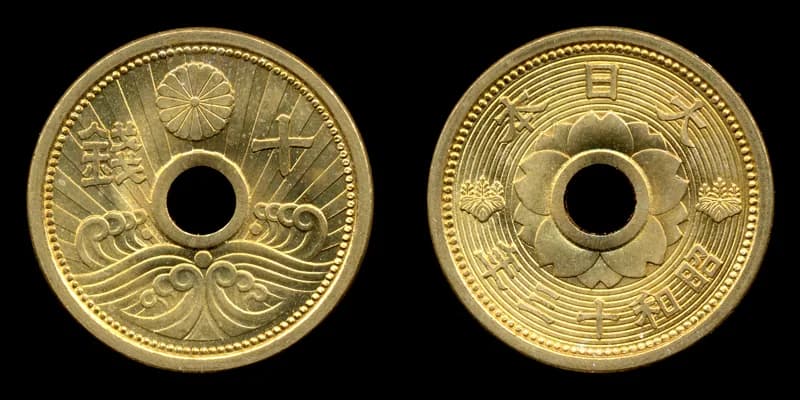
Image: Modern Japanese coinage / As6673 / Wikimedia Commons / CC BY-SA 3.0(source)
Bunsei Koban (文政小判) — A Debased Gold Coin Born in Edo's Age of Decadent Flourishing
The Reality of Quietly Advancing Debasement During the Flourishing Era of Bunka and Bunsei Culture
Subject coin: 文政小判
Overview
The Bunsei Koban (文政小判) is a gold coin minted during the Bunsei era (1819–1837) of the mid-to-late Edo period, with minting beginning in Bunsei 2 (1819). This period is known as an age of decadent cultural flourishing called Kasei Culture (化政文化), in which ukiyo-e, senryū, and kyōka thrived. Yet beneath the surface, the shogunate's finances were deteriorating and the purity of gold coins was declining — a parallel story unfolding in the shadows. The Bunsei Koban maintained a gold purity of 56.41% and a weight of 13.07 g. These specifications represented a further decline in quality from the Genbun Koban (元文小判), and the coin came to be widely known among commoners as the 'Bunsei Debasement.' The shift in the ratio of gold to silver mixed into the coin became one of the factors fueling inflation, and it exerted a major influence on the economy.
Specifications
- Denomination
- 1両
- Minting period
- 文政2年〜天保8年(1819-1837年)
- Metal composition
- 金56.41% / 銀43.59%
- Weight
- 13.07g
- Dimensions
- 縦約38mm × 横約24mm
- Mintage
- 不詳(諸説あり)
- Mint supervisor
- 後藤家(金座)
- Market price
- 照合済みの落札記録が揃うまで提示しません
Historical Background and Motive for Minting — The Bunsei Shogunate and Financial Hardship
Image: Modern Japanese coinage / Coindesmonnaies / Wikimedia Commons / CC BY-SA 4.0(source)
In Bunsei 2 (1819), the Edo shogunate was confronted with serious financial difficulties. The monetary system established on the foundation of the Keichō Koban (慶長小判) since the time of Tokugawa Ieyasu had long underpinned the Japanese economy, but as the era progressed, the shogunate's fiscal deficit became increasingly apparent alongside economic expansion. The shogunate's leadership — particularly during the reign of the 11th shogun Tokugawa Ienari (in office 1787–1837) — found its finances strained by lavish cultural activities and large-scale civil engineering projects. Ienari succeeded in supporting cultural endeavors and giving Edo a brilliant appearance, but behind that façade fiscal pressures continued to mount. Against this backdrop, the shogunate decided to lower the purity of its gold coins, and the result was the birth of the Bunsei Koban. With a gold purity of 56.41% — a further decline from the Genbun Koban — this coin was part of the shogunate's debasement measures undertaken to improve its finances. In the short term, the recoinage attempted to increase the silver content and thereby expand the volume of gold coins in circulation, but over the long term it became a factor that triggered inflation in the economy. These changes marked a turning point in monetary policy throughout the Edo period and went on to exert a profound influence on the monetary system that followed.
The Minting Process and Those Involved — The Role of the Kinza
Image: Modern Japanese coinage / Coindesmonnaies / Wikimedia Commons / CC BY-SA 4.0(source)
The minting of the Bunsei Koban was carried out with the Edo Kinza (金座, gold mint) at its center. The Kinza operated under the shogunate's supervision, with the Gotō family responsible for its management. The Gotō family had served as hereditary mint operators for gold coinage, and their skills and knowledge were indispensable to the shogunate. In the minting process for the Bunsei Koban, adjusting the ratio of gold to silver was of paramount importance. By raising the proportion of silver relative to a gold purity of 56.41%, the aim was to increase the apparent quantity of gold coins in circulation. This was part of the shogunate's effort to expand the volume of currency. The minting was carried out by craftsmen of the Kinza, and their techniques were highly sophisticated. The craftsmen alloyed gold and silver in the appropriate proportions, then poured the mixture into molds to form the shape of the koban. This process demanded refined skill, drawing on secret techniques that had been passed down through the generations of the Gotō family. The Kinza, as the site of minting, was under the strict supervision of the shogunate, and the craftsmen worked under that watchful eye. This ensured uniformity of quality and secured the shogunate's confidence. However, the policy of lowering the gold purity was one over which opinion was divided even within the shogunate itself, and there were not a few voices urging consideration of the economic consequences.
Circulation and Economic Impact — The Voice of the Commoners
Image: Modern Japanese coinage / Coindesmonnaies / Wikimedia Commons / CC BY-SA 4.0(source)
Once the Bunsei Koban began circulating in the market, its effects quickly reached the everyday lives of Edo's commoners. The decline in gold purity reduced the koban's real value, which triggered a rise in prices — that is, inflation. In the marketplace, the Bunsei Koban was nominally treated as equivalent in value to earlier koban, yet the problem was that its actual exchange rate differed in practice. Merchants receiving Bunsei Koban were compelled to factor in its lower value, which forced them to raise their prices. In particular, the prices of daily necessities such as rice and fish surged, dealing a direct blow to commoners' livelihoods. For example, one rice merchant reduced the amount of rice traded per ryō and sought to lessen the anxiety of accepting Bunsei Koban. Such moves were condemned by commoners as the 'Bunsei Debasement,' and dissatisfaction with Shogun Ienari's policies grew. Kyōka and senryū ridiculing the Bunsei Koban became popular and were the talk of Edo's streets. These circumstances vividly illustrate the economic conditions of the time, and these changes also served as a catalyst prompting the shogunate to reconsider its economic policies, suggesting the necessity of later shogunal reforms.
Impact on Later Ages — The Transition of the Monetary System
Image: Modern Japanese coinage / Coindesmonnaies / Wikimedia Commons / CC BY-SA 4.0(source)
The Bunsei Koban exerted a major influence on Japan's monetary system in the years that followed. As the figures of 56.41% gold purity and 13.07 g weight clearly show, this koban — whose minting began in Bunsei 2 (1819) — represented a further decline in quality from the Genbun Koban (元文小判), which had stood at 65.71% gold purity. This repeated debasement was also criticized as the 'Bunsei Debasement': while Kasei Culture flourished in the form of ukiyo-e, senryū, and kyōka, price inflation was advancing throughout the city. The decline in purity caused the shogunate to lose credibility and served as a prelude to a series of shogunal reforms, including the later Tenpō Reforms. In particular, the Tenpō Reforms of Tenpō 8 (1837) included a review of the monetary system, which became one of the reasons for the abolition of the Bunsei Koban. In the reforms led by Senior Councillor Mizuno Tadakuni, restoring confidence in the currency was deemed urgent, and the Bunsei Koban was suspended from circulation that same year. The Tenpō Koban (天保小判), by contrast, sought to restore the shogunate's credibility by raising the gold purity. The history of the Bunsei Koban — its minting supporting the shogunate's finances in the short term while destabilizing the economy over the long term and ultimately compelling reform — came to be recounted as a failure of shogunal fiscal policy, and analysis of it continues in modern numismatic research.
Value & Rarity
The current market value of the Bunsei Koban varies greatly depending on condition and rarity. The rarity of the Bunsei Koban stems from the quality debasement that arose from the shogunate's financial difficulties, and an understanding of that background makes it an attractive collecting target for numismatists. The Bunsei Koban possesses a historical background and also serves as an important primary source for understanding one aspect of the Edo-period monetary system. For collectors and historical researchers alike, its value is not limited to the purely monetary; it is regarded as an object of historical significance. In particular, the Bunsei Koban provides valuable clues for examining how shogunal policy influenced the economy and society.
Individual prices and auction results are listed only once verifiably matched records — with sale, lot, source URL and review date — exist.
Conclusion
The Bunsei Koban is an important presence that tells the story of the transition of Japan's monetary system from the mid-to-late Edo period. The decline in gold purity reflected the shogunate's financial difficulties, and as a result it triggered inflation that directly affected the lives of commoners. Through this coin, one can understand how the economic conditions and shogunal policies of the time unfolded and what kind of impact they exerted. Even today, the Bunsei Koban commands high regard among collectors and historians, attracting attention both for its rarity and its historical background. By holding a Bunsei Koban in one's hands, one can feel firsthand the economy and culture of Edo's age of decadent flourishing.
Related Stories
Ansei Chōgin — The Final Edo Era Silver Bullion Coin amidst the Turbulence of the Bakumatsu
A Short-lived yet Historical Silver Bullion Created Amidst the Turmoil of Opening Japan
Coin StoryAnsei Nibus Gin — A Silver Coin Born Amidst Port Opening and Fiscal Crisis
The Role of Subsidiary Silver Coins Issued in the Turbulent Closing Years of the Edo Period
Coin StoryBunkyū Eiho and the End of the Gold Coin System — Tracing the History of Edo Gold Coins
Bunkyū 2 (1862) marks the final currency reform of the shogunate, with a gold coin series issued alongside the Bunkyū Eiho (copper coins) as a symbol of late shogunate monetary chaos
Related Encyclopedia Entries
System and Overview of Edo Gold Coins
Conclusion: Edo gold coins are a stable and attractive investment/collection target, combining historical background, intrinsic gold value, and collector's premium.
EncyclopediaTypes and Evolution of Koban
Conclusion: Koban reflects the transitions of the Edo economy; understanding each type's characteristics and market value is crucial for purposeful collection and investment strategies.
EncyclopediaKeicho Koban
Conclusion: Keicho Koban is the first high-purity gold coin of the Edo Shogunate, representing the pinnacle of collection with both historical value and investment appeal.
Dealers
Dealers Handling This Category
A reference when considering a sale or appraisal. All are dealers and auction houses with a proven track record.
Ginza Coins
Ginza, Chuo-ku, Tokyo
One of Japan's most established numismatic dealers. The scale and variety of their regular auctions is among the largest in the country. Their catalogs are considered a benchmark for market pricing.
Japan Coin Auction (JCA)
Tokyo
Holds regular auctions with reliable hammer price data, making it a useful resource for tracking market values. Caters to a wide range of collectors from beginners to advanced buyers.
Taisei Coins
Tokyo
A dealer with an international network. Offers advanced services such as consignment to overseas auctions and NGC/PCGS grading submission. Recommended for high-value or internationally recognized coins.