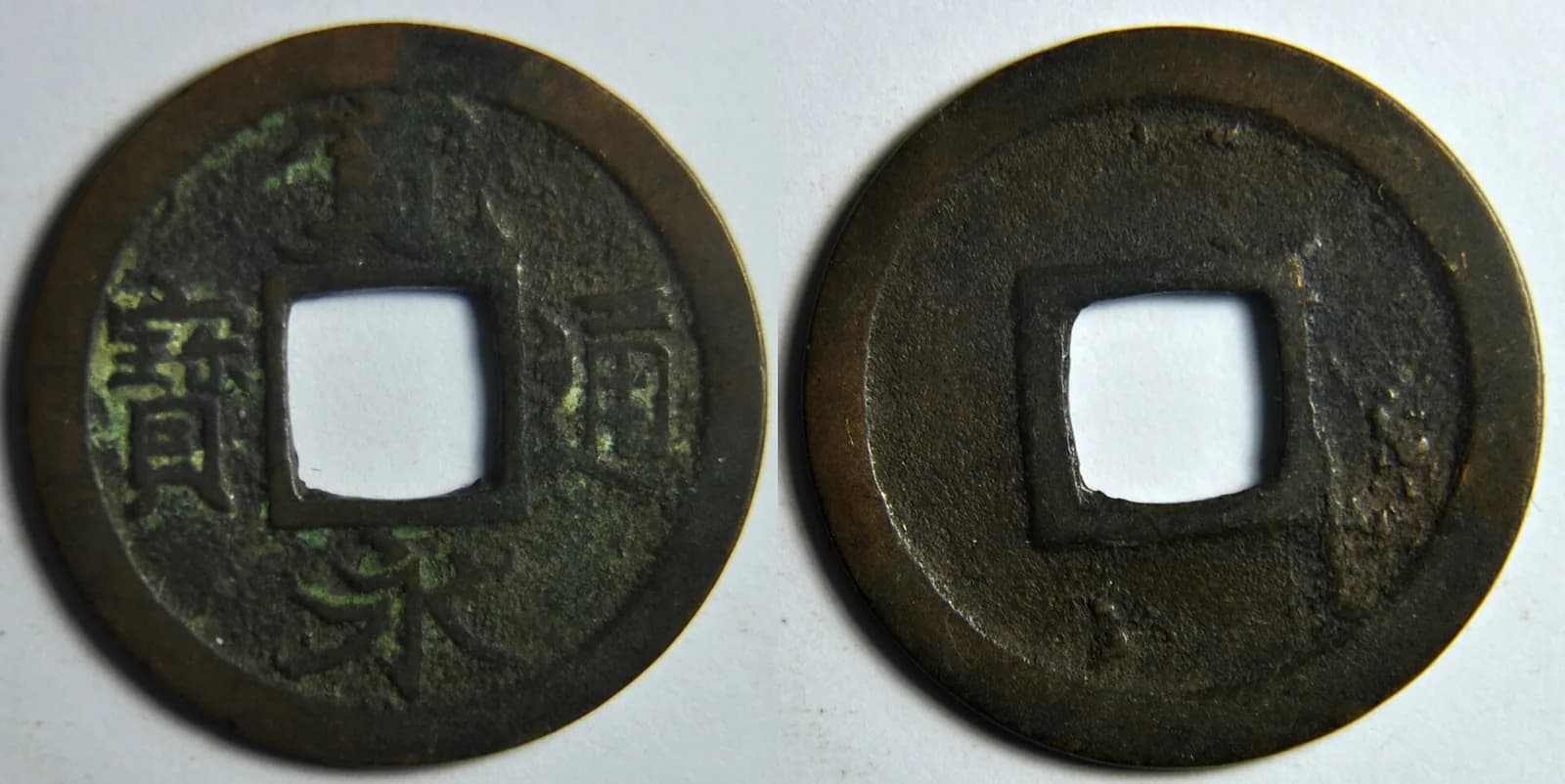
Image: Japanese holed coins (square-holed cash coins) / Jean-Michel Moullec from Vern sur Seiche (35, Bretagne), France / Wikimedia Commons / CC BY 2.0(source)
Monetization of Shōen Estate Tribute — The Currency Revolution of Medieval Japan
The Era of Converting Rice into Coin: The Foundation of a Monetary Economy
Subject coin: 荘園年貢の銭納化
Overview
From the 12th into the 13th century, the form of tribute (nengu) collected from Japan's shōen estates began to change dramatically. Initially, tribute was paid in rice and other agricultural produce, but gradually payment in coin—known as daisen-nō (代銭納)—became widespread. Behind this shift lay the political upheavals of the Taira clan's rise to power and the founding of the Kamakura shogunate. Taira no Kiyomori promoted trade with Song-dynasty China, invigorating the circulation of coin. This political background and economic climate had a profound effect on shōen management, compelling farmers to go to market and exchange rice for coin. This movement became one step toward laying the groundwork for the monetary economy seen in later periods. The spread of daisen-nō diffused an awareness of money throughout the countryside and contributed to the formation of a 'coin economy' in the subsequent Sengoku period.
Specifications
- Denomination
- 不詳(諸説あり)
- Minting period
- 1200年〜1400年
- Metal composition
- 銅、銀(諸説あり)
- Weight
- 不詳(諸説あり)
- Dimensions
- 不詳(諸説あり)
- Mintage
- 不詳(諸説あり)
- Mint supervisor
- 不詳(諸説あり)
- Market price
- 不詳(諸説あり)
Chapter 1: Political Background and Changes in the Shōen System
Image: Modern Japanese coinage / Coindesmonnaies / Wikimedia Commons / CC BY-SA 4.0(source)
In the latter half of the 12th century, Japan entered a great period of transformation with the rise of the Taira clan. Under the leadership of Taira no Kiyomori, trade with Song-dynasty China flourished, and large quantities of coin were imported from China. In 1167 (Nin'an 2), Kiyomori was appointed Daijō-daijin (Grand Minister of State), developed sea routes through the Seto Inland Sea, and promoted trade with Song China on a national scale. Through this trade, Sō-sen (宋銭, Song coins) flowed into Japan in great numbers and began circulating primarily in the Kinai region. Around this same time, the Kamakura shogunate was established and a centralized political structure was gradually taking shape. The shōen system still dominated local economies, but the form of tribute began to change. Even after the Taira clan's defeat at the Battle of Dan-no-ura in 1185, the coin circulation they had introduced did not stop, and a movement to pay tribute in coin at provincial shōen estates—known as 'daisen-nō (代銭納)'—began to emerge. Shōen proprietors encouraged payment in coin to reduce the burden of transporting goods over long distances and to manage tribute more efficiently. Entering the 13th century, the practice of converting a portion of tribute in kind—such as rice or silk—into coin and paying it as such became established, centered on shōen in and around the Kinai region, including Yamato, Settsu, and Ōmi. As a result, local farmers began the new economic activity of going to market, exchanging rice for coin, and paying their dues. Against this backdrop of demand, the holding of regular markets—such as sansai-ichi (markets held three times a month) and rokusai-ichi (markets held six times a month)—increased in various places, and an awareness of money permeated even the countryside. As coin-denominated rents spread, farmers became conscious of the value of coin in their daily lives, and the expansion of daisen-nō would go on to form the foundation of the 'coin economy' of the later Sengoku period. This transformation was the beginning of the expansion of a monetary economy across Japan.
Chapter 2: The Development of Markets and the Challenges Facing Farmers
Image: Modern Japanese coinage / Coindesmonnaies / Wikimedia Commons / CC BY-SA 4.0(source)
As daisen-nō spread, farmers faced a new challenge: the act of exchanging rice for coin at market. The development of markets advanced rapidly from the 12th into the 13th century, and particularly during the Kamakura period, markets came to be held on a regular basis. From the latter half of the 12th century, 'sansai-ichi'—markets held three times a month—spread throughout the Kinai region and western provinces, and by the 13th century, similar periodic markets had taken root across the eastern provinces as well. Markets became the centers of economic activity throughout Japan, and farmers were required to exchange their harvests for coin at these venues. Representative markets of the Kamakura period include the monzen-ichi (gate market) at Tsurugaoka Hachiman-gū in Kamakura and the Rokujō-Kawara in Kyoto. At the Rokujō-Kawara market, diverse goods such as rice, silk, and timber were traded using Song coins as a medium, and historical sources record the sight of farmers bringing in rice in order to pay tribute in coin to their shōen proprietors. By exchanging rice for coin at such markets, farmers moved beyond mere subsistence living and came to play a role in the monetary economy. Merchants, craftspeople, and even warriors gathered at these markets, and buying and selling were conducted briskly. As a result, an awareness of money permeated the countryside, and coin-denominated rents became common. The spread of coin-denominated rents placed farmers in a position where they had to be sensitive to annual fluctuations in rice prices, instilling economic thinking about profit and loss from transactions in rural society. The expansion of daisen-nō eventually formed the foundation for the 'coin economy' of the Sengoku period from the 14th into the 15th century, creating the conditions for daimyo across the country to utilize currency in managing their domains. The development of markets during this era built an important economic foundation that connected to later periods.
Chapter 3: The Expansion of the Coin Economy and Commoners' Monetary Sensibility
Image: Modern Japanese coinage / Coindesmonnaies / Wikimedia Commons / CC BY-SA 4.0(source)
As market transactions grew more active, an awareness of money gradually permeated among commoners as well. From the end of the 12th century into the 13th century, the monetization of tribute at shōen greatly transformed the rural agricultural economy. Farmers sold the rice they had harvested at market and received the proceeds in coin. This system known as 'daisen-nō' is said to have spread as a means by which shōen proprietors could save themselves the trouble of transporting tribute goods in kind; it spread rapidly in the first half of the 13th century, centered on shōen in and around the Kinai region. As a result, currency spread throughout the countryside and became established as part of everyday life.
For farmers to exchange rice for coin, the existence of periodically held 'ichi (市)'—markets—was indispensable. During the Kamakura period, 'sansai-ichi,' held three times a month, were established in various places, and by the latter half of the 13th century they had spread nationwide, centered on the Kinai region and western provinces. Farmers brought rice and agricultural produce to such markets and obtained Song coins and other imported coins. As coin-denominated rents were set, the people of the countryside became proficient in the value of coin and in calculation, and everyday monetary sensibility took root.
During the Kamakura period, coin-based transactions became common and commoners began to understand the value of coin. Coin-denominated small-plot rents spread, and the expansion of the coin economy further took hold after the 14th century, when daisen-nō had become widespread, forming the foundation for merchants and local strongmen in various regions during the Sengoku period to conduct economic activities centered on coin. The spread of monetary sensibility during this era can be said to have greatly contributed to the formation of merchant culture in the Sengoku period.
Chapter 4: Influence on the Sengoku Period and the Monetary Economy That Followed
Image: Modern Japanese coinage / Coindesmonnaies / Wikimedia Commons / CC BY-SA 4.0(source)
As the monetization of tribute at shōen progressed, the daisen-nō system exerted a great influence on the monetary economy of the Sengoku period. The Sengoku period (1467–1600) was an era of economic transformation alongside political upheaval. During this time, Sengoku daimyo gained power across Japan and competed to develop their domains economically. The monetary sensibility cultivated through daisen-nō supported the rise of merchants. In cities such as Sakai and Hakata, for instance, merchants became important players in the regional economy and prospered through transactions using coin. As a result, broader commercial networks were formed throughout the Sengoku period, and Japan's economy became all the more active. The economic activities of this era formed the foundation upon which Tokugawa Ieyasu later established the Edo shogunate and developed monetary institutions. The influence of tribute monetization did not merely promote the circulation of currency; in the long term, it became an important element in Japan's economic development.
Value & Rarity
The monetization of shōen estate tribute does not exist as a specific coin, but its historical significance is extremely important. This movement, which laid the groundwork for a monetary economy, exerted a great influence on the circulation of currency and the development of the economy in later eras. The specific coins used were largely Chinese coins imported through the Japan–Song trade of the period, with copper coins and silver coins being the mainstream. The coins of this era circulated in units of several thousand pieces and were deeply embedded in the daily lives of commoners. As daisen-nō spread, the value of coin came to be more widely recognized, connecting to the development of commercial cities and the circulation of currency from the Sengoku period onward. Today, the coins of that era carry high historical value and are popular as collector's items as well. While they are difficult to find on the market, their value as historical material is immeasurable. At old-coin auctions, well-preserved examples may command high prices, and they attract attention both for their rarity and their historical background.
Conclusion
The monetization of shōen estate tribute was not merely an economic reform; it exerted a great influence on Japan's economic development from the medieval through the early modern period. This movement, which laid the groundwork for a monetary economy and instilled a monetary sensibility among farmers, promoted the development of commerce and contributed to the formation of merchant culture in the Sengoku period. The spread of daisen-nō accelerated the expansion of a market economy across Japan and became an important turning point leading to the development of monetary institutions in the subsequent Edo period. Today, the coins of that era are studied as historical heritage and their value is recognized by collectors as well. In this way, the monetization of shōen estate tribute is passed down to posterity as an important chapter in the history of Japan's economy.
Related Stories
Eiraku Tsuho — The Chinese 'Standard Currency' that Moved Muromachi Japan
An Unknown Era When Foreign Coins Formed Japan's Economic Foundation
Coin StoryThe Monetization of Kamakura Estates — Innovations in the Medieval Currency Economy
The Transformation of the Japanese Economy Triggered by the Kamakura Shogunate and the Advancement of Monetized Tribute
Coin StoryThe Import and Circulation of Ming Coins — Tracing the History of Medieval Currency
Beyond Yongle Tongbao, Ming coins such as Hongwu Tongbao and Xuande Tongbao were issued in dozens. Their quality and trust discrepancies caused chaos in the Japanese market.
Dealers
Dealers Handling This Category
A reference when considering a sale or appraisal. All are dealers and auction houses with a proven track record.
Ginza Coins
Ginza, Chuo-ku, Tokyo
One of Japan's most established numismatic dealers. The scale and variety of their regular auctions is among the largest in the country. Their catalogs are considered a benchmark for market pricing.
Japan Coin Auction (JCA)
Tokyo
Holds regular auctions with reliable hammer price data, making it a useful resource for tracking market values. Caters to a wide range of collectors from beginners to advanced buyers.
Taisei Coins
Tokyo
A dealer with an international network. Offers advanced services such as consignment to overseas auctions and NGC/PCGS grading submission. Recommended for high-value or internationally recognized coins.