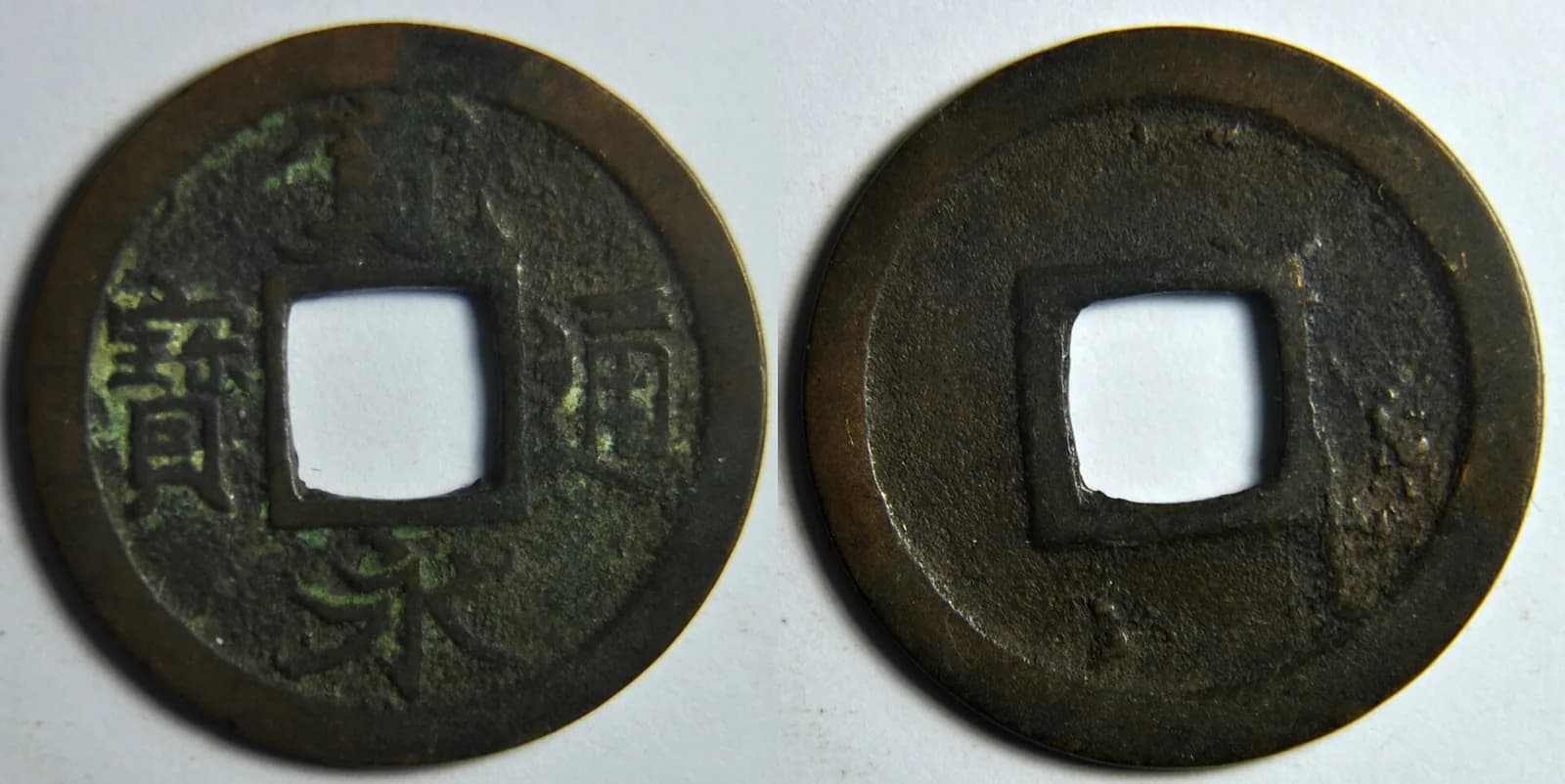
Image: Japanese holed coins (square-holed cash coins) / Jean-Michel Moullec from Vern sur Seiche (35, Bretagne), France / Wikimedia Commons / CC BY 2.0(source)
The Ashikaga Shogunate and the Policy on Imported Coins — The Currency Strategy of Muromachi Without Local Coins
The Reality of the 'Managed Currency' Strategy Supporting Finances through Management of Imported Coins by the Muromachi Shogunate
Subject coin: 足利幕府と渡来銭政策
Overview
In 1336, with the establishment of the Ashikaga Shogunate, the Muromachi period began. During this era, the shogunate did not issue its own currency but supported the economy by managing coins imported from China. Particularly, the Yongle Tongbao introduced through tribute trade was encouraged and its domestic circulation was promoted. This strategy allowed the shogunate to stabilize finances while keeping issuance costs low. Taxes on specific industries, such as the pawnbroker and sake brewer taxes, also became major financial sources supporting the shogunate's financial base. However, with the rise of Sengoku Daimyo, the shogunate's coin management functions gradually became obsolete. The Ashikaga Shogunate's currency policies had a lasting influence on subsequent Japanese monetary systems, visible in later currency systems, such as the details of the Keichō Koban and types and distinctions of Edo gold coins.
Specifications
- Denomination
- 銭
- Minting period
- 1336年〜1573年(室町時代)
- Metal composition
- 銅
- Weight
- 不詳(諸説あり)
- Dimensions
- 直径約2.5cm
- Mintage
- 不詳(諸説あり)
- Mint supervisor
- 不詳
- Market price
- 数千円〜数万円(状態による)
The Establishment of the Ashikaga Shogunate and Currency Policy — Economic Management Without Its Own Coins
Image: Modern Japanese coinage / Coindesmonnaies / Wikimedia Commons / CC BY-SA 4.0(source)
In 1336, Ashikaga Takauji established the Muromachi Shogunate. His goal was to establish a new government to replace the Kamakura Shogunate, as a descendant of the Minamoto clan, and to bring order to Japan. However, to establish an economic foundation, he chose not to issue his own currency. This decision was influenced by the technological and resource constraints of the time. Especially, the nationwide supply of gold, silver, and copper to support circulation was difficult, and there was also a shortage of artisans needed for coin minting. Thus, Takauji focused on coins imported from China. By managing the coins flowing in from the Yuan and Ming dynasties, he reduced issuance costs significantly while supporting the domestic economy. When the Ming dynasty was established in 1368, the Yongle Tongbao was introduced in large quantities through tribute trade, and the shogunate positioned it as the recommended currency. This resulted in more active domestic commerce. Takauji's policies were passed on to his successors, becoming a crucial pillar supporting the Muromachi Shogunate's finances. The shogunate further facilitated coin circulation through taxes on specific industries. The pawnbroker tax and sake brewer tax are notable examples. Although these policies temporarily stabilized the shogunate's financial base, their functions gradually became obsolete with the rise of Sengoku Daimyo.
The Circulation of Imported Coins and Economic Impact — The Reality of Tribute Trade
Image: Modern Japanese coinage / Coindesmonnaies / Wikimedia Commons / CC BY-SA 4.0(source)
Economic development during the Muromachi period was significantly supported by the circulation of imported coins through tribute trade. Tribute trade refers to formal trade relations with the Ming, leading to the massive influx of Yongle Tongbao into Japan. Especially in the mid-15th century, Ashikaga Yoshimitsu invigorated trade with the Ming, making it one of the financial pillars. During Yoshimitsu's era, merchants in Kyoto actively engaged in domestic and international trade using these coins. Due to its quality and stable value, the Yongle Tongbao was trusted within Japan, forming the basis for commercial transactions. This further stimulated the circulation economy and promoted the development of commercial cities. For instance, port towns like Sakai and Hakata thrived through trade utilizing imported coins. However, as the influx of imported coins increased, domestic shortages of coins also arose at times. Although the shogunate responded by reminting some coins, this sometimes led to a decline in coin quality. Such situations also affected the populace, spreading anxiety about price fluctuations and coin reliability. In rural areas, where coin circulation was limited, barter continued to be the norm, accentuating economic disparities between urban and rural areas.
Economic Impact and Public Response — The Reality of Imported Coins
Image: Modern Japanese coinage / Coindesmonnaies / Wikimedia Commons / CC BY-SA 4.0(source)
The circulation of imported coins had a significant impact on the Japanese economy during the Muromachi period. Especially, the influx of Yongle Tongbao contributed to the revitalization of commercial activities, aiding the development of cities such as Kyoto and Sakai, which were economic centers. Merchants actively facilitated domestic and international trade using these coins of stable value. This led to the opening of markets in various regions and the expansion of product distribution networks. However, along with the increased circulation of coins, a decline in their quality was also observed. While the shogunate reminted some imported coins, this occasionally undermined trust in them. Consequently, public anxiety about coins spread, particularly in rural areas where coin circulation was limited, barter remained prevalent, and economic disparities with urban areas widened. The common people had to contend with price fluctuations of essentials, feeling the instability of their lives. Meanwhile, some merchants capitalized on these economic fluctuations to make profits. For example, Osaka merchants timed their buying and selling of goods based on anticipated changes in coin value. This led some merchants to accumulate wealth, contributing to urban development. However, such economic instability greatly impacted the lives of commoners, sometimes triggering uprisings or riots.
Impact on Future Generations and the Obsolescence of the Coin Policy — The Rise of Sengoku Daimyo
Image: Modern Japanese coinage / Coindesmonnaies / Wikimedia Commons / CC BY-SA 4.0(source)
The coin policy of the Muromachi Shogunate gradually became obsolete with the rise of Sengoku Daimyo. Especially after the 16th century began, various Sengoku Daimyo introduced their own currency policies, and the shogunate's authority gradually waned. For instance, Oda Nobunaga stabilized the economy within his territory by issuing his own coins in the 1570s, solidifying his governance base. Consequently, the shogunate's currency policy became increasingly ineffective, and different currencies began circulating in various regions. Amidst this, the Yongle Tongbao remained a trusted currency, but its circulation gradually diminished. Furthermore, Toyotomi Hideyoshi implemented the sword hunt in 1588, disarming peasants while also working towards currency unification. This led to further development of the monetary economy, gradually resolving the economic chaos of the Sengoku period. Such historical developments were carried forward into the Edo period, influencing currency policies under the feudal domain system. During the Edo period, more systematic monetary systems, like types and market value of Koban coins and details of Edo silver coins, were established to ensure economic stability. Although the Ashikaga Shogunate's coin policy evolved with the times, its influence persisted into later eras.
Value & Rarity
The imported coins from the Ashikaga Shogunate era maintain a certain value in today's market. Particularly, the Yongle Tongbao is popular among collectors due to its reliability. Well-preserved pieces can be traded for tens of thousands of yen, though generally, they can be acquired for a few thousand yen. There are many types of imported coins, and with many forgeries in circulation, caution is necessary when purchasing. For example, using resources like how to distinguish fakes and counterfeit items is important for assessing authenticity. Moreover, due to their historical background, imported coins are recognized for their value and are particularly popular in ancient coin auctions. Considering the basics of ancient coin auctions for auction purchases is also viable. Imported coins are indispensable for understanding Japan's monetary history, and due to their rarity and historical significance, continued high demand among collectors is expected.
Conclusion
The Ashikaga Shogunate's policy on imported coins was a unique currency strategy that supported the domestic economy while keeping issuance costs low. This policy was an essential pillar supporting the Muromachi period's economy, and its influence continued in subsequent times. Specifically, the Yongle Tongbao, introduced through tribute trade, was trusted as a commercial transaction base, contributing to the revitalization of commercial activities. However, with the rise of Sengoku Daimyo, the shogunate's currency policy gradually became obsolete, leading to the circulation of different currencies in various regions. Consequently, in the ensuing Edo period, a more systematic monetary system was established, ensuring economic stability. Meanwhile, imported coins are recognized for their historical value, and they remain popular among collectors today. The Ashikaga Shogunate's currency policy holds an important position in Japan's monetary history, and its influence extends to the present day. It calls for a re-recognition of historical flows and the value of currency.
Related Stories
Counterfeiting and Crackdowns on the Eiraku Tsūhō (永楽通宝) — The Most Widely Circulated and Most Counterfeited Coin
A History of Counterfeiting and Regulation from the Kamakura Period through the Edo Period
Coin StoryEiraku Tsuho — The Chinese 'Standard Currency' that Moved Muromachi Japan
An Unknown Era When Foreign Coins Formed Japan's Economic Foundation
Coin StoryThe Monetization of Kamakura Estates — Innovations in the Medieval Currency Economy
The Transformation of the Japanese Economy Triggered by the Kamakura Shogunate and the Advancement of Monetized Tribute
Dealers
Dealers Handling This Category
A reference when considering a sale or appraisal. All are dealers and auction houses with a proven track record.
Ginza Coins
Ginza, Chuo-ku, Tokyo
One of Japan's most established numismatic dealers. The scale and variety of their regular auctions is among the largest in the country. Their catalogs are considered a benchmark for market pricing.
Japan Coin Auction (JCA)
Tokyo
Holds regular auctions with reliable hammer price data, making it a useful resource for tracking market values. Caters to a wide range of collectors from beginners to advanced buyers.
Taisei Coins
Tokyo
A dealer with an international network. Offers advanced services such as consignment to overseas auctions and NGC/PCGS grading submission. Recommended for high-value or internationally recognized coins.