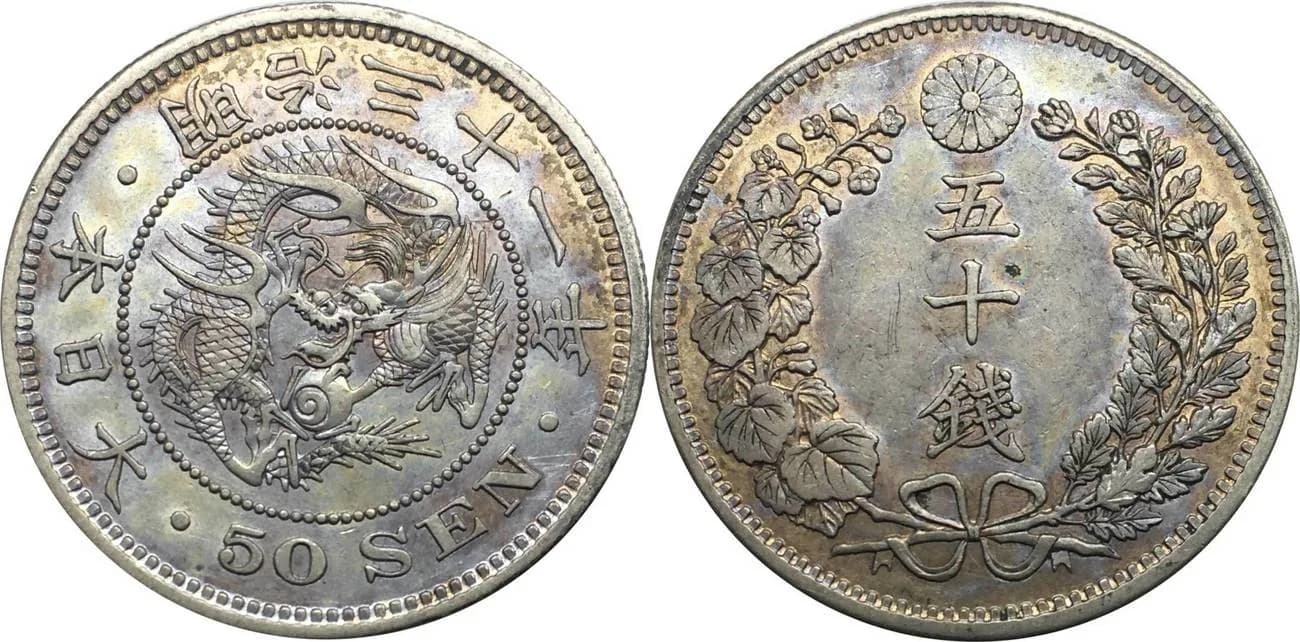
Image: Modern Japanese coinage / The government of the Empire of Japan. / Wikimedia Commons / Public domain(source)
Ryūhei Eihō — Tracing the History of Ancient Coins
Shortly after Emperor Kanmu moved the capital to Heian-kyō, the fourth imperial coinage was minted. 'Ryūhei' — A bridge from Nara to Heian inscribed with a wish for national prosperity
Subject coin: 隆平永宝
Overview
Ryūhei Eihō is an indispensable piece in discussing the history of Japanese currency from 796-818. Shortly after Emperor Kanmu moved the capital to Heian-kyō, the fourth imperial coinage was minted. 'Ryūhei' — A bridge from Nara to Heian inscribed with a wish for national prosperity. This article traces the story of Ryūhei Eihō as an ancient coin, from its historical background to its minting technology, its actual circulation, and its influence on later generations, with attention to historical facts. Understanding the historical context of this coin, beyond just market figures, will significantly change how its value is perceived. The history of Japanese currency began with the Wado Kaichin minted during the Nara period, passed through the diverse gold and silver coins of the Edo period, and continued to the modern currency of the Meiji era. For a foundational understanding, also refer to Overview and Charm of Ancient Coins and Detailed Explanation of Wado Kaichin.
Specifications
- Denomination
- —
- Minting period
- 796-818
- Metal composition
- —
- Weight
- —
- Dimensions
- —
- Mintage
- 不詳(諸説あり)
- Mint supervisor
- 不詳
- Market price
- 状態により変動(落札履歴を参照)
The Era Ryūhei Eihō Was Born — The Background of Its Minting
Image: Modern Japanese coinage / Coindesmonnaies / Wikimedia Commons / CC BY-SA 4.0(source)
The backdrop of Ryūhei Eihō's emergence is deeply connected to the political and economic circumstances of the time. Ancient coins were minted in response to the financial and circulation challenges faced by rulers, conceived from the needs of the society of the time. Let us start from the point where and why this currency was necessary under the circumstances of its era. The fact that it was minted in Enryaku 15 (796) as the fourth of the Imperial Twelve Coins is crucial for understanding its historical significance. The low number of surviving examples, requiring expert authentication of authenticity as a rare coin, is essential for understanding its historical positioning. Refer to Confirm Auction Prices of Old Coins for further insights. Considering the prices and systems of the era it was minted, it becomes clear that the significance of the same-named currency can differ greatly depending on the issue period. Existing specimens, worn and oxidized with time, increase in rarity the more their state is preserved from the time of minting. Market evaluations are intertwined with the three axes of rarity, preservation state, and collection popularity; no single factor alone can explain the price.
How Ryūhei Eihō Was Made — Materials and Techniques
Image: Modern Japanese coinage / Coindesmonnaies / Wikimedia Commons / CC BY-SA 4.0(source)
In explaining the value of Ryūhei Eihō, the materials and manufacturing process are indispensable. In ancient coins, the metal blend and finishing techniques reflect the craftsmanship of the artisans of the time, directly impacting modern evaluations. By carefully tracing the selection of materials and manufacturing processes, one can see the accumulation of techniques embodied in a single piece. The issuance fact shortly after the move from Nagaoka-kyō to Heian-kyō (794) during Emperor Kanmu's reign is essential for understanding its historical significance. Refer to Price Trend Confirmation on Market Chart for further insights. Existing specimens, worn and oxidized with time, increase in rarity the more their state is preserved from the time of minting. Market evaluations are intertwined with the three axes of rarity, preservation state, and collection popularity; no single factor alone can explain the price. Grasping the basic points such as script style, metal color, dimensions, and weight is the first step in discerning authenticity and lineage. Learning historical backgrounds allows one to feel the cultural depth of a coin that cannot be measured by market figures alone. As one continues collecting, the historical backgrounds and minting circumstances of each brand link together, growing knowledge three-dimensionally.
Ryūhei Eihō and People's Lives — Circulation and Economy
Image: Modern Japanese coinage / Coindesmonnaies / Wikimedia Commons / CC BY-SA 4.0(source)
After its issuance, Ryūhei Eihō passed from hand to hand and was used in daily life. Understanding how ancient coins circulated in the marketplace and their impacts on prices and transactions is core to understanding monetary history. Through the economic movements of the time and the reactions of the populace, the role this coin played is deciphered. The fact that 'Ryūhei' inscribes a wish for national prosperity and peace is indispensable for understanding its historical significance. Refer to Old Coin Grading Standards for further insights. Market evaluations are intertwined with the three axes of rarity, preservation state, and collection popularity; no single factor alone can explain the price. Grasping the basic points such as script style, metal color, dimensions, and weight is the first step in discerning authenticity and lineage. Learning historical backgrounds allows one to feel the cultural depth of a coin that cannot be measured by market figures alone. As one continues collecting, the historical backgrounds and minting circumstances of each brand link together, growing knowledge three-dimensionally. A single ancient coin serves as a document reflecting the economic policies and lives of the people of its time, and understanding its background changes how its value is perceived.
The Legacy of Ryūhei Eihō — Influence on Later Generations
Image: Modern Japanese coinage / Coindesmonnaies / Wikimedia Commons / CC BY-SA 4.0(source)
After its era, Ryūhei Eihō left its mark on subsequent currencies and the history of collection. Revisiting how ancient coins are positioned amid recoinage, abolition, and inheritance, and evaluated today, refines the accuracy of value judgments. Understanding the meaning that a past coin holds in today's market is pivotal for enhancing value assessment. The fact that it was a currency during the transition of the Ritsuryō state from Nara to Heian is crucial for understanding its historical positioning. Refer to Price Monitoring in Vault for Coins of Interest for further insights. Grasping the basic points such as script style, metal color, dimensions, and weight is the first step in discerning authenticity and lineage. Learning historical backgrounds allows one to feel the cultural depth of a coin that cannot be measured by market figures alone. As one continues collecting, the historical backgrounds and minting circumstances of each brand link together, growing knowledge three-dimensionally. A single ancient coin serves as a document reflecting the economic policies and lives of the people of its time, and understanding its background changes how its value is perceived. Considering the prices and systems of the era it was minted, it becomes clear that the significance of the same-named currency can differ greatly depending on the issue period.
Value & Rarity
The market value of Ryūhei Eihō is determined by three factors: rarity, preservation state (grade), and collection popularity. Even among ancient coins, differences in minting period, script style, and near-uncirculated condition can widen price ranges from several times to dozens. With limited numbers of specimens, rare coins rarely appear on the market, and well-preserved pieces increase in rarity over the years. When reading the market, it's prudent to check actual final sale prices across multiple cases rather than quoted prices. Latest price movements can be checked on Price Monitoring in Vault for Coins of Interest. Market evaluations are intertwined with three axes of rarity, preservation state, and collection popularity; no single factor alone can explain the price. Grasping basic points such as script style, metal color, dimensions, and weight is the first step in discerning authenticity and lineage.
Conclusion
Ryūhei Eihō, created out of the needs of the era from 796-818, played a role in people's lives and left its mark on later generations. Understanding the history behind a single coin fosters a reliable discerning eye that market statistics alone can't provide. For those interested in ancient coins, it is recommended to slowly develop your judgment framework by comparing multiple transaction data without rushing.
Related Stories
Naga-nen Taihō — Tracing the History of Ancient Coinage
The 7th coin of the Kōchō jūni-sen, issued in Shōwa 15 (848) during the reign of Emperor Ninmyō. From this time, the gap between the actual and nominal value of coins became serious.
Coin StoryFuhonsen — Solving the Mystery of the Oldest Coin from the Asuka Period
Japan's oldest circulating currency unearthed in Nara, Asuka
Coin StoryFuhon-sen — Tracing the History of Ancient Coins
In 1999, excavations in Asuka unearthed 'Japanese coins older than Wadōkaichin'. Why was Fuhon-sen made and why was it forgotten?
Dealers
Dealers Handling This Category
A reference when considering a sale or appraisal. All are dealers and auction houses with a proven track record.
Japan Coin Auction (JCA)
Tokyo
Holds regular auctions with reliable hammer price data, making it a useful resource for tracking market values. Caters to a wide range of collectors from beginners to advanced buyers.
Ginza Coins
Ginza, Chuo-ku, Tokyo
One of Japan's most established numismatic dealers. The scale and variety of their regular auctions is among the largest in the country. Their catalogs are considered a benchmark for market pricing.