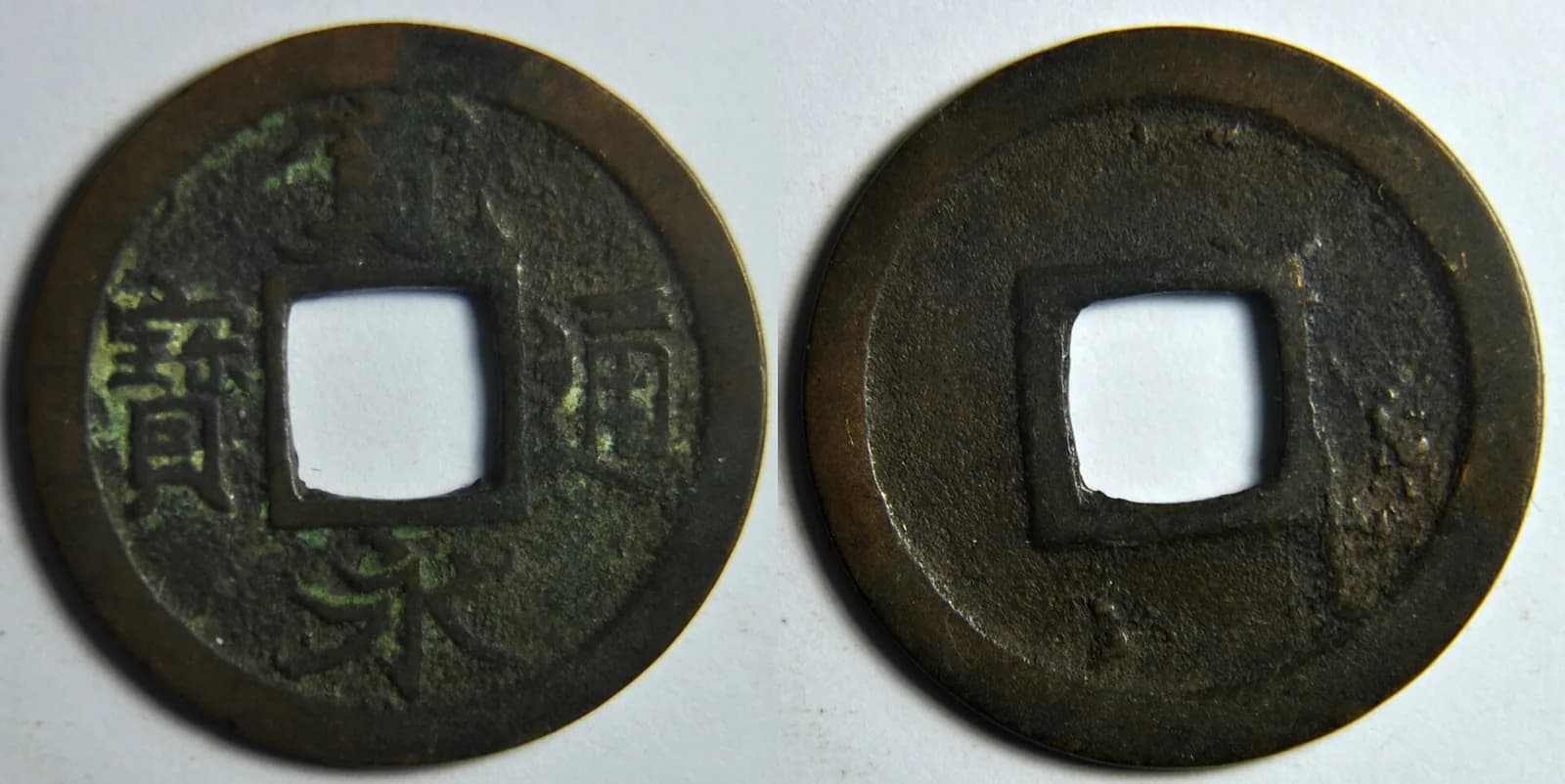
Image: Japanese holed coins (square-holed cash coins) / Jean-Michel Moullec from Vern sur Seiche (35, Bretagne), France / Wikimedia Commons / CC BY 2.0(source)
Yamashiro Bitasen — The 'Bad Money' of War-Torn Times and Economic Transformation
The turbulent economy indicated by Shoddy Coins that swept through Kyoto in the Muromachi and Sengoku periods
Subject coin: 山城鐚銭の流通
Overview
In the late Muromachi period, Japan was entering a period of warfare triggered by the Ōnin War. Amid this chaotic social situation, there existed coins that manipulated the lives of people mainly in the Yamashiro Province area of Kyoto. These were the 'Bitasen (鐚銭)', worn, chipped, or privately minted from inferior materials. As high-quality Chinese coins, known as 'seisen', became scarce, bitasen inevitably flooded the market, becoming indispensable for people's transactions. However, the poor quality created a significant value gap between them and seisen, severely impacting economic activities. It became common for 1 seisen to be exchanged for 2 to 4 bitasen, complicating commercial transactions. How did this difference in coin quality affect the lives of people at the time, and how was it overcome? This article unravels the circulation and historical significance of bitasen, which symbolizes medieval Japanese monetary economy. Coins like bitasen, closely tied to common people, are particularly fascinating in understanding the types and recognition of holed coins in Japanese monetary history.
Specifications
- Denomination
- 銭貨(文、貫など)
- Minting period
- 室町時代後期〜安土桃山時代初期(1450年頃〜1580年頃)
- Metal composition
- 銅、鉛、錫など(品位は極めて不安定)
- Weight
- 不定(摩耗・欠損が多いため、平均2g前後が多いが、私鋳銭は様々)
- Dimensions
- 不定(既存の中国銭を模したものが多いため直径20mm前後が多いが、私鋳銭は様々)
- Mintage
- 不詳(私鋳銭が多いため正確な枚数は不明)
- Mint supervisor
- 不詳(私鋳銭のため特定の設計者は存在しない)
- Market price
- 数百円〜数千円(状態の良いものは稀だが、種類によっては数万円)
Chapter 1: Currency Conditions in Turbulent Times — The Emergence of Foreign Coins and Bitasen
Image: Modern Japanese coinage / Coindesmonnaies / Wikimedia Commons / CC BY-SA 4.0(source)
In the mid-15th century, as the authority of the Muromachi shogunate began to wane, Japan's monetary economy reached a major turning point. Domestic coin minting had almost ceased after the late Heian period's Imperial Twelve Coins, with most circulating coins being Chinese 'Ming coins' brought to Japan through trade with Ming or privately. Ming coins like 'Hongwu Tongbao' and 'Yongle Tongbao' were prized for their quality and formed the basis of major economic activities. However, the supply of Ming coins was not always stable. As the Ming Dynasty intensified its maritime prohibition policies from the 1480s, the influx of coins into Japan decreased, leading to a severe domestic coin shortage. To remedy this shortage, locally produced 'private mint coins' began to appear everywhere, and poor-quality coins started flooding the market.
'Bitasen' refers to coins that emerged under such circumstances, heavily worn, chipped, or of inferior quality due to private minting. During the era of Shogun Ashikaga Yoshimasa, the Muromachi shogunate was already facing economic turmoil by the 1460s, and the Ōnin War, which began in 1467, exacerbated this chaos. This great conflict, with Kyoto as the main battlefield, lasted for 11 years, during which samurai from all over Japan converged on the capital, accelerating the circulation of inferior private mint and damaged coins around Kyoto, especially Yamashiro Province. In regions like Bizen Province and Suō Province, lords minted coins independently to strengthen their economic power. These regional private mint coins often contained high levels of lead or tin, with a low copper ratio, and were of notably poor quality. Unlike ancient Japanese coins such as Ancient Currency Overview and Charms, these coins proliferated without state control. The seisen shortage and economic chaos of the turbulent times laid the groundwork for bitasen to sweep through Kyoto.
Chapter 2: The Spread of Bad Money in Kyoto — The Social Gap between Seisen and Bitasen
Image: Modern Japanese coinage / Coindesmonnaies / Wikimedia Commons / CC BY-SA 4.0(source)
As the circulation of bitasen became more widespread, a severe monetary gap emerged in Kyoto's market. High-quality Chinese coins like Yongle Tongbao were called 'seisen', while heavily worn, chipped, or poorly minted coins were distinguished as 'bitasen'. A clear exchange ratio developed between seisen and bitasen, with common practices in Kyoto markets exchanging 1 seisen for 2 to 4 bitasen, sometimes even more. For example, records from the early 1500s mention exchanges of 1 kanmon (1000 coins) of Yongle coins for 2 kanmon of bitasen.
In this complex monetary situation, 'money changers' played an essential role. They appraised seisen and bitasen, set exchange rates based on quality, and made profits by exchanging. For instance, in the 1490s, there were many 'coin dealers' in Kyoto, who possessed the expertise to discern the authenticity and quality of coins. At their storefronts, coins brought in were meticulously graded based on whether they were seisen or bitasen and the quality level of bitasen, with a fee charged for exchanges. Although this appraisal and exchange process was complex and elusive to commoners, it was an indispensable service for merchants, leading to wealth accumulation among money changers. They also acted as financiers, accumulating and lending money. People of that time, unaware of Basic Knowledge for Coin Auctions, were tossed about by this complex monetary system and money changers in daily transactions. While this diminished monetary reliability and led to economic stagnation, it also fueled the emergence of a new business—exchange.
Chapter 3: Attempts to Eliminate Bad Money — The Futility of Repeated Coin Selection Orders
Image: Modern Japanese coinage / Coindesmonnaies / Wikimedia Commons / CC BY-SA 4.0(source)
The adverse impacts of bitasen circulation on the economy were issues the Muromachi shogunate and regional Sengoku daimyo could not ignore. Price fluctuations became routine, trust in commercial transactions was lost, and economic activity declined. To counter the spread of bad money, the shogunate and daimyo repeatedly issued 'coin selection orders (erizenirei)'. These orders were laws meant to distinguish between good-quality seisen and inferior bitasen, restricting the use of bitasen, or banning the circulation of specific coins.
The first large-scale coin selection order was said to be issued by the Muromachi shogunate in 1484. This order aimed to regulate market confusion by banning certain inferior coins and setting exchange ratios between seisen and bitasen. However, with an absolute shortage of seisen, it was impossible to completely stop bitasen circulation. The populace had no choice but to use the bitasen they had, and merchants had to accept bitasen to maintain customer transactions. Throughout the 1500s, numerous coin selection orders were issued by the shogunate, shugo daimyo, and even temples and shrines. For example, Hosokawa Masamoto issued one in 1502, and in 1532, local rulers in Settsu issued another, demonstrating a diverse range of issuers. Nevertheless, these orders had minimal impact, as legal measures out of touch with ground realities were often ignored or circumvented, and bad money continued to deeply infiltrate the market.
The repeated issuance of coin selection orders was not solely about exchange rate stabilization but was also seen as an effort by feudal lords to favor the circulation of coins minted within their territories. However, this inadvertently cemented the gap between seisen and bitasen. Amid the flood of inferior coins, people unknowingly learned How to Identify Forged and Altered Coins, finding ways to avoid low-quality coins. Yet, the economic turmoil of this era vividly illustrates the significant societal impact of coin quality.
Chapter 4: The End of Turmoil and the Transformation of Bitasen — Nobunaga's Economic Reforms
Image: Modern Japanese coinage / Coindesmonnaies / Wikimedia Commons / CC BY-SA 4.0(source)
As the turbulent era drew to a close, and Oda Nobunaga aimed for national unification, he focused on economic policies alongside military reforms. One of his iconic economic policies was 'Rakuichi Rakuza'. This policy abolished the privileges granted to specific merchants (za), allowing everyone to engage in commerce freely, and aimed to revitalize markets. Within this Rakuichi Rakuza decree, Nobunaga introduced groundbreaking policies for bitasen circulation.
Unlike previous coin selection orders that sought to prohibit or restrict bitasen circulation, Nobunaga allowed certain degrees of bitasen circulation. For instance, the Rakuichi Rakuza order issued in 1567 in Mino Kanō explicitly stated, 'Yongle coins are allowed circulation, bitasen too are allowed circulation.' This indicated a pragmatic decision to acknowledge the shortage of seisen and permitted the circulation of inferior bitasen to facilitate smooth economic activities. Nobunaga prioritized securing the volume of currency in markets and revitalizing economic activity over coin quality. This policy promoted the development of commerce and industry in Nobunaga's dominion, supporting his national unification efforts economically.
After Nobunaga's death, during Toyotomi Hideyoshi's era, monetary policy underwent further changes. Hideyoshi established a unified currency system based on Tensho Ōban and Yongle Tongbao, promoting nationwide circulation. As a result, the chaotic circulation of bitasen gradually diminished, leading Japan's monetary economy towards stability. Nevertheless, bitasen did not completely disappear. Even into the Edo period, poor-quality coins were still found in circulation in regions, with effects lasting until the era when Details of Keicho Koban were minted. Bitasen serves as a valuable historical testimony to the hardships faced by the medieval Japanese monetary economy and the ingenuity and wisdom of people overcoming those challenges.
Value & Rarity
Yamashiro bitasen is more akin to a 'state' or 'concept' indicating the condition of the medieval Japanese monetary economy rather than a 'coin' with a specific design or quality. Therefore, in the modern collector's market, it is rare for 'Yamashiro bitasen' to fetch a high value. Most are traded for a few hundred to a few thousand yen as worn or damaged Chinese coins or inferior privately minted coins. However, there are exceptions. For instance, rare privately minted coins confirmed to be minted in specific regions, or bitasen with legible inscriptions or distinctive designs, can be valued at tens of thousands of yen. Coins with a clear historical background and known provenance enhance their research value, leading to a higher evaluation.
In terms of rarity, the bitasen were widely circulated, making individual coins not particularly rare. However, due to their diversity, finding interesting types like certain privately minted coins or coins banned by specific coin selection orders is the charm for collectors. Few are well-preserved, as they were often heavily worn or corroded, making well-preserved bitasen considered valuable. Collectors gather them not only for their monetary value but for the historical stories they tell and to reflect on people's lives at the time. Current market prices can be more precisely tracked by checking price movements in market charts. Bitasen indeed is a profound entity, providing crucial insights into understanding a chaotic period in Japanese monetary history.
Conclusion
As the editor of Ittendo, looking back on the history of Yamashiro bitasen impresses upon me its depth. The gap between seisen and bitasen was not merely a coin quality issue but reflected the socioeconomic structures, people's lives, and rulers' struggles of that time. The repeated issuance of coin selection orders, despite persistent bitasen circulation, demonstrates how economic reality can surpass rulers' intentions. Oda Nobunaga's acceptance of bitasen's circulation shows his realism and importance placed on economic activity. Bitasen represents the harsh realities faced by monetary economies of turbulent times and the ingenuity and strategies people employed to overcome them, reminding us today of the significance of currency reliability and economic stability.
Related Stories
Eiraku Tsuho — The Chinese 'Standard Currency' that Moved Muromachi Japan
An Unknown Era When Foreign Coins Formed Japan's Economic Foundation
Coin StoryThe Monetization of Kamakura Estates — Innovations in the Medieval Currency Economy
The Transformation of the Japanese Economy Triggered by the Kamakura Shogunate and the Advancement of Monetized Tribute
Coin StoryThe Import and Circulation of Ming Coins — Tracing the History of Medieval Currency
Beyond Yongle Tongbao, Ming coins such as Hongwu Tongbao and Xuande Tongbao were issued in dozens. Their quality and trust discrepancies caused chaos in the Japanese market.
Dealers
Dealers Handling This Category
A reference when considering a sale or appraisal. All are dealers and auction houses with a proven track record.
Ginza Coins
Ginza, Chuo-ku, Tokyo
One of Japan's most established numismatic dealers. The scale and variety of their regular auctions is among the largest in the country. Their catalogs are considered a benchmark for market pricing.
Japan Coin Auction (JCA)
Tokyo
Holds regular auctions with reliable hammer price data, making it a useful resource for tracking market values. Caters to a wide range of collectors from beginners to advanced buyers.
Taisei Coins
Tokyo
A dealer with an international network. Offers advanced services such as consignment to overseas auctions and NGC/PCGS grading submission. Recommended for high-value or internationally recognized coins.