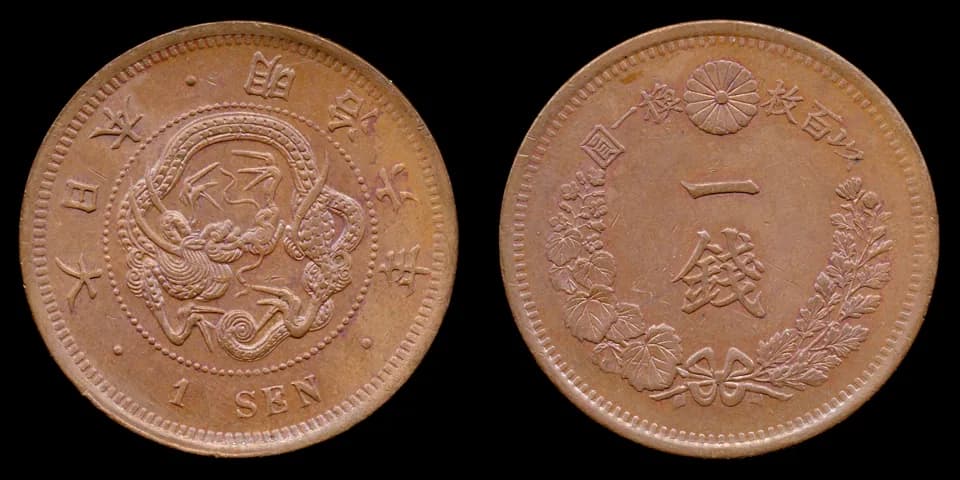
Image: Modern Japanese coinage / As6673 / Wikimedia Commons / CC BY-SA 3.0(source)
Post-Russo-Japanese War Subsidiary Coinage Reform — The 'Monetary Cleanup' That Supported the Meiji State
How the Weight of 1.7 Billion Yen in War Expenditures Transformed Japan's Monetary Order: The Unknown Story Behind the Scenes
Subject coin: 日露戦後の補助貨幣整理
Overview
Japan's victory in the Russo-Japanese War elevated its international standing, but the price exacted an enormous burden on state finances. War expenditures estimated at approximately 1.7 billion yen represented several years' worth of the national budget, quietly yet surely eroding the domestic economy—and the monetary order in particular. To overcome this unprecedented fiscal crisis and rebuild the economic foundations befitting a modern state, the Meiji government embarked on a bold reform of the monetary system.
The 'Major Subsidiary Coinage Reform' implemented in Meiji 39 (1906) was far more than a mere change of coin materials. It was a 'monetary cleanup' carried out as postwar settlement in parallel with the restructuring of the short-term bonds and military scrip that had ballooned during the Russo-Japanese War. The central objective of this reform was to uphold the gold standard that Japan had established in Meiji 30 (1897). As fluctuations in global silver prices threatened the stability of silver subsidiary coins, the government moved to eliminate silver from subsidiary coinage and transition to new materials such as cupronickel and bronze. This avoided the risk of bullion value surpassing face value and preserved the credibility of the national monetary system. This series of measures became an extremely important turning point in Japan's modern monetary history, laying a firm foundation for the system—continuing through the early Shōwa period—in which small-denomination coins were made of cupronickel and bronze. This grand story of monetary reform can be said to have been not merely an economic policy, but a great national undertaking with the country's future at stake. For those wishing to learn more about modern Japanese coinage, please also see Modern Coinage: Value and How to Identify It.
Specifications
- Denomination
- 1銭、2銭、5銭、10銭(主に5銭・10銭白銅貨)
- Minting period
- 明治39年(1906年)〜大正元年(1912年)頃
- Metal composition
- 白銅(銅75% / ニッケル25%)、青銅(銅95% / 錫4% / 亜鉛1%)
- Weight
- 10銭白銅貨 3.75g / 5銭白銅貨 2.81g
- Dimensions
- 10銭白銅貨 直径22.12mm / 5銭白銅貨 直径19.09mm
- Mintage
- 不詳(各貨幣種で大量に鋳造)
- Mint supervisor
- 造幣局
- Market price
- 数百円〜数千円(状態による。未使用品やエラー品は高値)
Chapter 1: The Weight of 1.7 Billion Yen in War Expenditures — The Crisis of the Gold Standard and the Stirrings of Subsidiary Coinage Reform
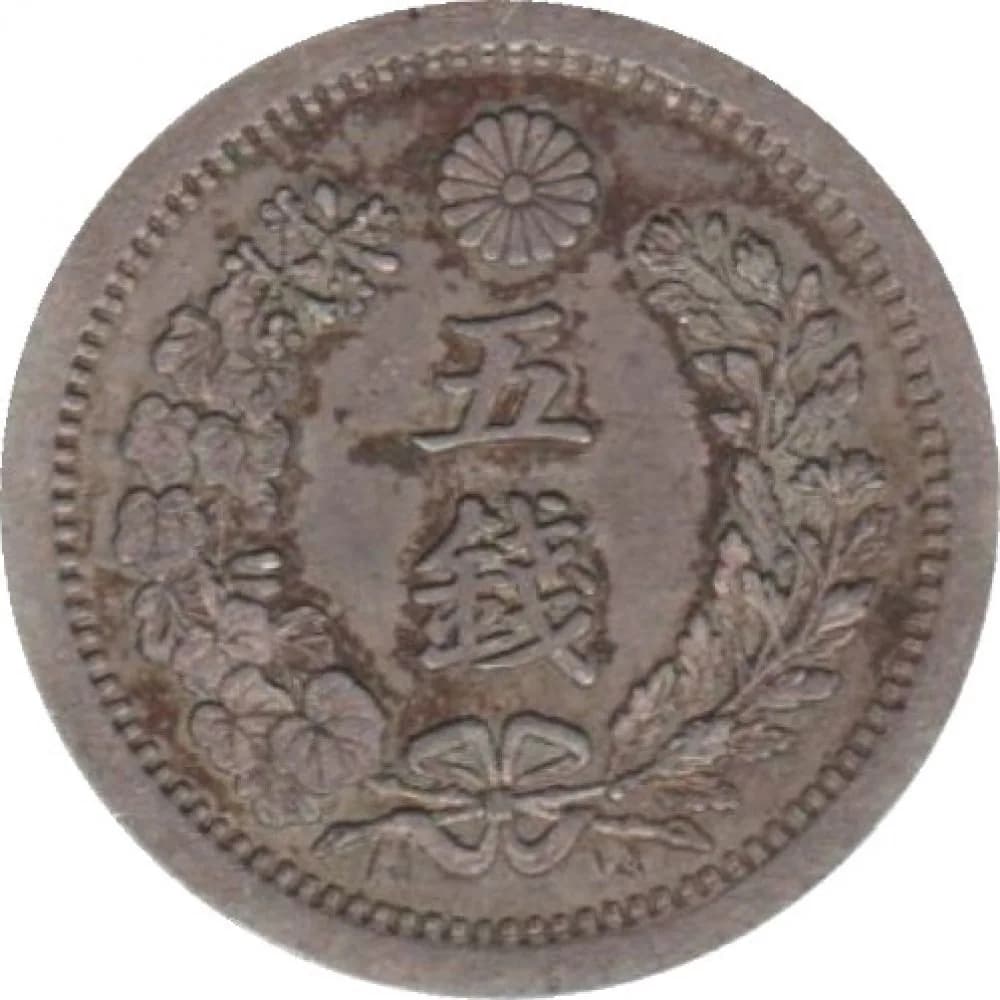
Image: Modern Japanese coinage / Coindesmonnaies / Wikimedia Commons / CC BY-SA 4.0(source)
The Russo-Japanese War, fought from Meiji 37 (1904) through Meiji 38 (1905), dramatically elevated Japan's international standing, but the price paid was beyond imagination. War expenditures incurred by Japan in this conflict are estimated at approximately 1.7 billion yen. Compared to the national budget of the time—for example, the expenditure budget for Meiji 37 of approximately 260 million yen—this was an enormous sum amounting to more than six years' worth of spending. These colossal war costs were funded mainly through the issuance of domestic and foreign bonds, tax increases, and military scrip issued during wartime, but postwar finances were plunged into a state of extreme tension.
As part of postwar settlement, the government was kept busy restructuring these short-term bonds and military scrip, but in the process it was made to realize that the very foundations of Japan's monetary system were beginning to waver. What was viewed as particularly problematic was the maintenance of the gold standard established in Meiji 30 (1897). Yoshirō Sakatani, who served as Finance Minister at the time, believed that upholding the gold standard was indispensable to preserving Japan's international creditworthiness. However, global silver prices were fluctuating sharply, and there arose the possibility that the bullion value of subsidiary coins such as the 10-sen and 5-sen pieces—minted in silver—would exceed their face value. If the bullion value of silver coins were to surpass face value, the coins might be melted down and flow abroad, triggering what is known as Gresham's Law: 'bad money drives out good.' In fact, in Meiji 37 (1904) the silver price surged, and there were instances in which the bullion value of the 10-sen silver coin temporarily exceeded its face value.
Under the Katsura Tarō Cabinet, the Ministry of Finance felt acutely the need to review the materials and fineness of subsidiary coinage as an urgent task. This was because if the subsidiary coins indispensable for small transactions remained in an unstable state, they could cause serious disruption to the lives of the people and to economic activity. A policy was settled upon to make maintaining the gold standard the top priority and to eliminate silver from subsidiary coinage. This was not merely a change of coin materials, but a strategic decision to make the economic foundations of the state unshakeable. For details on silver coins of the Edo period, please see Details on Edo Silver Coins.
Chapter 2: Behind the Scenes of the Birth of the Cupronickel Coin — The Challenge of New Materials and the Technology of the Mint
Image: Modern Japanese coinage / Coindesmonnaies / Wikimedia Commons / CC BY-SA 4.0(source)
In response to the national imperative of maintaining the gold standard and avoiding the risks posed by silver price fluctuations, the Meiji government in Meiji 39 (1906) amended the Coinage Law and carried out a change in the materials used for subsidiary coins. Under this amendment, the 10-sen and 5-sen coins were to be switched from silver to cupronickel, and the 1-sen and 2-sen coins from copper to bronze. At the center of this major project stood the Mint Bureau, located in Osaka.
The Mint Bureau of the time had assembled skilled technicians who supported the manufacture of Japan's modern coinage. They applied themselves to understanding the properties of the new materials—cupronickel (75% copper, 25% nickel) and bronze (95% copper, 4% tin, 1% zinc)—and to developing the technology needed to manufacture high-quality coins in a stable manner. Cupronickel had the advantage of a beautiful color resembling silver while also being highly wear-resistant, resistant to rust, and above all having a bullion value below its face value, greatly reducing the risk of melting and outflow abroad. The new 10-sen cupronickel coin was minted with a diameter of 22.12 mm, and the new 5-sen cupronickel coin with a diameter of 19.09 mm; while maintaining nearly the same sense of scale as the old silver coins, stable supply was achieved through the change of material.
The designs of the new coins were also deliberated upon. The 10-sen cupronickel coin adopted a rising sun and cherry blossoms, and the 5-sen cupronickel coin adopted paulownia leaves and cherry blossoms, expressing Japan's traditional aesthetic sensibility alongside the strength of a modern state. These designs followed the designs of the old silver coins while taking care to make the new-material coins readily accepted by the public. Simultaneously with the issuance of the new coins, a plan for the phased withdrawal of the existing silver subsidiary coins—namely the 10-sen silver coin and 5-sen silver coin—was also formulated. The Mint Bureau established a system for mass production of the new coins and, by supplying the new cupronickel and bronze coins throughout the country, proceeded with the smooth exchange of the old silver coins. This entire operation was not only a technical challenge but also an important process for restoring national credibility.
Chapter 3: The Common People's Purse and the New Coins — Price Fluctuations and Ripples Through the Economy
Image: Modern Japanese coinage / Coindesmonnaies / Wikimedia Commons / CC BY-SA 4.0(source)
Following the Major Subsidiary Coinage Reform of Meiji 39 (1906), new cupronickel and bronze coins began to circulate in the market. At first, some bewilderment was observed among the public toward coins made of unfamiliar materials, but the government and the Mint Bureau worked to spread the new coins through active public relations efforts and the withdrawal of the old silver coins. In particular, unlike the conventional silver coins, the cupronickel coins emitted a somewhat duller luster rather than the characteristic brilliance of silver, but their durability and convenience in daily use gradually came to be accepted by the public.
This monetary cleanup played an extremely important role in bringing stability to the postwar Japanese economy. The Russo-Japanese War had temporarily driven up prices—rice prices in particular showed a sharp rise from Meiji 37 (1904) through Meiji 38 (1905)—but the stable supply of subsidiary coinage contributed to curbing market confusion and facilitating small transactions. With the gold standard maintained, Japan's international creditworthiness was preserved, making it easier to attract investment from abroad. This was an indispensable element for postwar recovery and industrial promotion.
The reactions of the people varied. The switchover to the new coins took time especially in rural areas, and some confusion over exchange rates at shops was also reported in places. However, the government set a period for the withdrawal of the old silver coins and promoted smooth exchange through banks and post offices. For example, old 10-sen silver coins and 5-sen silver coins were exchanged at par with new 10-sen cupronickel coins and 5-sen cupronickel coins, with care taken to avoid any disadvantage to the public. The lives of ordinary people during this period, while buffeted by the waves of the 'boom' and 'reactionary recession' following the Russo-Japanese War, steadily proceeded along the path of modernization under the new monetary system. For a deeper understanding of the actual circulation of coinage in this era, a comparison with past monetary systems such as that covered in Details on Edo Silver Coins is also of interest.
Chapter 4: The Foundation of Small-Denomination Coinage — The Monetary System Continuing from Meiji into Shōwa
Image: Modern Japanese coinage / Coindesmonnaies / Wikimedia Commons / CC BY-SA 4.0(source)
The Major Subsidiary Coinage Reform of Meiji 39 (1906) did not merely represent a temporary change of coins; it exerted a long-lasting influence on Japan's subsequent monetary system. The framework of 'small-denomination coins = cupronickel and bronze' established by this reform continued to function as the standard for Japan's small-denomination coins through the early Shōwa period. This can be said to be proof that the strong will of the Meiji government to uphold the gold standard and ensure the credibility of the monetary system remained in tangible form.
Following this reform, the subsidiary coins of 10 sen and 5 sen issued in Japan were essentially made of cupronickel, and those of 1 sen and 2 sen of bronze. For example, the 'Chrysanthemum 10-Sen Cupronickel Coin' and 'Rice Stalk 5-Sen Cupronickel Coin' issued during the Taishō period were direct successors of the coins from the Meiji 39 reform, and the decisions made at that time are strongly reflected in their choice of design and material. These coins continued to support the Japanese economy until the severe inflation of the Second World War era caused their materials to change. The old silver coins were phased out of the market through exchange for the new coins, but some of them survive to this day as rare collector's items.
In the modern history of coinage, this Meiji 39 subsidiary coinage reform is highly regarded as an important turning point that made Japan's economic foundations as a modern state unshakeable. This monetary reform—carried out to overcome the national crisis of the Russo-Japanese War and achieve the two major goals of fiscal reconstruction and maintenance of the gold standard—can be said without exaggeration to have laid the groundwork for Japan's subsequent economic development. Without this historic decision, Japan's modernization might have been greatly delayed. Understanding the historical background of the coinage of this era will serve as a key to reading deeply into Japan's modern history. For those wishing to learn more about the value of old coins, please also refer to Standards for Old Coin Grading.
Value & Rarity
The 10-sen cupronickel coins, 5-sen cupronickel coins, 1-sen bronze coins, and 2-sen bronze coins issued under the Coinage Law amendment of Meiji 39 (1906) were all minted in large quantities, so ordinary circulated examples can be obtained at relatively low cost. For example, a piece in average condition generally trades at around a few hundred yen. However, uncirculated examples or those with a proof-like (mirror-finish) appearance can fetch anywhere from several thousand yen to, in some cases, tens of thousands of yen, depending on their state of preservation and rarity. In particular, error coins produced during the minting process or those of specific date issues tend to trade at high prices among collectors.
On the other hand, the old 10-sen silver coins and 5-sen silver coins withdrawn as a result of this reform had a high rate of withdrawal, meaning that few survive today and they are considered to hold high numismatic value. In particular, old silver coins in very fine condition or better not infrequently trade for tens of thousands to hundreds of thousands of yen. In this way, there is a large disparity in market value between the new and old subsidiary coins. When considering these coins for a collection, it is important to carefully assess condition, date, and authenticity by referring to Modern Coinage: Value and How to Identify It. Since counterfeits and altered pieces also circulate in the market, the use of a trustworthy specialist dealer or authentication service is recommended. When considering the use of old coin auctions, please see Basics of Old Coin Auctions. Checking price trends on the market chart is also an effective means of grasping market price movements.
Conclusion
The post-Russo-Japanese War subsidiary coinage reform was far more than a mere change of coin materials; it was a strategic decision to resolve the extremely important challenges of stabilizing Meiji Japan's state finances and the gold standard. While facing the enormous weight of approximately 1.7 billion yen in war expenditures, the government eliminated silver from subsidiary coinage and transitioned to cupronickel and bronze, thereby securing the credibility of the monetary system and laying the groundwork for Japan's subsequent economic development. This grand 'monetary cleanup' can be said to have been a turning point in history that is indispensable for understanding the course of modern Japan.
Related Stories
60th Anniversary of Local Autonomy Law 500 Yen Bicolor – 10-Year Journey Across 47 Prefectures
Commemorative Coin Series Born from the Law of 1947
Coin StoryAichi Expo Commemorative Silver Coin — Hope for the Future Carved with the Wisdom of Nature
The History and Value of the 1000-yen Silver Coin Commemorating the 2005 Aichi Expo
Coin StoryCommemorative 500 Yen Cupronickel Coin for the Enthronement of the Heisei Emperor — A Bridge from Heisei to Reiwa
The Story of a Historic Commemorative Coin Celebrating the Enthronement of the Heisei Emperor
Dealers
Dealers Handling This Category
A reference when considering a sale or appraisal. All are dealers and auction houses with a proven track record.
Ginza Coins
Ginza, Chuo-ku, Tokyo
One of Japan's most established numismatic dealers. The scale and variety of their regular auctions is among the largest in the country. Their catalogs are considered a benchmark for market pricing.
Taisei Coins
Tokyo
A dealer with an international network. Offers advanced services such as consignment to overseas auctions and NGC/PCGS grading submission. Recommended for high-value or internationally recognized coins.
Tokyo Coin Club
Tokyo
A membership-based coin dealer known for carefully selected, quality inventory.