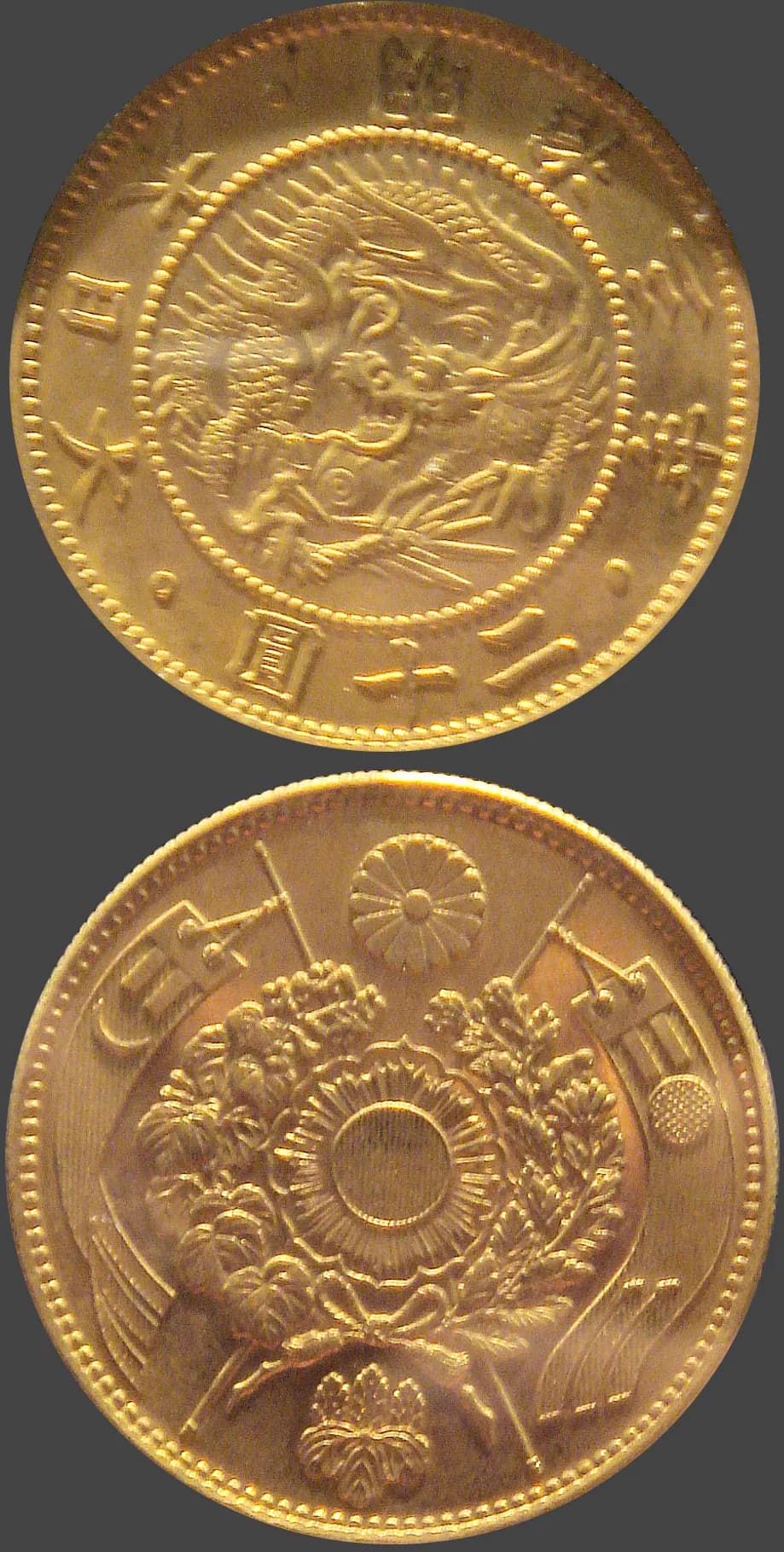
Image: Modern Japanese coinage / PHGCOM / Wikimedia Commons / CC BY-SA 3.0(source)
Nanryō Nishugin — The Edo Innovation Brought by the Currency Revolution of Tanuma Okitsugu
The Advent of Fixed-Amount Silver Coin Pointing the Way to Modernization
Subject coin: 南鐐二朱銀
Overview
The Nanryō Nishugin was a groundbreaking currency introduced by Tanuma Okitsugu, known as a reformer of the Edo period, as part of his commercial promotion policy. Minting began in Meiwa 9 (1772), and this currency used 'Nanryō', meaning high-quality silver, with a fixed face value eliminating the need for weighing. This was the first fixed-amount silver coin in the Edo period, aimed at facilitating economic circulation. Okitsugu sought to develop commerce and ensure a stable supply of currency, yet his policies sparked controversy. The Nanryō Nishugin circulated until Bunsei 7 (1824) and influenced later currency systems. The appearance of this currency pointed to a new direction in Edo-period monetary systems, holding historical significance as the germination of modern money. Understanding the entire monetary system of the time, such as Details of Edo Silver Coins and Types and Market Values of Koban, makes Nanryō Nishugin an important subject of study.
Specifications
- Denomination
- 二朱
- Minting period
- 明和9年(1772年)〜文政7年(1824年)
- Metal composition
- 銀
- Weight
- 約8.6g
- Dimensions
- 縦約26mm × 横約18mm
- Mintage
- 不詳(諸説あり)
- Mint supervisor
- 不詳(田沼意次の指導の下)
- Market price
- 30,000円〜200,000円(状態による)
Historical Background and Motives for Mintage — Tanuma Okitsugu's Ambition
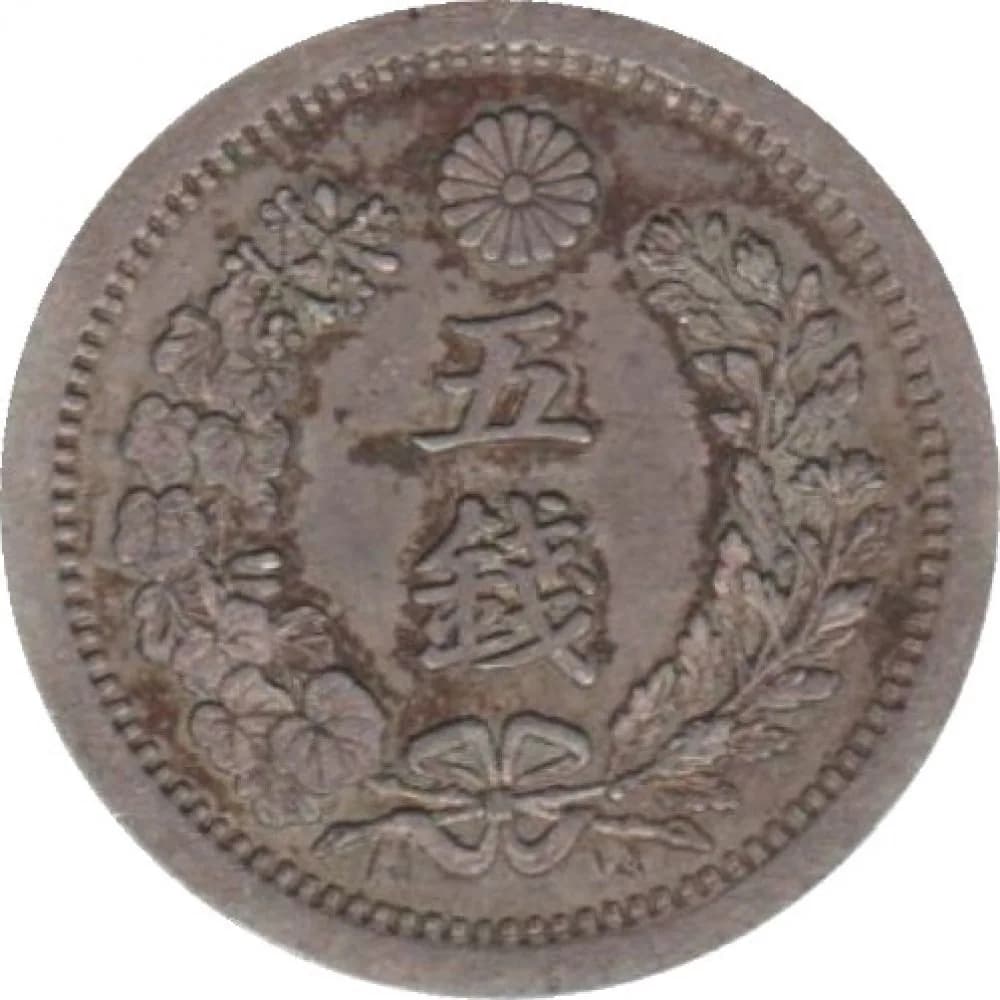
Image: Modern Japanese coinage / Coindesmonnaies / Wikimedia Commons / CC BY-SA 4.0(source)
In the mid-Edo period, with Tanuma Okitsugu at the center of power as a senior counselor in Meiwa 9 (1772), Japan's economy was shifting from agriculture-centered to commerce-centered. Tanuma decided to reform the currency system to promote commerce. His goal was to achieve more efficient economic circulation. The previous weighing silver coins required weighing at each transaction, causing inconvenience and time consumption. Therefore, Tanuma attempted to solve this issue by introducing the fixed-amount silver coin 'Nanryō Nishugin'. These silver coins were equivalent in value to 1/8 of one gold ryō, and were inscribed with '以南鐐八片換小判一両'. This inscription indicated that eight Nanryō Nishugin coins could be exchanged for one koban ryō, making them extremely convenient for merchants. Tanuma's policy seemed groundbreaking, but his bold reforms also led to backlash. Particularly, inadequate currency circulation in rural areas resulted in economic disruption. Tanuma's policies continued from 1772 to 1786 but were temporarily halted upon his downfall; nonetheless, Nanryō Nishugin contributed to commercial development, laying the foundation for later currency systems.
Minting Process and Personnel — Silver Coins Concentrating Technical Excellence
Image: Modern Japanese coinage / Coindesmonnaies / Wikimedia Commons / CC BY-SA 4.0(source)
The minting of Nanryō Nishugin gathered the most advanced technology and skilled craftsmen of the time. Minting was mainly carried out at the gold mint in Edo, with strict quality control standards for silver. 'Nanryō' refers to high-quality pure silver, and advanced techniques were used in silver refining to live up to the name. The silver was first refined to remove impurities, then rolled to uniform thickness, and poured into molds. In designing the Nanryō Nishugin, attention was also paid to the beauty of the engravings on the surface. The engraving '以南鐐八片換小判一両', crucial information indicating that eight Nanryō Nishugin equate to one koban ryō, was meticulously applied to each piece by skilled artisans. The involvement of renowned craftsmen from families like the Goto family is suggested, but the details remain debated and not entirely elucidated. Under Tanuma Okitsugu's guidance, these associates honed their skills to realize a new monetary system, resulting in the innovative Nanryō Nishugin. Thus conceived, it was a groundbreaking fixed-amount silver coin at the time, significantly influencing later currency system reforms.
Realities of Circulation and Economic Impact — The Silver Coin that Transformed the Market
Image: Modern Japanese coinage / Coindesmonnaies / Wikimedia Commons / CC BY-SA 4.0(source)
The advent of Nanryō Nishugin caused significant changes in the Edo-period market. The introduction of fixed-amount silver coins facilitated smoother commercial transactions, invigorating circulation particularly in commercial hubs like Edo and Osaka. With a fixed value equivalent to 1/8 of one gold ryō, the coins eliminated the need for weighing and were extremely convenient for merchants. This improved transaction speed and stimulated commercial activity. Prices stabilized, promoting economic development, especially in urban areas. However, the change had adverse effects in rural areas. Insufficient currency circulation led to rising prices, causing hardship for many farmers. The spread of Nanryō Nishugin widened economic disparities between urban and rural areas, receiving criticism for this effect. While Tanuma Okitsugu's policies aimed at commercial development, their impacts were not uniformly beneficial. Nevertheless, the introduction of Nanryō Nishugin advanced commerce, laying the groundwork for a modern monetary system. Leading towards the late Edo period, Japan's economy progressed to a new stage.
Legacy and Reminting — The Heritage of Fixed-Amount Silver Coins
Image: Modern Japanese coinage / Coindesmonnaies / Wikimedia Commons / CC BY-SA 4.0(source)
Nanryō Nishugin greatly influenced Japan's subsequent currency systems. Although abolished in 1824 with the advent of the Bunsei Koban, the concept of fixed-amount currency was carried into later systems. The success of Nanryō Nishugin emphasized the importance of currency standardization and smooth circulation, forming the basis for subsequent currency reforms. Specifically, the yen-sen-rin system in the Meiji era's New Currency Ordinance partially adopted the fixed-amount concept, smoothing the transition to modern Japan's currency system. Additionally, the importance of minting technology and quality control demonstrated by Nanryō Nishugin was inherited by later currency system reforms. It was not merely a silver coin but a symbol of the evolution of Japan's currency system. Tanuma Okitsugu's reforms continued to influence Japan's economy beyond his lifetime. His commercial promotion policies undoubtedly contributed to Japan's economic development across ages.
Value & Rarity
Nanryō Nishugin is highly evaluated in the antique coin market due to its historical background and technical value. Especially well-preserved pieces with clear inscriptions are often traded at high prices among collectors. Market prices range from 30,000 yen to 200,000 yen, and its rarity and historical value may cause its value to increase in the future. Nanryō Nishugin occupies a critical position in considering Tanuma Okitsugu's policies and their impact on subsequent Japanese monetary systems. Currently, transactions mainly occur in antique coin auctions and specialized shops, and it is particularly popular among collectors specializing in Edo-period coins. Understanding its historical background is key to discovering the true value of these coins.
Conclusion
Nanryō Nishugin was a groundbreaking fixed-amount silver coin introduced by Tanuma Okitsugu as part of his commercial promotion policy. Its introduction was a turning point in Japan's monetary system, paving the way for a modern currency system. Aiming for commercial development, this policy significantly influenced the economy of the time and later contributed to Japan's economic development. Due to its historical background and technical value, Nanryō Nishugin is still highly valued in the antique coin market. Even today, its innovation and influence continue to be recognized and hold a significant position in monetary history research. Nanryō Nishugin is not a mere relic of the past but continues to symbolize Japan's economic and currency evolution towards the future.
Related Stories
Ansei Chōgin — The Final Edo Era Silver Bullion Coin amidst the Turbulence of the Bakumatsu
A Short-lived yet Historical Silver Bullion Created Amidst the Turmoil of Opening Japan
Coin StoryAnsei Nibus Gin — A Silver Coin Born Amidst Port Opening and Fiscal Crisis
The Role of Subsidiary Silver Coins Issued in the Turbulent Closing Years of the Edo Period
Coin StoryBunkyū Eiho and the End of the Gold Coin System — Tracing the History of Edo Gold Coins
Bunkyū 2 (1862) marks the final currency reform of the shogunate, with a gold coin series issued alongside the Bunkyū Eiho (copper coins) as a symbol of late shogunate monetary chaos
Dealers
Dealers Handling This Category
A reference when considering a sale or appraisal. All are dealers and auction houses with a proven track record.
Japan Coin Auction (JCA)
Tokyo
Holds regular auctions with reliable hammer price data, making it a useful resource for tracking market values. Caters to a wide range of collectors from beginners to advanced buyers.
Ginza Coins
Ginza, Chuo-ku, Tokyo
One of Japan's most established numismatic dealers. The scale and variety of their regular auctions is among the largest in the country. Their catalogs are considered a benchmark for market pricing.
Osaka Numismatic Auction
Osaka
A Kansai-based coin auction house with particular strength in regional and hole coins.