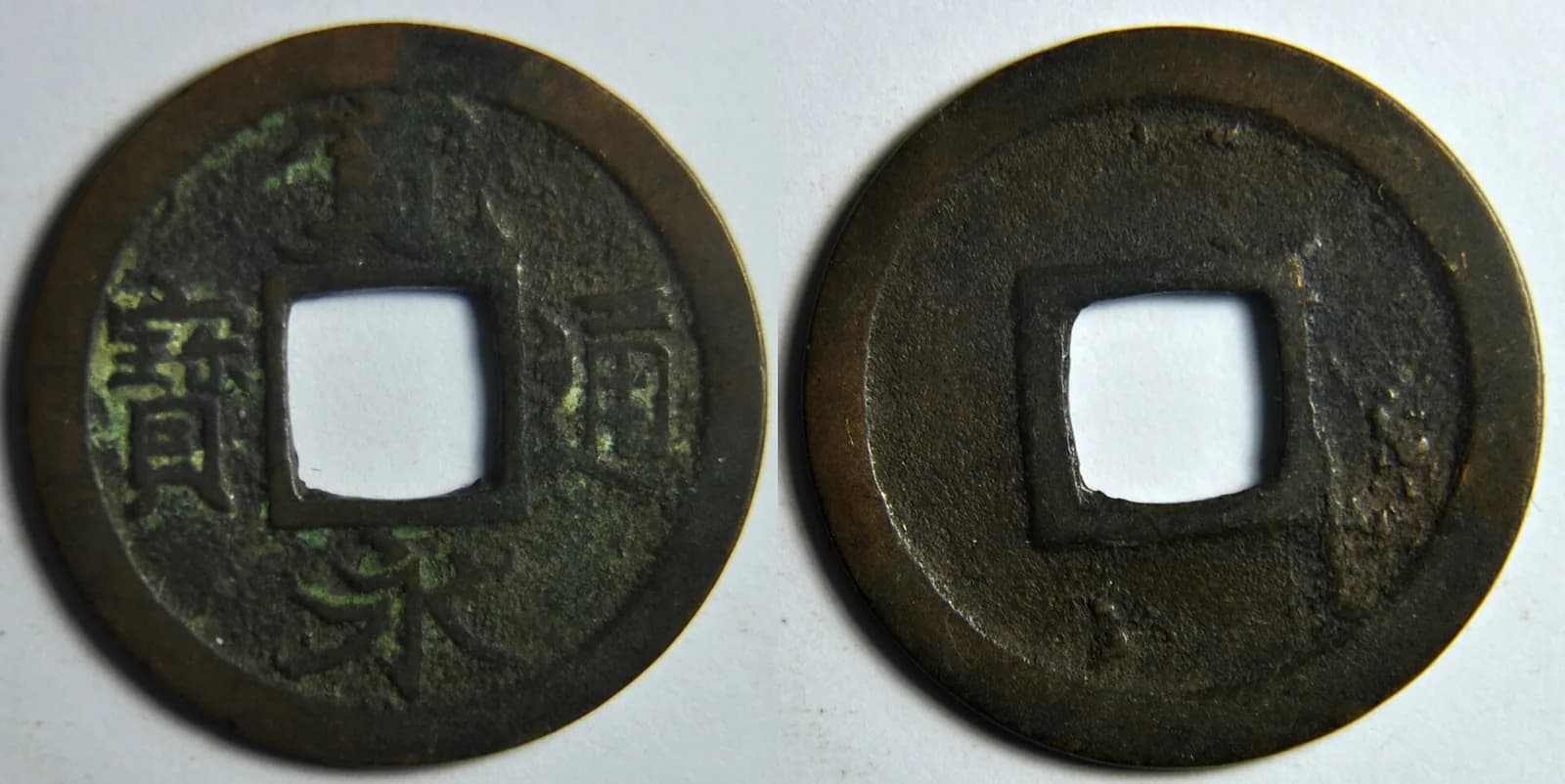
Image: Japanese holed coins (square-holed cash coins) / Jean-Michel Moullec from Vern sur Seiche (35, Bretagne), France / Wikimedia Commons / CC BY 2.0(source)
Gun'yō tehyō — The Economic Strategy of Wartime and Its Impact
The Fate of Currency Issued for the Occupied Territories Entrusted with the Dream of the Greater East Asia Co-Prosperity Sphere
Subject coin: 軍用手票(軍票)
Overview
Gun'yō tehyō were military banknotes issued by the Japanese military from 1937 to 1945 in occupied territories. Under the ideology of the Greater East Asia Co-Prosperity Sphere, attempts were made to circulate these notes in regions such as the Philippines, Malaya, and the Dutch East Indies (present-day Indonesia), but they faced numerous difficulties. In these areas, the notes bore inscriptions indicating they were issued under military governance, and forced exchanges with local currencies were carried out. However, residents continued to distrust this new currency. When the war ended and Japan was defeated, these military notes became worthless overnight, causing significant economic damage to local populations. Today, they are traded as collector's items, with their historical background and rarity affecting their valuation in the old currency market. By learning about the value of modern coins and how to identify them and the basics of coin auctions, they have become more valuable collection targets for collectors.
Specifications
- Denomination
- 額面不定(地域により異なる)
- Minting period
- 流通時代: 1937年〜1945年
- Metal composition
- 紙幣
- Weight
- 不適用
- Dimensions
- 不詳(地域により異なる)
- Mintage
- 不詳(諸説あり)
- Mint supervisor
- 不詳
- Market price
- 数百円〜数万円(状態・希少性による)
Chapter 1: Issuance During Wartime — The Dream of the Greater East Asia Co-Prosperity Sphere
Image: Modern Japanese coinage / Coindesmonnaies / Wikimedia Commons / CC BY-SA 4.0(source)
In 1937, with the outbreak of the China Incident (Sino-Japanese War), Japan was exploring new strategies. One of the strategies designed to strengthen economic control was the issuance of military banknotes, commonly known as "gun'yō tehyō," in occupied territories. From 1937 to 1945, they were issued in occupied regions like the Philippines, Malaya, and the Dutch East Indies, forming a key part of the Japanese military's economic policies. For instance, in the Philippines, following the invasion in 1942, military notes marked "Issued under Philippine Military Administration" were introduced the following year. These notes were forcibly exchanged with local pesos, although residents distrusted the new currency, stalling economic activity. Behind this was the fact that the notes were nominally yen but lacked substantive backing. Additionally, with shortages and inflation progressing, the stability of these notes deteriorated further. These measures were part of an attempt to complement military control with economic strategy under the Co-Prosperity Sphere ideology, but they failed to win over local sentiments. The issuance of military notes was a significant policy of the Japanese government at the time and positioned as part of the war effort, yet it fell far short of gaining popular support.
Chapter 2: Behind the Scenes of Minting and Circulation
Image: Modern Japanese coinage / Coindesmonnaies / Wikimedia Commons / CC BY-SA 4.0(source)
The issuance of military notes was not solely about printing money but involved complex minting processes and the cooperation of related parties. The Japanese military often utilized local printing offices in occupied territories to issue military notes with different designs and denominations. For example, in Malaya, the printing office in Kuala Lumpur was used in 1942, followed by production in Singapore's printing facilities. Local technicians and workers were reportedly mobilized to mass-produce under military orders. The material was paper, and strict quality control was maintained, but due to wartime shortages and technological limits, counterfeiting measures had limitations. Consequently, counterfeit military notes began to circulate, further eroding the currency's credibility. Moreover, the circulation of military notes was enforced within the local economy as a part of the Japanese military's occupation policy. Exchange rates were unilaterally set by the military, mandating exchanges with local currencies. However, this resulted in price surges and economic turmoil, severely impacting local inhabitants' lives. The issuance and circulation of military notes symbolized the Japanese military's economic strategy at the time but were riddled with numerous issues in practice.
Chapter 3: The Economy of Occupied Territories and the People's Reaction
Image: Modern Japanese coinage / Coindesmonnaies / Wikimedia Commons / CC BY-SA 4.0(source)
When military notes were introduced to occupied territories, they significantly impacted local economies and daily life. Military notes issued in 1942 in Malaya and the Philippines required obligatory exchanges with local currencies, leaving residents no choice but to comply. In the Philippines, for example, 1 Philippine peso was equated to 1 yen, advancing the exchange with military notes. However, as inflation proceeded, prices soared. By 1944, rice prices had tripled, making it challenging to acquire essential goods. Amid such economic chaos, the trust in military notes plummeted, and residents turned to the black market. In the black market, tangible assets like gold and silver were traded, and military notes were treated as mere pieces of paper. Residents understood the military notes held no real value and began to avoid using them in daily life. Additionally, local merchants increasingly refused to accept military notes, further stalling economic activity. These circumstances provoked resistance against Japanese occupation policies and eventually contributed to movements of local resistance. Although military notes aimed to economically control occupied territories, they ultimately failed to gain public confidence and became worthless overnight once the war ended.
Chapter 4: Subsequent Impact and Evaluation
Image: Modern Japanese coinage / Coindesmonnaies / Wikimedia Commons / CC BY-SA 4.0(source)
As the war ended and Japan faced defeat, military notes became worthless overnight. Following the day Japan ended the war on August 15, 1945, these notes became mere pieces of paper, causing significant economic harm to local populations. In regions like the Philippines and Malaya, residents had their entire holdings of military notes invalidated, resulting in the tragedy of immediate loss of savings. Consequently, many who lost their livelihoods fell into hardship, posing a significant hurdle to post-war recovery. In modern times, these military notes are traded as historical relics among collectors. Their value varies based on condition and rarity, often ranging from a few hundred to several tens of thousands of yen in transactions. Particularly, unused items or those in good preservation condition can fetch high prices. Military notes, issued as part of wartime economic policies, serve as a valuable material for understanding their historical background and the economic conditions of the time. For collectors, knowing about coin grading standards and how to identify fakes and processed items is crucial knowledge. These notes continue to convey the horrors of war as a testament, ensuring their story is passed down.
Value & Rarity
Military notes, as a symbol of the Japanese military's wartime economic policies, hold high historical value. Post-war, they became worthless, but today they are traded as collector's items. The market value varies based on condition and rarity, often ranging from a few hundred to several tens of thousands of yen. Particularly, unused items or those in good preservation condition can fetch high prices. For example, 1942-issued Philippine military notes can be valued at several tens of thousands of yen if unused. Moreover, the different designs by region add to their collectibility. However, counterfeits are also in circulation, making it important to be familiar with how to identify fakes and processed items when purchasing. Military notes maintain their historical significance as evidence of war's horrors, making them an intriguing collection subject for collectors providing insights into the economic conditions and historical background of the time.
Conclusion
Military notes, issued by the Japanese military in occupied territories as wartime currency, were entrusted with the dream of the Greater East Asia Co-Prosperity Sphere but ultimately disrupted local economies, causing damage to many residents. After the war ended, they became worthless overnight, but today they are recognized as collector's items. These military notes, issued as part of wartime economic policies, provide important insights into historical backgrounds and their impacts. Furthermore, the presence of military notes highlights the horrors of war and the limitations of economic policies, emphasizing the importance of preserving their historical meaning. For collectors, they will continue to be valued as important historical materials.
Related Stories
Wartime 10-sen Aluminum Coin — A Witness in Metal Reflecting Tumultuous Times
From 1940 to 1943, metal went to the battlefield. Aluminum 10 sen in the hands of the public
Coin StoryWartime Tin 10 Sen Coin — Japan's Dismal Outlook Etched in Tin of 1944
In an era when copper and nickel became weapons, the tin 10 sen coin narrates the last throes of wartime economy
Coin StoryWartime 50 Sen Brass Coin — Tracing the History of Wartime Currency
The 50 sen brass coin issued from Shōwa 13 (1938). A sign of changing coin materials driven by military expansion following the opening of the Second Sino-Japanese War
Dealers
Dealers Handling This Category
A reference when considering a sale or appraisal. All are dealers and auction houses with a proven track record.
Japan Coin Auction (JCA)
Tokyo
Holds regular auctions with reliable hammer price data, making it a useful resource for tracking market values. Caters to a wide range of collectors from beginners to advanced buyers.
Ginza Coins
Ginza, Chuo-ku, Tokyo
One of Japan's most established numismatic dealers. The scale and variety of their regular auctions is among the largest in the country. Their catalogs are considered a benchmark for market pricing.