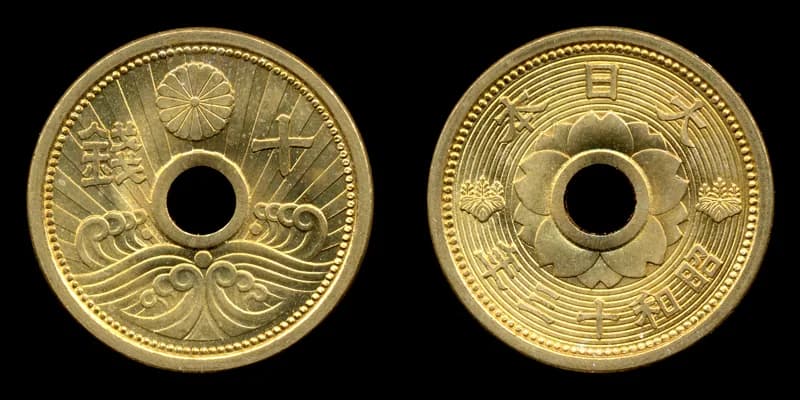
Image: Modern Japanese coinage / As6673 / Wikimedia Commons / CC BY-SA 3.0(source)
Hōei Koban (宝永小判) — The 'Compromise Koban' Born in an Age of Confusion
A coin that slipped through the cracks of history, vanishing in just four years between the Genroku and Shōtoku eras
Subject coin: 宝永小判
Overview
In the mid-Edo period, as the shogunate's finances grew increasingly strained, monetary policy entered a time of upheaval. It was amid this turmoil that the Hōei Koban (宝永小判) left its unmistakable mark on history, despite a remarkably brief lifespan of only four years. Minting of this koban began in Hōei 7 (1710), and its specifications — a gold purity of about 84% (84.29% in the prescribed-standard series) and a weight of about 9.3 g. Compared with its predecessor, the Genroku Koban (元禄小判) — prescribed purity 57.37%, measured weight around 17.80 g — the Hōei Koban restored purity to the Keichō level while nearly halving the weight, revealing the twin motivations at play: supplementing shogunal finances and stemming the outflow of gold and silver overseas. The fate of this koban, however, became intertwined with the downfall of the powerful Commissioner of Finance (Kanjō-bugyō), Ogiwara Shigehide, and the transitional period leading to the monetary reforms of Arai Hakuseki. As early as Shōtoku 2 (1712), the decision was made to switch to the successor Shōtoku Koban (正徳小判), and the Hōei Koban faded into the gaps of history as a 'compromise koban' born between two distinct monetary philosophies — those of the Genroku and Shōtoku eras. The koban issued during this short period is a remarkably fascinating presence, indispensable to any account of Edo-period monetary history.
Specifications
- Denomination
- 1両
- Minting period
- 宝永7年〜正徳4年(1710-1714年)
- Metal composition
- 金約84%(図録。規定品位系では84.29%)
- Weight
- 約9.3g(日本銀行所蔵標本の実測 9.30〜9.35g)
- Dimensions
- 実測 縦60.3〜60.6mm × 横32.0〜32.9mm(同標本)
- Mintage
- 不詳(諸説あり)
- Mint supervisor
- 後藤家(金座)
- Market price
- 照合済みの落札記録が揃うまで提示しません
Chapter 1: Historical Background — Ogiwara Shigehide's Fiscal Reforms and the Storm of Gold Coin Recoinage
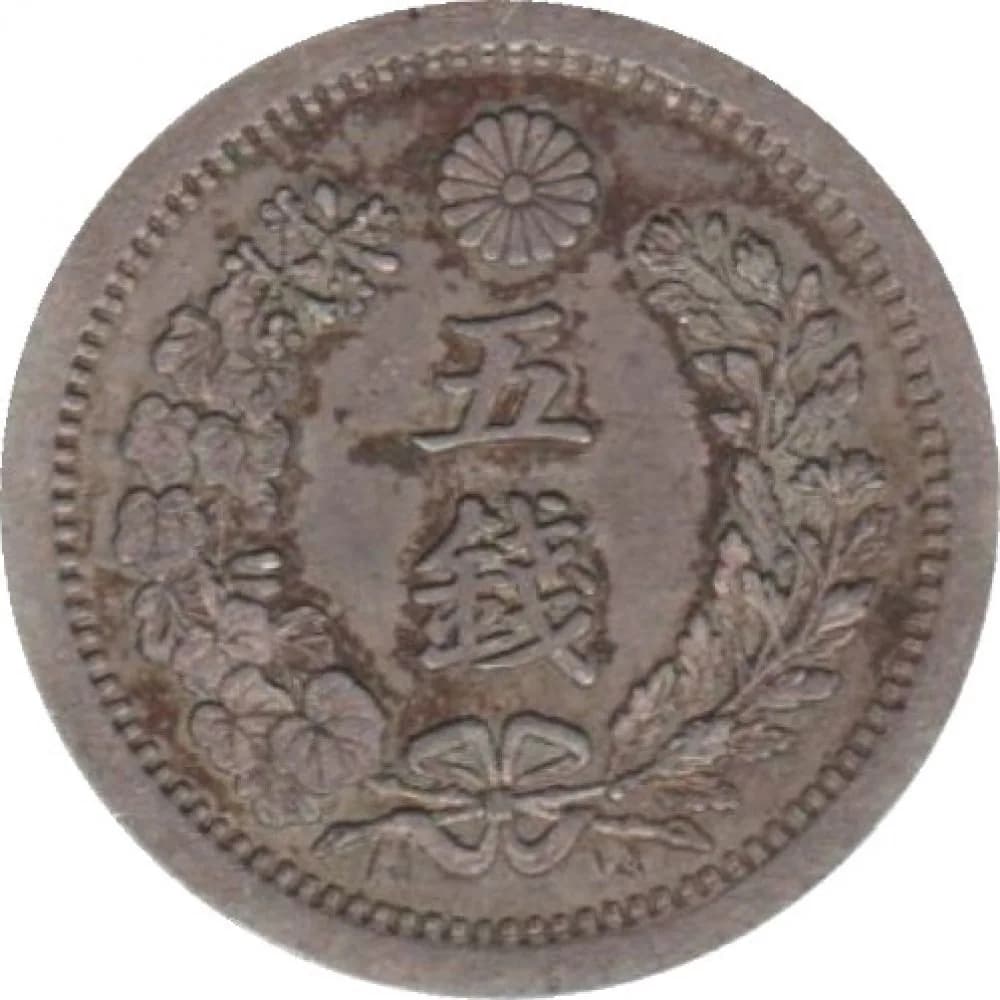
Image: Modern Japanese coinage / Coindesmonnaies / Wikimedia Commons / CC BY-SA 4.0(source)
In the mid-Edo period, as the era of the fifth shogun Tokugawa Tsunayoshi gave way to that of the sixth shogun Ienobu, the shogunate's finances were in serious crisis. Repeated natural disasters, construction projects, and the fiscal exhaustion concealed beneath the brilliance of Genroku culture had reached a level that could no longer be overlooked. It was Kanjō-bugyō Ogiwara Shigehide who wielded his considerable abilities to break through this predicament. At the heart of his policy was fiscal supplementation through currency recoinage — what was known as 'deme (出目).' The recoinage from the Keichō Koban (慶長小判) — with a gold purity of approximately 84% — to the Genroku Koban (元禄小判) at a prescribed purity of 57.37% brought enormous profits to the shogunate, but at the cost of rising prices and economic turmoil. Yet Ogiwara Shigehide did not stop there. As the Hōei era progressed, mounting fiscal pressure combined with growing concern over the outflow of gold and silver abroad. In particular, the awareness intensified that large quantities of gold and silver were flowing out through the Nagasaki trade, reducing the domestic money supply. Under these circumstances, in Hōei 7 (1710), the minting of a new koban began — the Hōei Koban. Ogiwara Shigehide schemed to secure the shogunate's deme by slightly recovering the gold purity from that of the Genroku Koban while substantially reducing the weight. This can be described as a last resort: maintaining monetary credibility to some degree by raising the purity, while enriching the finances by increasing the total volume minted. During this period, criticism of Ogiwara Shigehide's monetary policies was mounting, yet his financial acumen continued to move the highest circles of the shogunate. His dominance, however, would not last. With the later emergence of Arai Hakuseki in shogunal administration, his era came to an end. The Hōei Koban can truly be called a historical witness, born at the height of this turbulent turning point.
Chapter 2: Minting and Specifications — The Intention Behind a Modest Recovery in Purity and a Reduction in Weight
Image: Modern Japanese coinage / Coindesmonnaies / Wikimedia Commons / CC BY-SA 4.0(source)
The actual minting of the Hōei Koban took place at the Kinza (金座), the gold mint, managed from generation to generation by the Gotō family, who held the shogunate's commission for coin production, with skilled craftsmen working under strict supervision. The minting process began by blending gold and silver in a specific ratio and melting them in a smelting furnace. The molten alloy was then spread flat and formed into thin sheets called 'nobegane (延金).' These sheets were stamped into the koban shape, and on the obverse, the characters '壱両' were inscribed within a fan-shaped border along with the kaō (花押) of 'Mitsutsugi (光次),' the head of the Gotō family. On the reverse were struck the 'Sa (佐)' seal indicating the era, along with the verification stamps (kengokuin, 験極印) of the Kinza officials involved in the minting. The 'Sa' seal in particular is known as one of the defining characteristics of the Hōei Koban. The most noteworthy aspect of the Hōei Koban is its specifications. The gold purity returned to about 84% (84.29% in the prescribed series), a major recovery from the Genroku Koban's 57.37%. This is presumed to reflect an intention to restore, even marginally, the credibility of coinage that had declined due to the repeated circulation of low-quality currency. On the other hand, the weight was nearly halved, from around 17.80 g for the Genroku Koban to about 9.3 g. As a result, the actual gold content per ryō fell even further than that of the Genroku Koban. In rough terms, whereas the gold content of the Genroku Koban was approximately 10.2 g (17.8 g × 57.37%), that of the Hōei Koban was approximately 7.8 g (9.3 g × 84.29%) — a reduction of over 20%. This reduction in weight was a measure to maximize the 'deme' the shogunate could obtain through recoinage, and it speaks to the severity of the fiscal crisis. This 'compromise' specification — slightly raising the purity while greatly reducing the weight — can be said to reflect the contradictions Ogiwara Shigehide faced and the limits of his policies. The Hōei Koban, with its complex background, became an important touchstone that would determine the direction of subsequent monetary policy.
Chapter 3: Circulation and Confusion — The Short-Lived End of a 'Compromise' Attempt
Image: Modern Japanese coinage / Coindesmonnaies / Wikimedia Commons / CC BY-SA 4.0(source)
The Hōei Koban entered circulation in Hōei 7 (1710), but its life was extremely brief. The period of just four years — from 1710 to 1714 — places it among the shortest-lived of all Edo-period koban. This very brevity vividly conveys the political and economic turmoil of the time. When the Hōei Koban began circulating, the lives of ordinary people were already worn down by repeated recoinage. The price inflation caused by the debased Genroku Koban had become a serious social problem, and the prices of daily necessities, including rice, remained unstable. Although the Hōei Koban had recovered slightly in purity, its substantially reduced weight meant that its real value was sometimes perceived as having actually fallen, and confusion in the market did not subside. People, faced with a mixture of old and new koban in circulation, did not know which currency to trust, and commercial transactions tended to stagnate. Exchange rates were also unstable, and in some regions independent conversion standards were established, pushing economic activity into complete disarray. Amid these conditions, a major political shift occurred in Shōtoku 2 (1712). Kanjō-bugyō Ogiwara Shigehide, who had long controlled the shogunate's finances, fell from power, and in his place the Confucian scholar Arai Hakuseki was placed at the center of shogunal administration. Arai Hakuseki condemned Ogiwara Shigehide's monetary policies as 'misgovernance' and sought to stabilize monetary value and restore the economy by returning the purity of gold and silver to the level of the Keichō Koban era. Driven by Arai Hakuseki's firm intentions, the recoinage of the Hōei Koban was decided as early as Shōtoku 2 (1712), and the minting of the higher-purity Shōtoku Koban (正徳小判) commenced. The Hōei Koban, the last coinage of Ogiwara Shigehide and the prelude to Arai Hakuseki's reforms, concluded its role as precisely a 'bridge' currency. Its brief period of circulation brought yet further confusion to the people of the time, but for us today it heightens the coin's historical value as a testament to life lived through an age of upheaval.
Chapter 4: Historical Assessment — The Prelude to the Monetary Reform That Arai Hakuseki Sought
Image: Modern Japanese coinage / Coindesmonnaies / Wikimedia Commons / CC BY-SA 4.0(source)
Though the Hōei Koban circulated for only four brief years, it occupies a critically important place in the monetary history of the Edo period. The primary reason is that this koban stood as a 'compromise koban,' positioned at the intersection between the final stage of Ogiwara Shigehide's 'deme-first' monetary policy and the full-scale monetary reform of Arai Hakuseki's 'sound money' approach. Ogiwara Shigehide had drastically reduced the gold purity with the Genroku Koban, then with the Hōei Koban took the seemingly contradictory step of slightly recovering the purity while reducing the weight. This was an attempt to supplement the shogunate's finances while maintaining a degree of monetary credibility, but it ultimately deepened market confusion. Nevertheless, the appearance of the Hōei Koban paved the way for the sweeping monetary reform undertaken by Arai Hakuseki. When Arai Hakuseki took control of shogunal administration in Shōtoku 2 (1712), he argued that in order to halt the outflow of gold and silver overseas and stabilize the domestic economy, it was necessary to restore the purity of coinage to the level of the Keichō Koban. Under his leadership, the Hōei Koban was recoined into the Shōtoku Koban. The Shōtoku Koban returned the weight to approximately 18 g (per catalogue records), restoring it to the level of the Keichō Koban, and greatly increased the actual gold content (with a fineness of approximately 84%). This was the diametrically opposite direction from Ogiwara Shigehide's policies; while the shogunate's finances temporarily deteriorated, in the long run it contributed to the recovery of monetary credibility and the stabilization of prices. Because the Hōei Koban was born immediately before this dramatic policy reversal, its very existence can be said to symbolize the wandering of Edo-period monetary policy and the first signs of an escape from it. For modern monetary researchers and collectors, the Hōei Koban holds significance beyond that of a mere old coin. It is a precious historical document conveying the lives of people who lived through an age of upheaval, the anguish of the shogunate's fiscal management, and the hope for reform.
Value & Rarity
The Hōei Koban falls into the category of particularly rare Edo-period coins. The primary reason is the extremely short minting period — only approximately four years, from Hōei 7 (1710) to Shōtoku 4 (1714). Because the period of circulation was so brief, the number of surviving examples is inherently limited, and the coin consistently commands high demand in the collector market. In particular, after the decision was made in Shōtoku 2 (1712) to recoin into the Shōtoku Koban, active collection and recoinage took place, meaning the number of surviving examples is considered to be even further limited. Market value fluctuates significantly depending on the condition of the koban. For examples in the 'gokubihin (極美品)' — finest quality — class, with little wear and clearly legible stamps, transactions in the range of several million yen are not uncommon. Whether the 'Sa (佐)' seal struck on the reverse and the kaō of Gotō family head 'Mitsutsugi (光次)' are clearly visible are key points of evaluation. Furthermore, trial-strike coins occasionally discovered, or those bearing seals said to indicate a specific period of minting, command even greater rarity and become highly coveted among collectors. However, because these coins trade at high prices, forgeries and altered pieces unfortunately exist. For this reason, it is extremely important when purchasing to use a trusted specialist dealer or authentication body. The Hōei Koban, given its historical background and rarity, may attract attention as an investment asset, but its value is strongly rooted in its character as a historical document, and purchase for short-term speculative purposes is not recommended. It is a piece that demands a long-term perspective and a deep understanding of old coins.
Conclusion
The Hōei Koban was born in an era when the finances of the Edo shogunate were mired in confusion, and it ended as a short-lived 'compromise koban' after only four years. It can truly be described as existing at a historical turning point — the final monetary policy of Ogiwara Shigehide and the prelude to the full-scale monetary reform of Arai Hakuseki. The complex relationship between its gold purity and its weight speaks eloquently of the contradictions and anguish that the shogunate of the time faced, offering many insights to us today. To know how much this single koban influenced the lives of so many people and the fate of the nation is nothing other than the true joy of old coin collecting. ITTENDO will continue to delve deeply into the appeal of old coins as narrators of history such as this, and to share that with all of you.
Related Stories
Two-System of Chōgin and Mameitagin — Tracing the History of Edo Silver Coins
Edo silver coins were always circulated as a set of 'Chōgin (丁銀, Large)' and 'Mameitagin (豆板銀, Small)'. Why was this peculiar two-system created?
Coin StoryThe Window of the Closed Country, Ripples of Silver — How VOC Coins Transformed Japan's Economic Map
A Collision of Foreign Silver and Japanese Wealth on Dejima, Nagasaki
Coin StoryGenroku Chōgin - Tracing the History of Edo Silver Coins
Following the debasement of the Koban, silver was also counterfeited. The shock of the Genroku 8 (1695) Chōgin recoinage on Edo prices
Dealers
Dealers Handling This Category
A reference when considering a sale or appraisal. All are dealers and auction houses with a proven track record.
Ginza Coins
Ginza, Chuo-ku, Tokyo
One of Japan's most established numismatic dealers. The scale and variety of their regular auctions is among the largest in the country. Their catalogs are considered a benchmark for market pricing.
Japan Coin Auction (JCA)
Tokyo
Holds regular auctions with reliable hammer price data, making it a useful resource for tracking market values. Caters to a wide range of collectors from beginners to advanced buyers.
Taisei Coins
Tokyo
A dealer with an international network. Offers advanced services such as consignment to overseas auctions and NGC/PCGS grading submission. Recommended for high-value or internationally recognized coins.