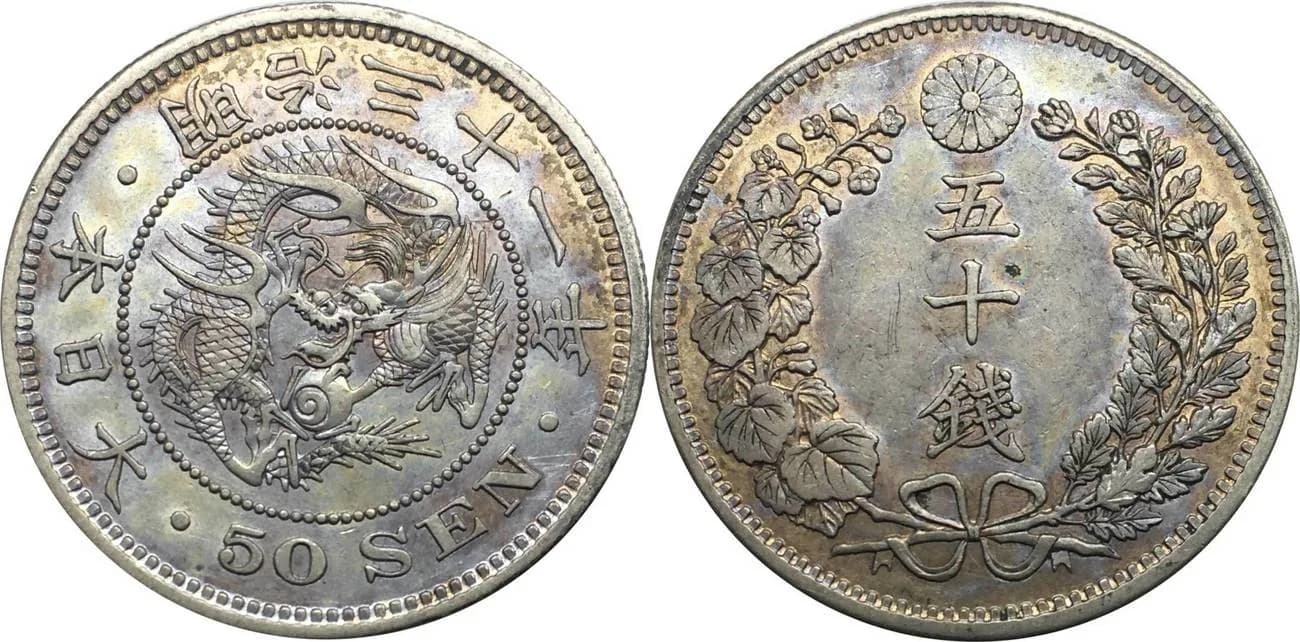
Image: Modern Japanese coinage / The government of the Empire of Japan. / Wikimedia Commons / Public domain(source)
Wadōkaichin — Empress Genmei's Monetary Revolution
In 708, Japan's first national currency transformed the economy from the capital of Nara
Subject coin: 和同開珎
Overview
Wadōkaichin, Japan's first official currency intended for nationwide circulation, began minting in Wadō 1 (708) by order of Empress Genmei. This birth was sparked by the auspicious discovery of copper in Musashi Province (present-day Chichibu area of Saitama Prefecture). The court called this discovery 'Wadō (nigiakagane)' and celebrated it by changing the era name to Wadō. Full-scale minting commenced in May of that year.
Wadōkaichin was designed after Tang dynasty's 'Kaigen Tsuho', issued in 621, as a fanghole round copper coin with the characters '和同開珎' inscribed. In addition to copper coins, there were also silver coins, but these were extremely rare with only a few dozen estimated to survive. Refer also to Overview of Ancient Coins and Detailed Encyclopedia of Wadōkaichin.
To promote circulation, the court enacted the 'Chikusen Joi Order' in Wadō 4 (711), an unprecedented policy that granted official ranks to those who saved more than 100,000 mon, thus nationally supporting currency circulation. By checking in the Market Index, the current values of old coins can be understood. As the first of the Twelve Imperial Coins, Wadōkaichin drove Japan's economy for about 50 years until the debut of Mannentsuho in 758. By learning Standards for Coin Grading, the value of collections can be more accurately assessed.
Specifications
- Denomination
- 1文(文銭)
- Minting period
- 和銅元年〜天平宝字2年(708年〜758年)
- Metal composition
- 銅銭・銀銭の2種
- Weight
- 約3.5g(銅銭)
- Dimensions
- 直径約24mm
- Mintage
- 不詳(諸説あり)
- Mint supervisor
- 不詳
- Market price
- 銅銭:数千円〜十数万円 / 銀銭:数百万円以上(状態・真贋鑑定による)
Episode 1: The Copper Mountain of Musashi and Empress Genmei's Decision — A Vision for a Monetary State
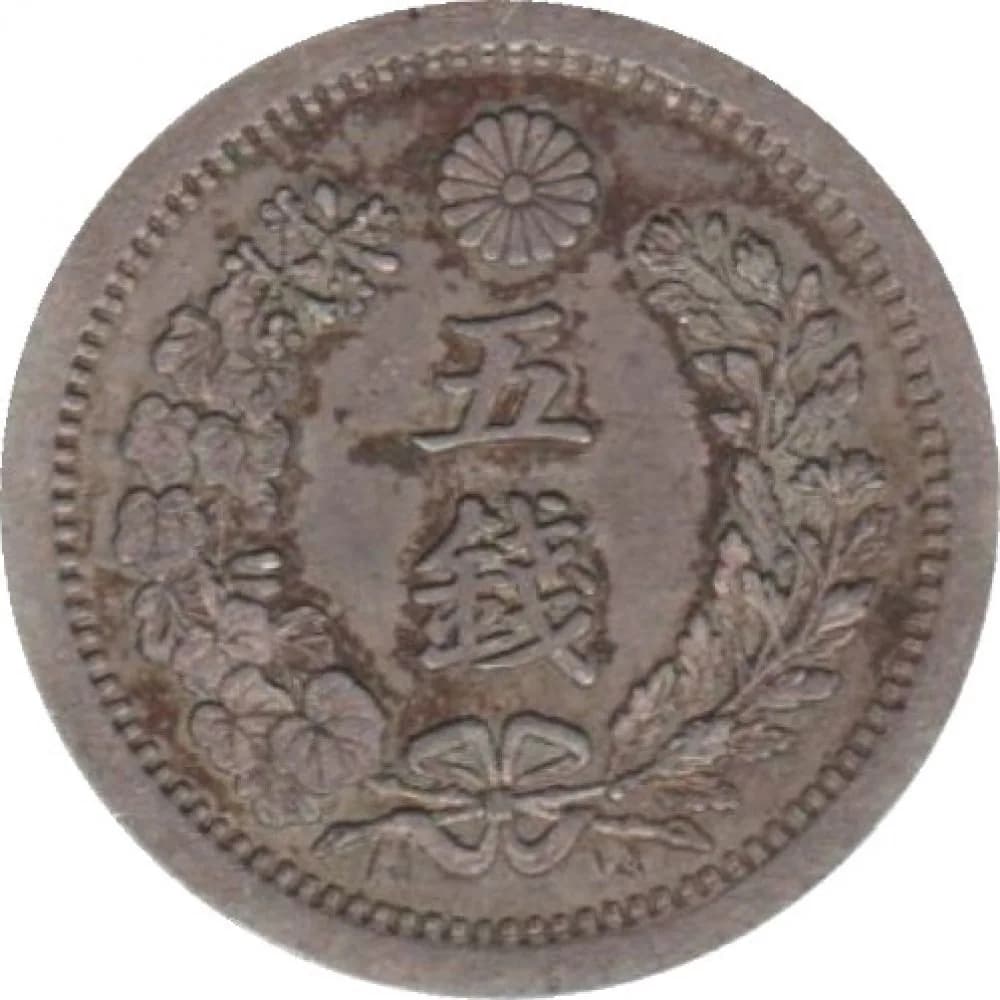
Image: Modern Japanese coinage / Coindesmonnaies / Wikimedia Commons / CC BY-SA 4.0(source)
In Keeun 5 (708), January, a report arrived at the court from the governor of Musashi Province. It was news that 'copper was discovered in Chichibu District.' For the court at that time, copper was an extremely important resource. The casting of Buddha statues, the temple bells, and the construction of the new capital—all required metal, yet domestic production was scarce, necessitating dependence on imports from China.
Empress Genmei responded immediately to the news. She changed the era name to 'Wadō (nigiakagane)' and declared the minting of official currency for national circulation as harnessing this heavenly gift. In Wadō 1 (708), May, the minting office was established, initiating full-scale coin minting.
While there were attempts at coinage in Japan before, such as 'Fuhonsen' (around 683), Wadōkaichin is the first coin issued by the state with the clear intention of nationwide circulation. Empress Genmei's vision was not merely the minting of coins. Alongside the establishment of a Ritsuryo state, it aimed to build a 'monetary economy state', funded by coins for tax collection, salary payments to officials, and city construction.
The capital relocation to Heijō-kyō (Wadō 3, 710) symbolized this. Expenses for moving from Fujiwara-kyō to the new capital, construction of the palace, and rewards for nobles and officials were managed with coins, enabling the court to visualize and manage its finances. Wadōkaichin was a key infrastructure element and was instrumental in supporting Empress Genmei's dream of completing the Ritsuryo state.
Modeled after Tang's 'Kaigen Tsuho' (issued in 621), it was the most trusted currency in the East Asian world at the time. For the Nara court actively incorporating Chinese culture through Tang missions, emulating this design philosophy was a natural choice. The fanghole round shape embodied the Eastern philosophy of 'heaven is round and earth is square', symbolizing national authority. Thus, Japan's first serious official currency stepped onto the historical stage. Refer to Overview of Hole Coins for more information.
Episode 2: Copper Coins and Silver Coins — Two Types of Wadōkaichin Reflecting Social Hierarchy
Image: Modern Japanese coinage / Coindesmonnaies / Wikimedia Commons / CC BY-SA 4.0(source)
Wadōkaichin existed in two forms: copper coins and silver coins, a fact overlooked by many people. Almost all Wadōkaichin seen in antique shops or auctions today are copper coins, with silver coins being extremely rare, with only a few dozen believed to be extant.
The oldest documented mention of silver coins is from an imperial edict in Wadō 1 (708). Silver coins were slightly larger and heavier than copper coins. Their value was several times that of copper coins, though exact conversion rates remain unspecified in historical documents, leading to various theories among researchers today.
Silver coins likely circulated for a very short period. Silver's limited production made it unsuitable for mass minting. Due to its high value, it was assumed silver coins were primarily used in ceremonial payments by the court and high-ranking nobles or in foreign trade, rather than in daily transactions by the populace. Indeed, documents housed in Shosoin contain references to silver coins, but they hardly appear in documents related to rural manorial estates.
Currently, confirmed silver coins are mainly held in museums and art galleries worldwide, rarely appearing in the general market. If a genuine item were auctioned, prices could soar from several million to tens of millions of yen. Understanding Basics of Old Coin Auctions is essential when facing such rare items.
For copper coins, values differ greatly depending on condition, minting location, and era. Initially minted coins have clearer characters, whereas later, mock minting (private imitation) increased, leading to quality variations. During the Nara and early Heian periods, local mints likely operated, using subtly different molds. Differences in character styles and casting quality are crucial appraisal points for numismatic researchers. Standards for Coin Grading will aid in understanding the foundations of such assessments.
The coexistence of silver and copper coins mirrored the hierarchical society of the time. Nobles and officials traded with silver, while commoners dealt with copper in daily transactions—this dual structure aligned with the rank order envisioned by the Ritsuryo system. Wadōkaichin was not just an economic tool but a historical artifact reflecting the social structure of the Nara period.
Episode 3: The Impact of the Chikusen Joi Order — An Era Where Saving Money Led to Career Advancement
Image: Modern Japanese coinage / Coindesmonnaies / Wikimedia Commons / CC BY-SA 4.0(source)
In Wadō 4 (711), the court issued an unprecedented law, the 'Chikusen Joi Order'. Its content was astonishing, granting official ranks to those who accumulated a certain amount of money, with specific figures like granting a junior eighth rank lower to those who saved over 100,000 mon.
From a modern perspective, this policy was an extremely clever 'quantitative easing strategy'. To promote circulation, the government offered direct incentives to citizens. However, records indicate that the response to the Chikusen Joi Order was not as high as might be expected. While there were those who desired ranks, obtaining Wadōkaichin itself was difficult for those in rural areas, making it a distant matter for the common people.
In the organized central region or around Kinai, certain circulation was observed, yet coin economies fell short of permeating to the far ends of the eastern and western provinces. Nevertheless, the historical significance of this policy was significant. By the state clearly indicating that 'one's social status could be raised by using money', perceptions of commercial activity began to change.
In the capital of the Nara period, Heijō-kyō, East and West markets (East Market and West Market) were established, where transactions using coins took place. Records in Shōsōin documents show cloth was valued at certain mon, oil at certain mon, confirming that price displays with coins were indeed functional. Agricultural products, silk fabrics, pottery, and ironware were traded with coins, marking an embryonic market economy qualitatively different from barter.
Yet, outside the market, 'yō and chō' (a taxation system paid in cloth or rice) remained the norm, making coin economy mainly a city-centered phenomenon. Wadōkaichin stood at the forefront of Japan's economy for about 50 years until Mannentsuho emerged in Tenpyō-hōji 2 (758). As the initiator of the Twelve Imperial Coins, the legacy of Wadōkaichin continues to influence monetary policies profoundly. By observing the Market Index, the current position of the old coin market can also be confirmed.
Episode 4: The Inception of the Twelve Imperial Coins and the Legacy of Wadōkaichin
Image: Modern Japanese coinage / Coindesmonnaies / Wikimedia Commons / CC BY-SA 4.0(source)
In Tenpyō-hōji 2 (758), with the issuance of the successor Mannentsuho, Wadōkaichin faced a formal retirement. However, the reality was different. Mannentsuho did not immediately become widespread, and in practice, the older Wadōkaichin continued to be used for a long time in private sectors. Even following Shinkōkaihō (765) and Ryūheieihō (796), none of the subsequent Twelve Imperial Coins carried the same social impact as Wadōkaichin did.
The Twelve Imperial Coins concluded with Kangen Daibō, issued in Tengyō 6 (943). After that, Japan's independent minting of official coins ceased. A 'coin gap period' lasting about 600 years from the late 10th century to the late 16th century ensued. This gap was filled by imported coins such as Song coins, Ming coins from China, and Korean mun from Korea. For a deeper understanding of this gap period, see Details of Imported Coins and Hole Coins.
With the advent of the Edo period, it wasn't until Kan’ei 13 (1636) that Kan'ei Tsūhō was formally issued, marking effectively no existence of Japan's own official currency. Thus, the concept of 'nation-sponsored circulating currency', pioneered by Wadōkaichin, took over 900 years to be revived.
In modern Japan, Wadōkaichin holds a strong appeal among coin collectors. Especially well-preserved copper coins may be traded for thousands to tens of thousands of yen. Silver coins, being close to nonexistent at auctions, are a 'phantom presence', seen only in museums. Authentication depends on factors such as the shape of characters, casting surface texture, weight, and diameter. Due to the presence of numerous mock mintings (privately coined imitations from later), it is vital to have evaluations conducted by trustworthy specialists well-versed in Standards for Coin Grading.
Counting from Wadō 1 (708), 2026 marks the 1318th year since Wadōkaichin was born. The small copper disc minted in the capital of Nara still passes through the hands of collectors, transmitting historical warmth. In discussions of Japan's economic history, the meaning of this 'first piece' never fades. As a time capsule connecting the past and present, that small copper disc with a hole continues to shine even today.
Value & Rarity
The market value of Wadōkaichin varies greatly depending on type, condition, and authenticity. Even for the most commonly circulated copper coins, those in excellent condition with clear characters are valued from several thousand to tens of thousands of yen. Especially those determined to be from the early Nara period or with standout character beauty, corrosion in good condition, and remaining metal texture are highly valued. Learning Standards for Coin Grading is the first step towards accurate evaluation.
Silver coins hold a different level of rarity. Surviving globally only in tens, they are mostly museum holdings. If a genuine piece appears on the market, prices may reach from millions to tens of millions of yen. However, this rarity leads to the existence of sophisticated counterfeits, and purchasing without professional authentication is extremely risky.
For copper coins, many mock mintings (privately coined imitations) circulate, and distinguishing requires experience. Understanding Basics of Old Coin Auctions and trading through trusted auction houses is recommended. As Japan's oldest national currency, Wadōkaichin holds high historical and cultural value, with increasing attention from museums and research institutions domestically and internationally.
Conclusion
From its inception in Wadō 1 (708) to retirement in Tenpyō-hōji 2 (758), Wadōkaichin supported Japan's first 'monetary state' for about 50 years. Its legacy goes beyond a mere copper disc. The concepts of 'state-guaranteed currency value', ' economic incentives where money could buy rank', and adopting the fanghole round shape shared across East Asia—all laid the foundations for Japan’s later economic system. When modern collectors hold Wadōkaichin, over 1300 years of history are condensed within. Empress Genmei's decision, the hustle and bustle of Heijō-kyō’s market—the small perforated copper disc continues to shine as a time capsule linking the past and present.
Related Stories
Chōsen Tsūhō — The Mission of the Imported Coin that Filled 600 Years of Coin Blank in Japan
From the Muromachi to Sengoku Period, the Foreign Copper Coin that Crossed the Sea and Moved the Japanese Market
Coin StoryKan'ei Tsūhō — "Japan's Longest-Lived Coin" in Circulation for 230 Years
The history of the hole coin that continued to be used from the unification of Edo coinage in Kan'ei 13 (1636) to Meiji
Coin StoryThe Age of Silk — The Story of the 'Currency' Trusted by Heian Aristocrats
The Monetary Affairs of the Heian Period, When Silk Was Valued More Than Coins
Series
Ancient Japanese Coins Tour
Part 2 of 5 in this series
- 1CoinpediaIntroduction to Ancient Coinage
- 2Coin StoryWadōkaichin — Empress Genmei's Monetary Revolution
- 3CoinpediaWado Kaichin
- 4Coin StoryKōchō Jūnisen — The Dream and Reality of the Ritsuryō State
- 5CoinpediaImperial Court Twelve Coins
Dealers
Dealers Handling This Category
A reference when considering a sale or appraisal. All are dealers and auction houses with a proven track record.
Japan Coin Auction (JCA)
Tokyo
Holds regular auctions with reliable hammer price data, making it a useful resource for tracking market values. Caters to a wide range of collectors from beginners to advanced buyers.
Ginza Coins
Ginza, Chuo-ku, Tokyo
One of Japan's most established numismatic dealers. The scale and variety of their regular auctions is among the largest in the country. Their catalogs are considered a benchmark for market pricing.