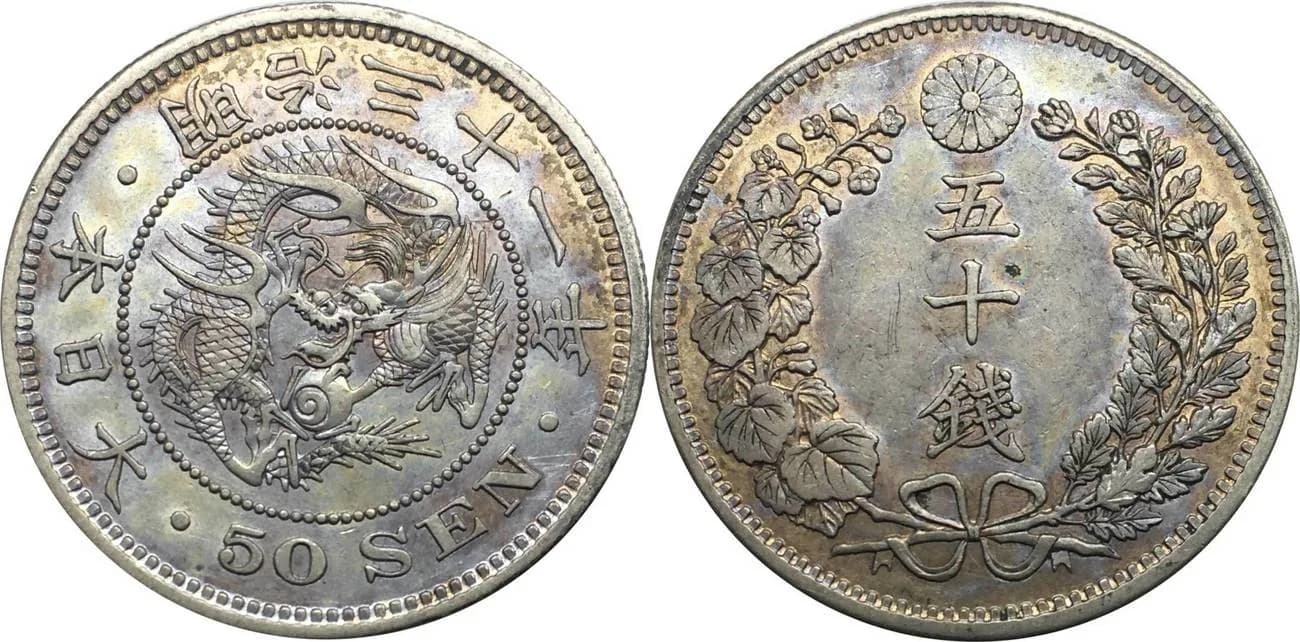
Image: Modern Japanese coinage / The government of the Empire of Japan. / Wikimedia Commons / Public domain(source)
Chōsen Tsūhō — The Mission of the Imported Coin that Filled 600 Years of Coin Blank in Japan
From the Muromachi to Sengoku Period, the Foreign Copper Coin that Crossed the Sea and Moved the Japanese Market
Subject coin: 朝鮮通宝
Overview
Chōsen Tsūhō is a copper coin whose minting started in the 5th year of King Sejong of Joseon (1423). With the four characters '朝鮮通宝' inscribed in its square-holed round shape, this coin flowed from the Korean Peninsula into the Japanese market during the Muromachi period. In Japan, after the last of the Imperial Coins, the Ken'en Taibō (乾元大宝) in 958, there were no domestically produced official coins issued for about 600 years. The imported coins like the Yongle Tongbao (minted in 1408) from Ming China and the Chōsen Tsūhō filled this 'coin blank period'. You can grasp the overall picture of Imperial Coins in Overview of Ancient Coins.
The Muromachi Shogunate issued the 'Senzenrei' in the 1500s to eliminate low-quality and damaged coins, but this also evidenced the overflow of imported coins in the market. Refer to Details of Anazen and Imported Coins and Details of Kan'ei Tsūhō as well. Until the Kan'ei Tsūhō was officially minted in Kan'ei 13 (1636), the Chōsen Tsūhō served as an important infrastructure of the Japanese economy. The current market value can be checked in Basic Knowledge of Old Coin Auctions.
Specifications
- Denomination
- 1文(推定)
- Minting period
- 李朝・世宗5年(1423年)以降
- Metal composition
- 銅
- Weight
- 約3.5g(推定)
- Dimensions
- 直径約24mm(推定)
- Mintage
- 不詳(諸説あり)
- Mint supervisor
- 李氏朝鮮政府
- Market price
- 数千円〜数万円(状態・種類による)
Chapter 1: From Ken'en Taibō to Chōsen Tsūhō — The 600-Year Coin Blank Period
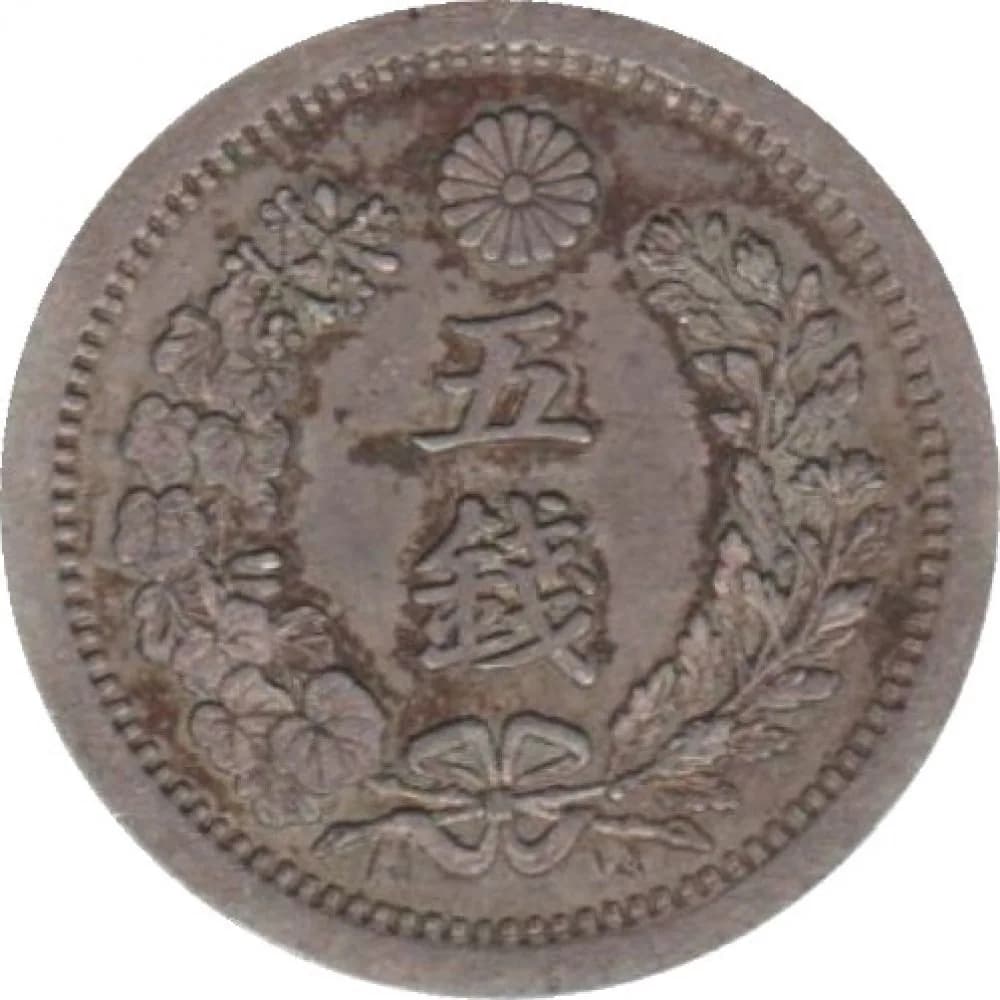
Image: Modern Japanese coinage / Coindesmonnaies / Wikimedia Commons / CC BY-SA 4.0(source)
In the 6th year of Tengyō (943), the last of the Imperial Coins, the Ken'en Taibō, was issued in Japan. For about 600 years since then, Japan lacked its own official currency, a 'coin blank period'. This does not mean economic activities halted. Trade from the late Heian to Kamakura and Muromachi periods expanded, relying entirely on coins imported from China and Korea.
From the late Heian to Kamakura period, trade with Song China was thriving, resulting in massive inflows of Song coins (the main subject of imported coins). Song coins settled in the Japanese market as 'one-mon coins' and were used for rice price conversions. However, after Song was defeated by Yuan (1271-), the import routes changed. From the 14th to 15th centuries, Yongle Tongbao (minted in 1408), issued by Ming (1368-1644), became the main imported coin, with massive imports through Japan-Ming trade (Tributary Trade, from 1401).
Amid this backdrop, the Chōsen Tsūhō was coined in the 5th year of King Sejong of Joseon (1423). The Joseon dynasty, founded by overthrowing Goryeo in 1392, began this under its fourth king. Sejong's reign (1418-1450) is known for the 'creation of Hangul' (1443) and was a cultural golden age, with currency system establishment being part of it.
Initially coined for distribution within Korea, Chōsen Tsūhō entered the Japanese market through active trade (primarily via Hakata and Tsushima) between Korea and Japan. Alongside Yongle Tongbao as a 'reliable foreign coin', Chōsen Tsūhō played an essential role in the commercial activities during the Muromachi period in Japan. Confirm the flow from Imperial Coins to imported coin eras in Overall Picture of Ancient Coins.
During the Muromachi period, local daimyo also issued 'Senzenrei', trying to eliminate excessively worn or clearly inferior coins, which indicates the wide variety of imported coins circulating at the time.
Chapter 2: Muromachi Markets and Imported Coins — Chōsen Tsūhō Driving the Commercial Economy
Image: Modern Japanese coinage / Coindesmonnaies / Wikimedia Commons / CC BY-SA 4.0(source)
During the Muromachi period (1336-1573), Japanese commerce significantly advanced. Amid political instability from conflicts like the Ōnin War (1467-1477), regional autonomy progressed, leading to the establishment of markets nationwide—regular markets, free markets, temple-front markets—spurring product distribution. The indispensable medium for these commercial activities was imported coins, of which Chōsen Tsūhō was a part.
Hakata was a critical point for Korea-Japan trade. The Sō clan of Tsushima mediated diplomacy and trade with Korea, bringing Korean coins, silk, and ceramics to Japan. Hakata merchants made huge profits reselling these inland. Chōsen Tsūhō circulated in big cities like Kyoto, Sakai, Nara, gaining acceptance as a 'reliable foreign coin.'
Documentary evidence on the usage differences between Yongle Tongbao and Chōsen Tsūhō is limited, but differences are presumed based on region and transaction type. Yongle Tongbao was mainly used for China trade settlements or large-scale business, whereas Chōsen Tsūhō was broadly used in Korea trade and local daily transactions.
Entering the Sengoku period (around 1467-1590), warlords intervened directly in currency policies. For instance, Takeda Shingen of Kai prohibited what he deemed 'bad coins' from circulation, whereas certain foreign coins were endorsed as 'good coins'. Within such policies, both Yongle Tongbao and Chōsen Tsūhō were often treated as good coins, continuing as reliable distribution means.
Yet, bartering (rice, cloth, soybeans, etc.) remained mainstream in rural areas where coin economies were not fully ingrained. The circulation of imported coins was concentrated around urban and main trade routes. Nevertheless, with commercial growth, their range gradually expanded, becoming common in large rural markets by the late Sengoku period, as confirmed in Explanations of Anazen and Imported Coins.
Chapter 3: The End of Sengoku and the Rise of Kan'ei Tsūhō — The Terminal of Imported Coins
Image: Modern Japanese coinage / Coindesmonnaies / Wikimedia Commons / CC BY-SA 4.0(source)
In the 18th year of Tenshō (1590), with his unification of Japan, Toyotomi Hideyoshi entered a new stage in currency policy. Hideyoshi aimed to organize a gold and silver currency system through issuing gold coins (Tenshō Ōban, Tenshō Tsūhō). However, imported coins continued to dominate the market in terms of copper coins.
After Tokugawa Ieyasu established the Edo Shogunate in Keichō 8 (1603), the shogunate sought national currency system unification. Gold coins such as Keichō Koban and Keichō Ichibugin, and silver coins like Keichō Chōgin were organized from Keichō 6 (1601). For copper coins, it took time until the full-scale nationwide minting of Kan'ei Tsūhō.
The history of Kan'ei Tsūhō is complex. The name 'Kan'ei Tsūhō' saw its first minting as unauthorized (privately minted) coins in Mito in Kan'ei 3 (1626). Later, full-blown official minting began with bakufu approval in Kan'ei 13 (1636), manufactured at minting sites nationwide. From this point, imported coins rapidly withdrew from the market.
The Edo Shogunate gradually strengthened the policy of 'using Japanese domestic coins.' Laws restricting imported coin circulation were issued, and Kan'ei Tsūhō became the main character of coins in the market. Legal provisions allowed continued use for some time, but the overwhelming supply of new Kan'ei Tsūhō quickly overshadowed the presence of coins like Chōsen Tsūhō or Yongle Tongbao, as observed in Details of Kan'ei Tsūhō.
In about half a century from Kan'ei 13 (1636), Chōsen Tsūhō disappeared from the Japanese market's main stage. The era of imported coins that supported Japanese commerce for over 200 years thus came to an end. Nonetheless, their legacy quietly carried forward into the Edo period's monetary economy as the foundation of Japan's coin culture.
Chapter 4: The Position of Chōsen Tsūhō in the Modern Collection Market
Image: Modern Japanese coinage / Coindesmonnaies / Wikimedia Commons / CC BY-SA 4.0(source)
What is the evaluation of Chōsen Tsūhō in today's ancient coin market? Pricewise, the typical range is from a few thousand to tens of thousands of yen, depending on condition, minting time, and acquisition route. Well-preserved and fine coins (those with clear characters and little wear) can fetch over tens of thousands of yen. Among imported coins, alongside Song coins (Chinese Song coins) and Yongle Tongbao, it is well-known and collected by a wide range of enthusiasts from novice to advanced collectors.
From an authenticity assessment standpoint, Chōsen Tsūhō is relatively straightforward but there are later replicas. The consistency of characters, quality of copper, shape of the square hole, and weight are key points for authenticity. Differences in wear and copper alloy composition exist between Chōsen Tsūhō circulated in Japan and those used in Korea (an area of ongoing research). Having Basic Knowledge of Coin Auctions and Guidelines of Coin Grading is the premise for safe trading.
Historically, collecting Chōsen Tsūhō means feeling the historical Japan-Korea economic exchange in one's hand. Held by Muromachi Hakata merchants, used in Sengoku markets, replaced by Kan'ei Tsūhō in early Edo—its historical weight is condensed in a single coin.
Moreover, for those collectors systematically collecting imported coins, Chōsen Tsūhō serves as a 'complementary entity for Japan's coin blank period', essential for the collection. For tracing coinage history through Imperial Coins, Imported Coins, Kan'ei Tsūhō, it represents the middle period. Check present value at Market Index for purchase reference.
The period when Chōsen Tsūhō circulated in Japan, from the Muromachi to early Edo, corresponds to around 200 years, roughly from King Sejong’s 5th year in Joseon (1423) to around Kan'ei 13 (1636). During these 200 years, Japan's coin economy couldn't exist without imported coins. Chōsen Tsūhō, telling this story, quietly yet eloquently continues to narrate the history of Japan-Korea economic exchange today.
Value & Rarity
The market value of Chōsen Tsūhō significantly varies based on condition, age, and mint location. The general circulation item market ranges from a few thousand to tens of thousands of yen, but fine items with clear character impressions and minimal wear can receive valuations exceeding tens of thousands of yen. Though relatively easier to acquire among imported coins, superior-quality items are limited, presenting a challenge for securing quality items for systematic collection.
Given the existence of later replicas, consultation with experts before purchase is advisable. Consistency of characters, shape of the square hole, the color and texture of copper, and weight (around 3.5g) are main authenticity criteria. Utilize Basic Knowledge of Coin Auctions and opt for acquisition through reliable auctions or coin dealers for safety.
Historically significant, Chōsen Tsūhō holds unique value as an 'imported coin supporting Japan's coin blank period'. In the historical context of roughly 700 years between the end of the Imperial Coins (958) and the widespread adoption of Kan'ei Tsūhō (post-1636), the role this coin played is significant. View as part of Japan's economic history rather than just a 'foreign coin'.Refer to Explanations of Anazen and Imported Coins for more insights.
Conclusion
Chōsen Tsūhō, born in the 5th year of King Sejong of Joseon (1423), served as a representative imported coin filling Japan's coin blank period during approximately 200 years from the Muromachi, through Sengoku, to early Edo periods. This foreign coin, serving as infrastructure in the Japanese market during the long blank period from Ken'en Taibō, the last of the Imperial Coins (958), to the spread of Kan'ei Tsūhō (post-1636), narrates the depth of Japan-Korea economic exchange. Compared to Details of Kan'ei Tsūhō, this historical continuity becomes clearer. On a single coin, 600 years of history are inscribed.
Related Stories
Wadōkaichin — Empress Genmei's Monetary Revolution
In 708, Japan's first national currency transformed the economy from the capital of Nara
Coin StoryKan'ei Tsūhō — "Japan's Longest-Lived Coin" in Circulation for 230 Years
The history of the hole coin that continued to be used from the unification of Edo coinage in Kan'ei 13 (1636) to Meiji
Coin StoryThe Age of Silk — The Story of the 'Currency' Trusted by Heian Aristocrats
The Monetary Affairs of the Heian Period, When Silk Was Valued More Than Coins
Related Encyclopedia Entries
Introduction to Ancient Coinage
Conclusion: Ancient Japanese coinage holds high historical and academic value, but its extreme rarity and high forgery risk make it a target primarily for advanced collectors and investors.
EncyclopediaIntroduction to Holed Coins
Conclusion: Holed coins offer an accessible entry point to numismatics, providing intellectual investment opportunities where knowledge and experience uncover rarity and value.
EncyclopediaThe World of Kanei Tsuho
Conclusion: Kanei Tsuho, the cornerstone currency of the Edo economy, offers profound value for both collection and investment by discerning its mother coins and rare variant calligraphies.
Dealers
Dealers Handling This Category
A reference when considering a sale or appraisal. All are dealers and auction houses with a proven track record.
Japan Coin Auction (JCA)
Tokyo
Holds regular auctions with reliable hammer price data, making it a useful resource for tracking market values. Caters to a wide range of collectors from beginners to advanced buyers.
Ginza Coins
Ginza, Chuo-ku, Tokyo
One of Japan's most established numismatic dealers. The scale and variety of their regular auctions is among the largest in the country. Their catalogs are considered a benchmark for market pricing.