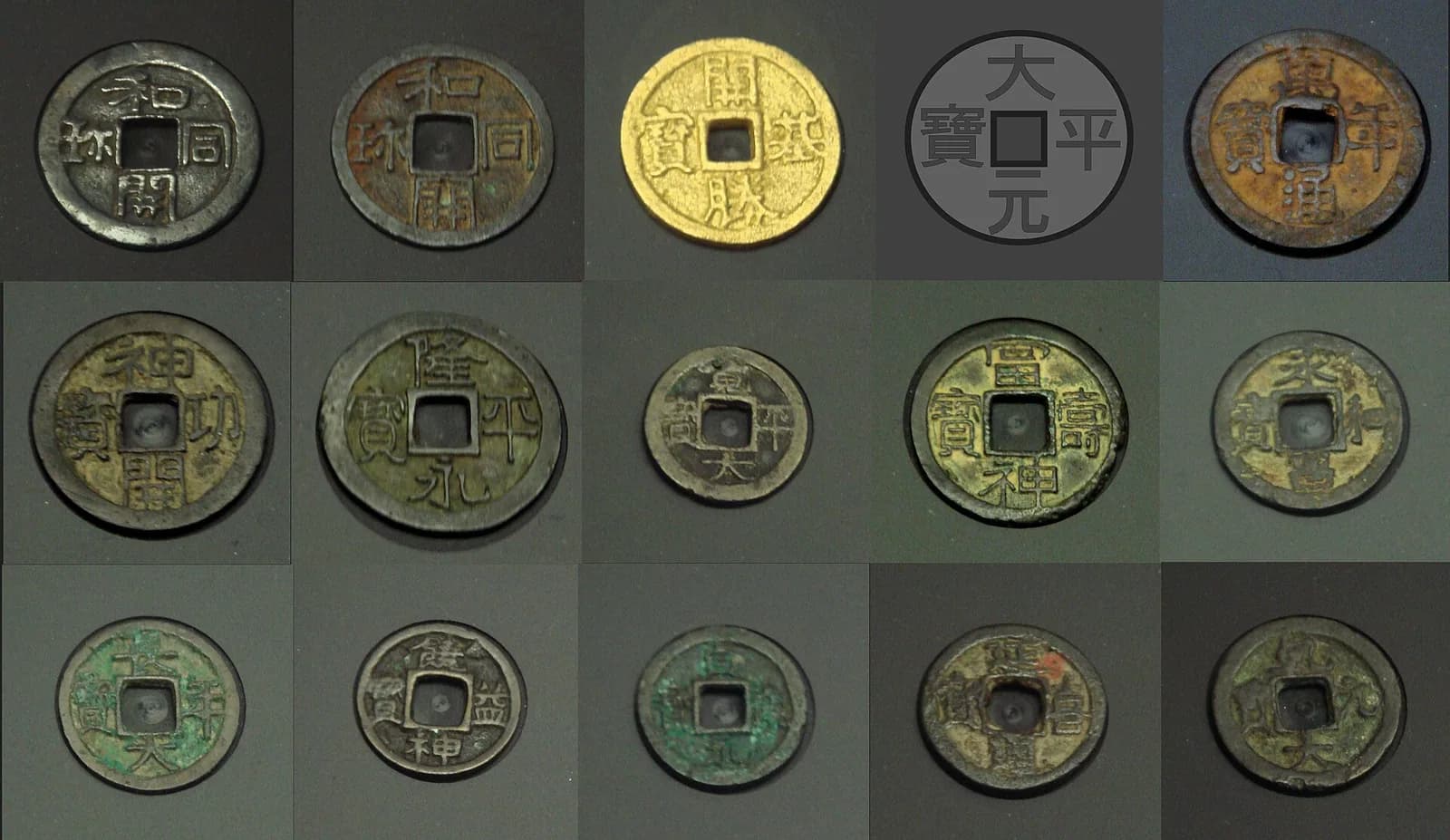
Historical Background: Approximately 250 Years of Coin Issuance History
Kōchō Jūnisen refers to the collective name for 12 types of copper coins issued by the Ritsuryō government over approximately 250 years, beginning with Wadōkaichin (和同開珎) in 708 and ending with Kengen Taihō (乾元大宝) in 958. These coins represent the first attempts by Japan's ancient state to establish its own monetary economy. In order of issuance, they are Wadōkaichin (708), Mannentsūhō (万年通宝) (760), Jingū Kaigen (神功開宝) (765), Ryūhō Eihō (隆平永宝) (796), Fukujusumpō (冨壽神宝) (818), Jōwa Shōhō (承和昌宝) (835), Chōnen Taihō (長年大宝) (848), Nōekishinpō (饒益神宝) (859), Jōgan Eihō (貞観永宝) (870), Kanpyō Taihō (寛平大宝) (890), Engi Tsūhō (延喜通宝) (907), and Kengen Taihō (958). With each new coin issued, an exchange rate with the previous coin was established. These coins tell the story of the establishment, maintenance, and eventual decline of the Ritsuryō system, a period marked by significant upheaval in ancient Japan. Particularly, the early Wadōkaichin is marked as the first full-fledged circulating currency in Japan. For further understanding of ancient currency, see Introduction to Ancient Coins (Wadōkaichin, etc.). The Ritsuryō government sought financial stabilization through the issuance of new coins but faced numerous challenges. The dual goals of promoting currency circulation and ensuring sound national finances often conflicted, leaving a significant mark on history.
Rarity and Price Guide of Each Coin: The Path to Completion
The prices of each coin in the Kōchō Jūnisen vary significantly based on their rarity and condition. Earlier coins are less prevalent, and well-preserved ones tend to fetch high prices. These prices are shaped by a complex interaction of mintage numbers, existing quantities, and their historical backgrounds. Understanding Factors Determining the Value of Old Coins will enable more thoughtful collecting. For any coin type, price deviations based on condition can range from 2 to 5 times, making detailed condition checks essential when purchasing. Especially important are the clarity and wear of inscriptions, which are key factors influencing value. Individual prices and auction results are listed only once verifiably matched records — with sale, lot, source URL and review date — exist.
Evolution of Form and Quality: A Mirror Reflecting the Nation's Decline
All Kōchō Jūnisen were in the form of round coins with square holes, but a significant feature is the noticeable decline in quality over their issuance period, reflecting the financial deterioration of the Ritsuryō state and a decline in minting technology. Early coins like Wadōkaichin and Mannentsūhō used relatively sophisticated minting techniques, with clear inscriptions and balanced forms. They also contained a relatively high amount of copper, contributing to a sense of weight when held. However, from the middle period onwards, the copper content gradually decreased while impurities like lead and tin increased. As a result, the quality of the coins declined, and the minting became rougher. Particularly in the latest coins like Engi Tsūhō and Kengen Taihō, many are extremely poor in quality, with some coins so poorly made that the inscriptions are barely readable. The thickness of the coins is also uneven, with distorted rims. This decline in quality vividly illustrates the financial struggles of the declining ancient state and the loss of supporting technical skills. For collectors, these differences in quality are important indicators for assessment and grading. Refer to Standards for Grading Old Coins to develop the ability to assess their condition.
Inflation Policy and the Demise of Monetary Economy: A Peculiarity in Japanese History
The issuance of Kōchō Jūnisen was closely linked to repeated inflation policies. With each new coin, the government set its value higher compared to previous coins, for instance, setting Mannentsūhō to be exchanged for ten Wadōkaichin. This was equivalent to a currency devaluation in modern terms, where the government effectively attempted to cover fiscal deficits with increased coinage. However, this policy led to rapid price increases, putting pressure on people's lives. In the market, coins lost credibility, and movements rejecting coins became widespread. Especially in rural areas, bartering and rice-based economies persisted, making it difficult for currency to penetrate. This turmoil in the monetary economy, coupled with a decline in the Ritsuryō government's ruling ability, solidified public distrust in coins. As a result, after the issuance of Kengen Taihō in 958, the Ritsuryō government abandoned issuing copper coins. For about 600 years thereafter, coins imported from China, known as toraisen, became the main circulating currency—a unique situation in global history. The final piece of evidence indicating this historical turning point of "abandoning coin issuance" is the Kengen Taihō, symbolizing a significant milestone in Japan's monetary history. By understanding How to Read Coin Market Cycles, one can consider the impact of ancient economic policies on modern markets.
Points for Authenticity Examination: Specialist Knowledge for Discrimination
Authentication of Kōchō Jūnisen is one of the most important skills in collecting old coins. Particularly for rare mid-period coins such as Jingū Kaigen, Fukujusumpō, and Chōnen Taihō, many sophisticated counterfeits exist, demanding vigilant attention. The basics of authentication start with examining the "calligraphy." Each coin type has unique character shapes, thickness, and balance. Becoming familiar with these and thoroughly observing for unnatural points is crucial. Next, cross-reference the "weight and diameter" with standard values for each coin type. Due to differences in materials and minting methods, counterfeits often have deviating figures. The "nature of rust" is also a crucial judgment factor. Naturally occurring rust possesses a unique texture and color change from long-term aging. In contrast, artificially created rust shows characteristics like unnatural color variations and adherence. Additionally, check the "cross-sectional shape of the rims." Authentic coins often reflect distinct cross-sections corresponding to the minting techniques of each era. For late coins like Engi Tsūhō and Kengen Taihō, the fact that authentic coins themselves were poorly minted makes distinguishing from counterfeits paradoxically more challenging. These coins require expert knowledge to carefully assess the blurring of inscriptions and copper characteristics. Essential literature includes "Nihon Kahei Zukan" (published by Japan Numismatic Dealers Association). Also, refer to Complete Guide to Identifying Fakes and Altered Items to hone authentication skills.
Completion Strategy: A Gradual Collection Plan
Completing all 12 of Kōchō Jūnisen is one of the ultimate goals for ancient coin collectors. Achieving this requires a planned and gradual approach. It is wise to start with later coins that are relatively inexpensive and easier to obtain. Specifically, begin with purchasing Engi Tsūhō, Kengen Taihō, Kanpyō Taihō, and use them to develop an eye for the basic features and authentication of Kōchō Jūnisen. Next, move on to mid-priced coins like Ryūhō Eihō, Jōwa Shōhō, Nōekishinpō, Jōgan Eihō, broadening your collection. It is important to choose well-preserved examples and patiently wait for their appearance on the market. Then, for the highly priced early to mid-period rare coins like Mannentsūhō, Jingū Kaigen, Fukujusumpō, Chōnen Taihō, take your time in searching without rushing. Particularly for Wadōkaichin, as it will be the highlight of the collection, it is wise to choose a specimen in the best possible condition last. This step-by-step approach is effective not only for budget management but also for accumulating knowledge and experience. Alongside the joy of collecting, it provides a deeper understanding of history. Understand The Difference Between Investment and Collection Thoughts to establish your own collection style. Individual prices and auction results are listed only once verifiably matched records — with sale, lot, source URL and review date — exist.
Market Trends and Price Range: Current Trading Situation
The market price for Kōchō Jūnisen varies greatly based on the historical value and rarity of each coin. Early coins like Wadōkaichin are often traded at high prices even individually, with amounts reaching from several hundred thousand yen to potentially millions depending on condition. This is because of their esteemed position in Japanese monetary history. On the other hand, later coins like Engi Tsūhō and Kengen Taihō are relatively easier to acquire, with purchases possible starting from tens of thousands of yen. Mid-period coins are typically priced from tens of thousands to several hundred thousand yen, with condition significantly impacting their price. Trades are conducted through specialized coin dealers, major auction houses, or online coin trading sites. Especially well-preserved specimens or coins with high rarity tend to achieve high prices at auctions. A complete set of all 12 coins is extremely rare and seldom available on the market. Should such a set be listed, the total amount is estimated to range from hundreds of thousands to over a million yen. Collectors constantly need to monitor past auction records and market trends to determine appropriate pricing. By Searching Past Auction Sale Records, one can grasp more specific price trends.
Kōchō Jūnisen's Reflection on Japan's Economic History: The Rise and Fall of Ancient States
The issuance and cessation of Kōchō Jūnisen over approximately 250 years can be termed Japan's "first experiment" in monetary economy. The Ritsuryō government repeatedly attempted inflation policies through new coin issuance, but ultimately lost credibility in currency, failing to establish a full-fledged monetary economy. This failure was largely due to Japan's social structure at the time, particularly the persistent barter and rice economy in rural areas, which hindered the penetration of currency. The underdevelopment of monetary economy highlighted the fragility of the Ritsuryō state's governance and fiscal foundation. With the cessation of copper coin issuance after Kengen Taihō in 958, Japan entered a unique historical situation where for about 600 years, coins imported from China (toraisen) became the main circulating currency. The choice of "abandoning coin issuance" was a direct consequence of the failure to successfully issue Kōchō Jūnisen, which significantly influenced Japan's subsequent economic development. Therefore, these 12 coins are not just objects of coin collections; they serve as a grand "record of failure" in Japanese economic history, offering numerous lessons to future generations. Holding a Kōchō Jūnisen provides a valuable historical experience, connecting with the rise and fall of ancient states and how people engaged with currency during that time.