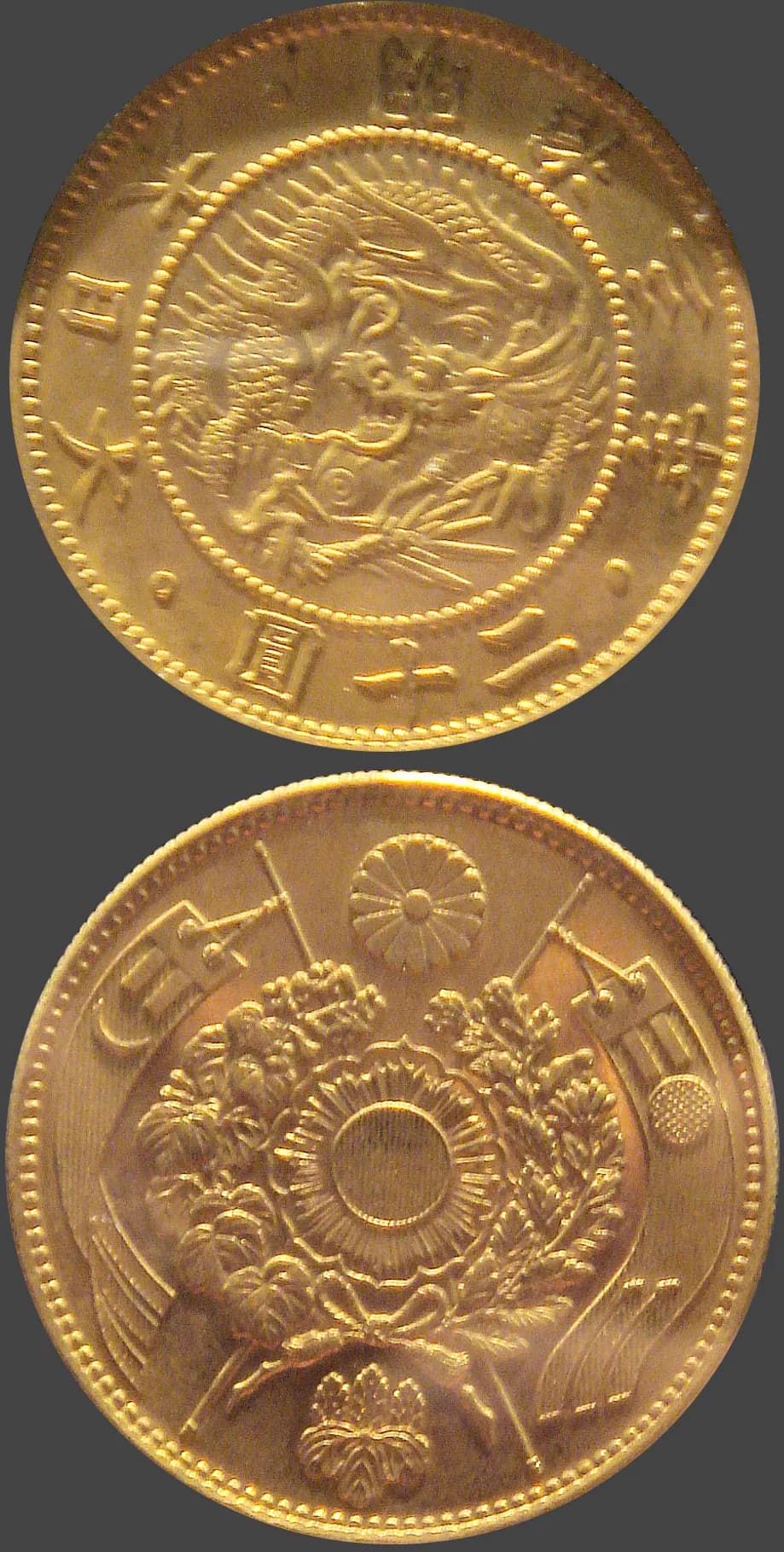
Image: Modern Japanese coinage / PHGCOM / Wikimedia Commons / CC BY-SA 3.0(source)
Tenpō Chōgin — The Lowest Purity Silver Coin Born During the Reform Era
Silver Coin of the Edo Period Born from the Financial Difficulties of the Tenpō Reforms
Subject coin: 天保丁銀
Overview
The Tenpō Chōgin was a silver coin circulated from 1837 to 1859 during the Edo period, minted during the Tenpō Reforms. This era saw the financial difficulties of the shogunate intensifying, especially in 1837, a year marked by significant political upheaval with the Ōshio Heihachirō Rebellion. Mizuno Tadakuni, who led the Tenpō Reforms, decided to mint silver coins as a means of financial reconstruction. However, the silver purity was merely 26.96%, the lowest among Edo silver coins. This low purity clearly reflects the shogunate's dire financial situation at the time. Compared to the 80% purity of the Keichō Chōgin, the Tenpō Chōgin's purity dropped to less than a third, indicating that it was a desperate measure in light of the economic circumstances of the time. The Tenpō Chōgin continued to circulate until it transitioned to the Ansei Chōgin in 1859.
Specifications
- Denomination
- 丁銀
- Minting period
- 天保8年〜安政6年(1837-1859年)
- Metal composition
- 銀26.96% / 銅73.04%
- Weight
- 44匁(約165g)
- Dimensions
- 約50mm × 80mm
- Mintage
- 不詳(諸説あり)
- Mint supervisor
- 後藤家(銀座)
- Market price
- 20万円〜80万円(状態による)
Chapter 1: Background of the Tenpō Reforms and Minting
Image: Modern Japanese coinage / Coindesmonnaies / Wikimedia Commons / CC BY-SA 4.0(source)
In 1837, the eighth year of the Tenpō era, the shogunate's financial difficulties became severe. The Ōshio Heihachirō Rebellion, which broke out in Osaka that year, further highlighted the unstable fiscal situation of the shogunate. Mizuno Tadakuni pushed forward with the Tenpō Reforms and decided to mint silver coins as a part of fiscal reconstruction. At that time, a review of the currency system was imperative for the Edo shogunate, which urgently needed to rebuild its finances. Mizuno Tadakuni chose not to follow the high purity standard set by the Keichō Koban minted in the Keichō era and significantly reduced the purity. As a result, the silver purity dropped to 26.96%. This had the effect, as seen in the types of Edo gold coins and their identification, of shaking confidence in the currency at the time. Mizuno Tadakuni had to take such measures to solve the shogunate's fiscal difficulties. Additionally, as part of the Tenpō Reforms, land redistribution and restrictions on commercial activities were implemented, having a significant impact on the overall economy. Although the issuance of the silver coins was intended to stabilize finances, contrary to the shogunate's intentions, it caused public anxiety and economic turmoil.
Chapter 2: Minting Process and Technology
Image: Modern Japanese coinage / Coindesmonnaies / Wikimedia Commons / CC BY-SA 4.0(source)
The minting of the Tenpō Chōgin was overseen by the Gotō family, who managed the Ginza and had a reputation for expertise in coin minting throughout the Edo period. The Gotō family's technical prowess was considered the best in Japan at the time. However, an unprecedented measure was taken in the minting of the Tenpō Chōgin, with the decision to considerably lower the purity of silver. This was influenced by a shortage of silver supply and fluctuations in copper prices, resulting in a composition of 26.96% silver and 73.04% copper. This combination was challenging even for the technicians of the time. In the Ginza, new technologies were introduced to enhance minting efficiency, and craftsmen utilized these techniques to engage in mass production. Although silver refining technology evolved and alloying with copper advanced, the drop in purity was unavoidable, and the resulting chōgin had a dulled luster and increased weight compared to previous coins, making it easily recognizable to the populace. These technical advancements influenced later currency reforms, leading to a reevaluation of silver purity during the transition to the Ansei Chōgin. Moreover, being the minting site, the Ginza was also a center of technological innovation in Edo's monetary circulation.
Chapter 3: Circulation and Economic Impact
Image: Modern Japanese coinage / Coindesmonnaies / Wikimedia Commons / CC BY-SA 4.0(source)
The appearance of the Tenpō Chōgin in the market caused ripples in the Edo economy. Due to its low silver purity, the Tenpō Chōgin was questioned for its reliability from the outset. In comparison to the previous Keichō Chōgin, its value was significantly lower, and exchange rates dropped substantially. For instance, one Tenpō Chōgin was said to hold only a third of the value of the same weight of Keichō Chōgin. As a result, merchants became cautious in their transactions, with many reluctant to accept the Tenpō Chōgin, leading to instability in prices. Particularly, prices for necessities like rice and salt temporarily soared due to the circulation of the Tenpō Chōgin. Ordinary people were bewildered by these changes, fostering dissatisfaction with the unstable currency system. In this environment, farmers and townspeople were forced to further economize to safeguard their livelihoods. As illustrated in the basics of coin auctions, the value and circulation of currency are deeply connected to the stability of society as a whole. The circulation of this currency persisted during the turmoil at the end of the Edo period and ultimately concluded with the emergence of the Ansei Chōgin.
Chapter 4: Impact on Later Times and Currency Transition
Image: Modern Japanese coinage / Coindesmonnaies / Wikimedia Commons / CC BY-SA 4.0(source)
The Tenpō Chōgin, as a symbol of the currency system's transition during the late Edo period, had a substantial impact on later generations. Although the circulation of the Tenpō Chōgin temporarily alleviated the shogunate's financial difficulties, it led to long-term economic turmoil. In response, the Ansei Chōgin appeared in 1859, leading to the gradual phase-out of the Tenpō Chōgin. By increasing its silver purity, the Ansei Chōgin aimed to restore currency trust, but it was too late, and trust in the shogunate had been greatly damaged. Nevertheless, the experience of the Tenpō Chōgin served as a lesson for the later Meiji government's modernization of the currency system. As shown in the value and identification of modern currency, the Meiji government proceeded with policies to unify the purity and weight of currency, enhancing reliability both domestically and internationally. Subsequently, the Tenpō Chōgin gained popularity among collectors, with its historical value re-evaluated. It serves as an important object of study, vividly illustrating the economic conditions of that time. Thus, the Tenpō Chōgin is essential not only as currency but also for understanding the economy and politics of the Edo period.
Value & Rarity
The Tenpō Chōgin is of great interest to modern collectors due to its historical background and low purity. Although its value at the time of circulation was low, today its rarity and historical value are recognized, and it fetches high appraisals in the collector's market. Depending on its condition, it can be traded for prices ranging from 200,000 yen to 800,000 yen. Especially those remaining in an uncirculated condition are extremely rare and can fetch high prices at auctions. Additionally, due to its minting background, the Tenpō Chōgin is treated as vital material for researching the economic conditions of the late Edo period. Collectors are required to be well-versed in distinguishing the characteristics of the Tenpō Chōgin, as detailed in ways to identify counterfeits and altered coins. Thus, the Tenpō Chōgin continues to attract attention from both a historical and market value perspective.
Conclusion
The Tenpō Chōgin stands as a coin symbolizing political and economic upheaval during the late Edo period, and its historical significance is immense. The minting of low purity vividly demonstrated the shogunate's financial difficulties and led to economic chaos, yet it also provided important lessons for later currency system reforms. Today, it is regarded as valuable material for collectors and history researchers. Understanding the economic conditions and political dynamics of the Edo period through the Tenpō Chōgin offers rich insights for contemplating modern economic policies. The story of the Tenpō Chōgin provides precious lessons from past failures, helping to build a better future.
Related Stories
Genroku Ichibuban Kin — The Small Gold Coins of Edo That Changed Overnight
The Drastic Drop in Gold Purity of Genroku Ichibuban and Its Impact
Coin StoryThe Genroku Koban — Shigehide Ogiwara's Financial Revolution and the Consequences of the Genroku Bubble
The man who halved the gold content to save the shogunate, and the merits and demerits of his actions
Coin StoryIchibu-gin — The 'Gold-Silver Ratio Trap' Exposed by Unequal Treaties and the Monetary Crisis of the Late Edo Period
The Systematic Outflow of Gold Coins Triggered by the Opening of Ports in 1858, and the Shogunate's Last Resort: The Manen Recoinage
Dealers
Dealers Handling This Category
A reference when considering a sale or appraisal. All are dealers and auction houses with a proven track record.
Japan Coin Auction (JCA)
Tokyo
Holds regular auctions with reliable hammer price data, making it a useful resource for tracking market values. Caters to a wide range of collectors from beginners to advanced buyers.
Ginza Coins
Ginza, Chuo-ku, Tokyo
One of Japan's most established numismatic dealers. The scale and variety of their regular auctions is among the largest in the country. Their catalogs are considered a benchmark for market pricing.
Osaka Numismatic Auction
Osaka
A Kansai-based coin auction house with particular strength in regional and hole coins.