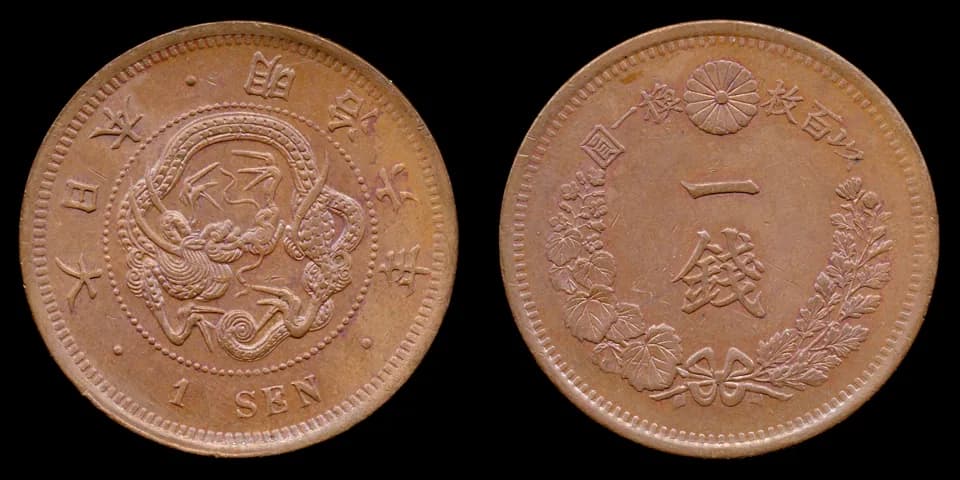
Image: Modern Japanese coinage / As6673 / Wikimedia Commons / CC BY-SA 3.0(source)
Former 20-Yen Gold Coin (Meiji 3) — The Highest-Denomination Gold Coin That Stamped Modern Japan's 'Gold Standard'
The Story of the New Currency Regulations and the Osaka Mint Born from the Scars of the Boshin War, and the Enigmatic Meiji 3 Issue
Subject coin: 個別の価格は、照合済みの記録(出典つき)が得られたものだけを市場記録に掲載する方針です。
Overview
The former 20-yen gold coin (旧20円金貨) is modern Japan's highest-denomination gold coin, struck in accordance with the New Currency Regulations (新貨条例) promulgated by the Meiji government in May 1871 (Meiji 4). Struck to a fineness of .900, weighing 33.33 g, and measuring 35.1 mm in diameter, it bears an intricately rendered dragon design on the obverse and a chrysanthemum crest together with the inscription「二十圓」on the reverse.
The coin's origins lie in the monetary confusion that followed the Boshin War. From the late Edo period through the early Meiji era, domain notes (hansatsu), inconvertible paper currency, and various old coins circulated side by side, hampering commercial transactions. The new government regarded the establishment of a modern, unified monetary system as a matter of urgency, and it was the finance official Ōkuma Shigenobu who took the lead in drafting the New Currency Regulations, which adopted the Western decimal system.
Set as the highest denomination, the former 20-yen gold coin was also a 'calling card of the state,' signaling Japan's intention to enter the international gold standard to audiences at home and abroad. Among all issues, the Meiji 3 (1870) dated coin is an exceptionally rare specimen believed to have been produced during the trial-striking and preparation phase before the Osaka Mint officially opened, and it is treated in today's collector market as a national-treasure-class rarity.
This article follows, in narrative form, the monetary chaos of the Boshin War, Ōkuma Shigenobu's design of the New Currency Regulations, the establishment of the Osaka Mint and the introduction of Western technology, and the mystery of the Meiji 3 dated coin—the 'phantom gold coin.'
Specifications
- Denomination
- 個別の価格は、照合済みの記録(出典つき)が得られたものだけを市場記録に掲載する方針です。
- Minting period
- 明治3年〜13年(1870〜1880)
- Metal composition
- 金(品位.900)
- Weight
- 33.33g
- Dimensions
- 直径35.1mm
- Mintage
- 全体で約15万枚(うち明治3年銘は数十枚以下と推定。諸説あり)
- Mint supervisor
- 大阪造幣局(外国人技師の指導下に製造)
- Market price
- 鑑定書必須)。 個別の価格は、照合済みの記録(出典つき)が得られたものだけを市場記録に掲載する方針です。
The Boshin War and Monetary Chaos — The Economic Foundation for a 'New Japan'
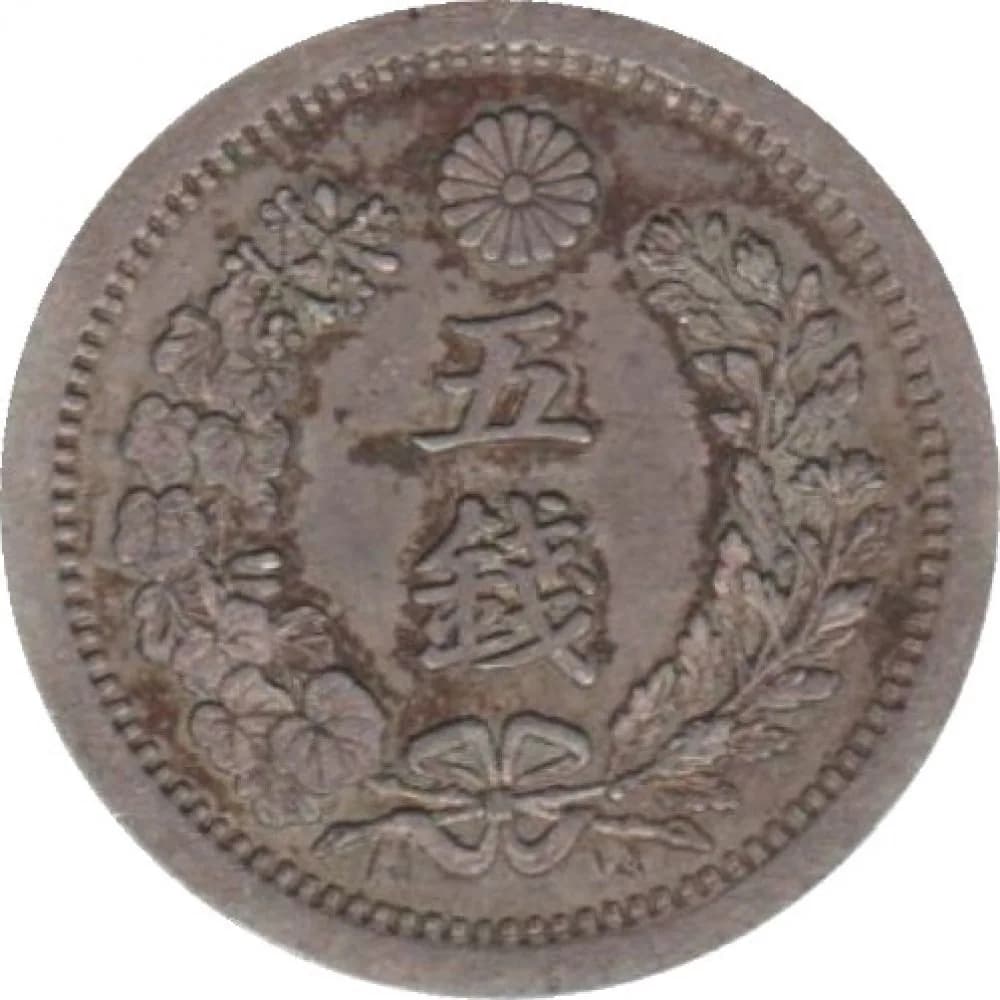
Image: Modern Japanese coinage / Coindesmonnaies / Wikimedia Commons / CC BY-SA 4.0(source)
The Boshin War, ignited by the Battle of Toba–Fushimi in January 1868 (Keiō 4), continued for more than a year until the fall of Hakodate's Goryōkaku at the end of that same year. To finance the civil war, the new government issued large quantities of inconvertible paper currency known as Dajōkan-satsu (太政官札), deepening an economic turmoil that had persisted since the end of the Edo period.
Japan in the late Edo period already suffered severe monetary disorder. Domain notes issued independently by each han numbered in the hundreds of varieties, with differing fineness standards and exchange terms. The shogunate's traditional tri-metallic system of gold, silver, and copper coins—exemplified by the Keichō Koban (慶長小判), chōgin silver, and Kan'ei Tsūhō (寛永通宝)—had lost credibility following the reduction in gold fineness during the Man'en recoinage of 1860. After the Ansei period, when foreign trade commenced, Mexican silver coins and foreign gold coins also flowed into the country, further complicating the monetary system.
Young officials of the Ministry of Finance (Ōkurashō, established in 1869, Meiji 2), who managed the new government's finances, envisioned a 'Western-style unified monetary system' as the solution to this disorder. Their principal references were the American gold coin system and the European gold standard. Three pillars underpinned the plan: a decimal system that would eliminate complex exchange calculations, a guarantee of fineness based on fixed gold and silver content, and the establishment of a modern mint to strike coins domestically.
Around the time of the abolition of domains and establishment of prefectures (haihan-chiken, Meiji 4, 1871), the recall of domain notes also became urgent. Monetary reform that would reconcile the old gold, silver, and copper coins with the new paper currency and new coinage was positioned as one of the most critical tasks in state-building for the Meiji government, ranking alongside military reform and diplomacy.
Ōkuma Shigenobu and the New Currency Regulations — Designing the Modern Monetary System
Image: Modern Japanese coinage / Coindesmonnaies / Wikimedia Commons / CC BY-SA 4.0(source)
The central figure in the Meiji government's monetary reform was Ōkuma Shigenobu (大隈重信), a native of the Hizen domain (Saga domain). Appointed Ōkura-taifu (大蔵大輔, Vice Minister of Finance) in 1869 (Meiji 2), Ōkuma was only 31 years old at the time. As a young finance official, he voraciously studied Western economic systems and set to work designing a new monetary framework.
Ōkuma's principal references were the American Coinage Act (1792) and the bimetallic gold-silver standard of French-speaking countries. His goals were a decimal system—1 yen = 100 sen = 1,000 rin—that would eliminate the need for complex currency-conversion arithmetic, and the establishment of a gold standard linked to international exchange rates. Joining the gold standard that had become widespread among foreign nations during the late Edo and early Meiji periods (formally established in Britain in 1816) was also a prerequisite for Japan to be recognized as a modern state.
On May 10, 1871 (Meiji 4), the New Currency Regulations (新貨条例) were promulgated. Gold was set as the monetary standard, with 1 yen pegged to 1.5 g of pure gold (equivalent to approximately 1.67 g of gold coin at a fineness of .900). Gold coins were issued in five denominations—20 yen, 10 yen, 5 yen, 2 yen, and 1 yen—while silver and copper coins were also issued as subsidiary currency. The 20-yen gold coin, the highest denomination, was positioned as the 'flagship product' demonstrating Japan's creditworthiness in international financial markets.
The implementation of the New Currency Regulations marked a watershed in Japan's economic modernization. Ōkuma continued to be involved in fiscal policy thereafter, devoting himself to building the foundations of the modern Japanese economy until he was forced out of the government in the Political Crisis of 1881 (Meiji 14).
The Opening of the Osaka Mint — Dragon-Design Gold Coins Born of Western Technology
Image: Modern Japanese coinage / Coindesmonnaies / Wikimedia Commons / CC BY-SA 4.0(source)
The implementation of the New Currency Regulations required a mint equipped with modern facilities. The Meiji government purchased a complete set of manufacturing equipment from the Royal Hong Kong Mint and decided to establish a new mint in Osaka.
On April 4, 1871 (Meiji 4), the Osaka Mint (大阪造幣局, initially called the Zōhei-ryō) officially opened. The building, constructed near the former residence of Ogata Kōan in Osaka, was fitted with the latest Western manufacturing machinery powered by steam engines, including rolling mills, cutting presses, and coining presses. Gotō Shōjirō was appointed as the first Mint Director, and foreign engineers, headed by Thomas William Kinder (a British engineer), provided technical guidance.
The design of the former 20-yen gold coin features a dragon motif inscribed with「大日本」and the year on the obverse, and a chrysanthemum crest together with the denomination「二十圓」on the reverse. The dragon is an auspicious motif from Japanese tradition and at the same time a bold design element found on Western coinage as well, making it a design that fused the visual languages of East and West. The specifications—33.33 g in weight and .900 in fineness—were calibrated in accordance with international gold coins of the era, such as the British sovereign and the American 20-dollar gold coin.
The former 20-yen gold coin was the largest and highest-denomination piece in the Meiji gold coin series, and it carried the significance of a 'specimen coin' demonstrating the technical capabilities of the Osaka Mint to audiences at home and abroad. Total mintage is given as approximately 150,000 pieces, struck over a ten-year period from Meiji 3 through Meiji 13, though annual output varied considerably.
The Mystery of the Meiji 3 Date — From Trial Striking to Phantom Gold Coin
Image: Modern Japanese coinage / Coindesmonnaies / Wikimedia Commons / CC BY-SA 4.0(source)
Among all former 20-yen gold coins, those bearing the date「明治三年」occupy a singular position. The Osaka Mint officially opened in April 1871 (Meiji 4), meaning that in 1870 (Meiji 3) work was still at the stage of constructing the building, installing equipment, and conducting test runs. Yet a certain number of former 20-yen gold coins inscribed「明治三年」have been confirmed to exist in today's collector market, with estimates placing surviving examples at no more than several dozen.
Various theories exist regarding how the Meiji 3 date came about. One leading theory holds that these were 'trial pieces' or 'verification samples' produced through trial-striking or proof-striking carried out before the mint commenced full operation—manufactured in small quantities to test the performance of the coining equipment or as sample pieces for presentation to the government. (Accounts of this background differ among sources and have not been definitively established.)
Another theory posits the possibility that part of the manufacturing process was carried out in advance at a separate facility during Meiji 3. Because the Meiji government was pressing urgently for the establishment of a monetary system, the possibility that some trial production was conducted before the official opening cannot be entirely ruled out. In any case, surviving former 20-yen gold coins bearing the Meiji 3 date are extraordinarily few in number, and no official documents that fully establish their provenance have been confirmed to date.
Records exist of examples having appeared at Heritage Auctions in the United States, and the issue is recognized among international Japanese numismatic collectors as a rarity of the highest rank.
Individual prices are listed only once verifiably matched, sourced records exist.
Value & Rarity
Valuations of the former 20-yen gold coin in the collector market are largely determined by three factors: date, condition, and grading.
The rarest and most valuable is the「明治三年」dated issue. Confirmed surviving examples are estimated at no more than several dozen, and a certificate from a grading service (PCGS, NGC, or a Japanese specialist institution) is essential.
For standard issues dated Meiji 4 through Meiji 13, market prices vary considerably by grade.
Contributing to the coin's elevated value is growing demand from Japanese numismatic collectors in Europe and North America. Entering the 2020s, hammer prices at international auctions such as Heritage Auctions and Stack's Bowers have been rising, and long-term demand appears firm.
From an investment and holding perspective, even standard-issue examples (Meiji 4–13) command substantial collector value in addition to their bullion value, and under appropriate storage conditions (humidity control, sealed cases) this is a coin well suited to long-term holding. Regular monitoring of market price trends is recommended.
Individual prices are listed only once verifiably matched, sourced records exist.
Conclusion
The former 20-yen gold coin is a gold coin struck by the Meiji government—rising from the chaos of the Boshin War—as 'proof of a modern state.' Ōkuma Shigenobu's vision embodied in the New Currency Regulations, the Western technology introduced to the Osaka Mint, and Japan's national will inscribed in the dragon motif—in this single coin, the economic essence of the Meiji Restoration is distilled.
Among all issues, the Meiji 3 dated coin holds an irreplaceable value as a 'phantom witness' produced at the very dawn of modern Japan. Even standard issues command a collector premium substantially exceeding their bullion value, making this a coin of high investment merit from a long-term holding perspective.
Related Stories
Ichibu-gin — The 'Gold-Silver Ratio Trap' Exposed by Unequal Treaties and the Monetary Crisis of the Late Edo Period
The Systematic Outflow of Gold Coins Triggered by the Opening of Ports in 1858, and the Shogunate's Last Resort: The Manen Recoinage
Coin StoryKan'ei Tsūhō — "Japan's Longest-Lived Coin" in Circulation for 230 Years
The history of the hole coin that continued to be used from the unification of Edo coinage in Kan'ei 13 (1636) to Meiji
Coin StoryMeiji Shin-ka Jōrei — The Challenge of Retiring the Old Gold and Silver Coinage
The Currency Reform of Modern Japan Brought About by the New Currency Regulations
Related Encyclopedia Entries
20 Yen Gold Coin
Conclusion: The 20 Yen Gold Coin is the pinnacle of modern Japanese gold coinage, offering historical, artistic, and investment value as a high-value collector's item. Certified examples provide long-term asset growth and immense collecting satisfaction.
EncyclopediaMeiji Gold Coins
Conclusion: Meiji Gold Coins represent a premier investment target from modern Japan, highly valued both domestically and internationally for their historical significance, exceptional artistry, rarity, and solid bullion value.
EncyclopediaOverview of Modern Era Coinage
Conclusion: Japanese modern coinage, due to its rarity and international grading standards, represents an attractive option for long-term investment.
Dealers
Dealers Handling This Category
A reference when considering a sale or appraisal. All are dealers and auction houses with a proven track record.
Ginza Coins
Ginza, Chuo-ku, Tokyo
One of Japan's most established numismatic dealers. The scale and variety of their regular auctions is among the largest in the country. Their catalogs are considered a benchmark for market pricing.
Taisei Coins
Tokyo
A dealer with an international network. Offers advanced services such as consignment to overseas auctions and NGC/PCGS grading submission. Recommended for high-value or internationally recognized coins.
Tokyo Coin Club
Tokyo
A membership-based coin dealer known for carefully selected, quality inventory.