The World of Collecting Hole Coins — From Kan'ei Tsuho to Kouchou Coins, the Editorial Team Explores "The Most Profound Category"
Hole coins with over 1300 years of history can serve as both a beginner's entrance and an advanced collector's destination. Unravel the diverse classification systems and the charms of collecting
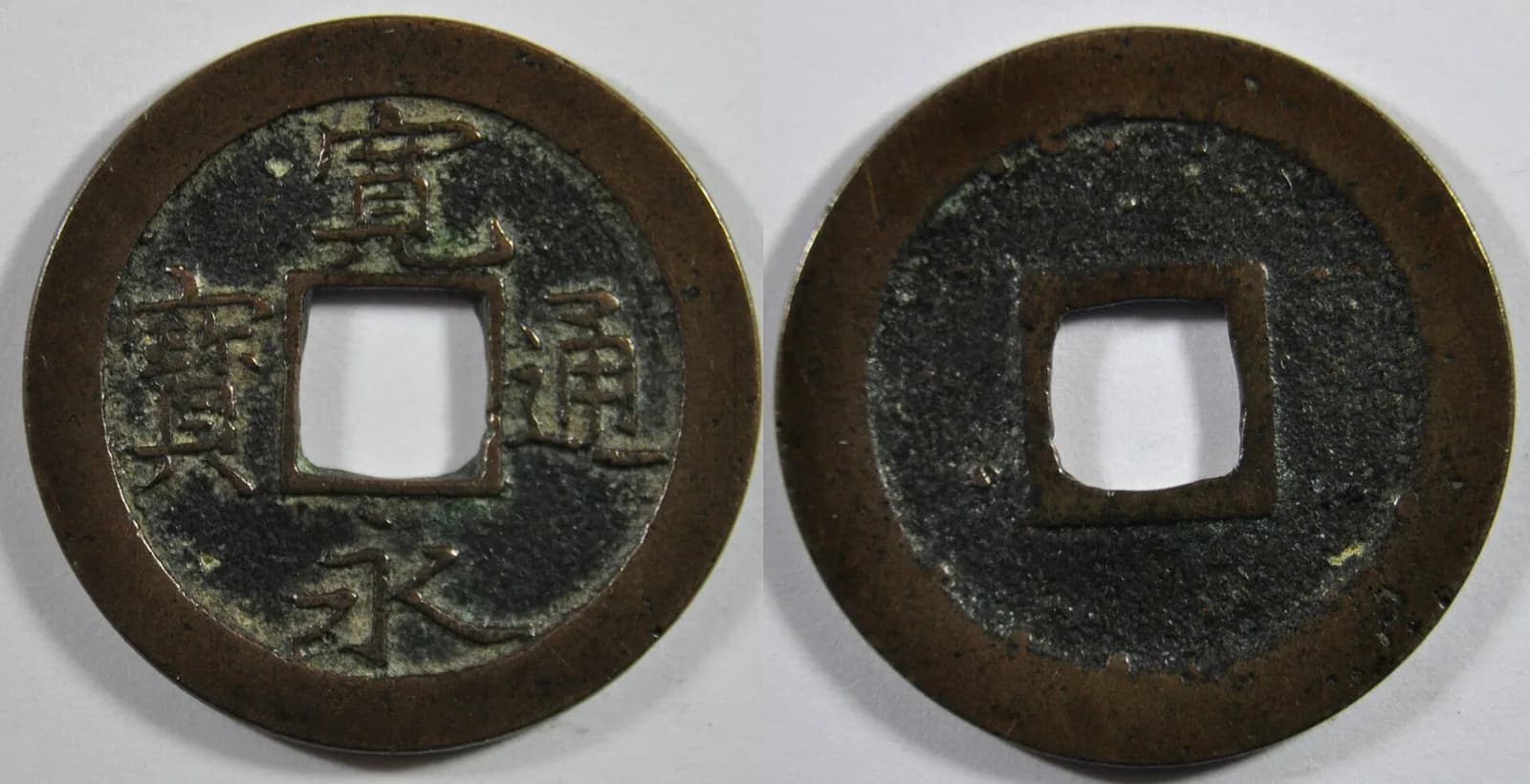
The "hole coins" with a square hole in the center have over 1300 years of history, from the Wadokaiho in Wado 1 (708) to the early Meiji period. The editorial team analyzes why collecting hole coins is considered "the most profound category," covering the mint locations of Kan'ei Tsuho, the rarity of Kouchou twelve coins, and the forgery history of Tempou Tsuho.
The 1300 Years of Hole Coins — From Wadokaiho to Kan'ei Tsuho
The history of hole coins begins with the Wadokaiho, minted in the first year of Wado (708) during the Nara period. It was Japan's first circulating currency, modeled after the Tang's Kaiyuan Tongbao (first minted in 621) and issued two years after the relocation of the capital to Heijo-kyo during the reign of Empress Genmei. The inscription "和同開珎" is in Tang-style regular script, and the square hole in the center follows the tradition of Chinese coins.
Subsequently, twelve kinds of copper coins were minted up to the Heian period, collectively known as the Kouchou Twelve Coins: Wadokaiho, Mannentsuho, Jinkoukaiho, Ryuhei Eiho, Fujushinho, Showashouho, Chonen Taiho, Joekishinho, Jogan Eiho, Kanpei Taiho, Enkyotsuho, Kengen Taiho. As the times progressed, the quality of minting declined, with the last, Kengen Taiho (958), being extremely poorly made, weighing only about 1g.
After the Kouchou Twelve Coins, the state ceased to issue coins for over 300 years in Japan. Medieval Japan operated under a "Toraizan Economy" importing Song and Ming coins from China, with Yong Le Tongbao (Ming dynasty) functioning as the de facto standard currency. The extensive minting of domestic coins resumed with the issuance of Kan'ei Tsuho in Kan'ei 13 (1636).
Kan'ei Tsuho began its issuance under Tokugawa Iemitsu and circulated for over 230 years until the Meiji government established a new currency system in Meiji 4 (1871). Hence, it's called "Japan's longest-living coin." The coins were concurrently minted at more than 50 mints nationwide, such as Edo, Mito, Sendai, Matsumoto, Takada, Sado, Ashio in Shimotsuke, Sakamoto in Omi, etc., and their combinations of minting locations and years amount to hundreds. This extensive combination is the first reason why collecting hole coins is considered "profound."
Classification System of Kan'ei Tsuho — The "First Wall" Conveyed by the Editorial Team
When collecting Kan'ei Tsuho in earnest, the first barrier to overcome is the classification system. Generally, antique coin dealers and specialty books classify them into the following tiers.
The first tier is the division between "Old Kan'ei" and "New Kan'ei." Old Kan'ei refers to coins minted from Kan'ei 13 (1636) to around the Genroku period, considered early rare specimens of Kan'ei Tsuho. New Kan'ei refers to coins minted after the Genroku period, particularly after the re-minting in Genroku 10 (1697), which are relatively easy to obtain due to large circulation.
The second tier is classification by minting location: Edo coin, Mito coin, Sendai coin, Matsumoto coin, Takada coin, Sado coin, Ashio coin in Shimotsuke, Sakamoto coin in Omi, etc., each showing regional differences in script characteristics, copper composition, edge width, etc. Among these, Sakamoto coin in Omi (minted for a short period early in the Edo era) is known for its rarity, sometimes trading for hundreds of thousands of yen if in good condition.
The third tier is classification by "text." Even within the same minting location and year, differences appear in the script due to the parent coin (coin used as an example for molds), called "so-and-so hand." Hundreds of such hands have been identified, including "Shima-ya text," "Seiji-Obverse Text," "Fukyute," "Seiji-Upper Yong," and numerous others.
In the industry, serious collections of Kan'ei Tsuho generally aim for "completeness of all mints and hands" or "deep focus on specific minting locations and eras." The former becomes a decades-long collection plan, while the latter can take several years to over a decade. This is why collecting hole coins is called an "end point for advanced collectors."
Forgery History of Tempou Tsuho and the Modern Market — The Boundary Between Fake and Genuine
When discussing hole coin collection, Tempou Tsuho is another unavoidable topic. It is a 100-mon coin, with an oval shape, issued in Tempou 6 (1835) under Mizuno Tadakuni's government for financial relief, equating to 100 Kan'ei Tsuho pieces in value. However, the disparity between face value and intrinsic metal value made it an ideal target for forgery.
Documents confirmed through the editorial team's research show that Tempou Tsuho forgery was systematically organized by various domains at the end of the Edo period. Satsuma Domain's Tempou Tsuho (also known as Satsuma Tsuho) was reputedly minted as a replacement for domain notes, creating its own category in today's collection market. Additionally, other domains like Mito, Aizu, Morioka, Akita, Sendai also forged coins with regional differences in script and edge shapes.
In today's collection market, these "Domain Mints" are firmly established as objects of collection, classified by "minting subject" rather than dismissed as fakes. Pricing varies by minting subject, such as Edo's official mint, Mito, Satsuma, Morioka, Akita, Aizu, and Sendai, with fine domain-minted coins sometimes trading for higher prices than those of the official mint.
This embodies the unique aesthetic of hole coin collection: over time, the boundary between "forgery" and "genuine" blurs, with everything being equally appraised as a part of Japan's ancient coin history. Although potentially confusing for new collectors, for veteran collectors, it is the very delight of enjoying the "layers of history." Though Tempou Tsuho ended its role as legal tender with the ban on currency use in Meiji 9 (1876), it continues to trade in the modern market at prices ranging from a few thousand yen, with rare domain-minted coins fetching tens of thousands of yen.
First Time Hole Coin Collection — The Editorial Team Recommends a 4-Step Introduction Route
For those beginning to collect hole coins, the editorial team has organized a recommended introductory route based on actual market observations.
The first step is to "understand the classification system." Read a comprehensive beginner's article that covers the overall picture of hole coins and grasp the positioning of the major categories such as Kouchou twelve coins, Old Kan'ei, New Kan'ei, and Tempou Tsuho. Kouchou Twelve Coins are state-minted coins from the Nara to Heian period (708-958), with genuine ones being rare and expensive, ranging from tens of thousands to several million yen. New Kan'ei, with large circulation after the mid-Edo period, can be acquired from a few hundred yen. Understanding this price structure initially prevents purchasing dilemmas.
The second step is "contact with actual items." At coin shows (held several times a year in Tokyo, Osaka, Nagoya) or at trustworthy ancient coin dealers' stores, you can compare hundreds of kinds of hole coins firsthand. The editorial team recommends selecting a typical piece of New Kan'ei Tsuho minted after the Genroku era (1688-1704) as the first coin (100 to 1000 yen). Learning to recognize script, edges, and surface standards through bodily experience lays the foundation for future authenticity judgments.
The third step is "correlation with specialist books." In the world of hole coin collecting, there are specialized books like "Japan Coin Encyclopedia" and "Kan'ei Tsuho Great Encyclopedia," documenting sorting standards with photos of each minting location and hand. Mastering grading and condition evaluation guidelines also enables meticulous judgment in purchasing and selling.
The fourth step is "participating in the market." It involves engaging in antique coin auctions to acquire a current sense of market value. As rare specimens of Kouchou Twelve Coins (such as Ryuhei Eiho and Fujushinho) or rare "hand" of Old Kan'ei are prevalent in the market, learning basic knowledge of authenticity judgment before targeting high-priced items is strongly recommended. In hole coin collecting, a "knowledge advantage" is the principle that sustains your long-term collector life.
After the enactment of the new monetary system in Meiji 4 (1871), traditional hole coins ended their role as legal currency. However, many hole coins continued to circulate through the Meiji, Taisho, and Showa antique markets, leading to the establishment of systematic classification research after the antique coin collection boom in the 1960s. In the modern market, typical New Kan'ei Tsuho coins minted in several million units during the Edo period remain accessible, while rare Kouchou Twelve Coins or rare "hand" of Old Kan'ei are limited in supply, with scarcity premiums increasing annually. It is emphasized that hole coin collecting is a category to approach slowly over decades.
Conclusion
The allure of collecting hole coins lies in its "endless depth," woven by 1300 years of history and thousands of classification systems. From the ancient Wadokaiho to the early modern Kan'ei Tsuho and the late Tempou Tsuho, each hole coin embodies the history of Japanese currency itself. For those just beginning, the editorial team recommends starting with a Kan'ei Tsuho introductory book, identifying minting locations starting with coins on hand as the orthodox entry into hole coin collection.
For reference, entry-level prices for hole coins are typically from 100 yen to 1,000 yen a piece for typical New Kan'ei Tsuho, several thousand to tens of thousands of yen for Old Kan'ei and rare "hand," several tens of thousands to several million yen for genuine Kouchou Twelve Coins, and from several thousand to tens of thousands of yen for domain-minted Tempou Tsuho. By checking coin shows, dealers' counters, and reliable online auctions in parallel, a sense of market value can be acquired within a few months. Collecting hole coins is a lifelong endeavor, and the key is to enjoy without haste.
Related Editorials
Dealers
Dealers Handling This Category
A reference when considering a sale or appraisal. All are dealers and auction houses with a proven track record.
Ginza Coins
Ginza, Chuo-ku, Tokyo
One of Japan's most established numismatic dealers. The scale and variety of their regular auctions is among the largest in the country. Their catalogs are considered a benchmark for market pricing.
Japan Coin Auction (JCA)
Tokyo
Holds regular auctions with reliable hammer price data, making it a useful resource for tracking market values. Caters to a wide range of collectors from beginners to advanced buyers.
Taisei Coins
Tokyo
A dealer with an international network. Offers advanced services such as consignment to overseas auctions and NGC/PCGS grading submission. Recommended for high-value or internationally recognized coins.