Overview of Tenpō Tsūhō: The Large Coins That Supported the Late Edo Economy
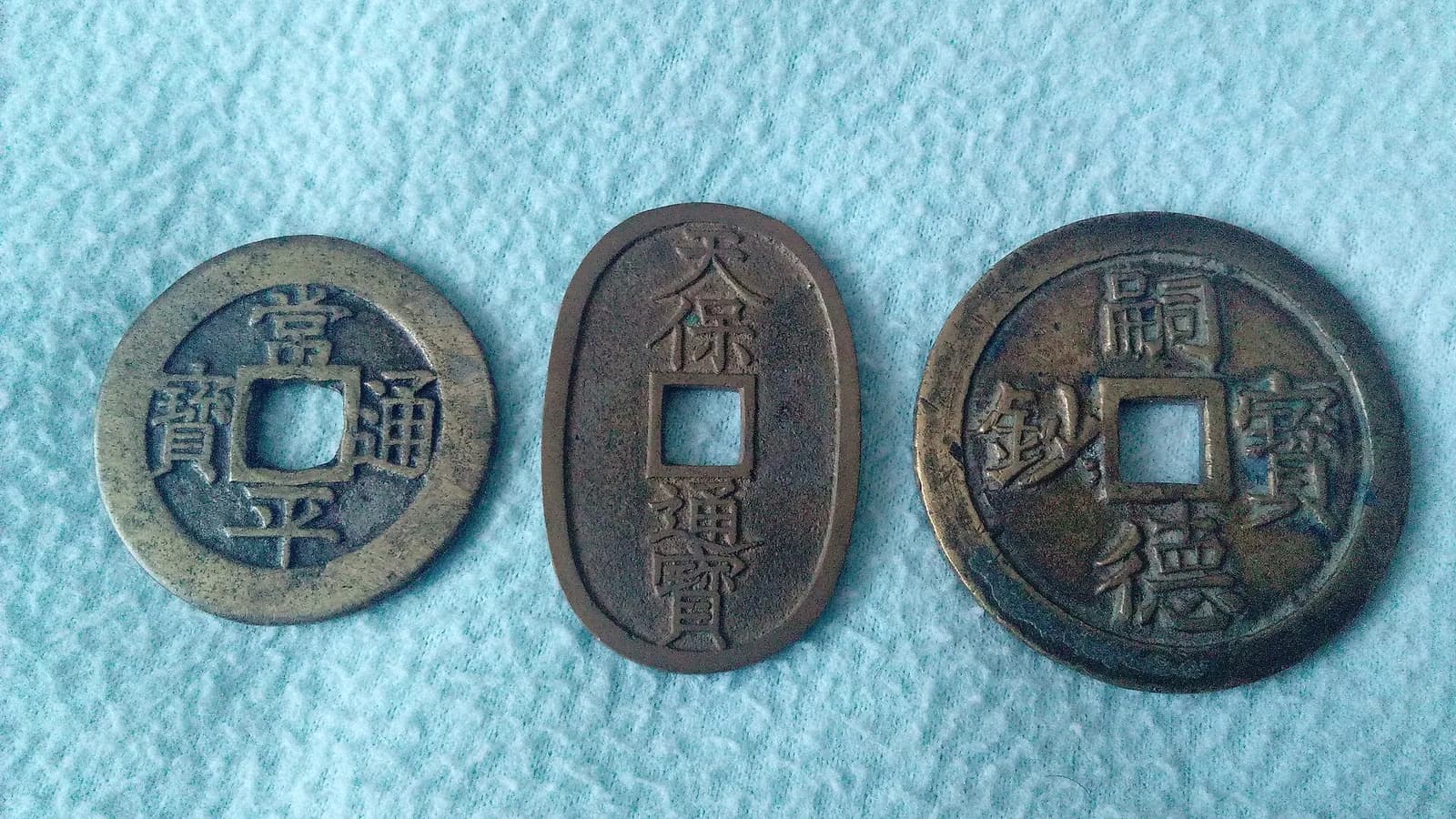
Tenpō Tsūhō (天保通宝) is a large denomination coin with a face value of 100 mon, first minted in the late Edo period in Tenpō 6 (1835). Its distinctive feature is its beautiful elliptical shape modeled after koban gold coins. Measuring approximately 49mm in length and 33mm in width, its size made it stand out among contemporary hōsen coins. The coin features a rectangular hole in the center, with the inscription "天保通寳" on the obverse and "當百" on the reverse. It weighs approximately 20.6 grams and is significantly heavier than previous hōsen coins. Despite this weight, the copper content fell short of its face value, highlighting its role as nominal currency designed to alleviate the shogunate's financial difficulties. Japan at the time was suffering from repeated famines and deteriorating finances. The shogunate repeatedly re-minted coins to adjust the money supply and stabilize its finances. The Tenpō Tsūhō emerged in this economic climate and became a symbol of the late Edo period. Its unique shape earned it the nickname "Tenpō coin", and it became widely accepted and deeply integrated into people's lives.
Minting and Circulation History: Influence Beyond Face Value
The minting of Tenpō Tsūhō began under the supervision of the Gotō family of the Kinza in Edo. However, due to subsequent financial difficulties, unauthorized production (secret minting) by regional domains spread across Japan. Many influential domains like the Satsuma, Tosa, Mito, and Aizu domains produced secret coins to restore their finances. This widespread secret minting starkly demonstrated the declining control of the shogunate and the economic independence aspirations of the domains. The Tenpō Tsūhō supported Japan's economy for approximately 36 years until its circulation was halted in Meiji 4 (1871) after the Meiji Restoration. During this period, its actual value was about 80 mon against a face value of 100 mon. Despite initially falling below its face value, the high denomination made it widely accepted. It also helped alleviate the shortage of small coins in rural areas. While its role ended with the transition to a new currency system, its influence was considerable. The history of the Tenpō Tsūhō is a reflection of the economic history of the tumultuous late Edo period. For more details on identifying and valuing Tenpō Tsūhō, please refer to the detailed article.
Classification of Official and Secret Mint Coins: Basic Identification
Tenpō Tsūhō is primarily classified into "Honza Coins" (official mints) and "Secret Mint Coins" based on their origin of production. Honza Coins were minted at government-sanctioned mints like the Kinza and Ginza and typically feature sharp inscriptions and high-quality copper. They adhere closely to weight specifications and are known for their superior overall quality, circulating as the authorized currency that reflected the shogunate's prestige. On the other hand, Secret Mint Coins were produced unofficially by various domains. Struggling financially, these domains resorted to secret minting to bolster their economies. As a result, the inscriptions often appear degraded, and the quality of copper may vary, showing greater variance compared to Honza Coins. However, some Secret Mint Coins, such as those from Satsuma Domain, maintained such high quality that they could be mistaken for Honza Coins, making identification challenging even for experts. Identifying the origin of Secret Mint Coins is a major theme in collecting Tenpō Tsūhō and offers deep insights. Beginners entering this field should first understand the basic differences between Honza Coins and Secret Mint Coins. Use the guide on identifying counterfeits and modified coins to recognize authentic features.
Features and Rarity of Secret Mint Coins by Origin: Collector's Curiosity
The allure of collecting Tenpō Tsūhō Secret Mint Coins lies in pinpointing their origin. Coins with a confirmed origin hold high collectible value due to their historical background and rarity. Each domain's minting techniques and financial status are reflected in the quality and inscriptions of the coins, necessitating detailed observation. For instance, Satsuma Domain coins typically have excellent copper quality and are slightly heavier (around 21–22g). Mito Domain coins have a distinctively long vertical stroke in the "天" character, reflecting a unique style. Tosa Domain coins are characterized by a relatively thin rim. Additional examples include the unique inscriptions and minting traces found on Aizu Domain and Sendai Domain coins. Determining origin requires comprehensive assessment of inscriptions, weight, copper color, rim shape, and even subtle minting marks. The process of comparing with specialized references and past evaluation cases is the greatest pleasure in this field. While many factors determine the value of old coins, identifying the origin of Secret Mint Coins is the prime example.
Honza Coins Appraisal Points: Authenticity in Detail
In appraising Honza Coins, the brushwork of the inscriptions and overall balance are important criteria. First, check the evenness of the horizontal strokes in the "天" character; in Honza Coins, these strokes are often orderly. Next, focus on the flow of brush strokes in the "保" character's right side (the radical). Smooth, forceful brushwork is a hallmark of Honza Coins. Moreover, examine the balance of the "當百" inscription on the reverse and the arrangement of the "百" character. Ensure inscription stability, particularly the neatness of the "百" character. The rim's thickness and uniformity are also indicators of Honza Coins' quality. Standard Honza Coins typically weigh 20–21g, with a length of 49–50mm and width of 32–33mm. Deviations from these specifications or significant inscription degradation suggest the possibility of Secret Mint Coins or replicas. Basic tools for coin appraisal include scales capable of 0.1g precision and accurate rulers. Mastering these tools and developing an eye for detail are the first steps in honing appraisal skills.
Vigilance Against Modern Replicas: Discerning Enhanced Counterfeits
Due to its unique shape and historical value, Tenpō Tsūhō is susceptible to a plethora of modern replicas. While many are produced as souvenirs, toys, or educational materials, some are deceitfully sold as authentic. Beginners must be cautious not to purchase based solely on appearance. Key points in detecting replicas include first weighing them. Modern replicas often weigh significantly less than authentic coins (about 20.6g), ranging between 12–15g. Next, observe the surface finish; replicas created via mold pressing lack the casting texture typical of genuine coins and tend to have a slick feel. Be wary of coins lacking a natural patina developed through years of circulation, or those artificially treated. Buying from antique markets or street vendors is especially risky and requires careful judgment. It's wise to confirm the genuine qualities and weight at a reputable old coin dealer and select pieces accompanied by authentication certificates.
Identifying Early, Middle, and Late Periods by Size and Weight: Deciphering History
Honza Coins of Tenpō Tsūhō exhibit slight specification differences across minting periods, likely influenced by advances in minting technologies, material acquisitions, and production scale changes. Coins minted in the early period (circa Tenpō 6–10) tend to be slightly heavier with thicker rims. During this period, the coins were carefully crafted, often with good copper quality. As mass production systems took hold in the mid-period, specifications stabilized and weight slightly decreased. Moving towards the later period near the end of the Edo period, financial deterioration and shortages led to poorer copper quality and rougher minting. Weight and thickness measurements aid in period identification and are a recognized method among Tenpō Tsūhō researchers. Early pieces, due to their rarity and high quality, are valued more than mid to late-period pieces. Experimental coins and unique mother coins with divergent specifications are part of the comprehensive classification system for old coins. Knowledge of these distinctions enhances the depth of collection.
Enjoyment and Starting Tips in Collecting: Entering the World of Tenpō Tsūhō
Collecting Tenpō Tsūhō is attractive to many enthusiasts due to its unique allure. For newcomers, it is recommended to start by purchasing a well-preserved Honza circulating coin from a trustworthy old coin dealer. Next, prepare a precise scale (0.1g accuracy) and a ruler to measure the acquired Tenpō Tsūhō, developing a habit of measurement. This practice helps in recognizing differences in specifications and signs of Secret Mint Coins. Furthermore, obtaining specialized books featuring Secret Mint Coin classification charts and attempting script comparison will guide you into the profound world of Tenpō Tsūhō. To protect your collection, practice proper coin storage methods. With its elliptical and large design, the Tenpō Tsūhō visually dominates among old coins. It's a satisfying addition as the "face" of a collection, providing the joy of tangibly holding history.