Background of the Emergence of Varieties
Kan'ei Tsūhō (寛永通宝) was the backbone currency supporting the Japanese economy for about 230 years from Kan'ei 13 (1636) in the early Edo period to the end of the Edo period. The lengthy minting period and the presence of mints throughout the country were factors that led to the creation of numerous varieties. The differing minting techniques, master coins, copper composition ratios, and even the craftsmanship habits at each mint led to subtle differences in calligraphy, size, and copper quality. In particular, during the early Kan'ei period (1636-1659), numerous private mints flourished, and the diversity was remarkable. In the new Kan'ei period (from 1668 onward), the shogunate increased the number of government-controlled mints, aiming for quality standardization. However, distinct coins with unique calligraphy and features continued to be minted at major mints like Kameido, Fukagawa, Sado, Sendai, and Akita. These varieties are said to number in the hundreds, and their complete classification is still an ongoing endeavor among numismatic researchers. For a basic understanding of Kan'ei Tsūhō, refer to Types and Valuation of Kan'ei Tsūhō.
Representative Varieties and Characteristics
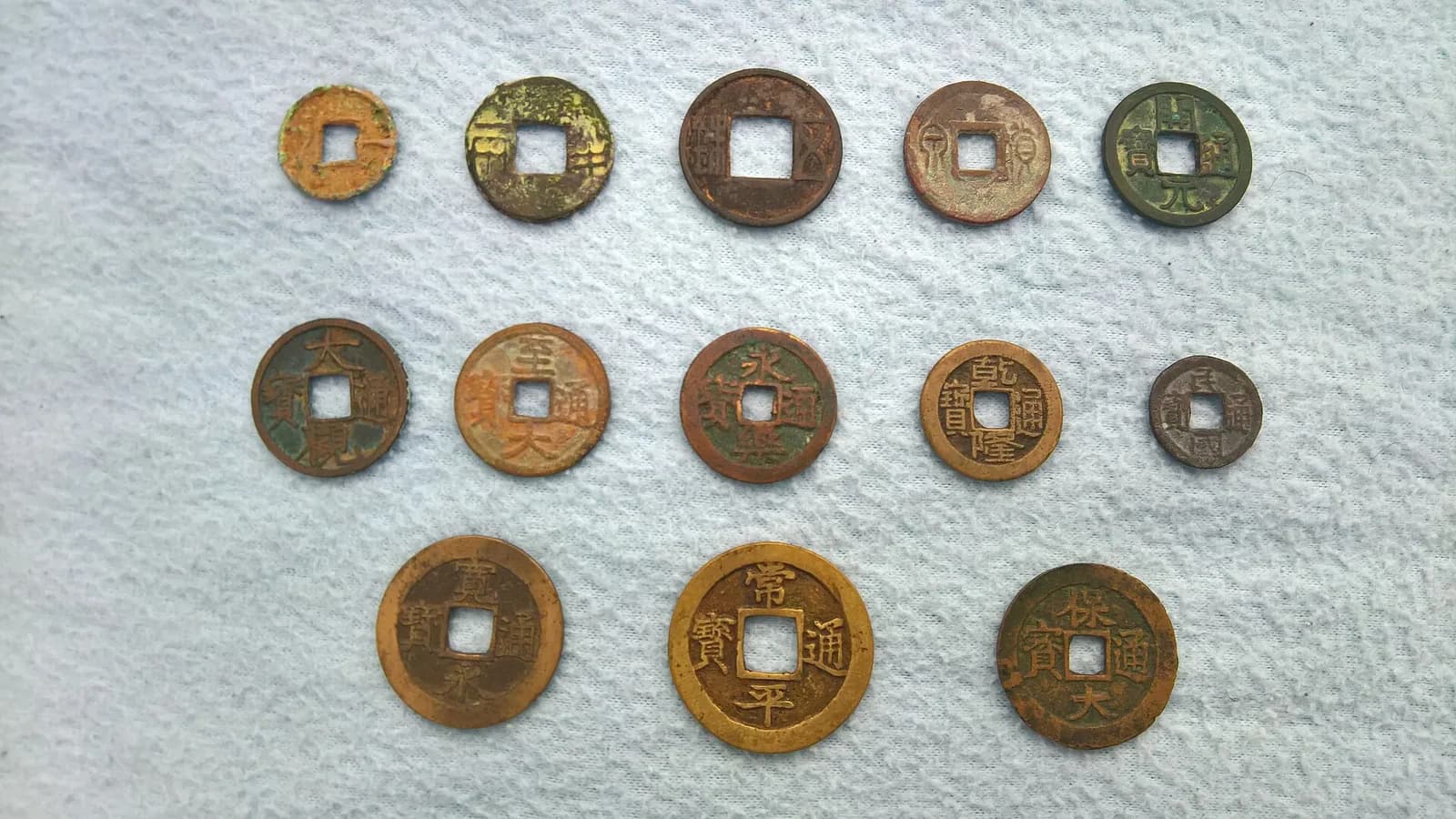
Kan'ei Tsūhō has numerous varieties, but here are representative ones that are popular among collectors. The "Nisui Ei (二水永)", a representative of early Kan'ei, features the character "永" that resembles two water droplets, making it rare and highly valued. "Shimayabun (島屋文)" is known for its thick, strong, and unique script style, and it is another symbolic variety of early Kan'ei. In the new Kan'ei period, many coins had inscriptions on the reverse indicating the mint location. "Seijihai Bun (正字背文)" features the character "文" on the backside, indicating it's minted at Edo's Kameido (Catalog: Back Inscription=Edo Kameido). "Haisha (背佐)" signifies the Sado mint, and "Haisei (背千)" indicates that it was produced at Sendai's Ishinomaki mint, reflecting the deep economic ties of these regions. The "Matsumoto Coin" minted in Shinano Matsumoto is known for its neat and orderly calligraphy. The "Mito Coin" minted by the Mito Domain has a strong and unique script style, reflecting the distinct characteristics of the region. These diverse coins are outlined in the Introduction to Chinese Hole Coins (Kan'ei Tsūhō & Tenpō Tsūhō).
Price Range List of Varieties
The price of Kan'ei Tsūhō varies significantly based on its variety, preservation condition, and rarity. Generally, common new Kan'ei Tsūhō (circulating coins) are traded in the market at around 10 to 50 yen. In contrast, circulating coins with rare calligraphy from the early Kan'ei period can be valued at approximately 500 to 5,000 yen. These price ranges also change depending on market supply and demand balance and whether a coin has been appraised. To understand the value of your collection, refer to Factors Determining the Value of Old Coins and Price Trends in the Market Chart. The policy is to list individual prices and auction examples only when verified records (with event, lot, source URL, and confirmation date) are available in the market records.
Importance of Master Coins
In the collection of Kan'ei Tsūhō varieties, the "master coin (母銭)" holds the highest value and historical significance. The master coin was used as a prototype to create molds for minting circulating coins. Compared to circulating coins, master coins are about 1mm to 2mm larger in diameter, and their engravings are deeper and more distinct. The finishing touch of the contour is exceptionally precise, and the casting surface is often smooth. These features demonstrate the meticulous craftsmanship of the mint's artisans. Even if a circulating coin with a calligraphy generally valued at 10 yen is identified as a master coin, it can be appraised in the range of tens of thousands to hundreds of thousands of yen. Appraising master coins requires advanced experience and specialized knowledge. It involves not just measuring size but also comparing weight, clarity of engravings, the texture of the cast surface, and patterns of wear due to aging, all comprehensively. Understanding the Standards of Old Coin Grading can also aid accurate value assessment.
What is a Test Coin?
Test coins (試鋳銭) are experimental coins made to check the quality, calligraphy, and material before entering mass production. They functioned similarly to prototypes in modern product development. Kan'ei Tsūhō test coins are characterized by even finer engraving than circulating coins, with pronounced details. The material and weight may differ from the final minted product, and these differences become subjects of academic research. Only a limited number of test coins were produced, and very few remain today, making them rarely encountered by ordinary collectors in the market. However, their existence provides crucial clues for understanding the minting technology and monetary policy of the time. They are often stored in museums or research institutions, and their discovery is significant news in the numismatic world.
Specific Procedures for Calligraphy Appraisal
Appraising the calligraphy of Kan'ei Tsūhō is a specialized task involving combined analysis of several factors. First, closely observe the four characters "寛永通宝" inscribed on the coin's front. Specifically, check: ① whether the top of "寛" (the canopy-like top) is wide or narrow, ② the angle and length of the two water lines of the "永" character and the position of the dots, ③ the style of the "マ" part in "通" and the position of the point in the shinnyō, and ④ the number of horizontal lines (3 or 4) in the "貝" part of "宝." By examining these combinations, it's possible to narrow down the calligraphy lineage. Next, verify the existence and type of the back inscriptions and measure the diameter, thickness, and weight accurately. Finally, determine the mint from the overall features such as copper quality, casting surface texture, and edge finish. For a deeper understanding, refer to Types & Classification System of Old Coins to grasp the overall picture.
Practice of Selection and Collection
In collecting Kan'ei Tsūhō varieties, "selection (選別)" is a very common method practiced by many collectors. It involves purchasing Kan'ei Tsūhō coins, often sold in bulk by coin dealers or at auctions, and manually searching for rare varieties within them. Standard pieces can be acquired for about 10 to 50 yen each, so starting with a bulk purchase of 100 pieces for around 1,000 yen is feasible. Discovering a variety worth several thousand or even tens of thousands of yen within this can bring great joy and economic benefit to collectors. The key to successful selection and collection lies in developing an ability to discern minute differences in calligraphy. It's essential to study systematically through specialized books and gain practical experience by examining large numbers of coins for comparison. For efficient selection, prepare bright lighting, a high-powered loupe, and a classification table at hand. For information on acquiring old coins, see Guide to Old Coin Acquisition & Purchase Methods.
Reference Books and Learning Tools for Classification
Delving deeper into the research and collection of Kan'ei Tsūhō varieties requires the use of reliable reference books and learning tools. The Japan Mint Inspection Bureau's 'Illustrated Catalog of Japanese Coins' (Toyokeizai Shinposha) is an ideal comprehensive historical resource for understanding Edo period currency, including Kan'ei Tsūhō. In recent years, online databases and old coin research forums have become well-equipped, allowing for comparison with actual photos and information exchange with other collectors from home. Utilizing these tools permits a more efficient and deeper exploration of the world of Kan'ei Tsūhō. Before starting collection, it's also crucial to understand the Differences and Thought Process between Investment and Collection.
Caution and Measures Against Counterfeiting
Due to the high value of rare Kan'ei Tsūhō varieties, they have long been targets for counterfeiting. In modern times, there are even precise counterfeits made using advanced techniques such as electroforming (electroplating casting), sometimes making it difficult to distinguish them from genuine items. Several points are essential to distinguish counterfeits. First, ① weight measurement is crucial. Counterfeits often use different metals like lead or zinc, resulting in weight differences from the authentic ones. Next, ② the feel of the casting surface is important. Electroformed pieces tend to have an unnaturally uniform surface. ③ Checking under ultraviolet light is also effective. Artificially colored patina might fluoresce under UV light. When considering purchasing high-priced rare items, it's strongly recommended to always have them appraised by a reliable expert. Confirm the presence of any guarantees before purchasing and make decisions carefully. For more detailed information on counterfeiting, refer to Complete Guide to Identifying Fakes and Processed Items.