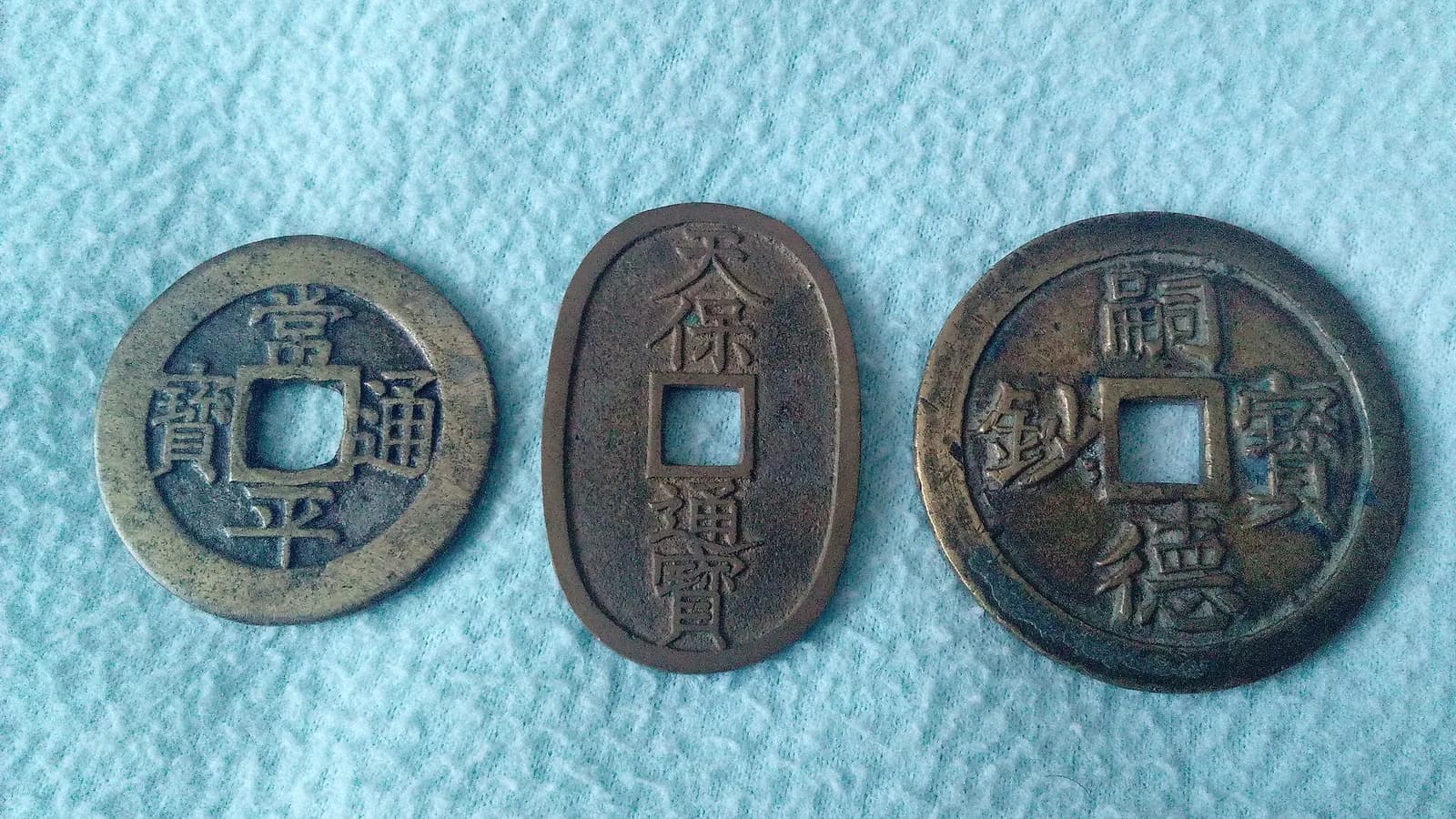
Overview of Tenpō Tsūhō
The Tenpō Tsūhō (天保通宝) is a large copper coin first minted in the late Edo period during Tenpō 6 (1835). It was issued as a "Tōhyaku-sen" equivalent to one hundred mon. Its distinctive feature is its elliptical shape measuring approximately 49mm vertically and 33mm horizontally, with a square hole in the center. This is about twice the size of the traditional Kan'ei Tsūhō (寛永通宝), which had a diameter of about 25mm. The obverse features the inscription "天保通寳", while the reverse bears "當百". This large coinage was one of the key policies implemented to stabilize the shogunate's finances at the time. The standard specifications are a weight of about 20.6g and a thickness of approximately 2.5mm. Its imposing appearance stands out particularly in the Introduction to Cash Coins (Kan'ei Tsūhō and Tenpō Tsūhō), attracting many collectors for its visual appeal.
Background and Economic Significance of Minting
The purpose behind minting Tenpō Tsūhō was to supplement the deteriorating finances of the shogunate. The Tenpō period faced repeated famines and external crises, placing the finances in an extremely severe situation. The shogunate aimed to generate seigniorage from coin minting, the profit derived from the difference between face value and material value, as a source of revenue. At that time, the material value of copper was far below one hundred mon, effectively implementing an inflation policy to gain profit from currency issuance. Consequently, in private transactions, the coins often exchanged at a market rate of around 80 mon or less, seldom reflecting the nominal value. This discrepancy between market and nominal value was a major cause of forgery, leading to a shake in the "credit," one of the Factors Determining the Value of Old Coins.
Distinction Between Official and Illicit Coins
The Tenpō Tsūhō can be broadly divided into 'honzazen,' officially minted by the shogunate, and 'mitsuzō-sen' or illicit coins, secretly minted by various domains. The honzazen were produced in the Zeiza (coin mint) managed by the Goto family of the Edo Kinza, characterized by clear inscriptions and meticulous finishing. Their quality is consistent, showcasing the manufacturing setup that reflected the shogunate's prestige. Conversely, mitsuzō-sen were produced by many domains, including the Satsuma, Mito, and Tosa domains, to alleviate financial distress or meet local circulation demands. These coins prominently display regional characteristics in their script and casting quality. Despite crackdowns by the shogunate, their circulation was substantial. Among these coins, some have unique appeal or rarity not found in honzazen, making them a popular legitimate collection target, distinct from the Complete Guide to Identifying Counterfeits and Altered Items.
Regional Characteristics of Illicit Coins
Mitsuzō-sen (illicit coins) of Tenpō Tsūhō have distinct script, copper quality, and weight depending on their origin. For instance, Satsuma domain coins are relatively high-quality, some so skillful that they are hard to distinguish from honzazen, although they tend to be slightly heavier than the honzazen (about 20.6g), with a trend of 21g to 23g. Mito domain coins show differences in the angle and length of the first stroke of the “天” character and the brushwork of the “保” character. Tosa domain coins are known for their somewhat coarse copper quality and shallow engravings. Additionally, domains like Chōshū, Okayama, and Hizen also produced illicit coins. Determining these origins requires comprehensive judgment, including weighing, script comparison, and copper color observation. Even experts sometimes disagree, showing the depth of variation within the Varieties of Old Coins and Classification System. For collectors, this diversity is the true allure of collecting mitsuzō-sen.
Practical Points for Appraisal
When appraising the authenticity and quality of Tenpō Tsūhō, the first elements to focus on are the angle and length of the first horizontal stroke of the '天' character, and the connection of strokes in the '仙人' section of the '保' character. Honzazen coins are generally finely cast, with sharp and even contours in the script. In contrast, mitsuzō-sen often have blurred script contours and uneven thickness in the rim. Additionally, the shape and position of the hole and the color tone of the copper are important clues. The average weight of honzazen is around 20.6g, but mitsuzō-sen range from 18g to 23g, depending on origin and technology. Those that deviate significantly from this standard are likely mitsuzō-sen. Using a loupe to check the fine finish of the coin's rim and the depth of the engravings is also effective. While wear conditions may alter evaluations, practicing judgment according to Old Coin Grading Standards is recommended.
Caution on Counterfeits and Modern Replicas
Due to their popularity and high circulation, Tenpō Tsūhō sees modern replicas made from brass and zinc alloys, commonly sold as souvenirs or for display. These modern replicas are notably lighter (around 12-15g) and often have a uniform color with excessive shine. They also tend to have unnaturally smooth surfaces without traces of casting marks (sand grain). Authentic Edo-period coins exhibit rough casting surfaces and naturally occurring verdigris and wear from long-term use. Additionally, during the Edo period, there were forgeries called 'shichūsen,' not authorized by the shogunate. These differ from modern replicas as they were made using period technology to refine copper, making them harder to distinguish. However, modern replicas can be easily identified with a precise scale. Beginners often mistakenly purchase replicas as antiquities, perpetuating this problem. To avoid such issues, it is crucial to thoroughly read the Guide to Identifying Counterfeits and Altered Items and to buy from trusted coin dealers.
Market Records and Evaluation
Standard honzazen of Tenpō Tsūhō are typically traded in the price range of 5,000 yen to 15,000 yen, maintaining relatively high value among cash coins. Particularly, coins in well-preserved or pristine condition trade at higher prices. Rare mitsuzō-sen or script variations can range from tens of thousands to hundreds of thousands of yen, depending on their rarity. Tenpō Tsūhō are notable for their large size and strong visual impact, making them well-suited for collection displays, with demand from overseas collectors remaining steady. They possess good liquidity among cash coin categories, and understanding the Reading the Cycles of the Old Coin Market makes them comparatively easy to evaluate as collection targets. Several dozen are auctioned annually in specialized auctions, with quality honzazen maintaining stable auction prices. Mitsuzō-sen that clearly specify origin, script, and grade are more likely to fetch higher prices due to their rarity. Individual prices and auction results are listed only once verifiably matched records — with sale, lot, source URL and review date — exist.
Care and Management Precautions
Due to their large size, Tenpō Tsūhō often present challenges in storage space, so storing them in individual coin holders (coin slabs or airtights) is strongly recommended. As with all copper products, humidity accelerates verdigris formation, so storage in a well-ventilated area away from direct sunlight is fundamental. Using desiccants is also effective. If verdigris is already present, it is important to leave it as is and not attempt removal. Using metal polish or abrasives can damage the coin's surface and significantly reduce its value, and thus should be strictly avoided. When specialist cleaning is deemed necessary, consulting a professional coin cleaning service is advisable. By practicing Correct Old Coin Storage Methods, you can preserve the value of your precious collection for a long time. Since the copper quality in mitsuzō-sen is inconsistent and susceptible to rust, regularly checking the condition provides reassurance.
Enjoying the Collecting Journey and Starting Steps
The impressive size and appearance of Tenpō Tsūhō offer great satisfaction as the first old coin for beginners. It is advisable to purchase your first piece, a standard honzazen (5,000 yen to 15,000 yen), from a trusted coin dealer to get familiar with the authentic texture and weight. As you progress in your collection, challenging yourself to identify the origins of mitsuzō-sen by weighing and script observation will deepen your knowledge and experience, adding to the joy of collecting Tenpō Tsūhō. Learning the characteristics of each area and building a unique collection is an unparalleled pleasure. Utilizing related reference books and joining coin communities for information exchange are crucial steps in expanding your collecting pleasure. For details on procuring old coins, see the Guide to Sources and Purchase Methods for Old Coins.
Details on Market Prices (Common, Fine, and Extremely Fine Conditions)
The price guide for honzazen of Tenpō Tsūhō varies considerably based on preservation. Common condition (with signs of circulation, uneven verdigris) ranges from 3,000 yen to 8,000 yen, fine condition (clear inscriptions, even verdigris, little wear) from 10,000 yen to 25,000 yen, and extremely fine condition (sharp inscriptions and rims, almost no wear) often ranges from 30,000 yen to 70,000 yen. These are guidelines and actual prices may fluctuate based on individual condition and market demand. Mitsuzō-sen ranges widely from 3,000 yen up to potentially hundreds of thousands of yen, especially for rare scripts or error coins. Modern replicas are lighter, around 12g to 15g, distinguishing them from authentic Edo-period coins (19g to 22g), identifiable with precision scales. Understanding these price guides will help discern "good deals" from "overpriced items" in auctions. Further detailed grading criteria can be learned from the Practical Guide to Old Coin Grading. Individual prices and auction results are listed only once verifiably matched records — with sale, lot, source URL and review date — exist.
Recommendations for Beginners: Choosing the First Coin
For beginners, the recommended starting point with Tenpō Tsūhō is to directly purchase a 'standard honzazen (fine condition)' from a reputable coin dealer with a budget of about 8,000 yen to 15,000 yen. This expense is a valuable investment in familiarizing oneself with the authentic feel, weight (around 20g), and clarity of inscriptions, paving the way for developing appraisal skills. The large and easily discernible Tenpō Tsūhō serves as an ideal educational tool for beginners in assessing coins. Starting with internet auctions poses risks such as counterfeit likelihood and difficulties in condition assessment, so purchasing your first coin from a specialist coin dealer or physical store is advised. "Knowing the authentic before examining counterfeits" is a safe and certain collecting strategy. Furthermore, consult Introduction and Usage of Old Coin Auctions after gaining experience with coin-dealer purchases.
Common Mistakes and Attention to Similar Coins
Common beginner errors in collecting Tenpō Tsūhō include purchasing 'modern replicas' and mistaking 'mitsuzō-sen for honzazen.' Replicas, as noted, are significantly lighter (12g to 16g), with overly uniform copper color and no coarse casting marks. Honzazen has a standard weight of 19g to 22g, easily discernible using precise scales. While mitsuzō-sen often display coarser finishes compared to honzazen, their rarity sometimes grants them high value. Therefore, mistaking them for honzazen doesn't necessarily mean a "loss," but caution is necessary for high-priced items without a known origin. Additionally, the Bunkyū Eihō also circulated as a Tōhyaku-sen and has a similar shape, so care should be taken to avoid confusion. Learning the differences in the Collecting Guide to Bunkyū Eihō is also important. Just by habitual weight measurement, most mistakes can be prevented.