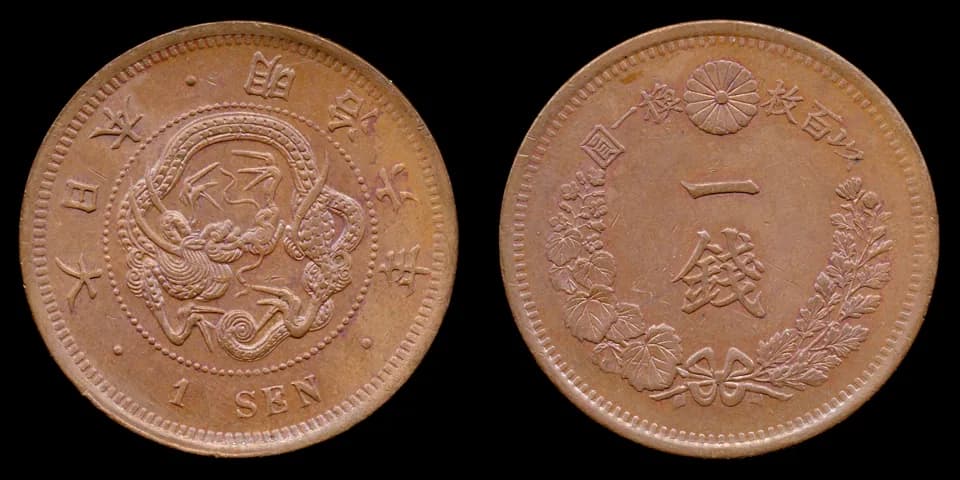
Image: Modern Japanese coinage / As6673 / Wikimedia Commons / CC BY-SA 3.0(source)
Meiji Half-Sen — The Short-Lived Tale of a Copper Coin
Exploring the Background of Japan's Smallest Modern Coin, Disappeared in Just 3 Years
Subject coin: 明治半銭(5厘)銅貨
Overview
The Meiji Half-Sen, minted from Meiji 6 (1873) to Meiji 8 (1875), is Japan's smallest denomination copper coin in modern currency history. Weighing 1.27g, featuring a dragon design on the obverse and the characters for half-sen along with the chrysanthemum crest on the reverse, this coin offers a glimpse into Japan's economic situation and governmental monetary policy at the time, despite its brief existence. The minting ceased after just 3 years due to rapid economic changes and the government's goal of unifying the monetary system. Its scarcity makes it highly valuable among collectors, with market prices varying based on condition. We explore the history of the Meiji Half-Sen alongside the political and economic backdrop of the era. Detailed information can also be found in Modern Coin Values and Identification.
Specifications
- Denomination
- 半銭(5厘)
- Minting period
- 明治6年〜8年(1873年〜1875年)
- Metal composition
- 銅製
- Weight
- 1.27g
- Dimensions
- 直径約20mm
- Mintage
- 不詳(諸説あり)
- Mint supervisor
- 不詳
- Market price
- 5,000円〜30,000円(状態による)
Chapter 1: The Meiji Restoration and Currency Reform — Dawn of a New Era
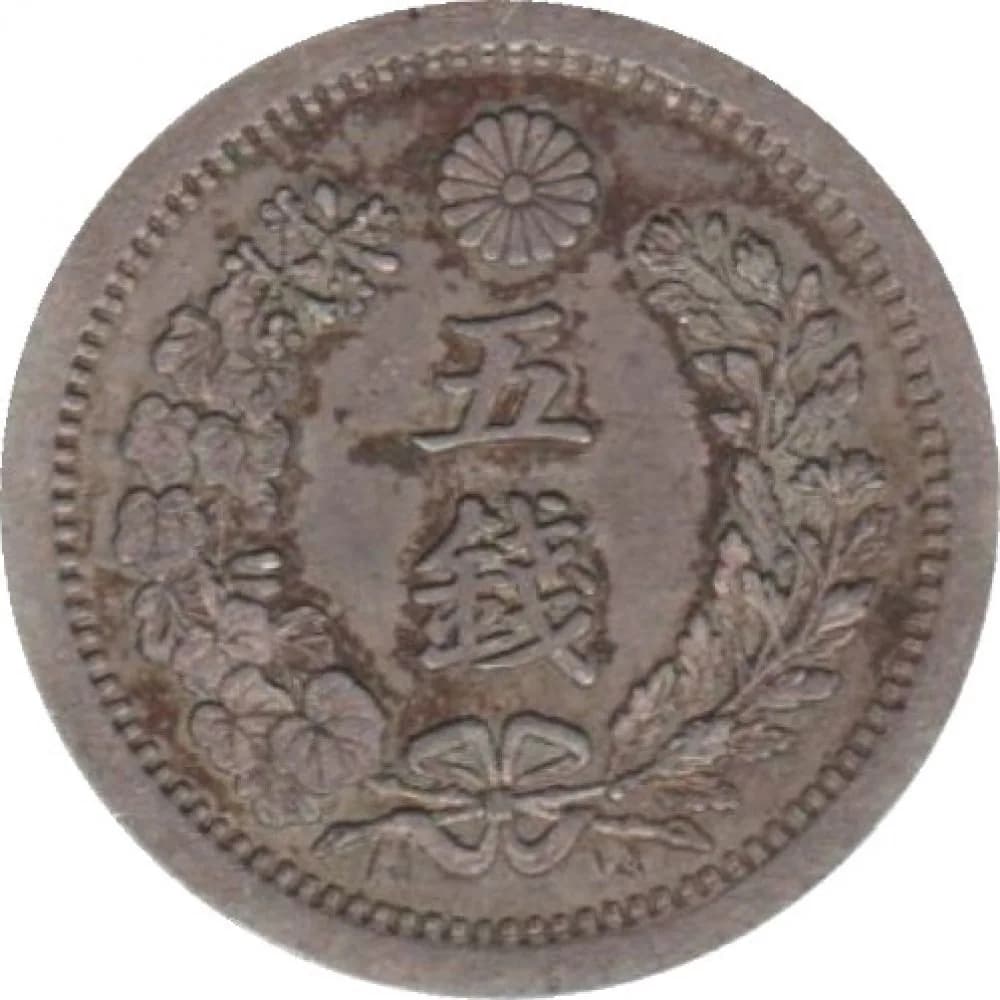
Image: Modern Japanese coinage / Coindesmonnaies / Wikimedia Commons / CC BY-SA 4.0(source)
During the early Meiji period, following the collapse of the shogunate and the establishment of a new government, Japan embarked on a path of rapid modernization. Among the most important reforms was the establishment of a monetary system. The Meiji government aimed to abolish the old complex currency system and introduce a more modern, unified system. In 1871, the New Currency Act was enacted, creating a new system centered around the yen. The Meiji Half-Sen emerged during this period. In Meiji 6, the government decided to issue copper coins ranging from 1 rin to 1 yen. The Half-Sen, the smallest denomination, was valued at half of 1 sen, or 5 rin. This was in response to the need for small denomination coins for minor transactions in regional economies. However, its minting ended just three years later in 1875. The reasons for this short lifespan included rapid economic fluctuations and the government's move towards simplifying the currency system. Post-Restoration Japan faced intense inflation and price changes, gradually reducing the demand for small coins like the Half-Sen. The government aimed to stabilize the economy by narrowing down coin types and simplifying circulation.
Chapter 2: Behind the Scenes of Minting — Challenges and Innovations
Image: Modern Japanese coinage / Coindesmonnaies / Wikimedia Commons / CC BY-SA 4.0(source)
The minting of the Meiji Half-Sen was a product of technological innovation and people's efforts in Japan at the time. It was primarily minted at the Osaka Mint, a facility established by the Meiji government to streamline the new monetary system and equipped with the latest technology from the West. Craftsmen involved in minting used high-precision machines to meticulously produce each coin. The design decision included engraving Japan’s emblem, the dragon, on the obverse, and the Half-Sen characters with a chrysanthemum crest on the reverse. This was intended to reflect Japan's traditional values while symbolizing the transition to a new era. The material used was copper, sourced domestically to keep costs low by utilizing local resources. The minting process required extremely high precision for the small weight of 1.27g. Craftsmen honed their skills daily to maintain quality. However, the economic challenges faced by the rapidly modernizing Meiji government were also present. At this time, Japan had to balance the introduction of Western technologies and the use of domestic resources, and the minting of the Half-Sen was part of this endeavor.
Chapter 3: Circulation and Everyday Life — The Role of Small Denomination Coins
Image: Modern Japanese coinage / Coindesmonnaies / Wikimedia Commons / CC BY-SA 4.0(source)
What impact did the circulation of the Meiji Half-Sen have on Japanese markets and everyday life? The Half-Sen played a critical role in local markets and small transactions. It was used for buying rice, vegetables, and daily necessities, underpinning daily transactions. Issued by the Meiji government, this smallest denomination coin was closely linked to the lives of ordinary people. However, amidst rapid changes in the economy, its necessity gradually faded. With inflation countermeasures and industrial advances, prices increased, and the purchasing power of the Half-Sen declined. Consequently, the Half-Sen gradually disappeared from the market. Additionally, the government aimed to simplify the currency system by reducing the variety of circulating coins. This led to the elimination of small denomination coins like the Half-Sen. While some in the public lamented its disappearance as convenient, government intentions could not be opposed, and circulation eventually ceased. Thus, the Meiji Half-Sen was withdrawn from circulation after only three years. When compared to the Keichō Koban details, its short circulation period becomes evident.
Chapter 4: The Legacy of Half-Sen — Its Influence and Evaluation
Image: Modern Japanese coinage / Coindesmonnaies / Wikimedia Commons / CC BY-SA 4.0(source)
What legacy did the brief history of the Meiji Half-Sen leave for future generations? Primarily, as a result of changes in the monetary system, it became a symbol of the Meiji government's economic policies transition phase. Although the abolition of the Half-Sen was an unavoidable decision in the government's push for efficiency in the monetary system, such policies significantly contributed to Japan’s modernization. Furthermore, the short-lived minting and circulation of the Half-Sen have made the remaining coins extremely valuable. They fetch high prices among collectors, particularly those in good condition. Coins with clear dragon and chrysanthemum designs are highly prized for their rarity. Moreover, the existence of the Half-Sen serves as a critical historical record of how rapidly Japanese society was transforming. In the study of Meiji currency reforms, the Half-Sen stands as an invaluable document, acknowledged for its academic significance. Even today, the Half-Sen continues to capture the interest of coin collectors and historians as an essential clue in understanding Japan’s currency history. The history of the Half-Sen is vital for deeply understanding Modern Coin Values and Identification.
Value & Rarity
Due to its short minting period and rarity, the Meiji Half-Sen holds significant collector value. Prices in the market typically range from 5,000 yen to 30,000 yen, depending on the condition. Coins with clear dragon and chrysanthemum designs may trade for even higher prices. Its rarity stems from its historical context, with minting ending after just 3 years, resulting in extremely low circulation and few well-preserved examples. This reflects the rapid economic changes Japan was undergoing at the time and the swift transition of the monetary system. As such, the Meiji Half-Sen is highly regarded for both its historical and scarcity value, with expectations of continued appreciation. Knowing How to Identify Counterfeits and Altered Coins is also crucial to safely enjoy collections.
Related Guide: Overview of Meiji Era Coins
Conclusion
Despite its brief period of existence, the Meiji Half-Sen played a vital role in Japan’s modernization. Symbolizing the rapid economic changes and monetary reforms Japan experienced post-Meiji Restoration, this copper coin was closely linked to the daily lives of people before its circulation ceased. However, due to its rarity and historical importance, it continues to be highly valued by collectors and historians today. Through the story of the Meiji Half-Sen, we can learn about the complexity of Japan's modern currency history and how currency served its purpose during a period of rapid social change. The history conveyed by this small copper coin continues to intrigue many, offering new perspectives.
Related Stories
60th Anniversary of Local Autonomy Law 500 Yen Bicolor – 10-Year Journey Across 47 Prefectures
Commemorative Coin Series Born from the Law of 1947
Coin StoryHeisei Inauguration Commemorative 100,000 Yen Gold Coin — Japan’s Historical Golden Emblem
Limited Edition Gold Coin Celebrating the Heisei Emperor’s Inauguration, Learning from the Showa Experience
Coin StoryFormer 20-Yen Gold Coin (Meiji 3) — The Highest-Denomination Gold Coin That Stamped Modern Japan's 'Gold Standard'
The Story of the New Currency Regulations and the Osaka Mint Born from the Scars of the Boshin War, and the Enigmatic Meiji 3 Issue
Dealers
Dealers Handling This Category
A reference when considering a sale or appraisal. All are dealers and auction houses with a proven track record.
Ginza Coins
Ginza, Chuo-ku, Tokyo
One of Japan's most established numismatic dealers. The scale and variety of their regular auctions is among the largest in the country. Their catalogs are considered a benchmark for market pricing.
Taisei Coins
Tokyo
A dealer with an international network. Offers advanced services such as consignment to overseas auctions and NGC/PCGS grading submission. Recommended for high-value or internationally recognized coins.
Tokyo Coin Club
Tokyo
A membership-based coin dealer known for carefully selected, quality inventory.