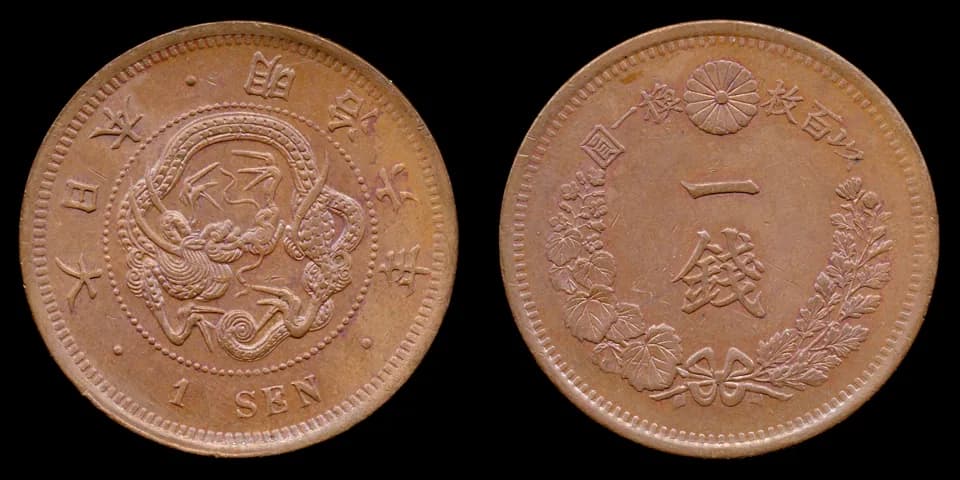
Image: Modern Japanese coinage / As6673 / Wikimedia Commons / CC BY-SA 3.0(source)
Meiji 5 Yen Gold Coin — The "Gold" Bridge Connecting Japan to the World
A Symbol of Transition to the Gold Standard, the Foundation of Modern Japan
Subject coin: 明治5円金貨
Overview
For Japan, which embarked on the path to becoming a modern nation following the Meiji Restoration, smooth economic exchanges with the international community were an urgent issue. The transition to the gold standard, a global monetary system, was an inevitable choice to establish national credibility and achieve economic independence. The Meiji 5 Yen Gold Coin, issued under the Currency Act enacted in Meiji 30 (1897), was born as a progeny of this grand national project.
This gold coin represented more than just currency. It was the product of the extraordinary determination of the Meiji government to skillfully utilize the enormous reparations acquired from the Sino-Japanese War and reconstruct the Japanese economy in accordance with the rules of the international financial market. Meeting international standards with a weight of 4.167g and a gold purity of 90%, this small gold coin became a passport for Japan's economy to connect with the world and be recognized as a member of the international community. The obverse features a powerful Rising Sun emblem, and the reverse displays the prestigious Paulownia and Chrysanthemum crests, symbolizing the dignity and hope of modern Japan. The appearance of this gold coin signaled a groundbreaking moment where Japan departed from the old Edo gold coins and their identification and from the era of silver coins, stepping into a new international economic order. It continued to be the cornerstone of Japan's financial system, supporting the nation's economic development until the gold export ban in Showa 6 (1931). Through this story, let's unravel the historical role played by the Meiji 5 Yen Gold Coin and the nation's dreams embedded in its radiance.
Specifications
- Denomination
- 5円
- Minting period
- 明治30年〜昭和6年(1897-1931年)
- Metal composition
- 金90% / 銅10%
- Weight
- 4.167g
- Dimensions
- 直径約16.96mm
- Mintage
- 約12,856,120枚(明治30年銘から大正元年銘まで)
- Mint supervisor
- 大蔵省造幣局 / 不詳
- Market price
- 5万円〜50万円以上(状態や年銘による)
Chapter 1: Challenge to the International Stage — Path to Establishing the Gold Standard
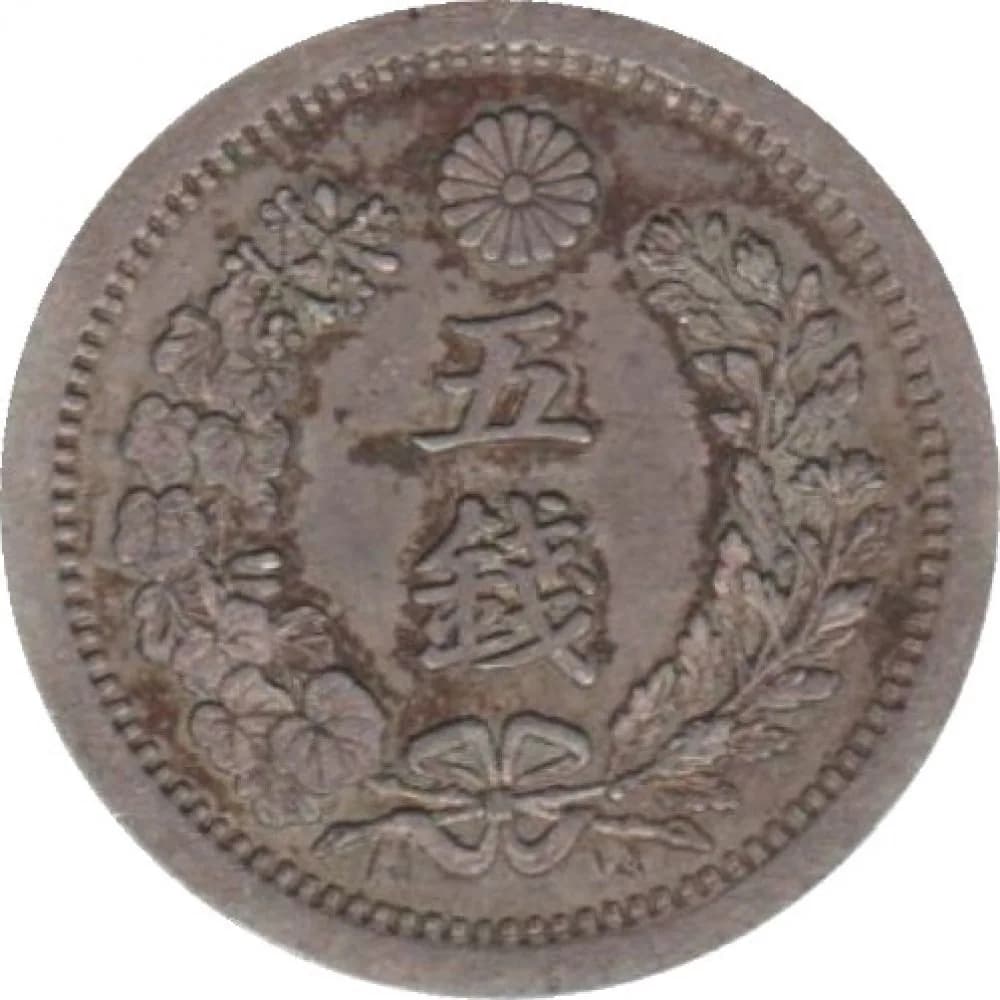
Image: Modern Japanese coinage / Coindesmonnaies / Wikimedia Commons / CC BY-SA 4.0(source)
After the Meiji Restoration, Japan was fervently constructing a modern nation, but the journey was not smooth. Particularly in economic aspects, Japan was grappling with severe challenges. The government issued excessive non-convertible banknotes to cover the costs of internal unrests like the Satsuma Rebellion (1877) and industrial promotion policies. This led to inflation, eroded the credibility of the currency, and plunged the economy into chaos. At the time, Japan adopted the silver standard, but major global powers, especially Britain, Germany, and the United States, had already moved to the gold standard, making gold-based settlements the mainstream in international trade. Thus, Japanese silver coins had low international credibility, resulting in inconveniences and exchange rate instability in trade settlements.
To break out of this situation, the government viewed currency system reform as an urgent task. Finance Minister Matsukata Masayoshi, who pushed for fiscal reform, strongly advocated moving to the gold standard by progressing with deflationary policies and organizing banknotes. However, insufficient domestic gold reserves made its realization extremely difficult. The turning point came with the outbreak of the First Sino-Japanese War in Meiji 27 (1894). Japan's victory over Qing China resulted in receiving a colossal reparation under the Treaty of Shimonoseki in Meiji 28 (1895). The amount was an astounding 360 million silver yen. Considering the national budget was around 80 million yen at the time, the enormity of this reparation becomes evident.
This reparation became the decisive resource for Japan to transition to the gold standard. The government successfully exchanged the silver-based reparation into gold in the London market, securing substantial gold reserves. Thus, the path towards adopting the gold standard became concrete, leading to the enactment of the "Currency Act" on March 26, Meiji 30 (1897) under the Ito Hirobumi administration, with the new system starting on October 1 of the same year. This currency act specified that only gold coins would be the fiat currency, and the gold content per yen was clearly stipulated at 0.75 grams. As a result, the Japanese yen established its status as an international currency and was connected to the global financial market. This transition to the gold standard was a major project symbolizing Japan's modernization, with the Meiji 5 Yen Gold Coin playing a critical role in Understanding the value and identification of modern coins.
Chapter 2: Wisdom and Technology at the Mint — Engraving the Symbol of a New Japan
Image: Modern Japanese coinage / Coindesmonnaies / Wikimedia Commons / CC BY-SA 4.0(source)
Following the enactment of the currency act that cemented the transition to the gold standard, the production of the new standard gold coins was entrusted to the Osaka Mint. The Meiji government understood that reliability and quality of currency were crucial in aspiring to be on par with Western powers. Therefore, the mint gathered the latest technology and the best craftsmen, undertaking the manufacture of the new gold coins under strict standards.
The specifications of the Meiji 5 Yen Gold Coin were designed to match international gold standard criteria. The weight was 4.167 grams, and the gold purity was 90%, with the remaining 10% being copper. This alloy ratio optimized durability while ensuring the value of gold. Pure gold was too soft and prone to wear, so mixing copper increased its hardness, ensuring usability in circulation. This precise alloying and casting technology spoke to the high level of industrial technology in Japan at the time.
The design of the coin also carried significance as a symbol of modern Japan. The obverse displayed a vibrant "Rising Sun emblem" centrally positioned, representing the dignity of the state and hope for development. The Rising Sun emblem is a stylized depiction of the sun rising, symbolizing national prosperity. Around it, the national name "Dai Nippon" and the era "Meiji 30" are inscribed, indicating the issuer and era. The reverse bears the imperial "Chrysanthemum Crest" and the government-associated "Paulownia Crest" on the sides, with "Five Yen" inscribed centrally, denoting the denomination. These motifs demonstrated Japan’s tradition and authority to the international community while symbolizing national unity in a new era.
To engrave these intricate patterns and inscriptions into a small gold coin with a diameter of about 16.96mm, the mint's engineers employed cutting-edge engraving and pressing technologies of the time. Their skilled craftsmanship and uncompromising attitude towards quality gave birth to the beautifully radiant Meiji 5 Yen Gold Coin. The production of this coin went beyond mere currency manufacture, providing an opportunity to showcase Japan's technological prowess and aesthetic sensibilities to the world. Its intricate design continues to captivate modern collectors, and its quality continues to be highly regarded in Standards for antique coin grading.
Chapter 3: The Economic New Era Opened by the Gold Coin — Trust as an International Currency
Image: Modern Japanese coinage / Coindesmonnaies / Wikimedia Commons / CC BY-SA 4.0(source)
With the enforcement of the Currency Act on October 1, Meiji 30 (1897), the Meiji 5 Yen Gold Coin and other new gold currencies began to circulate. The advent of this gold coin brought dramatic changes to Japan's economy. The most significant impact was the skyrocketing international credibility of the yen. Japan's currency under the silver standard had been subjected to fluctuating evaluations in the international market, often placing Japan in a disadvantageous position in trade transactions. However, the transition to the gold standard and the issuance of gold coins adhering to international standards meant that the Japanese yen could now be directly exchanged with the world's major currencies, stabilizing its value.
This stability directly translated into the expansion of international trade. Japanese companies could now engage in overseas transactions without worrying about exchange rate fluctuations. For instance, Japan's major exports like raw silk and tea were supplied to the Western market at stable prices, and the gold earned in return was used to import machinery and raw materials vital for developing modern industries. This also facilitated the inflow of foreign capital into Japan, accelerating large-scale infrastructure development and industrial promotion, such as railway construction and factory establishments. U.K. bankers, noticing Japan's economic stability and growth potential, began to invest actively. This was a sign that Japan's economy had been integrated into the global economic system.
Meanwhile, the Meiji 5 Yen Gold Coin, with its high denomination, was rarely handled by the general public in everyday transactions. Considering the prices of the time, 1 yen was equivalent to several thousand to ten thousand yen today, making the 5 Yen Gold Coin a "large sum." Therefore, it was primarily used in interbank transactions, large commercial deals, and international settlements, while the general public used Various types of hole coins and their identification like copper coins, small-denomination silver coins, and banknotes for shopping. However, the existence of gold coins instilled a sense of security among the public, assuring them of a sound national treasury and guaranteed currency value. It symbolized the nation's prosperity and elevated international status, also boosting the public's confidence. At bank windows, exchanges between silver coins or banknotes and gold coins took place, enhancing the credibility of the financial system. By the late Meiji 30s, international gold coin issuance for funding the Russo-Japanese War (1904-1905) further increased Japan's presence in the international financial market.
Chapter 4: From the Era of Gold to the Era of Fluctuation — The Disappearing Radiance in the Waves of History
Image: Modern Japanese coinage / Coindesmonnaies / Wikimedia Commons / CC BY-SA 4.0(source)
The Meiji 5 Yen Gold Coin served as Japan's fiat currency for approximately 34 years, from the enactment of the Currency Act in Meiji 30 (1897) until the gold export ban in Showa 6 (1931). This period aligned with Japan's leap forward as a modern nation and its increased prominence in the international community. The gold standard, by backing currency value with gold, contributed to domestic economic stability and the smooth facilitation of international trade. This was a groundbreaking system that set itself apart from a domestically exclusive currency system like that of Details of the Keichō Koban, and connected Japan with the global economy.
However, with the outbreak of World War I (1914-1918), the global economic landscape shifted significantly. Major countries halted gold exports for wartime funding and effectively temporarily abandoned the gold standard. Japan ceased gold coin issuance in Meiji 44 (1911), and no gold coins were minted in the Taisho era and beyond. Post-war, countries aimed to return to the gold standard, but global economic imbalances persisted, creating instability. Japan also faced turmoil following the Great Kanto Earthquake in Taisho 12 (1923) and subsequent financial panics.
The decisive blow to the world economy was the global depression that began in Showa 4 (1929) in America. This unprecedented economic crisis spread worldwide, compelling countries to opt out of the gold standard to protect their economies. Japan was no exception. On December 13, Showa 6 (1931), Takahashi Korekiyo, Finance Minister under the Inukai Tsuyoshi administration, executed the "gold export ban," effectively ending gold standard maintenance. Consequently, the exchange between gold and the Japanese yen was halted, and the Meiji 5 Yen Gold Coin ceased its role as fiat currency.
The gold export ban signified a shift to a managed currency system, wherein Japan's financial policies were henceforth dictated by government discretion. The "gold" era symbolized by the Meiji 5 Yen Gold Coin came to a close, transitioning to an era of fluctuating exchange rates and managed currency systems. This gold coin fully accomplished its historical mission as a symbol of Japan's modernization and a testament to its challenge in the international economy. Today, its historical background and intricate design are highly valued by many collectors with Basic knowledge of antique coin auctions.
Value & Rarity
The Meiji 5 Yen Gold Coin, as a symbol of the gold standard in Japan's modern history, is highly appreciated in the collector market for its historical significance. Though not exceedingly scarce, its issuance was relatively short, from Meiji 30 to Taisho 1, with the Meiji 30 coin holding special value as the first currency issued under the gold standard. Moreover, coins from Taisho 1 are known for their rarity due to lower minting numbers.
Market value drastically varies based on the coin’s condition, year markings, and rarity. Near-mint coins fetch extremely high prices, ranging from several hundred thousand yen to more than one million yen, especially for rare year markings or proof coins (trial mintage). Conversely, circulated coins with wear are generally traded for tens of thousands to over one hundred thousand yen, due to their gold content and historical value. Notably, coins from Meiji 30 and Taisho 1 tend to be priced higher in comparison to other years.
In collection practices, the quality directly influences pricing, necessitating caution against Identifying fakes and modified items when purchasing. Gold coins rely on weight and fineness, thus coins with verification by a professional body are recommended. Also, monitoring the antique coin market and gold prices, such as Checking price trends with market charts, is crucial for informed transactions. The Meiji 5 Yen Gold Coin is recognized not only as an investment but also as a precious historical artifact charting Japan's modernization trajectory. Its radiance constitutes proof of the passion and wisdom of the Meiji pioneers who challenged the international community.
Conclusion
The Meiji 5 Yen Gold Coin transcends the mere confines of currency, symbolizing Japan's challenge toward internationalization and economic self-reliance as a modern state. Utilizing the reparations from the Sino-Japanese War as its basis, Japan transitioned to the gold standard, integrating its economy into the international financial market, encapsulated in the brilliance of this small gold coin. Meeting international standards with a weight of 4.167g and 90% gold purity, this coin demonstrated Japan’s credibility to the world and laid the groundwork for subsequent economic growth. Though its role concluded with the gold export ban in Showa 6 (1931), the historical contributions of the Meiji 5 Yen Gold Coin remain incalculable. This coin allows us to reflect on the passion and wisdom of those who navigated a turbulent era. As the editor of Ittendo, I hope to continue conveying the story that this coin embodies to many people.
Related Stories
60th Anniversary of Local Autonomy Law 500 Yen Bicolor – 10-Year Journey Across 47 Prefectures
Commemorative Coin Series Born from the Law of 1947
Coin StoryFormer 20-Yen Gold Coin (Meiji 3) — The Highest-Denomination Gold Coin That Stamped Modern Japan's 'Gold Standard'
The Story of the New Currency Regulations and the Osaka Mint Born from the Scars of the Boshin War, and the Enigmatic Meiji 3 Issue
Coin StoryMeiji Trade Silver Coins — The Reason for the Birth of Silver Coins Exclusively for Foreign Trade
Japanese silver coins forbidden for domestic circulation, their design philosophy and fate
Dealers
Dealers Handling This Category
A reference when considering a sale or appraisal. All are dealers and auction houses with a proven track record.
Ginza Coins
Ginza, Chuo-ku, Tokyo
One of Japan's most established numismatic dealers. The scale and variety of their regular auctions is among the largest in the country. Their catalogs are considered a benchmark for market pricing.
Taisei Coins
Tokyo
A dealer with an international network. Offers advanced services such as consignment to overseas auctions and NGC/PCGS grading submission. Recommended for high-value or internationally recognized coins.
Tokyo Coin Club
Tokyo
A membership-based coin dealer known for carefully selected, quality inventory.