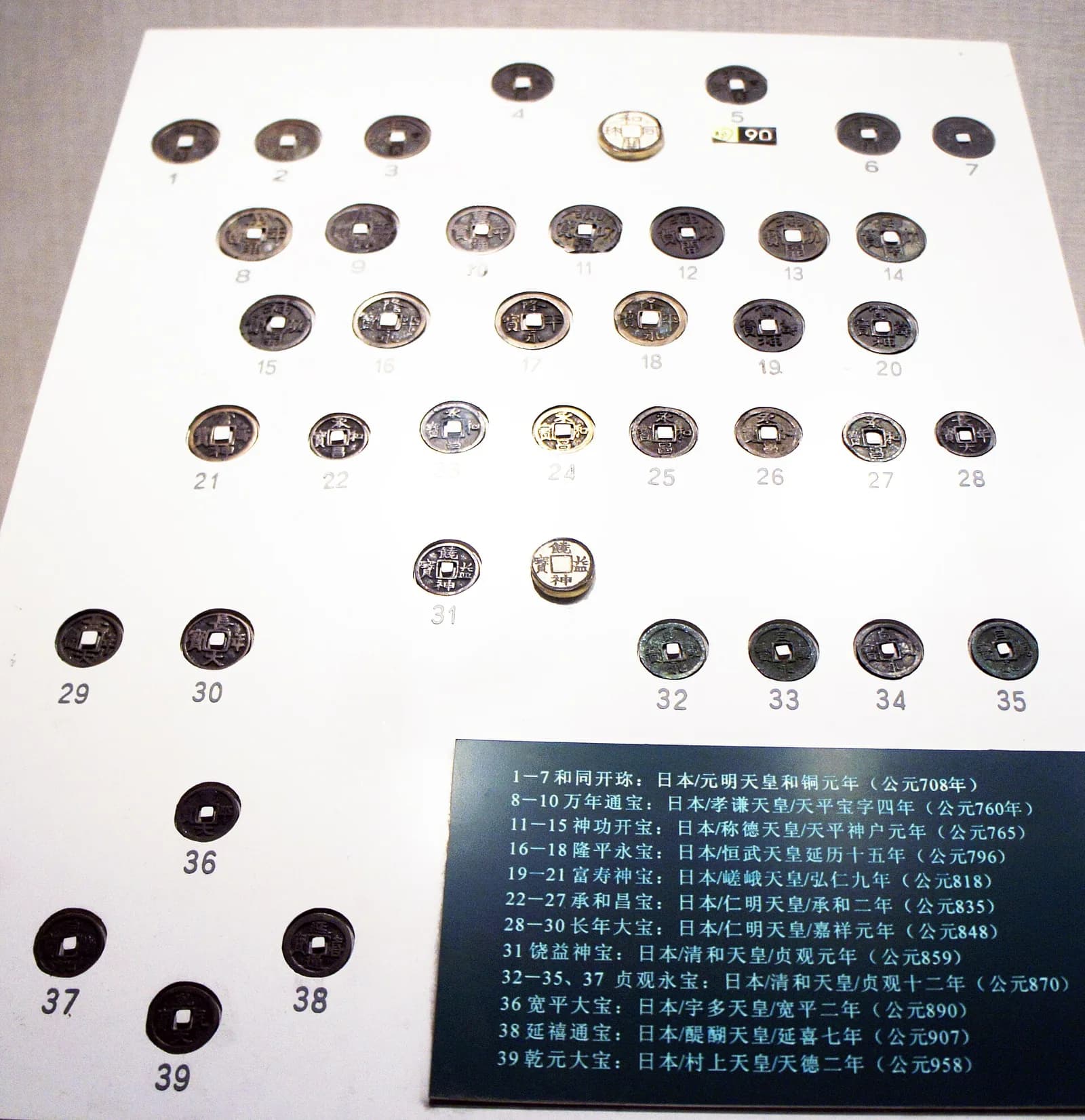
Kōchō Jūnisen are a group of 12 types of copper coins symbolizing the establishment of a monetary system in ancient Japan. Issued over about 250 years from the Wadō Kaichin (和同開珎) in 708 to the Kengen Taihō (乾元大宝) in 958, they mark Japan's initial attempt to develop its own currency economy.
Kōchō Jūnisen: The Beginning of Ancient Japan's Monetary System
The Kōchō Jūnisen, issued by the ritsuryō government over approximately 250 years from 708's Wadō Kaichin to 958's Kengen Taihō, are collectively named for 12 types of copper coins. These coins document Japan's first attempt to establish its own currency economy. Arranged by issue order, they include Wadō Kaichin, Mannen Tsuuhō (万年通宝), Jingū Kaihō (神功開宝), Ryūhei Eihō (隆平永宝), Fusū Shinhō (富寿神宝), Shōwa Shōhō (承和昌宝), Chōnen Taihō (長年大宝), Nōeki Shinhō (饒益神宝), Jōkan Eihō (貞観永宝), Kanpyō Taihō (寛平大宝), Enki Tsuuhō (延喜通宝), and Kengen Taihō. Each new issuance established an exchange ratio with older currencies.
Kōchō Jūnisen reflect the volatile period of the establishment and subsequent decline of ancient Japan’s ritsuryō system. Notably, the Wadō Kaichin is recognized as the first coin issued for nationwide circulation, signifying significant historical importance. Through these coins, the ritsuryō government aimed to stabilize finances but faced challenges between promoting circulation and sound national finances, leaving a substantial historical impact.
The price of each coin type among the Kōchō Jūnisen varies greatly based on rarity and condition. Earlier coins tend to be fewer in number and well-preserved ones are typically more expensive. Prices are influenced by mintage numbers, survival rates, and historical context, sometimes resulting in price differences of 2 to 5 times. Especially crucial are the sharpness of the inscriptions and degree of wear, which significantly impact value.
For more details and historical background on each coin type, see Kōchō Jūnisen.
Historical Background of Kōchō Jūnisen and Influence on Their Valuation
Despite sharing a common form of round coins with square holes, the Kōchō Jūnisen significantly degrade in quality as issuance progresses. Early coins like the Wadō Kaichin and Mannen Tsuuhō were crafted with sophisticated minting techniques, exhibiting clear and balanced inscriptions with comparatively high copper content. In contrast, later coins saw a marked decline in quality, reflecting the fiscal deterioration and minting skill decline of the ritsuryō state, serving as a mirror to the decline of the ancient nation.
This backdrop was influenced by repeated inflation policies. New coins were valued higher than old, such as the Mannen Tsuuhō set to exchange at 10 Wadō Kaichin per coin. These devaluation policies attempted to offset fiscal deficits through coinage expansion, leading to sharp price increases and a loss of confidence in coin value in the market.
Especially in rural areas, a barter and rice-based economy remained resilient, hindering penetration of a currency economy. Amidst this, the governing ability of the ritsuryō state waned, and distrust of currency spread. Ultimately, following the issuance of the Kengen Taihō in 958, the ritsuryō government had to abandon copper coin issuance.
The Kengen Taihō symbolizes the historical turning point of "abandoning currency issuance," representing a significant landmark in Japan's monetary economic history. This suggests that ancient economic policies can impact modern markets, making it essential for collectors to understand the historical context when discerning state. Evaluating these quality differences is guided by Coin Grading Standards.
For approximately 600 years, only coins imported from China circulated in Japan, an extraordinary situation globally. The historical background of the Kōchō Jūnisen greatly influences their evaluation and remains a crucial index in the modern market. Further examination is possible with Wadō Kaichin and Overview of Ancient Coinage.
Conditions That Differentiate the Value of Kōchō Jūnisen
Determining the authenticity of Kōchō Jūnisen is a crucial factor in collecting. Specifically, many sophisticated counterfeits exist of middle period coins like Jingū Kaihō, Fusū Shinhō, and Chōnen Taihō, necessitating expert knowledge to discern them. As a basic practice of determining authenticity, checking the "script style" is crucial. Each coin type has unique character shapes, thickness, and balance, requiring familiarity. Thorough observation for irregularities and caution against abnormalities is needed.
Assessing "weight and diameter" against standard values for each coin type is also important. Counterfeits may deviate from standard weight or diameter due to differences in materials and casting methods. Additionally, the "nature of the rust" serves as an important assessment factor. Naturally occurring rust has a distinct texture and tone over time, while artificially created rust shows unnatural color variations or adhesion patterns. The "cross-sectional shape of the rim" should also be checked, as authentic coins often bear distinctive cross-sections reflecting the minting techniques of their times.
In late period coins like the Enki Tsuuhō and Kengen Taihō, authentic coins themselves were poorly minted, complicating counterfeit differentiation. In such cases, specialized knowledge is needed to closely examine character wear and copper characteristics. Detailed points of authentication can be further understood by referencing How to Distinguish Authenticity and Readings on Coin Grading Standards.
Market records show a trend where specimens meeting these criteria hold scarcity and high value. Understanding the difficulty of distinguishing genuine from counterfeit middle period coins or the poor minting characteristics of late period coins, and conducting authentication with expert knowledge, is essential in collecting activities.
Points for Acquisition and Retention of Kōchō Jūnisen
When acquiring and retaining Kōchō Jūnisen, certain checks are important. This group of coins holds a special place within Japan's monetary history, with market prices largely varying depending on the historical value of each coin type and the rarity of existing quantities. Especially for early coins like the Wadō Kaichin, transactions can involve very high sums. Thus, assessing price suitability at purchase is crucial.
Transactions in the market occur through specialized coin dealers, major auction houses, and online coin trading sites, with well-preserved or highly rare coin types often fetching high prices at auction. When considering purchases, it's recommended to search past auction sale records to confirm price fluctuations and trends.
In addition, when retaining Kōchō Jūnisen, proper storage methods are required. Since preservation condition massively impacts value, it is important to prepare storage environments by referring to Proper Storage Methods for Coins. Particularly, improper humidity and temperature control may lead to coin degradation, necessitating caution.
Moreover, Kōchō Jūnisen are not merely collection items but important historical materials in Japan's economic history. These 12 coins provide a valuable historical experience of the rise and fall of ancient states and how people interacted with currency. Therefore, understanding historical context and enhancing value through acquisition and retention are also crucial elements.
Historical Value of Kōchō Jūnisen and Difficulty in Collection
Kōchō Jūnisen are known as a rare group of coins depicting the economic history of ancient Japan. Not merely collector’s items, these coins serve as important resources for understanding the transition of Japan’s history and economy. Completing a collection of Kōchō Jūnisen is very challenging, enhancing the value of each coin due to their rarity. Market records highlight their high popularity, attracting interest from collectors and researchers.
Among the Kōchō Jūnisen, there are ones minted in various locations, each with different backgrounds. For instance, coins with inscriptions on the back are known as Edo Kameido coins, and those with rear inscriptions are classified as Sendai Ishinomaki coins. These classifications reflect minting locations and historical background, providing fascinating elements for collectors.
Furthermore, collecting Kōchō Jūnisen has not only historical value but also active market trading due to their rarity. Auction records show a high number of transactions, drawing significant interest from collectors and investors. Understanding market trends is essential in collecting.
In conclusion, Kōchō Jūnisen, with their historical value and collection difficulty, represent a very special group of coins. Market records continue to demonstrate their importance as key entities narrating the economic history of ancient Japan. Through these coins, one can engage with Japan's history and culture, which stands as the greatest appeal of the Kōchō Jūnisen.