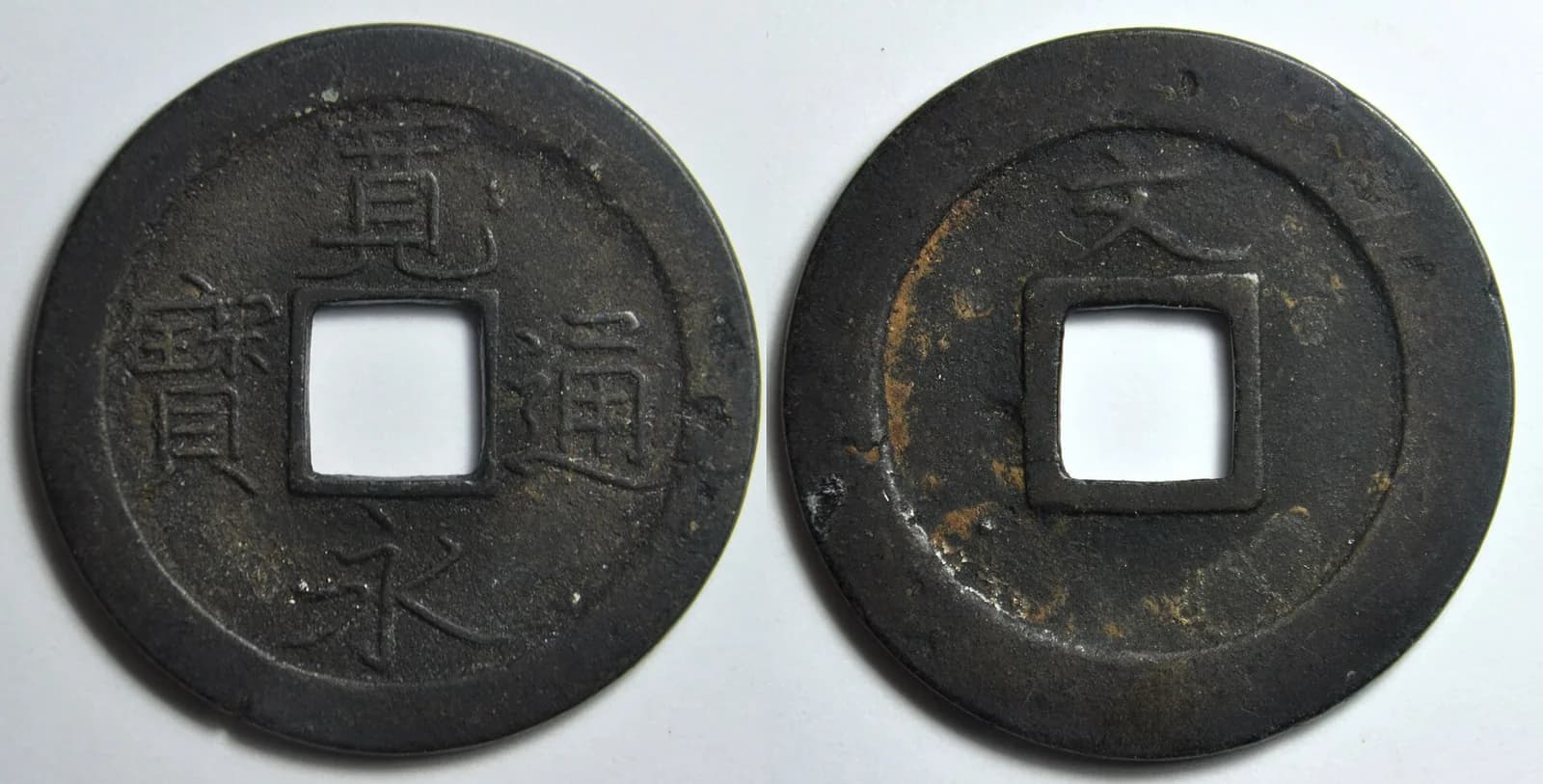
Ancient Kan'ei Tsūhō coins, minted in the early Edo period, derive their value heavily from differences in minting locations and scripts. This article provides an in-depth explanation of the historical background and collection value of ancient Kan'ei Tsūhō coins.
Overview of Ancient Kan'ei Tsūhō and Their Historical Background
Ancient Kan'ei Tsūhō is a part of the Kan'ei Tsūhō coins minted in the early Edo period, first produced in Kan'ei 13 (1636) and continued until the Meireki era (1655-1658). This period is clearly distinguished from the "New Kan'ei" period and is recognized as a separate category in the numismatic community. The primary feature of the ancient Kan'ei period is the diverse scripts, materials, and sizes used by various private mints due to the shogunate's incomplete control over minting. Approved mints in Edo, Kyoto, Sendai, Mito, Tsu, and Nagato Hagi each utilized their own techniques to manufacture coins, leading to hundreds of script variations.
The order to mint these coins was issued by Matsudaira Nobutsuna in Kan'ei 13 (1636), initially limited to only three mints in Edo, Kyoto, and Sendai. However, the mint locations expanded rapidly afterward, further enhancing the diversity of ancient Kan'ei Tsūhō coins. Understanding this complex minting system is the starting point for collecting and appraising ancient Kan'ei Tsūhō.
The difference between ancient and new Kan'ei coins lies in their temporal boundaries and quality uniformity. Starting in Kanbun 8 (1668), the shogunate-established Kameido mint began producing what was known as new Kan'ei coins. The Meireki era marked the decline of private mint activities, signalling the end of the ancient Kan'ei era. Due to private mint production, ancient Kan'ei coins feature significant variances in script, size, copper quality, and weight, with subtle differences even among coins from the same mint. On the other hand, new Kan'ei coins saw improved standardization and stability in quality under direct shogunate control.
The collection value of ancient Kan'ei Tsūhō lies in their diversity. The abundant script variations create the allure of a "treasure hunt for rare scripts" for collectors. For detailed information, please refer to Ancient Kan'ei Tsūhō.
Historical Background of Ancient Kan'ei Tsūhō and Its Impact on Evaluation
As coins manufactured during the Edo period, ancient Kan'ei Tsūhō hold a lengthy historical significance that significantly affects their current market evaluation. Script differences are particularly influential in this evaluation. Research by experts like Tanaka Hirofumi has become a standard, with classifications based on script. Collectors highly prize scripts such as "Nimizue" and "Shimaya-bun" for their unique features.
The "Nimizue" script, believed to have been minted early in the Edo mint, is traded at high prices due to its rarity. Excellent condition pieces can fetch hundreds of thousands of yen to over a million yen due to their distinctive shape. In contrast, the "Shimaya-bun" script, associated with the Kyoto mint, features a robust script and is valued from tens of thousands to hundreds of thousands of yen. Their popularity and valuation are closely tied to their historical background.
Furthermore, distinguishing between mold coins and circulation coins is crucial in evaluating the value of ancient Kan’ei Tsūhō. Mold coins are the prototypes for casting and are evaluated differently than circulation coins. Mold coins typically have a larger diameter, deeper and clearer engravings, and smoother surfaces. Such physical attributes contribute to their high valuation. However, accurate appraisal is challenging, as well-preserved circulation coins or later replicas can be misidentified as mold coins. Accurate appraisal requires a comprehensive evaluation.
This evaluation of ancient Kan'ei Tsūhō is based on historical background, script variations, and distinctions between mold and circulation coins. Resources like Variants of Kan'ei Tsūhō Details are also referenced. Market records clearly show how these factors influence evaluations, providing key insights for collectors and investors.
Auction Trends in the Ansen Category Overall
In the past 90 days, the median auction price for the entire Ansen category was ¥1,708 with 56 transactions. Compared to the previous 90-day period, with a median auction price of ¥1,500 and 68 transactions, the median has increased by about 13.9% while the number of transactions has decreased. This data has moderate reliability due to at least 30 transactions recorded in each period.
Specific examples of auctions during this period include transactions of Tenpō Tsūhō. For instance, on September 23, 2026, Tenpō Tsūhō was auctioned for ¥1,799 and ¥2,000. In contrast, on September 20, the same Tenpō Tsūhō was auctioned for a much higher ¥9,300. This stark variation within the same category is evident in individual transaction prices.
Also, on September 18, a regionally minted Tenpō Tsūhō was auctioned for ¥780, demonstrating price fluctuations due to particular characteristics. These data provide insight into overall price trends in the Ansen category, although individual transaction details and conditions can lead to significant price differences.
This information indicates category-wide price trends but not the specific market values of individual ancient Kan'ei Tsūhō. For more detailed price trends, please refer to Check Price Trends on Market Charts or View Auction History.
Factors Determining the Value of Ancient Kan'ei Tsūhō
The factors influencing the value of ancient Kan'ei Tsūhō include condition, rarity, and authenticity risks. These factors are closely related to differences in minting locations, with the characteristics of each mint location serving as critical evaluation criteria. The earliest Kan'ei Tsūhō minted in the Edo mint often receive high evaluations for the strength of their inscriptions and finish quality. Conversely, Sendai coins produced in the Sendai Domain exhibit rough scripts and unique copper properties, with variable quality requiring careful valuation.
Understanding the characteristics of each mint location is essential for appraising ancient Kan'ei Tsūhō. For example, coins like Matsumoto-sen with their elegant scripts are highly valued, and certain scripts or finishes can attract collectors' interest. In the market, well-preserved circulation coins may be valued from about 100 yen to 1,000 yen, influenced greatly by mint characteristics and script beauty.
Authenticity risks must also be considered as a significant factor. Counterfeits exist for ancient Kan'ei Tsūhō, requiring knowledge for authenticity verification. Comparing multiple coins from different mint locations or scripts can facilitate identifying authenticity. For detailed authenticity determination methods, refer to How to Differentiate Genuine from Fake.
Additionally, criteria for grading the condition of old coins are important. Coins in better condition tend to receive higher evaluations, with factors like rust and wear affecting value. Detailed evaluation criteria are explained in Grading Criteria for Old Coins.
Judging the value of ancient Kan'ei Tsūhō requires a comprehensive consideration of these factors. Understanding differences in mint locations, condition, and authenticity risks provides a valuable knowledge base for collectors. Market records allow for confirmation of how these factors influence evaluations.
Considerations for Collecting and Storing Ancient Kan'ei Tsūhō
Certain points need attention for the collection and storage of ancient Kan'ei Tsūhō. Due to authenticity issues, there is known existence of counterfeit rare scripts, requiring particular caution. For the rarest items like "Nimizue," there might be skillful counterfeits produced in later generations circulating in the market. When purchasing, seeking multiple experts' opinions and confirming the presence of an appraisal certificate is crucial. Please check Complete Guide to Distinguishing Fakes and Altered Coins for criteria to distinguish fakes or altered coins.
Regarding condition evaluation, as ancient Kan'ei Tsūhō are made of copper, the occurrence of green rust (rokushō) due to aging oxidation is common. While this green rust is sometimes evaluated as a natural aging feature, some prefer to remove it for a cleaner appearance. Generally, aggressive cleaning or chemical treatments are not recommended as these actions can damage the coin's surface and risk lowering its value.
For storage methods, using airtight containers to prevent oxidation, regularly replacing silica gel, is recommended. For particularly rare scripted items, storing in coin slabs (encapsulation cases by grading institutions) is advantageous for both value preservation and improved liquidity. The Correct Storage Methods for Old Coins provides detailed guidelines on storage.
Paying attention to these points for the collection and storage of ancient Kan'ei Tsūhō is critical for maintaining their value. It requires careful judgment while referring to expert opinions.
The Diversity and Value of Ancient Kan'ei Tsūhō
Ancient Kan'ei Tsūhō, born from the early Edo period's turmoil and vitality, remains a treasure trove of diversity, appealing to advanced collectors with a wide range of values. With distinctions in script and mintage location, their value spans from several hundred yen to several million yen. This diversity and variation in value are one of the attractions in collecting ancient Kan'ei Tsūhō and continue to captivate collectors' interests.
Among the ancient Kan'ei Tsūhō, some coins have unique back inscriptions related to specific mints like Buku (back inscription)—standing for Kameido Edo minted coins known for Kanbun era traits. These unique inscriptions offer glimpses into the historical backgrounds of respective regions. For example, Buku indicates Edo Kameido mint, while Sento is for Sendai Ishinomaki mint in the Sendai Domain and Sato for Sado mint under direct shogunate control. By understanding these mint differences, collectors contemplate the historical backgrounds of each coin to determine their value.
This diversity of value makes ancient Kan'ei Tsūhō appealing to collectors, allowing them to understand the unique features of each coin and evaluate market valuations accordingly.
In conclusion, ancient Kan'ei Tsūhō, due to their diversity and breadth of values, endlessly fascinate collectors across eras. It's confirmed from market records that differences in mintage and script significantly affect their value, and such evaluations will continue into the future.